No food will make you stop smoking. If a page promises otherwise, close it. But the foods to help quit smoking that are genuinely worth your attention do three modest, useful things: they make cigarettes taste worse, they take the edge off the physical restlessness of the first two weeks, and they keep you from mistaking a caffeine overdose for nicotine withdrawal. That last one catches more people than you would expect.
This guide separates what the evidence supports from what has been repeated for decades without support. Some of the most popular advice on this topic — megadose antioxidant supplements, “flushing” nicotine out with water, avoiding spices — is either unproven or, in one specific case, actively dangerous for people who smoke.
Foods to help quit smoking: The short answer
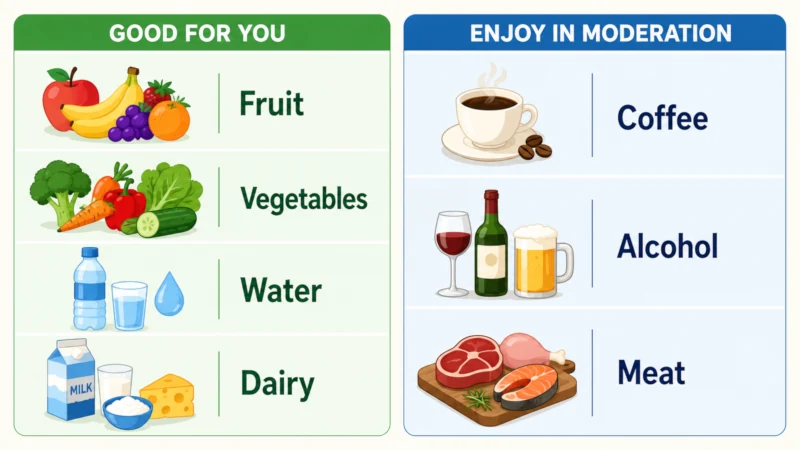
| Fruit, vegetables, water, juice and dairy commonly make cigarettes taste worse; meat, coffee and alcohol make them taste better. [McClernon et al., cigarette palatability, 2007]Cut caffeine by roughly half on quit day. When you stop smoking, your body clears caffeine far more slowly, and the jitters, racing heart and insomnia that follow are easy to mistake for withdrawal. [CDC guidance on withdrawal symptoms, 2024] [UCSF Smoking Cessation Leadership Center, drug interactions with tobacco smoke, 2022]People who smoke need about 35 mg more vitamin C per day than people who don’t — an amount covered by an orange or half a cup of red pepper. [NIH Office of Dietary Supplements, vitamin C fact sheet, 2021]Do not take high-dose beta-carotene supplements. In two large trials they increased lung cancer risk in people who smoke. Carrots are fine; the pills are not. [NIH Office of Dietary Supplements, vitamin A and carotenoids, 2025]Food supports a quit attempt. It does not replace one. Medication and counselling together have the strongest evidence. [Cochrane review of nicotine replacement therapy, 2018] |
Can food really help you quit smoking?
Honestly: a little, and indirectly. There is no clinical trial showing that eating a particular food causes people to stop smoking. What exists is weaker but not worthless.
In a national cohort of 1,000 adults who smoked, those in the highest quartile of fruit and vegetable intake were about three times more likely to have been tobacco-free for 30 days when researchers followed up 14 months later, after adjusting for income, education, drinking, exercise and drug use [Haibach et al., fruit and vegetable intake and smoking, 2013]. That is an observational finding, not proof of cause. People who eat more produce differ from people who don’t in dozens of ways researchers cannot fully measure. The authors said as much.
The more useful evidence is about taste. Duke researchers asked 209 people who smoked which foods and drinks changed how their cigarettes tasted [McClernon et al., cigarette palatability, 2007]. The answers were consistent enough to be practical, and they point in a direction you can act on this week.
Foods that make cigarettes taste worse
This is the most immediately usable finding in the whole field. If a cigarette tastes stale and metallic, the reward you have been chasing for years is smaller. Smokers in the Duke survey reported the pattern below. Note that people who smoked menthol cigarettes reported far less of an effect in either direction — menthol appears to flatten out both the worsening and the enhancing [McClernon et al., cigarette palatability, 2007].
| Category | Reported to worsen cigarette taste | Reported to improve cigarette taste |
| Produce | Fruit and vegetables | — |
| Drinks | Water, juice and other non-caffeinated drinks | Coffee, tea, cola, alcohol |
| Dairy | Milk, cheese, yoghurt | — |
| Protein | — | Meat |
Source: survey of 209 adults who smoked; self-reported, not a taste-lab experiment. [McClernon et al., cigarette palatability, 2007]
What to do with that: put a glass of water or a piece of fruit where the after-meal cigarette used to go. Have a glass of milk before the moment you would normally light up. It is a small lever, but it is free and it works on the part of smoking that medication does not touch — the sensory ritual.
The caffeine trap most people are never warned about
Tobacco smoke — not the nicotine, the smoke — speeds up the liver enzyme that breaks down caffeine. Regular smoking increases caffeine clearance by roughly 56%, which is why people who smoke can drink four cups of coffee and sleep fine [UCSF Smoking Cessation Leadership Center, drug interactions with tobacco smoke, 2022]. Stop smoking, and that enzyme activity falls back toward normal within days.
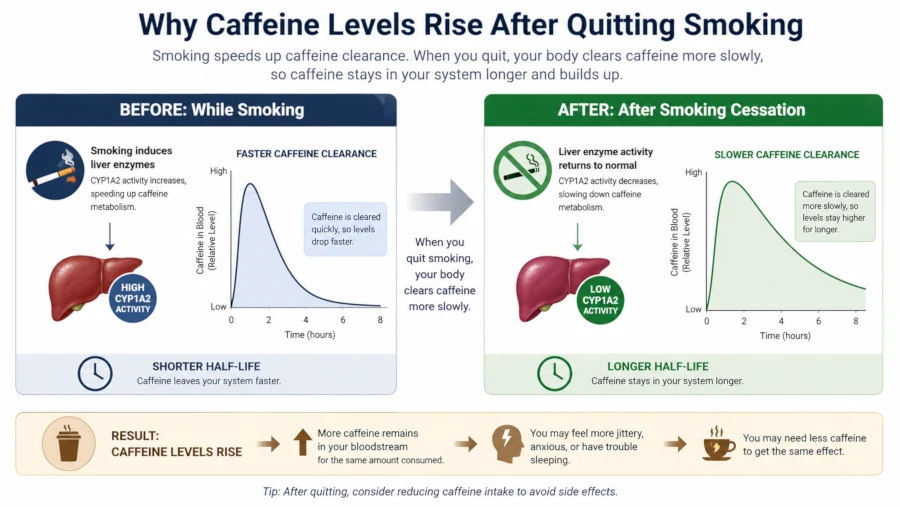
Keep drinking the same amount of coffee and your caffeine levels climb. The result is jitteriness, a racing heart, irritability and insomnia. Every one of those is also a nicotine withdrawal symptom, which is exactly the problem: people conclude that quitting is unbearable when what is actually unbearable is their fifth espresso now behaving like their eighth.
The CDC advises cutting back on coffee, tea and other caffeinated drinks when you quit, specifically because caffeine now lasts longer in your body, and keeping them out of the late afternoon and evening to protect sleep [CDC guidance on withdrawal symptoms, 2024]. Clinical pharmacy references go further and suggest halving caffeine intake around quit day [UCSF Smoking Cessation Leadership Center, drug interactions with tobacco smoke, 2022]. Taper over a few days rather than stopping abruptly, or you will trade one withdrawal headache for another.
Alcohol is the trigger worth taking seriously
Alcohol works against a quit attempt twice over. It makes cigarettes taste better [McClernon et al., cigarette palatability, 2007], and it impairs the judgement you need to resist a craving. The National Cancer Institute is direct about this: your ability to resist smoking triggers is reduced under the influence of alcohol, and many people find it easiest to drink less or skip it entirely in the first weeks [National Cancer Institute, coping with nicotine withdrawal, 2022].
If you do drink, the NCI suggests choosing a different drink from the one you used to pair with cigarettes, and avoiding the specific bar or room where you always smoked [National Cancer Institute, coping with nicotine withdrawal, 2022]. Change the scene, not just the substance.
Vitamin C: what is true, and what is oversold
The true part: people who smoke genuinely do need more vitamin C. Smoke increases the amount the body uses to repair free-radical damage, so the recommended intake is 35 mg per day above the standard adult figure of 90 mg for men and 75 mg for women [NIH Office of Dietary Supplements, vitamin C fact sheet, 2021]. That is a real, official adjustment — not a wellness talking point.
The scale is worth knowing, because it is small. One medium orange, half a cup of raw red pepper, or a kiwi covers the extra 35 mg several times over. Our guide to vitamin C rich foods lists the densest sources if you want to build a few into your day.
The oversold part: vitamin C is not an antidote to nicotine or tar. It does not neutralise the carcinogens in tobacco smoke, and it will not reduce your cravings. The NIH notes that while people with high vitamin C intake from fruit and vegetables tend to have lower rates of several cancers, taking vitamin C supplements — with or without other antioxidants — does not appear to protect against cancer [NIH Office of Dietary Supplements, vitamin C fact sheet, 2021]. Eat the food. Skip the megadose.
If you do take supplemental vitamin C, the adult upper limit from all sources is 2,000 mg per day; above that, diarrhoea, nausea and stomach cramps are common. It can also worsen iron overload in people with haemochromatosis, may interfere with chemotherapy and radiotherapy, and in one study reduced the heart-protective effect of a statin-plus-niacin combination [NIH Office of Dietary Supplements, vitamin C fact sheet, 2021].
The antioxidant supplement warning: this one matters
If you take one piece of safety information from this page, take this one. Beta-carotene is the pigment in carrots, sweet potato and spinach, and eating those foods is entirely fine. High-dose beta-carotene supplements are a different substance in a different dose, and in people who smoke they have been shown to increase lung cancer risk.
Two large randomised trials found this. In the Alpha-Tocopherol, Beta-Carotene study, 29,133 men who smoked took 20 mg of beta-carotene daily for five to eight years; lung cancer incidence rose 18%, and overall death rate rose 8%. In the Carotene and Retinol Efficacy Trial, 18,314 current and former smokers and asbestos-exposed workers took 30 mg beta-carotene plus retinyl palmitate; the trial was stopped early because lung cancer risk had risen 28%, death from lung cancer 46%, and all-cause mortality 17% [NIH Office of Dietary Supplements, vitamin A and carotenoids, 2025].
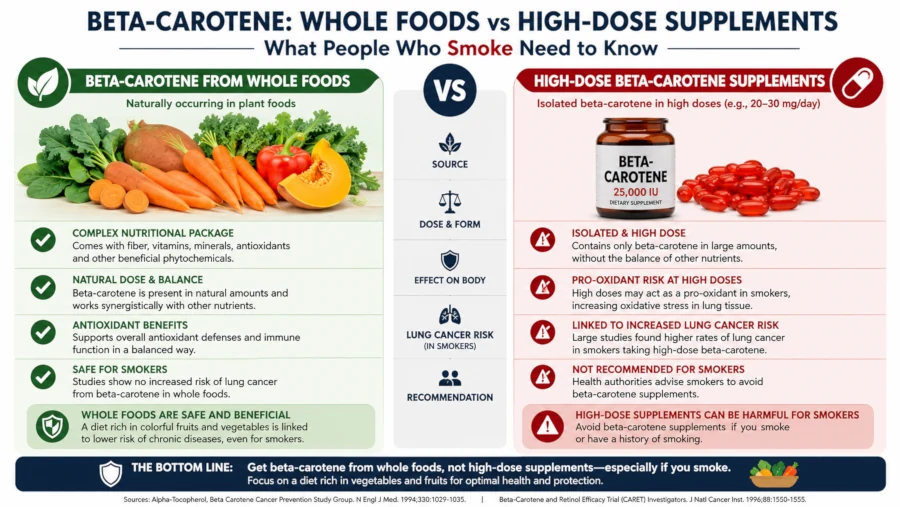
The US Food and Nutrition Board now advises against beta-carotene supplements for the general population except to correct a genuine vitamin A deficiency [NIH Office of Dietary Supplements, vitamin A and carotenoids, 2025]. Beta-carotene turns up in many multivitamins and in most eye-health formulas, so it is worth reading the label rather than assuming.
The distinction is not a technicality. Whole foods deliver carotenoids in small amounts alongside fibre and hundreds of other compounds; a capsule delivers a pharmacological dose that behaves differently in lungs exposed to smoke.
About “flushing nicotine out” with water and juice
Water is useful during a quit attempt. It gives your hands and mouth something to do, it appears to make cigarettes taste worse [McClernon et al., cigarette palatability, 2007], and being properly hydrated makes the first week less miserable. Drink it.
What it does not do is detoxify you. Nicotine is broken down by your liver on its own schedule; no drink, juice fast or cleanse speeds that up meaningfully, and by the time cravings become a problem the nicotine is largely gone anyway. What remains is a brain that has adapted to expect it, and that adapts back over weeks regardless of what you drink. If you want the full sequence of what improves and when, see our practical quit plan.
What to actually keep in the house
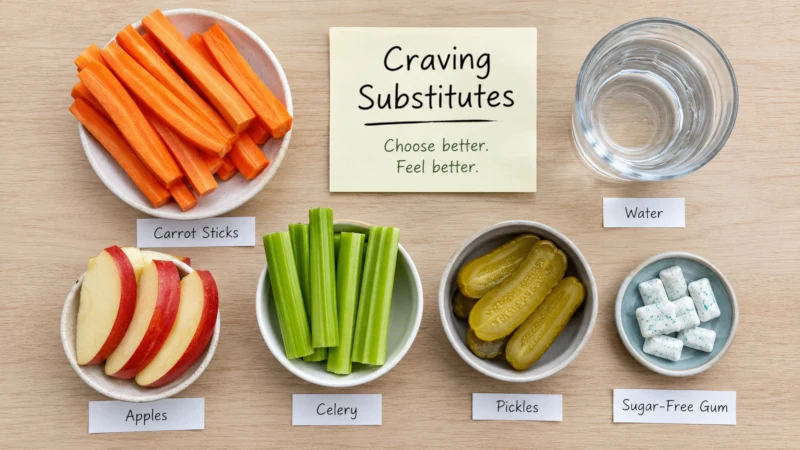
Cravings usually last a few minutes. The point of a snack is not nutrition, it is occupying the same 90 seconds that a cigarette used to occupy. The NCI suggests chewing on carrots, pickles, apples, celery, sugarless gum or hard candy, on the grounds that keeping your mouth busy interrupts the psychological pull [National Cancer Institute, coping with nicotine withdrawal, 2022]. The CDC adds celery, carrots and sugar-free mints, and points out that a toothpick or a straw does the hands-and-mouth job with no calories at all [CDC guidance on withdrawal symptoms, 2024].
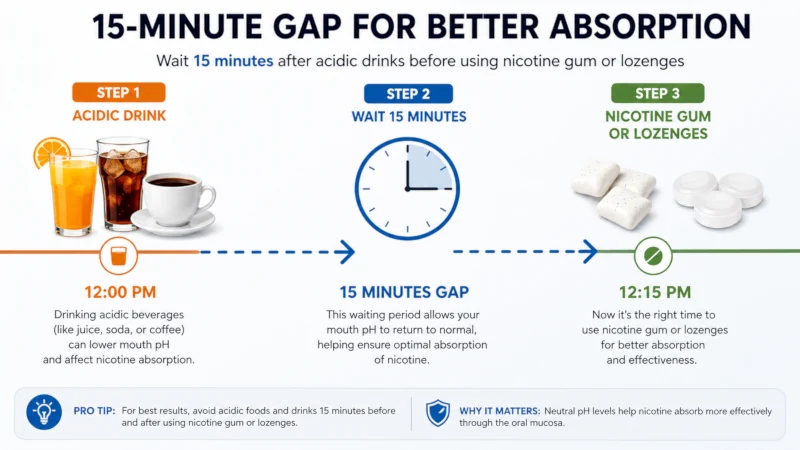
One practical detail that is easy to get wrong: if you are using nicotine gum or lozenges, they release nicotine less effectively when you have just had coffee, juice or another acidic drink [National Cancer Institute, coping with nicotine withdrawal, 2022]. Leave a gap of about 15 minutes either side. People often conclude the gum “doesn’t work” when the real problem was the coffee they were holding.
Keep the strongest trigger foods out of arm’s reach in week one. For many people that means the specific combination — the coffee-and-cigarette, the beer-and-cigarette, the after-dinner one — more than any single food. The NCI notes that spicy and sweet foods increase the urge for some people; if that is you, it is worth noticing, but there is no reason for everyone to avoid seasoning [National Cancer Institute, coping with nicotine withdrawal, 2022].
Weight gain: real, usually modest, and not a reason to keep smoking
Appetite goes up after you quit, your body burns calories slightly more slowly, and food genuinely tastes better once smoke stops dulling your senses of taste and smell [CDC guidance on withdrawal symptoms, 2024]. The NCI puts typical weight gain at under 10 pounds [National Cancer Institute, coping with nicotine withdrawal, 2022].
That is a real change and it is fair to mind it. It is not a reason to keep smoking, and the trade is not close. If weight is your main worry, both bupropion and nicotine gum or lozenges have been shown to blunt post-quit weight gain, which is a reasonable thing to raise with a prescriber when you are choosing between options [National Cancer Institute, coping with nicotine withdrawal, 2022]. Regular meals help more than restriction; skipping meals tends to end in a craving you handle badly.
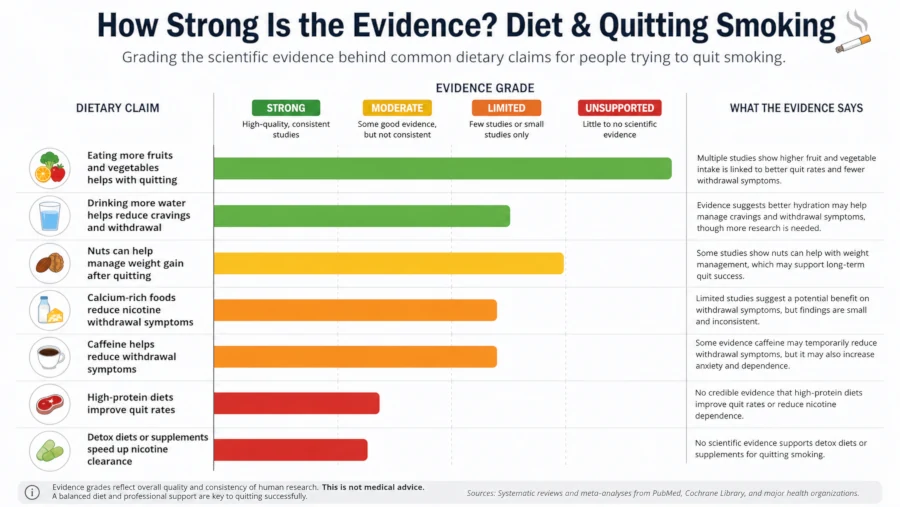
How strong is the evidence, claim by claim?
| Claim | Strength of evidence | What that means in practice |
| Extra vitamin C is needed by people who smoke | Strong | An official +35 mg/day adjustment; easily met with food. |
| High-dose beta-carotene supplements raise lung cancer risk in smokers | Strong | Two large randomised trials; one stopped early. Avoid the supplement. |
| Certain foods make cigarettes taste worse | Moderate | Consistent self-report from 209 smokers; not a controlled taste experiment. |
| Caffeine levels rise after quitting | Strong | Well-established pharmacology; halving intake is standard advice. |
| Alcohol makes relapse more likely | Moderate to strong | Consistent clinical guidance and self-report. |
| Higher fruit and vegetable intake predicts staying quit | Limited | One observational cohort. Encouraging, not causal. |
| Water or juice “flushes” nicotine from the body | Not supported | Hydration helps you cope; it does not speed clearance. |
| Avoiding spices helps you quit | Not supported | Individual triggers vary; no general evidence. |
Medication interactions and who should take extra care
Quitting changes how your body handles several medicines, and this is under-discussed. Because tobacco smoke induces the CYP1A2 enzyme, blood levels of some drugs rise once you stop. Clozapine and olanzapine levels can climb enough to require a dose reduction; theophylline levels should be monitored; INR is worth checking if you take warfarin [UCSF Smoking Cessation Leadership Center, drug interactions with tobacco smoke, 2022]. None of this is a reason not to quit. It is a reason to tell your prescriber your quit date in advance rather than afterwards.
- Pregnant or breastfeeding: quitting is strongly recommended, but nicotine replacement products are not routinely recommended in pregnancy without medical advice, and beta-carotene or high-dose vitamin supplements should not be started without discussing them first [National Cancer Institute, coping with nicotine withdrawal, 2022] [NIH Office of Dietary Supplements, vitamin A and carotenoids, 2025].
- Taking clozapine, olanzapine, theophylline, warfarin or other CYP1A2-metabolised medicines: speak to your prescriber or pharmacist before quit day [UCSF Smoking Cessation Leadership Center, drug interactions with tobacco smoke, 2022].
- Being treated for cancer: check with your oncologist before taking vitamin C or other antioxidant supplements, especially at high doses [NIH Office of Dietary Supplements, vitamin C fact sheet, 2021].
- Living with haemochromatosis: high-dose vitamin C can worsen iron overload [NIH Office of Dietary Supplements, vitamin C fact sheet, 2021].
- History of depression or anxiety: mood changes after quitting are more likely and more severe; plan support in advance rather than waiting to see [National Cancer Institute, coping with nicotine withdrawal, 2022].
- Using dip, chew or snus as a substitute: this is not a quit strategy — see our guide to the dangers of smokeless tobacco.
What food cannot do — and what does
Food is scaffolding. The load-bearing structure is different. Pooled results from 133 trials and more than 64,000 participants put the abstinence rate with nicotine replacement therapy at about 1.55 times that of control, and Cochrane rated the evidence high quality [Cochrane review of nicotine replacement therapy, 2018]. Prescription options and counselling add further to that. The CDC’s free quitline, 1-800-QUIT-NOW, offers coaching at no cost across the United States [CDC guidance on withdrawal symptoms, 2024].
The sensible arrangement is to use both: proven treatment for the chemistry, and the food and routine changes on this page for the parts of smoking that treatment does not reach. If you have not set a quit date yet, start with our practical quit plan.
When to get medical help
Withdrawal itself is uncomfortable but not dangerous. Some symptoms are not withdrawal. Call emergency services now if you have:
- Chest pain or pressure, or pain spreading to the jaw, neck or arm
- Severe or sudden breathlessness
- Sudden weakness or numbness on one side, sudden trouble speaking, sudden vision loss or loss of balance
- Coughing up blood
- Fainting, or a heart rate that feels fast and irregular and will not settle
Book a routine appointment for a cough that persists beyond a few weeks, ongoing wheeze or breathlessness, or a hoarse voice that does not resolve. Quitting does not substitute for having a persistent symptom looked at.
Mood matters too. If low mood does not improve within a couple of weeks, or feels unmanageable, contact a healthcare provider [CDC guidance on withdrawal symptoms, 2024]. If you have thoughts of harming yourself, call or text 988 (the Suicide & Crisis Lifeline in the US), available 24 hours a day, or go to your nearest emergency department [CDC guidance on withdrawal symptoms, 2024].
| Health disclaimer: This article is for general education and information only. It is not medical advice and does not replace diagnosis, treatment or guidance from a qualified healthcare professional. No food, drink, vitamin or supplement described here is intended to diagnose, treat, cure or prevent any disease, and none of them will make you stop smoking on their own. Talk to a doctor or pharmacist before starting any supplement or quit-smoking medicine, particularly if you are pregnant or breastfeeding, are under 18, take prescription medication, or live with a heart, liver, kidney or mental health condition. Seek emergency care for chest pain, severe breathlessness, signs of stroke, or thoughts of self-harm. In the United States, free confidential quit coaching is available at 1-800-QUIT-NOW. |
Frequently Asked Questions
What foods kill nicotine cravings fastest?
Nothing kills a craving outright. What helps is occupying the few minutes it lasts: sugar-free gum, hard candy, carrot or celery sticks, an apple, a glass of cold water [National Cancer Institute, coping with nicotine withdrawal, 2022]. Fruit, vegetables and dairy have the added benefit of making a cigarette taste worse if you do reach for one [McClernon et al., cigarette palatability, 2007].
Should I take a vitamin C supplement when I quit?
You need 35 mg per day more than a non-smoker, which one orange covers. A supplement is not necessary if you eat fruit and vegetables, and supplemental vitamin C has not been shown to protect against cancer [NIH Office of Dietary Supplements, vitamin C fact sheet, 2021]. If you take one anyway, stay under 2,000 mg a day from all sources and check with your doctor if you are on chemotherapy, radiotherapy or a statin.
Are antioxidant supplements good for a smoker’s lungs?
No — and high-dose beta-carotene is specifically harmful. Two large trials found it increased lung cancer risk in people who smoked, and the Food and Nutrition Board advises against beta-carotene supplements for the general population [NIH Office of Dietary Supplements, vitamin A and carotenoids, 2025]. Antioxidant-rich food is a different matter and is worth eating.
Why do I feel so anxious and sleepless after quitting when I haven’t changed anything?
Check your coffee. Smoking speeds up caffeine clearance by about 56%, and stopping reverses that, so your usual intake now hits harder [UCSF Smoking Cessation Leadership Center, drug interactions with tobacco smoke, 2022]. The CDC recommends cutting back on caffeinated drinks and keeping them out of the late afternoon [CDC guidance on withdrawal symptoms, 2024]. If symptoms persist after you have tapered caffeine, they are more likely to be withdrawal, and they usually ease over the first month [National Cancer Institute, coping with nicotine withdrawal, 2022].
Does drinking a lot of water clear nicotine out of my system faster?
Not in any meaningful way. Your liver clears nicotine on its own timetable. Water is genuinely useful as a craving substitute and for hydration, but a “detox” plan is not a cessation treatment and you do not need one.
Will I gain weight, and can food prevent it?
Some weight gain is common, typically under 10 pounds [National Cancer Institute, coping with nicotine withdrawal, 2022]. Regular meals, planned low-calorie snacks and any amount of physical activity help [CDC guidance on withdrawal symptoms, 2024]. Nicotine gum, lozenges and bupropion have each been shown to reduce post-quit weight gain, which is worth raising with a prescriber [National Cancer Institute, coping with nicotine withdrawal, 2022].
References
- National Institutes of Health, Office of Dietary Supplements. Vitamin C — Fact Sheet for Consumers. Updated 22 March 2021. → View source
- National Institutes of Health, Office of Dietary Supplements. Vitamin A and Carotenoids — Fact Sheet for Health Professionals. Updated 10 March 2025. → View source
- Centers for Disease Control and Prevention. 7 Common Withdrawal Symptoms. Tips From Former Smokers. Reviewed 27 September 2024. → View source
- National Cancer Institute. Handling Nicotine Withdrawal and Triggers When You Decide To Quit Tobacco. Reviewed 3 January 2022. → View source
- Smoking Cessation Leadership Center, University of California San Francisco. Drug Interactions with Tobacco Smoke. 2022. Adapted from Zevin S, Benowitz NL, Clin Pharmacokinet 1999;36:425–438. → View source
- McClernon FJ, Westman EC, Rose JE, Lutz AM. The effects of foods, beverages, and other factors on cigarette palatability. Nicotine & Tobacco Research. 2007;9(4):505–510. PMID 17454706. → View source
- Haibach JP, Homish GG, Giovino GA. A longitudinal evaluation of fruit and vegetable consumption and cigarette smoking. Nicotine & Tobacco Research. 2013;15(2):355–363. PMID 22614546. → View source
- Hartmann-Boyce J, Chepkin SC, Ye W, Bullen C, Lancaster T. Nicotine replacement therapy versus control for smoking cessation. Cochrane Database of Systematic Reviews. 2018;5:CD000146. PMID 29852054. → View source
