
Home remedies can make withdrawal more bearable. They cannot make it safe. Ginger tea can settle a churning stomach. A dark room, a warm bath, and someone sitting with you can carry you through a bad night. None of that changes what your nervous system does while it readjusts — and with alcohol and sedatives, what it does can kill you. So the useful version of natural home remedies for drug detox is narrow but real: comfort care layered on top of medical care, never instead of it.
Which substance you’re stopping decides nearly everything else on this page, so start there.
Natural home remedies for drug detox: Which drug you’re stopping changes the whole picture
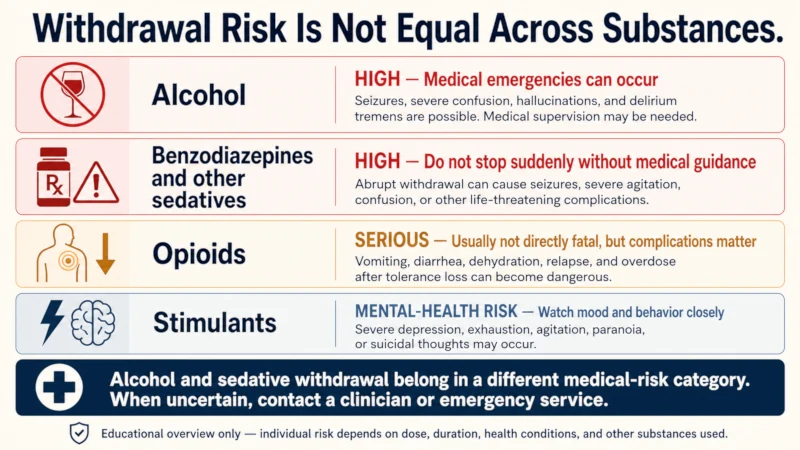
| Substance | Is unsupervised withdrawal dangerous? | What that means for you |
| Alcohol | Yes — can become life-threatening | Get assessed before you stop. Moderate-to-severe cases may need hospital care. |
| Benzodiazepines and similar sedatives | Yes — abrupt stops can trigger seizures | Never stop suddenly. You need a prescriber-designed, individualized taper. |
| Opioids | Usually not fatal, but genuinely risky | Dehydration and aspiration are real. The bigger danger comes after, when tolerance has dropped. |
| Stimulants, cannabis, nicotine | Physically lower risk | Watch mood. Crashing mood and thoughts of suicide are their own emergency. |
Alcohol
Alcohol is the one people underestimate. Symptoms usually begin within about eight hours of the last drink, though they can start days later, and they tend to peak between 24 and 72 hours — sometimes continuing for weeks (MedlinePlus on alcohol withdrawal, 2025). In its severe form, delirium tremens, withdrawal can bring fever, sudden severe confusion, hallucinations, and seizures. MedlinePlus does not hedge on the stakes: alcohol withdrawal is a serious condition that can quickly become life-threatening, and while most people recover fully, death is possible — particularly when delirium tremens develops.
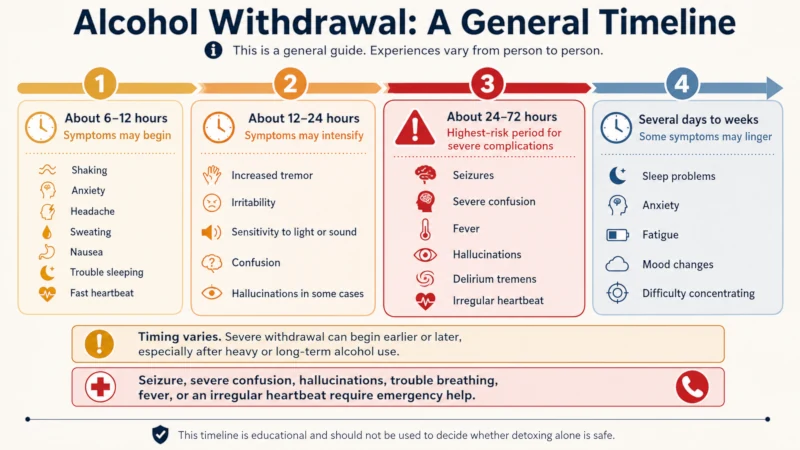
That’s why setting matters more than ingredients. People with moderate to severe symptoms may need treatment in a hospital or a facility equipped for withdrawal, where they can be monitored and given fluids and sedatives. Milder cases can often be handled as an outpatient, but even then the standard guidance includes having someone stay with you and checking in with your provider almost daily.
If alcohol is your substance, the first move isn’t shopping — it’s a phone call. Once you have medical guidance in place, it’s reasonable to ask your clinician about the supplements people commonly reach for during alcohol withdrawal, including thiamine, rather than deciding on your own.
Benzodiazepines, sleep medications, and other sedatives
Physical dependence on a benzodiazepine can develop within days to weeks, even when the medication is taken exactly as prescribed. Stopping suddenly, or cutting the dose too fast, can produce withdrawal reactions that include seizures and can be life-threatening — which is why the FDA requires a boxed warning on every medicine in the class (FDA Drug Safety Communication on benzodiazepines, 2020). Severe reactions listed by the FDA also include catatonia, delirium tremens, hallucinations, mania, psychosis, and suicidal thoughts.
There is no universal taper schedule. The FDA’s instruction to prescribers is to build a patient-specific plan, reduce gradually, and pause or step back up if withdrawal symptoms appear. Even with a careful taper, some symptoms — anxiety, insomnia, muscle pain, tremor — can persist, and a protracted syndrome can last weeks to as long as a year. None of that is something a tea fixes, and none of it is a reason to quit cold turkey to “get it over with.”
Opioids
Opioid withdrawal is miserable and usually not life-threatening on its own (MedlinePlus on opiate and opioid withdrawal, 2024). Early symptoms — anxiety, agitation, muscle aches, sweating, insomnia, runny nose, yawning — typically start within about 12 hours of the last heroin dose, or around 30 hours after methadone. Later come cramping, diarrhea, nausea, and vomiting.
The complications are the part worth taking seriously. Vomiting can lead to aspiration and lung infection. Vomiting and diarrhea together cause dehydration and electrolyte disturbances. And MedlinePlus notes plainly that withdrawing on your own can be very hard and may be dangerous. There’s a further risk that arrives after the worst is over, covered further down this page.
Stimulants, cannabis, and nicotine
Stopping stimulants, cannabis, or nicotine generally doesn’t carry the same risk of seizures or medical collapse. The danger shifts to mood: a hard crash, deep low mood, and thoughts of suicide are the things to watch. If those show up, that’s an emergency in its own right — call or text 988, the Suicide and Crisis Lifeline, which is free and available around the clock.
Red flags: stop and get emergency help
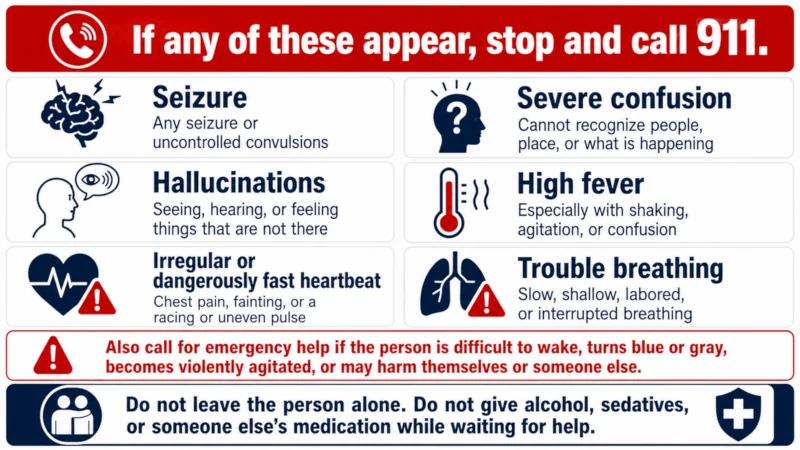
Go to an emergency room or call 911 if any of these appear during withdrawal:
- A seizure — or anything that looks like one
- Fever
- Sudden severe confusion, or seeing or hearing things that aren’t there
- An irregular or racing heartbeat
- Trouble breathing
- Vomiting or diarrhea you can’t keep ahead of, with no urine output, dizziness on standing, or confusion
Call or text 988 if you’re having thoughts of harming yourself. Don’t wait to see whether it passes.
Comfort measures that are actually reasonable at home
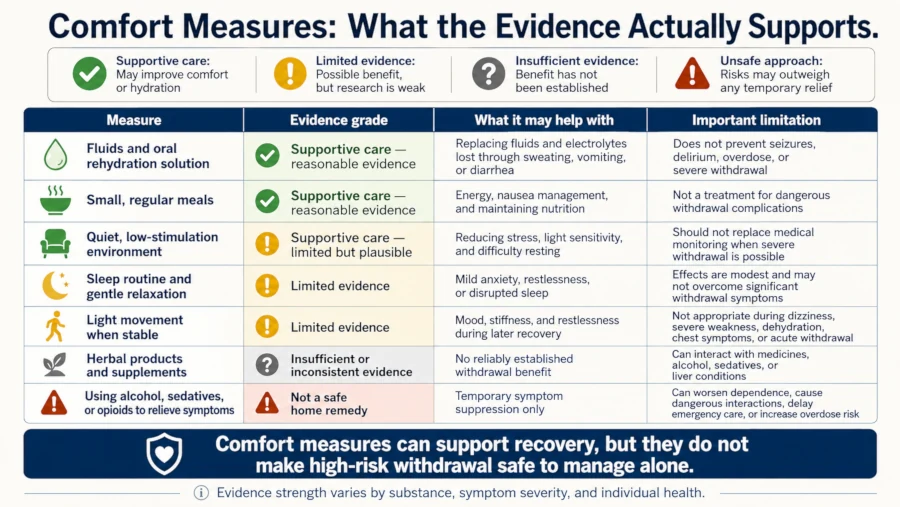
These won’t detoxify anything — your liver and kidneys handle that. What they can do is make the hours more tolerable while medical care does the real work.
Fluids first
Vomiting and diarrhea are what tip withdrawal into dehydration and electrolyte trouble, and those complications land people in the hospital more often than the withdrawal itself. Small, frequent sips beat forcing down a large glass you’ll bring back up. Oral rehydration solutions are more useful here than plain water, because you’re losing salt as well as fluid. Skip the herb-infused “cleansing” waters; there’s no evidence any of them speed clearance of a drug, and a few carry interactions you don’t need right now.
Ginger, for nausea
Ginger has the most respectable evidence of anything in this article — but read the fine print. A systematic review and meta-analysis of 12 randomized trials in 1,278 pregnant women found ginger significantly improved nausea compared with placebo, though it did not significantly reduce the number of vomiting episodes, and the authors described the overall quality of evidence as low (Viljoen et al., Nutrition Journal, 2014). Their subgroup analysis favored daily doses under about 1,500 mg.
That’s pregnancy-related nausea, not withdrawal nausea. No trial has tested ginger in drug withdrawal, so using it here is an extrapolation — a reasonable one, given how safe ginger is at food-like amounts, but an extrapolation. Fresh ginger tea or a small capsule is fine for most people. Ask a pharmacist first if you take a blood thinner.
Food, when you can face it
Appetite usually disappears. Don’t fight it with a nutrition plan. Get in what stays down — broth, crackers, bananas, rice, yogurt — and treat anything else as a bonus. The claim that specific foods “repair neurotransmitters” or “flush toxins” during withdrawal isn’t supported. Eating steadily helps because it keeps you hydrated and functional, which is a smaller and more honest promise.
Sleep, and why the sleep aisle isn’t the answer
Insomnia is one of the most punishing parts of withdrawal, and it’s where people reach hardest for herbs. Valerian is the usual pick. The evidence for it is inconsistent, and the American Academy of Sleep Medicine recommended against using valerian for chronic insomnia in adults in its 2017 clinical practice guidelines (NCCIH on valerian, 2025). NCCIH considers it generally safe for short-term use in most adults — doses of 300 to 600 mg daily have been used with apparent safety for up to six weeks — with side effects including headache, stomach upset, mental dullness, and vivid dreams. Little is known about its safety in pregnancy or breastfeeding.
Two cautions matter more than usual in this context. Valerian shouldn’t be combined with alcohol or sedatives. And stopping it abruptly after chronic use can itself produce withdrawal symptoms — anxiety, irritability, insomnia — which is the last thing you need layered on top. If you want the fuller picture on the herb, we’ve covered what valerian root does and doesn’t do separately.
Unglamorous sleep basics do more than any capsule: a cool dark room, no screens late, no caffeine after midday, and a consistent wake time even after a terrible night.
Warmth, quiet, and low-stakes movement
A hot shower or a warm bath eases muscle aches and gives you twenty quiet minutes. Epsom salts are cheap and low-risk if you like them — just treat the warmth as the active ingredient rather than the magnesium. Gentle movement, a short walk, or slow stretching can take the edge off restlessness. Slow breathing helps some people ride out an anxiety spike. None of this is a treatment; all of it is legitimately useful for getting through an afternoon.
For the calming herbs people ask about most, we’ve laid out what the research actually supports for anxiety — including which ones don’t hold up.
Herbs and supplements to be careful with
Kava — the one to skip here
Kava turns up on almost every home-detox list, and it’s the single worst fit for this situation. Kava products have been linked to rare cases of liver injury, some of them serious or even fatal, and NCCIH specifically states that kava should not be used together with other substances that have sedative effects, such as benzodiazepines or alcohol (NCCIH on kava, 2025). It may also carry special risks in pregnancy and breastfeeding. Long-term high doses can cause kava dermopathy — dry, scaly skin with reddened eyes and yellowing of the skin, hair, and nails.
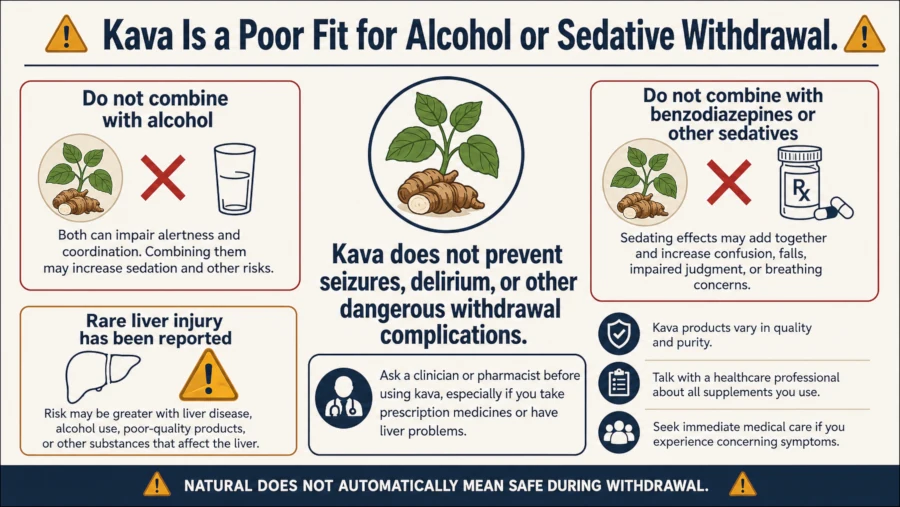
If you are withdrawing from alcohol or a sedative, or taking any prescription that affects the liver, kava is not a reasonable thing to add on your own.
Anything sold as a “detox”
Detox teas, charcoal products, and cleanse kits are marketing categories, not treatments. Nothing in that aisle has been shown to shorten withdrawal or clear a drug faster, and supplements aren’t reviewed by the FDA for effectiveness before sale. Both NCCIH fact sheets cited on this page carry the same warning in different words: some herbs and medicines interact in harmful ways, so tell your clinician about everything you’re taking. When a product is being sold to you as the answer to something this serious, that’s a reason for more skepticism, not less.
If you’re pregnant or breastfeeding
Don’t start any of the herbs on this page. NCCIH flags kava as carrying special risks in pregnancy and breastfeeding, and says little is known about whether valerian is safe in either. More importantly, withdrawal during pregnancy is a conversation for an obstetric clinician before you change anything — not a decision to make alone, and not one where stopping abruptly is automatically the safer choice.
The risk almost nobody mentions: your tolerance drops
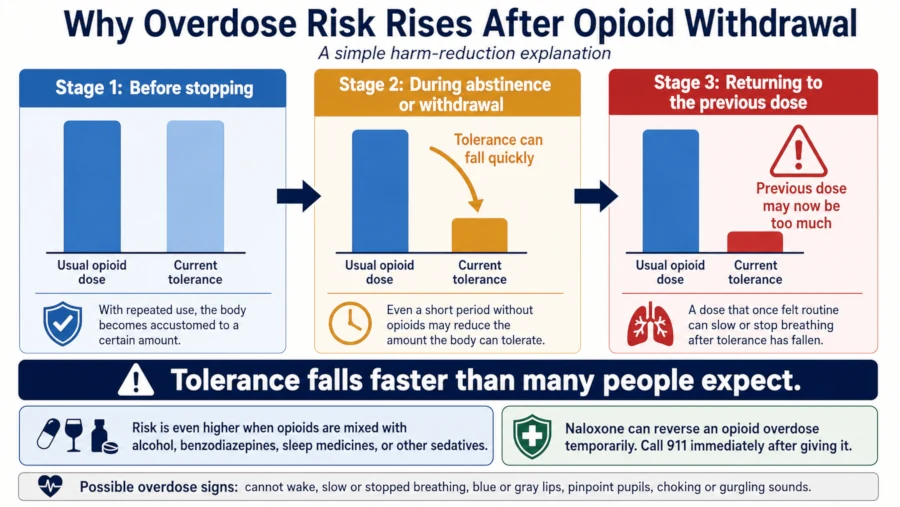
This is the part that gets left out of gentle-detox articles, and it’s the one that kills people. MedlinePlus states it directly: the biggest complication of opioid withdrawal is returning to drug use, and most opioid overdose deaths occur in people who have just detoxed. Withdrawal lowers your tolerance, so a dose you handled routinely two weeks ago can be an overdose today (MedlinePlus on opiate and opioid withdrawal, 2024).
Two practical things follow. Ask a pharmacist or your clinician about carrying naloxone, and make sure someone close to you knows where it is and how to use it. And don’t use alone — the person in the room is what turns a survivable overdose into a survived one.
What actually changes outcomes
Getting through withdrawal is the beginning, not the finish. What the evidence supports is medical management during withdrawal, followed by real treatment.
For opioids, methadone relieves withdrawal symptoms and is also used long-term; buprenorphine treats withdrawal and can shorten detox and be continued as maintenance; clonidine eases anxiety, agitation, muscle aches, sweating, and cramping; and naltrexone helps prevent relapse. MedlinePlus is explicit that people who go through withdrawal repeatedly should be treated with long-term methadone or buprenorphine maintenance, and that most people need ongoing treatment after detox — self-help groups, outpatient counseling, intensive outpatient care, or inpatient treatment.
For alcohol, treatment aims at reducing withdrawal symptoms, preventing complications, and helping you cut back or stop, with monitoring, fluids, and sedatives as needed. Anyone going through opioid detox should also be checked for depression and other mental health conditions, since treating those lowers relapse risk. To find care near you, SAMHSA’s National Helpline is free, confidential, and staffed 24 hours a day, 365 days a year, in English and Spanish: 1-800-662-HELP (4357).
Ginger for the nausea and a warm bath for the aches have a place in that plan. They just aren’t the plan.
| HEALTH DISCLAIMER: This article is for education only. It is not medical advice, a diagnosis, or a treatment plan, and it is not a substitute for care from a licensed clinician. No food, herb, tea, bath, or supplement described here treats, cures, or prevents substance use disorder or makes withdrawal safe. Talk with a healthcare professional before starting or stopping anything — especially if you take prescription medication, are pregnant or breastfeeding, or have liver, heart, or mental health conditions. If you are withdrawing from alcohol or a sedative, get medical guidance before you stop, not after symptoms begin. If this is an emergency, call 911. For treatment referrals, call SAMHSA’s National Helpline at 1-800-662-HELP (4357). If you are thinking about suicide, call or text 988. |
Frequently Asked Questions
Can I detox from drugs at home using natural remedies?
It depends entirely on the substance. With alcohol or benzodiazepines, unsupervised withdrawal can be life-threatening, so get medically assessed before you stop. With opioids, home withdrawal is survivable for most people but genuinely risky, and MedlinePlus notes it can be dangerous to attempt alone. In every case, home remedies address comfort, not safety.
Do any home remedies speed up drug detox?
No. Clearance is handled by your liver and kidneys on their own timeline. Nothing you drink, soak in, or swallow shortens that. What comfort measures can do is make the wait more tolerable, which is worth something — just not what the marketing claims.
Is kava safe for withdrawal anxiety?
It’s a poor choice here. Kava has been linked to rare but sometimes fatal liver injury, and NCCIH says it shouldn’t be combined with other sedatives such as benzodiazepines or alcohol. If anxiety is the main problem, that’s a conversation with a clinician, not a supplement purchase.
Does valerian help with withdrawal insomnia?
Possibly, modestly, for some people — the evidence is inconsistent, and the American Academy of Sleep Medicine recommended against valerian for chronic insomnia in adults in 2017. It also shouldn’t be mixed with alcohol or sedatives, and stopping it abruptly after regular use can cause its own withdrawal symptoms.
Why is overdose risk higher after detox?
Because tolerance falls fast. MedlinePlus notes that most opioid overdose deaths occur in people who have just detoxed, since a dose that was routine before withdrawal can be an overdose afterward. Keeping naloxone accessible and not using alone are the two protections that matter most.
Who should never attempt this at home?
Anyone withdrawing from alcohol or benzodiazepines without medical guidance; anyone who is pregnant or breastfeeding; anyone who has had a withdrawal seizure or delirium tremens before; anyone with significant liver, heart, or mental health conditions; and anyone who would be alone through it.
References
- Alcohol withdrawal. MedlinePlus Medical Encyclopedia, U.S. National Library of Medicine. Reviewed January 1, 2025. View source
- Opiate and opioid withdrawal. MedlinePlus Medical Encyclopedia, U.S. National Library of Medicine. Reviewed May 4, 2024. View source
- FDA requiring Boxed Warning updated to improve safe use of benzodiazepine drug class. U.S. Food and Drug Administration Drug Safety Communication, September 23, 2020. View source
- Kava: Usefulness and Safety. National Center for Complementary and Integrative Health, NIH. Last updated April 2025. View source
- Valerian: Usefulness and Safety. National Center for Complementary and Integrative Health, NIH. Last updated May 2025. View source
- Viljoen E, Visser J, Koen N, Musekiwa A. A systematic review and meta-analysis of the effect and safety of ginger in the treatment of pregnancy-associated nausea and vomiting. Nutrition Journal. 2014;13:20. PMID 24642205; PMC3995184; DOI 10.1186/1475-2891-13-20. View source
- National Helpline. Substance Abuse and Mental Health Services Administration (SAMHSA). Page updated March 25, 2026. View source
