The Bugloss plant is a blue-flowered Mediterranean herb with a long folk reputation for soothing skin, loosening coughs, and cleansing the system. Here is the short version, and it is not what most herbal pages will tell you: no human trial supports any of those uses, and the plant belongs to a family whose signature compounds are known to injure the liver.
That doesn’t make bugloss an acute poison. Nobody collapses after a cup of it. It makes it a plant whose traditional internal uses — the tea, the infusion, the thirty-grams-per-litre recipe handed down through old herbals — sit on the wrong side of a safety line that regulators drew two decades ago.
Quick answer: what bugloss can and can’t do
- There is no human evidence. No clinical trial in people supports bugloss for arthritis, wound healing, coughs, digestion, liver health, immunity, or infection.
- The benefits you’ll see listed elsewhere come from tradition, from lab dishes, or from studies of other plants in the same family. None of that is evidence of benefit in you.
- The genuine finding here is a risk, not a benefit. Bugloss sits in the borage family (Boraginaceae), and plants across this family — including bugloss itself — produce pyrrolizidine alkaloids, compounds your liver converts into toxins [El-Shazly & Wink, 2014].
- Don’t take bugloss internally. Not as tea, not as an infusion, not as a tincture or capsule. No safe home dose has been established.
- The claim that bugloss “supports the liver” has it exactly backwards. The liver is the organ this plant family is known to damage.
What the bugloss plant actually is
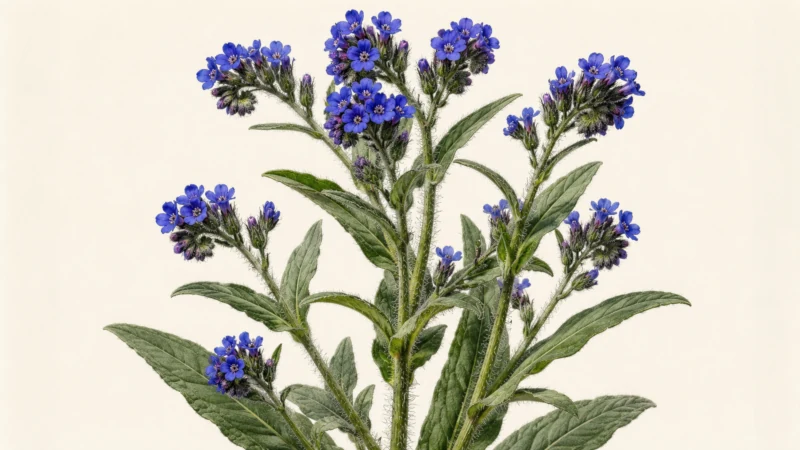
“Bugloss” usually means Anchusa azurea — also called blue bugloss, Italian bugloss, or large blue alkanet. It’s a coarse, bristly perennial in the borage family that grows three to five feet tall and carries deep blue-violet flowers in late spring, a bit like an oversized forget-me-not [Missouri Botanical Garden, 2026]. It’s native to the Mediterranean, southern and eastern Europe, North Africa, and east into the Himalaya, and it has escaped gardens and naturalised across much of the United States and into British Columbia [Kew Plants of the World Online, 2026]. The closely related Anchusa officinalis, common bugloss or common alkanet, gets used interchangeably in folk medicine and appears in the same recipes.
The genus name comes from Greek and probably points back to a red dye once taken from the roots of plants in this group [Missouri Botanical Garden, 2026]. That dye gave us the word “alkanet.” It also gave us a great deal of confusion.
Why the name matters more than it should
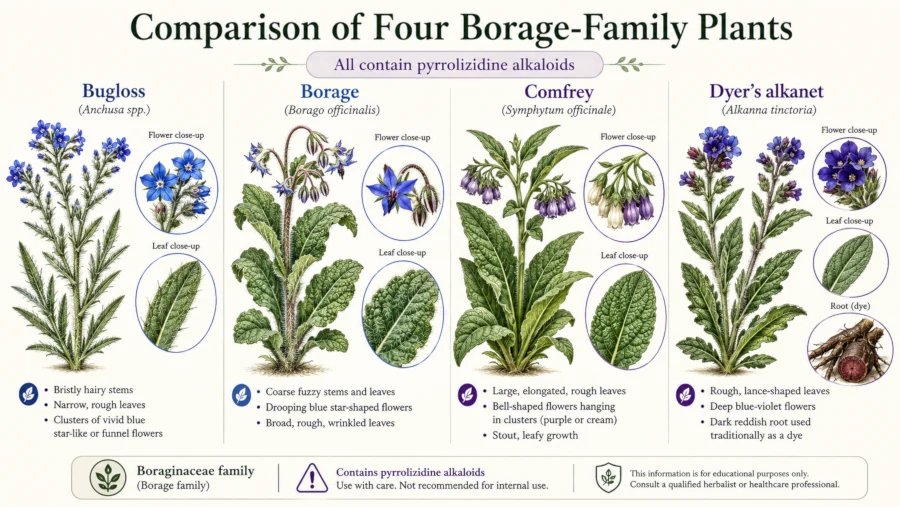
“Bugloss” and “alkanet” get slapped onto at least half a dozen plants: Anchusa azurea, Anchusa officinalis, viper’s bugloss (Echium vulgare), dyer’s alkanet (Alkanna tinctoria), and more. When names blur like that, people reasonably assume the properties blur too — and that somewhere in the tangle there’s a safe version.
There isn’t. Every one of those plants is a Boraginaceae, and nearly every genus in the Boraginaceae makes pyrrolizidine alkaloids [El-Shazly & Wink, 2014]. The naming muddle doesn’t open an exit. It just spreads the same problem across more labels.
What bugloss is traditionally used for
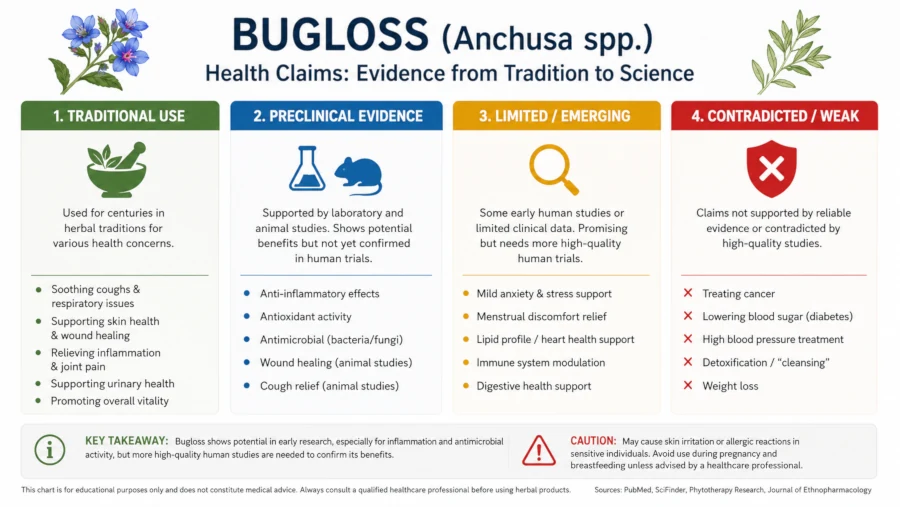
Old European herbals recommend bugloss flowers and leaves as a sweat-inducing, urine-promoting, cough-loosening remedy, usually brewed as an infusion. The fresh juice was pressed onto irritated skin as a soothing compress, on the logic that the plant is rich in mucilage — the slippery, gel-like fibre that also makes okra and marshmallow root feel slick.
Modern lists have piled on: anti-inflammatory, antioxidant, antimicrobial, wound-healing, digestive, immune-boosting, liver-protective. Those are extrapolations. They come from test-tube assays, from compounds bugloss happens to share with other species, or from the general pharmacology of the borage family. They do not come from anyone testing bugloss on a person.
What the evidence actually supports
Here is the honest tally.
| Claimed use | What actually exists | Evidence strength |
| Skin soothing, emollient | Traditional use; plant contains mucilage and allantoin | Traditional only — no human trials |
| Wound healing | Traditional use; extrapolated from related plants | None in humans |
| Cough, cold, chest congestion | Traditional use as an expectorant infusion | Traditional only |
| Diuretic, “cleansing” | Traditional use | Traditional only |
| Anti-inflammatory, antioxidant | Test-tube assays on Anchusa extracts | Preclinical (lab dish) only |
| Antimicrobial | Lab studies on extracts | Preclinical only |
| Digestive complaints | Traditional use | Traditional only |
| Immune support | No research specific to bugloss | None |
| Liver support / hepatoprotection | No supporting evidence. This plant family is a recognised cause of liver injury. | Contradicted by the evidence |
One thread of the traditional story does have real credentials, though not the way people assume. Allantoin, found in bugloss and other borage-family plants, is a legitimate skin protectant: the U.S. Food and Drug Administration recognises it as an over-the-counter active ingredient at 0.5 to 2 percent [FDA, 21 CFR 347.10]. That’s a purified compound at a controlled dose in a finished product. It is not a mug of home-brewed flower tea, and a compound’s safety record doesn’t transfer to every plant that happens to contain it.
The safety problem: pyrrolizidine alkaloids and your liver
Pyrrolizidine alkaloids, or PAs, are chemical defences plants make to deter insects from eating them. Boraginaceae is among the families most associated with them, and PAs have been documented directly in Anchusa officinalis — the very species used as bugloss — where they include intermedine and lycopsamine, alongside curassavine and 7-acetyllycopsamine [El-Shazly & Wink, 2014].
Those first two names deserve your attention. Intermedine and lycopsamine are among the pyrrolizidine alkaloids in comfrey — the borage-family plant whose oral use was pulled from the market in most countries precisely because of them [NIH LiverTox, 2022]. Bugloss isn’t a distant relative carrying a theoretical family resemblance. It carries some of the same molecules.
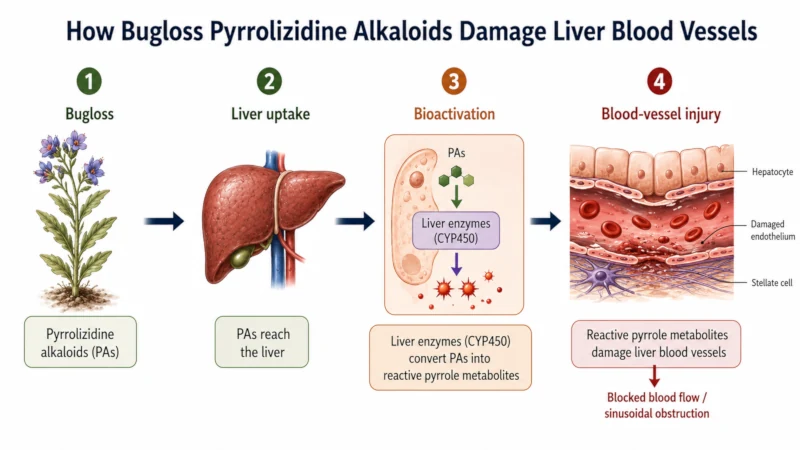
Here’s what those molecules do. Your liver’s cytochrome P450 enzymes convert 1,2-unsaturated PAs into highly reactive pyrrole metabolites. Those metabolites attack the endothelial cells lining the small veins inside your liver, and can block them off — a condition called hepatic sinusoidal obstruction syndrome, previously known as veno-occlusive disease [NIH LiverTox, 2022]. It’s often slow and quiet at first: fatigue, a swelling belly, weight gain that’s really fluid, then jaundice. It can progress to liver failure. The European Food Safety Authority has concluded that 1,2-unsaturated PAs may act as genotoxic carcinogens in humans, and that supplements made from PA-producing plants can deliver enough to cause short-term toxicity [EFSA, 2017].
The parts traditionally used are the worst parts to use
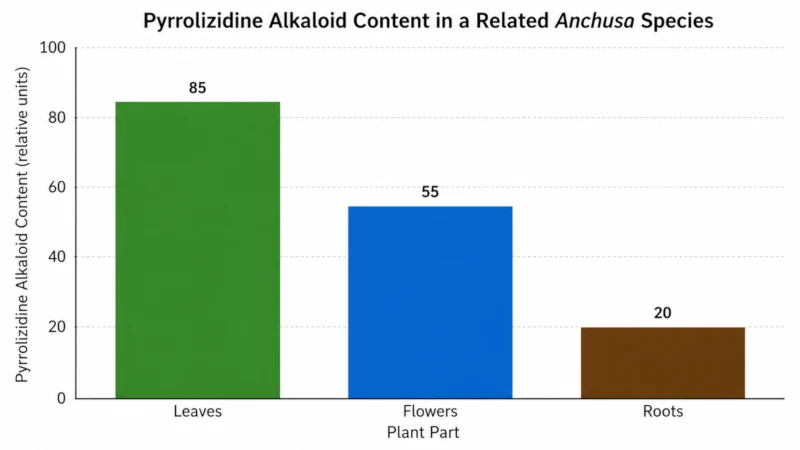
Old bugloss recipes call for the flowers and the leaves. In a chemical analysis of Anchusa strigosa, a close relative, pyrrolizidine alkaloids were most concentrated in the leaves, with the flowers close behind, and the roots carrying only a small fraction of the load [Phytochemistry, 2005]. The traditional recipe reaches for the two richest sources.
PA content also swings widely by species, plant part, plant age, and time of harvest [NIH LiverTox, 2022]. That variability is itself the hazard. You cannot look at a jar of dried bugloss and know what’s in it. Neither can the person who sold it to you.
What regulators have done about this class of plants
In July 2001 the U.S. Food and Drug Administration wrote to the supplement industry advising that comfrey and other sources of pyrrolizidine alkaloids shouldn’t be used in supplements at all, and recommending that firms stop marketing them and tell customers to stop using them. The Federal Trade Commission brought enforcement actions the same month, requiring topical comfrey products to carry a blunt warning: external use only, because swallowing the product can cause serious liver damage [FTC, 2001].
In Europe, the Committee on Herbal Medicinal Products at the European Medicines Agency maintains a standing public statement that sets limits on both oral and skin use of herbal medicines containing toxic unsaturated PAs [EMA, 2021]. EFSA, meanwhile, singled out tea, herbal infusions, and plant-based supplements as leading dietary sources of PA exposure [EFSA, 2017].
Bugloss has never been the target of its own regulatory action, largely because almost nobody sells it commercially. It sits squarely inside the class of plants these rules were written for.
Side effects, interactions, and who should avoid bugloss
Documented side effects. There are none, in the strict sense — because there is no clinical safety data on bugloss in humans. No trials, no dosing studies, no adverse-event monitoring. An absence of reported harm reflects how rarely the plant is used, not how safe it is. The predictable risk comes from the alkaloid class it belongs to: liver injury from repeated or prolonged internal use.
Interactions. PA toxicity is amplified by anything that induces liver enzymes, including phenobarbital [NIH LiverTox, 2022]. Anything else that taxes your liver — regular alcohol, acetaminophen, various prescription drugs — pushes in the same direction. If you take medication that your liver processes, that’s a reason to skip this plant, not a reason to be careful with it.
Pregnancy and breastfeeding. Avoid entirely. Pyrrolizidine alkaloids can reach a developing fetus, and infants appear especially susceptible to PA-induced liver injury [NIH LiverTox, 2022].
| Who should avoid bugloss | Why |
| Pregnant people | PAs can reach the fetus; the developing liver is highly vulnerable |
| Breastfeeding parents | PAs from these plants can pass into breast milk |
| Infants and children | Infants are particularly susceptible to PA liver injury |
| Anyone with liver disease | The target organ is already compromised |
| Anyone on regular medication | Liver-enzyme interactions increase PA toxicity |
| Anyone drinking alcohol regularly | Compounding burden on the same organ |
| Everyone, by mouth | No safe internal dose has been established |
If you’re still considering bugloss
Some people will use it anyway. It’s growing in the garden, it’s in a family recipe, it’s on a list somewhere. If that’s you, here is the narrowest defensible position.
Don’t swallow it. No tea, no infusion, no tincture, no capsule, no “just one cup.” That is the line, and it isn’t a soft one.
Topical use is lower-risk, not risk-free. A compress of fresh leaves on unbroken skin delivers far less alkaloid into your bloodstream than drinking it does. Broken skin changes the maths completely — damaged skin absorbs much more — so never put bugloss on cuts, grazes, open wounds, or an angry rash. Keep it brief, keep it to a small area, and stop at the first sign of irritation.
There’s a better option for nearly every use. If you want a soothing emollient for dry or irritated skin, gentler plants with fewer question marks are covered in our guide to herbs for skin issues and the more focused list of herbs for eczema. If you want a plant with real liver research behind it, milk thistle and artichoke leaf have actual randomised trials; our guide to herbs for the gallbladder and liver ranks them by evidence quality. And if what you’re really after is the comfrey-style bruise-and-sprain benefit, the plant with genuine trial data is comfrey root — on intact skin only, and never by mouth.
Realistic expectations
Bugloss is not going to cure anything. It has no demonstrated effect on arthritis, cancer, heart disease, infection, or immunity, and the antioxidant results people quote come from a dish in a lab, not a person in a trial. At best, a compress of mucilage-rich leaves might feel pleasant on dry skin, the way any slippery plant might. That’s the ceiling.
What it can do, taken internally over weeks or months, is quietly damage your liver. No meaningful upside, a real and documented downside. That asymmetry is the whole story of this plant.
Red flags: when to stop and get medical help
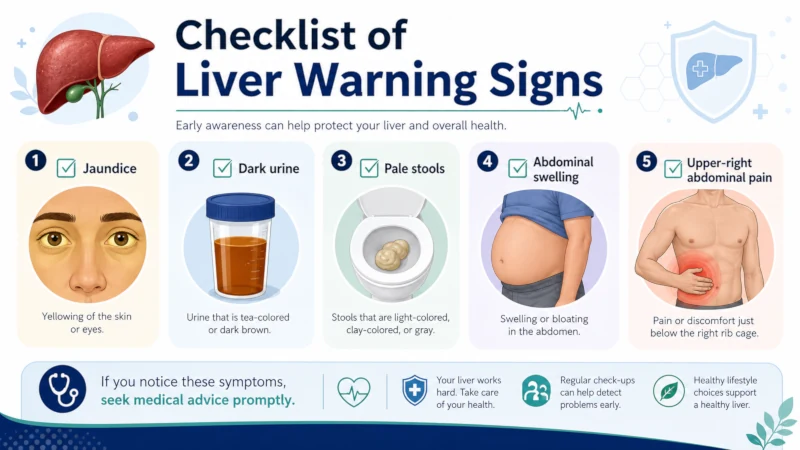
Stop using bugloss — or any borage-family plant — and speak to a doctor promptly if you notice:
- Yellowing of the skin or the whites of the eyes
- Dark urine, or pale, clay-coloured stools
- Pain or a dragging fullness in the upper-right abdomen
- A swelling belly, or unexplained weight gain that feels like fluid
- Persistent nausea, vomiting, or loss of appetite
- Unusual fatigue that doesn’t lift
Seek urgent care for severe abdominal pain, vomiting that stops you keeping fluids down, confusion or unusual drowsiness, or jaundice that comes on suddenly.
Liver injury from pyrrolizidine alkaloids can build over weeks to months and is easy to mistake for something ordinary early on [NIH LiverTox, 2022]. Tell the clinician exactly what you took and for how long. It changes what they look for, and how quickly they look.
| HEALTH DISCLAIMER: This article is for general education and is not medical advice. It is not a substitute for diagnosis or treatment by a qualified clinician. Bugloss should not be taken by mouth in any form. Herbal preparations can interact with prescription and over-the-counter medicines, and some are unsafe in pregnancy, while breastfeeding, or with existing health conditions. Do not stop or change any prescribed treatment based on this article. If you have symptoms of liver trouble — yellow skin or eyes, dark urine, pale stools, upper-right abdominal pain, or a swelling abdomen — contact a doctor, and seek urgent care if symptoms are severe or worsening. |
Frequently Asked Questions
Is bugloss tea safe to drink?
No. Bugloss belongs to the borage family, and pyrrolizidine alkaloids have been identified directly in Anchusa officinalis [El-Shazly & Wink, 2014]. No safe internal dose has been established, and repeated intake of PA-containing plants is linked to serious liver injury [NIH LiverTox, 2022]. Traditional infusion recipes for bugloss were written long before any of this was understood.
Doesn’t bugloss support the liver?
That claim circulates widely and it is not supported by anything. No human study shows bugloss protecting the liver, and its plant family is a recognised cause of hepatic sinusoidal obstruction syndrome [NIH LiverTox, 2022]. If you want plants with genuine liver research behind them, start with milk thistle and artichoke leaf.
Is bugloss the same as borage, comfrey, or alkanet?
They’re different plants in the same family. Borage (Borago officinalis), comfrey (Symphytum officinale), dyer’s alkanet (Alkanna tinctoria) and bugloss (Anchusa species) are all Boraginaceae, and pyrrolizidine alkaloids have been documented right across the family [El-Shazly & Wink, 2014]. The common names get used loosely. The chemistry doesn’t care.
Can I put bugloss on my skin?
Topical use on intact skin carries far less risk than swallowing it, because much less alkaloid gets into the bloodstream. Never apply it to broken or inflamed skin, which absorbs a great deal more, and don’t use it for extended periods. Bear in mind there is still no clinical evidence that it does anything.
Bugloss grows in my garden. Should I worry?
Having it in the garden is fine — it’s an excellent bee plant. The risk lies in eating it, brewing it, or letting children or pets browse on it. Anchusa azurea self-seeds readily and has naturalised across much of North America [Kew Plants of the World Online, 2026], so it’s worth being able to recognise it if it turns up uninvited.
References
- National Institute of Diabetes and Digestive and Kidney Diseases. “Comfrey.” LiverTox: Clinical and Research Information on Drug-Induced Liver Injury. Updated 24 May 2022. NBK548370. → View source
- El-Shazly A, Wink M. “Diversity of Pyrrolizidine Alkaloids in the Boraginaceae: Structures, Distribution, and Biological Properties.” Diversity, 2014;6(2):188–282. DOI 10.3390/d6020188. → View source
- European Food Safety Authority. “Pyrrolizidine alkaloids in tea, herbal infusions and food supplements.” 27 July 2017. → View source
- U.S. Federal Trade Commission. “FTC Announces a Second Case Focusing on Safety Risks of Comfrey Products Promoted via Internet.” 13 July 2001. → View source
- European Medicines Agency, Committee on Herbal Medicinal Products. “Public statement on the use of herbal medicinal products containing toxic, unsaturated pyrrolizidine alkaloids (PAs).” EMA/HMPC/893108/2011 Rev. 1, 2021. → View source
- U.S. Food and Drug Administration. 21 CFR § 347.10 — Skin protectant active ingredients. → View source
- Royal Botanic Gardens, Kew. “Anchusa azurea Mill.” Plants of the World Online, 2026. → View source
- Missouri Botanical Garden. “Anchusa azurea.” Plant Finder, 2026. → View source
- “Pyrrolizidine alkaloids from Anchusa strigosa and their antifeedant activity.” Phytochemistry, 2005. PMID 15963543. → View source
