
A fever means your body is fighting something, and most of the time, that fight is worth letting happen. But the headache, the chills, the restless discomfort — those are the parts you want to manage. If you’ve been searching for essential oils for fever, you’re probably wondering whether peppermint, eucalyptus, or lavender can actually help you feel better while your immune system does its work.
The short answer: essential oils will not cure a fever or replace ibuprofen or acetaminophen. No credible evidence shows that any essential oil lowers body temperature in humans. What certain oils can do is ease some of the symptoms that come with a fever — congestion, headache, muscle aches, poor sleep, and general misery — when used safely alongside conventional care. This guide walks through the oils with the best supporting evidence, how to use them without hurting yourself, and when to stop the home remedies and call a doctor.
What a Fever Actually Is (and When Essential Oils Fit In)
A fever is a temporary rise in body temperature, usually triggered by an infection. Your hypothalamus — the brain’s thermostat — resets your baseline temperature upward as part of the immune response. For most adults, a temperature of 100.4°F (38°C) or higher counts as a fever (Mayo Clinic, 2025). Fevers below 104°F (40°C) from common viral infections may actually help the immune system and are generally not harmful.
That context matters for essential oils. Since fever itself is a defense mechanism, the goal is not necessarily to “break” it, but to manage the uncomfortable symptoms that come with it: body aches, congestion, headache, sleeplessness, and anxiety. That is where certain essential oils may offer modest, complementary comfort.
Essential Oils That May Help With Fever Symptoms
None of the oils below have been proven in clinical trials to reduce fever temperature in humans. Their value lies in symptom relief — easing the discomforts that make being sick feel worse.
Peppermint Oil
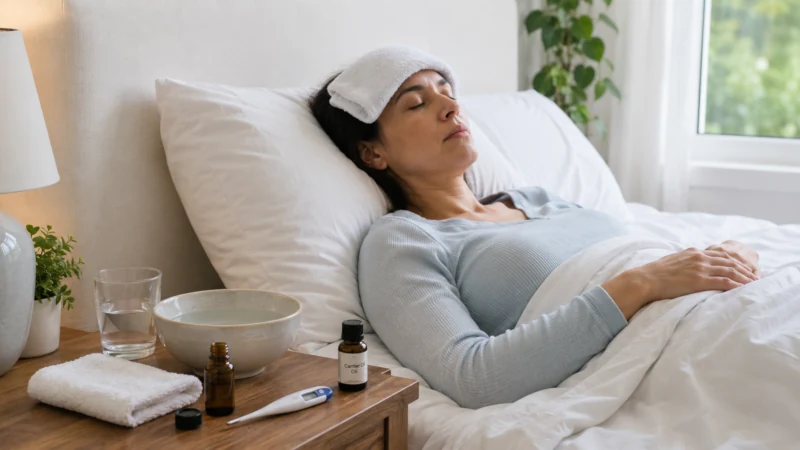
Peppermint oil’s active compound, menthol, creates a cooling sensation on the skin by activating TRPM8 cold receptors on nerve endings — the same receptors that sense actual cold temperatures (Nature Communications, 2020). This is a genuine physiological effect: menthol tricks your nervous system into feeling cooler, even though your core temperature has not changed. One study found that topical menthol gels decreased skin temperature and produced a subjective cooling sensation, though the effect was not proportional to menthol concentration (Johar et al., 2015).
For fever, this means a diluted peppermint oil application on the forehead or temples may create a sense of relief from feeling overheated, even if it is not lowering your actual temperature. Peppermint’s menthol content can also help open nasal passages when you are congested (Cleveland Clinic, 2021).
How people use it during a fever:
- Add 2–3 drops to a diffuser to help clear stuffy airways.
- Dilute 2–3 drops in one ounce of carrier oil (such as jojoba or sweet almond) and apply a small amount to the temples or forehead for a cooling sensation.
- Add a few drops to a cool washcloth compress for the forehead.
Eucalyptus Oil
Eucalyptus oil’s primary active compound, 1,8-cineole (also called eucalyptol), has the strongest respiratory evidence of any essential oil compound. A review of preclinical and clinical studies found that 1,8-cineole has mucolytic and spasmolytic effects on the respiratory tract, with anti-inflammatory properties that may help reduce mucus hypersecretion (Juergens, 2014). Clinical trials have studied cineole capsules (taken orally, not as essential oil aromatherapy) for conditions like acute rhinosinusitis and bronchitis, showing symptom improvement.
For fever-related congestion, inhaling eucalyptus oil vapor is a traditional approach with some laboratory backing but limited rigorous human trial data for the inhalation route specifically. The Cleveland Clinic lists eucalyptus as an oil that can soothe a stuffy nose and open nasal passages during cold season.
How people use it during a fever:
- Steam inhalation: Add 2–3 drops to a bowl of hot water, drape a towel over your head, and breathe slowly. Adults only — not recommended for young children.
- Diffuse in a room to create a clearing atmosphere.
- Dilute in carrier oil and apply to the chest, similar to a vapor rub.
Lavender Oil
Lavender oil is not a decongestant or a cooling agent. Its value during a fever is different: it may help you sleep. A 2022 systematic review of 20 randomized controlled trials found that lavender essential oil was associated with improved sleep quality in adults without diagnosed insomnia (Kang et al., 2022). A more recent 2026 meta-analysis of 11 RCTs with 628 participants confirmed a significant sleep-enhancing effect, though the authors noted the overall study quality was limited (Holistic Nursing Practice, 2026).
When you are sick with a fever, rest is one of the most important things your body needs. If lavender helps you fall asleep more easily, that alone can be worth using it. Lavender also has modest evidence for reducing anxiety, which often accompanies being unwell.
How people use it during a fever:
- Add a few drops to a diffuser in the bedroom before sleep.
- Place 1–2 drops on your pillowcase (test for staining first).
- Add a few drops, mixed with carrier oil, to a warm bath before bed.
Chamomile Oil
Chamomile (both Roman and German varieties) has a long folk-medicine history as a calming herb. Chamomile tea is widely used for relaxation. As an essential oil, chamomile has been studied primarily for anxiety and sleep, with some evidence of mild calming effects, though the research base for the oil specifically is thin compared to lavender.
During a fever, chamomile is best thought of as a comfort measure: something soothing to diffuse or add to a warm compress, rather than a treatment for the fever itself. Its anti-inflammatory properties are noted in traditional use and some laboratory studies, but human clinical data specific to fever symptoms is lacking.
How people use it during a fever:
- Warm compress: Add a few drops to a warm, damp washcloth and apply to the forehead or chest.
- Diffuse in the bedroom for a calming atmosphere.
- Chamomile tea (the herb, not the essential oil) remains a gentler option.
Ginger Oil
Ginger’s active compounds, including gingerols and shogaols, have demonstrated anti-inflammatory properties in laboratory studies, and ginger (as a food and supplement) has reasonably good evidence for reducing nausea. In traditional medicine systems, ginger has been used to promote perspiration during fever — the idea being that sweating helps the body cool down.
The scientific support for ginger essential oil specifically during fever is limited. Most ginger research involves dietary ginger or standardized supplements, not the essential oil. If nausea accompanies your fever, ginger tea made from fresh ginger root is a better-studied option than the essential oil.
How people use it during a fever:
- Diffuse ginger essential oil for its warming aroma.
- Brew fresh ginger tea (sliced ginger root in hot water for 10 minutes) — this uses the whole food, not the essential oil.
- Dilute in carrier oil for a warming massage on sore muscles.
How to Use Essential Oils for Fever Safely
Essential oils are concentrated plant extracts that require careful handling. The National Association for Holistic Aromatherapy (NAHA) and the reference text Essential Oil Safety by Tisserand and Young both emphasize dilution, patch testing, and awareness of individual risk factors.
Dilution Basics
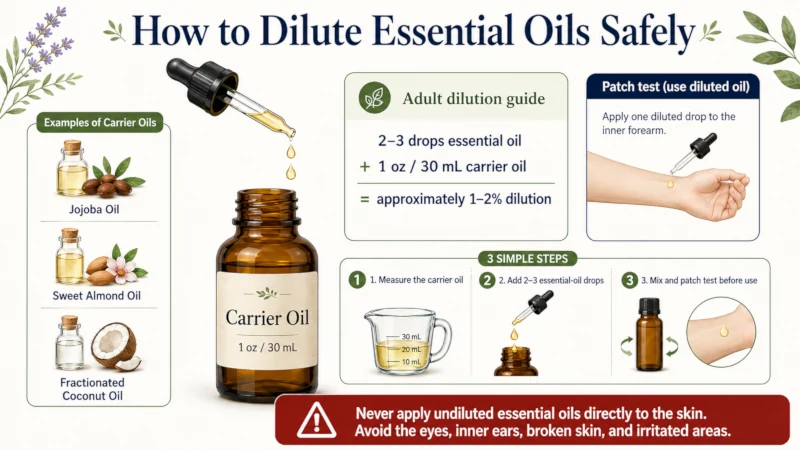
Never apply undiluted essential oil directly to your skin. Mix 2–3 drops of essential oil per one ounce (approximately 30 mL) of carrier oil. Good carrier options include sweet almond oil, jojoba oil, and fractionated coconut oil. This produces roughly a 1–2% dilution, which is standard for adult use (NAHA safety guidelines). Always do a small patch test on the inner forearm before broader application.
Diffusion
Add the recommended number of drops (usually 3–5 for a standard room diffuser) with water. Diffuse for 30–60 minutes at a time rather than continuously. Make sure the room is ventilated. Peppermint, eucalyptus, and lavender are common choices for diffusion during illness.
Topical Application
After diluting, you can apply oil blends to the temples (for headache), the chest (for congestion), or the soles of the feet. Avoid sensitive areas including the eyes, inner ears, and any broken or irritated skin.
Baths and Compresses
For a fever bath, add 4–6 drops of diluted essential oil (pre-mixed in carrier oil or a dispersant like bath gel) to a warm — not hot — bath. Lavender and chamomile work well here. For a compress, add 2–3 drops of peppermint or eucalyptus oil to a bowl of cool water, soak a washcloth, wring it out, and place on the forehead or back of the neck.
Steam Inhalation
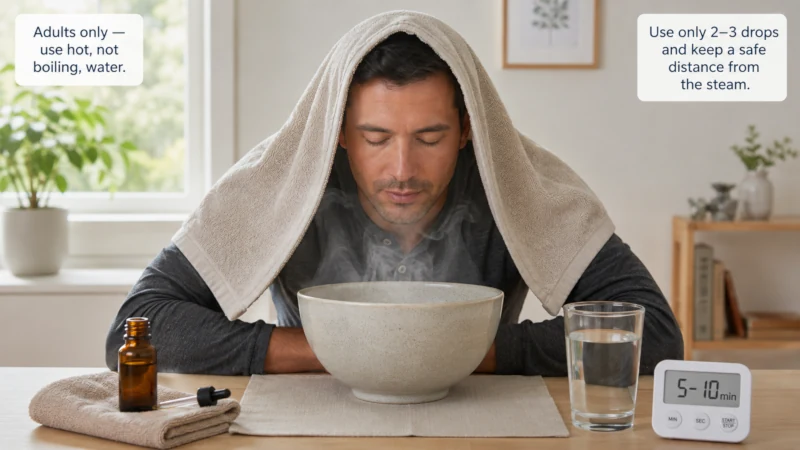
Add 2–3 drops of peppermint or eucalyptus oil to a bowl of hot (not boiling) water. Lean over the bowl with a towel tented over your head and breathe slowly through your nose for 5–10 minutes. This method is for adults only. Steam inhalation is not recommended for children due to burn risk and potential respiratory irritation from concentrated vapors.
Who Should Avoid Essential Oils
| Group | Precaution |
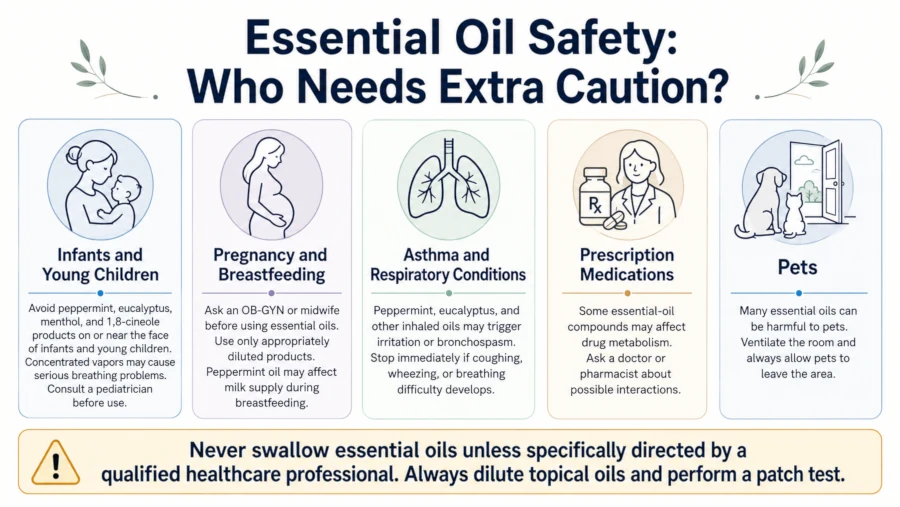
| Infants and children under 6 | Do not apply peppermint oil, eucalyptus oil, or any menthol-containing product to or near the face of an infant or young child. Inhaling menthol or 1,8-cineole can cause serious breathing problems. NAHA advises special caution with these oils in young children. |
| Pregnant or breastfeeding women | Lavender, chamomile, eucalyptus, and ginger are generally considered safe when properly diluted, per NAHA. However, peppermint oil during breastfeeding may affect milk supply. Talk to your OB-GYN or midwife before using essential oils during pregnancy. |
| People with asthma or respiratory conditions | Inhaled essential oils, particularly eucalyptus and peppermint, can trigger bronchospasm in some people with asthma. Start with very small amounts and stop if breathing worsens. |
| People taking medications | Essential oils can interact with certain medications. Peppermint oil, for example, can affect how the body processes some drugs. Talk to your pharmacist or doctor if you take prescription medications. |
| Pets | Many essential oils are toxic to cats and dogs. If you diffuse oils in a home with pets, ensure the room is ventilated and the pet can leave freely. |
Source: NAHA Safety Information; Tisserand & Young, Essential Oil Safety, 2nd ed., 2014.
Supporting Your Recovery: What Actually Works for Fever
Essential oils are a small piece of the comfort picture. The foundations of fever management are simpler and better supported:
- Hydration. Fever increases fluid loss through sweating. Water, clear broth, and electrolyte drinks help prevent dehydration. The Mayo Clinic lists drinking plenty of fluids as a primary self-care recommendation.
- Rest. Your body needs energy to fight the underlying infection. Physical activity can raise your body temperature further. Rest is not optional — it is part of the recovery.
- Appropriate clothing and room temperature. Wear lightweight, breathable clothing. Keep the room cool and well-ventilated. If you are not shivering, a single sheet or light blanket is enough.
- Over-the-counter fever reducers. Acetaminophen (Tylenol) and ibuprofen (Advil, Motrin) are effective at reducing fever and relieving body aches. Use them according to label directions. Do not give aspirin to children or teenagers due to the risk of Reye’s syndrome (Mayo Clinic, 2025). These medications treat the symptom, not the cause, but they can make you significantly more comfortable.
When to See a Doctor
Essential oils and self-care measures are not a substitute for medical evaluation. Seek medical attention in any of these situations:
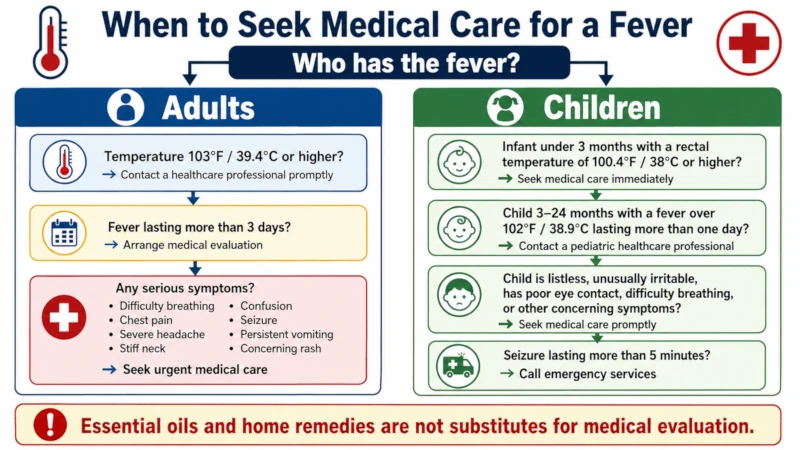
For adults:
- Temperature of 103°F (39.4°C) or higher
- Fever lasting more than three days
- Severe headache, stiff neck, rash, persistent vomiting, difficulty breathing, chest pain, confusion, or seizures
For children:
- Any fever in an infant under 3 months old (rectal temperature 100.4°F / 38°C or higher) — seek care immediately
- Fever over 102°F (38.9°C) in children 3–24 months that lasts more than a day
- A child who is listless, unusually irritable, or has poor eye contact
- Seizures — call 911 if a seizure lasts more than five minutes
Source: Mayo Clinic — Fever: Symptoms and Causes, 2025.
| Health Disclaimer: This article is for educational and informational purposes only. It is not medical advice and does not replace the guidance of a qualified healthcare professional. Essential oils can cause skin irritation, allergic reactions, and medication interactions. Do not apply essential oils to children, infants, pregnant women, or people with respiratory conditions without consulting a healthcare provider first. If your fever is high, persistent, or accompanied by serious symptoms, seek medical care promptly. Never use essential oils as a substitute for prescribed medication or professional medical treatment. |
Frequently Asked Questions
Can essential oils actually lower a fever?
No. There are no clinical trials showing that any essential oil reduces core body temperature in humans. Peppermint oil’s menthol can create a cooling sensation on the skin by activating cold-sensing nerve receptors, but this does not change your internal temperature. Essential oils may help you feel more comfortable during a fever by easing congestion, headache, or sleeplessness.
Is it safe to use essential oils on a child with a fever?
Use extreme caution. Do not apply peppermint, eucalyptus, or any menthol-containing oil to the face or near the nose of infants or young children — NAHA and multiple safety references warn this can cause serious respiratory problems. For older children, lavender diffused in a well-ventilated room is generally considered one of the safer options. Always consult your pediatrician first.
Which essential oil is best for fever with congestion?
Eucalyptus oil has the most laboratory and clinical evidence for respiratory support, thanks to its 1,8-cineole content. Peppermint oil can also help open airways. Both should be diluted appropriately and are best used by adults via diffusion or steam inhalation.
Can I use essential oils while taking ibuprofen or acetaminophen?
In most cases, topical or inhaled essential oils used at recommended dilutions do not interact with OTC fever reducers. However, if you take prescription medications, check with your pharmacist, because some essential oil compounds can affect drug metabolism.
Are essential oils safe during pregnancy when I have a fever?
Lavender, eucalyptus, and chamomile are generally considered safe when properly diluted, according to NAHA and the IFPA pregnancy guidelines. Peppermint oil may affect milk supply during breastfeeding. Always talk with your OB-GYN or midwife before using any essential oil during pregnancy — and be aware that a fever during pregnancy warrants a call to your provider regardless.
Should I ingest essential oils to treat a fever?
No. NAHA does not support the indiscriminate internal use of essential oils. Never swallow essential oils unless specifically directed by a qualified health professional using a product formulated for internal use. Essential oils are highly concentrated and can burn mucosal tissue or cause toxicity.
References
- Mayo Clinic Staff. “Fever — Symptoms and Causes.” Mayo Clinic. Updated December 24, 2025. View source
- Mayo Clinic Staff. “Fever — Diagnosis and Treatment.” Mayo Clinic. Updated December 24, 2025. View source
- National Association for Holistic Aromatherapy. “Safety Information.” NAHA. View source
- Cleveland Clinic / Yufang Lin, MD. “11 Essential Oils: Their Benefits and How To Use Them.” Cleveland Clinic Health Essentials. December 14, 2021. View source
- Kang H-J, et al. “The Effect of Lavender on Sleep Quality in Individuals Without Insomnia: A Systematic Review.” Holistic Nursing Practice. 2022;36(4):223–231. PMID 35708558. View source
- Holistic Nursing Practice. “The Sleep-Enhancing Effect of Lavender Essential Oil in Adults: A Systematic Review and Meta-Analysis.” 2026;40(2). PMID 40600743. View source
- Juergens UR. “Anti-inflammatory properties of the monoterpene 1.8-cineole: current evidence for co-medication in inflammatory airway diseases.” Drug Research. 2014;64(12):638–646. PMID 24831245. View source
- Johar P, et al. “Menthol concentration in topical cold gel does not have significant effect on skin cooling.” Journal of Thermal Biology. 2015;49-50:172–176. PMID 25773465. View source
- Yin Y, et al. “Molecular mechanisms underlying menthol binding and activation of TRPM8 ion channel.” Nature Communications. 2020;11:3790. View source
- Tisserand R, Young R. Essential Oil Safety: A Guide for Health Care Professionals. 2nd ed. Churchill Livingstone/Elsevier; 2014.
