
If you found this page hoping the mayapple plant is a natural remedy you can use at home, here’s the honest answer first: nearly everything genuinely valuable about mayapple reaches patients through a pharmacy or a doctor’s office, not a foraging basket.
The plant — Podophyllum peltatum, also called American mandrake — gave modern medicine one of its most useful plant compounds. It’s also poisonous enough that eating the wrong part can cause a violent illness, and large enough doses can be fatal [LiverTox, 2022]. Both things are true, and the real mayapple plant benefits only make sense when you hold them together.
What the mayapple plant actually is
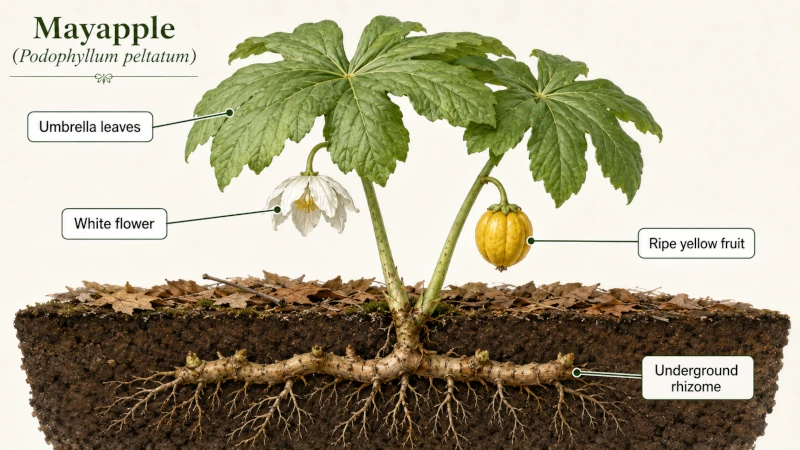
Mayapple is a low woodland perennial native to eastern North America, easy to recognize by the umbrella-shaped leaves that carpet the forest floor in spring. A plant with two leaves produces a single white flower between them, which becomes an egg-shaped fruit that ripens from green to soft yellow by mid- to late summer [Missouri Dept. of Conservation]. You’ll see it sold under folk names — American mandrake, wild mandrake, ground lemon, raccoon berry — but it has no botanical relationship to the Mediterranean mandrake (Mandragora) of European legend. The shared “mandrake” nickname caused the confusion; the plants are unrelated and sit in different families.
What gives mayapple both its medicinal value and its danger is a group of compounds concentrated in the rhizome (the underground stem) and roots — chiefly podophyllotoxin, along with the related alpha- and beta-peltatins [Cornell Botanic Gardens].
Mayapple at a glance
| Feature | Detail |
| Scientific name | Podophyllum peltatum L. (family Berberidaceae) |
| Common names | American mandrake, wild mandrake, ground lemon, raccoon berry |
| Where it grows | Damp woods and meadows across eastern North America |
| Key compounds | Podophyllotoxin; alpha- and beta-peltatins (in rhizome and roots) |
| Edible part | Fully ripe yellow fruit only, in small amounts — all other parts toxic |
The real benefit: the medicines that came from mayapple
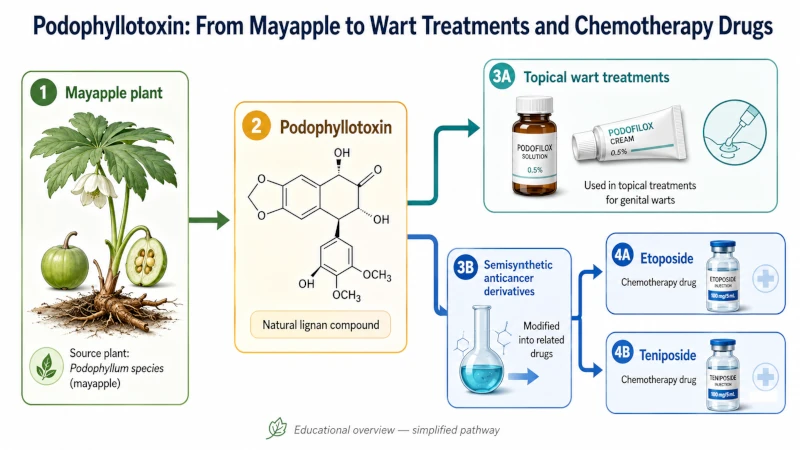
Mayapple’s biggest contribution to health isn’t anything you do with the plant yourself. It’s the raw material. Podophyllotoxin, obtained from the roots and rhizomes, is the precursor of established medicines used today [Drugs.com, 2025].
Treatment for genital and skin warts
Purified podophyllotoxin is the active ingredient in podofilox (brand name Condylox), a prescription topical medicine approved by the U.S. FDA for external genital and perianal warts caused by HPV [NIH ClinicalInfo]. It works by arresting cell division — binding reversibly to a protein called tubulin and stalling cells partway through dividing — which makes the wart tissue break down [FDA label]. In a meta-analysis of randomized trials, podophyllotoxin 0.5% cleared genital warts completely in roughly 56% of patients, and recurrence rates are typically around 20–30% [Drugs.com, 2025]. Burning, pain, itching, and inflammation at the application site are common.
The two available forms differ in a way that matters for safety. Patient-applied podofilox 0.5% is purified and standardized, so it can be used at home on a strict prescribed schedule [CDC, 2021]. Podophyllin — the older, crude resin (sold as Podocon-25, a 25% resin) — is different: it is a powerful caustic and severe irritant that is to be applied only by a physician, not dispensed to the patient, and washed off within one to four hours to limit how much is absorbed into the body [FDA label]. Neither is something to improvise from a plant you dug up. For a gentler skin-soothing herb, see calendula’s skin benefits.
Chemotherapy drugs (etoposide and teniposide)
The plant’s most far-reaching benefit came from chemistry rather than herbalism. In the lab, podophyllotoxin was modified into two semisynthetic drugs — etoposide and teniposide — that work by a different mechanism than the parent compound. Rather than disrupting cell scaffolding, they bind topoisomerase II and DNA, preventing DNA breaks from being resealed, which halts DNA replication and kills the cell [LiverTox]. Etoposide was approved by the FDA in 1983 and is a backbone chemotherapy agent for small cell lung cancer and testicular cancer, with further use in lymphomas and leukemias [StatPearls]; it appears on the World Health Organization’s list of essential medicines. Teniposide is used for childhood leukemia and malignant brain tumors [LiverTox].
These are potent prescription drugs given by oncologists, with serious side effects of their own — bone marrow suppression, nausea, vomiting, and hair loss among them [etoposide review, 2025]. They belong in this article only because they trace directly back to the mayapple, a genuinely remarkable plant-to-pharmacy story. The plant itself does not treat cancer, and trying to use it that way will harm you. (For diet and prevention — a separate question — see what the evidence shows about a cancer-preventing diet.)
What people used to do with it — and why medicine stopped
Indigenous peoples across eastern North America, including the Cherokee, Menominee, and Meskwaki, used the plant as a purgative, cathartic, laxative, and emetic, and understood its poison well enough to use the root against crop pests [Cornell Botanic Gardens]. Settlers later adopted the resin, podophyllin, as a purgative, and by the 19th century it had a place on pharmacy shelves.
That era is over, for good reason. Podophyllin was removed from the United States Pharmacopeia in 1942 because of its severe toxicity, and oral mayapple products have since been withdrawn from the market [Drugs.com, 2025]. The folk dosing you may still find online — swallow a fraction of a gram of root, or so many milligrams of resin, to “cleanse” the bowel — describes an abandoned practice that modern toxicology treats as dangerous. Don’t follow it.
The one part you can eat — carefully
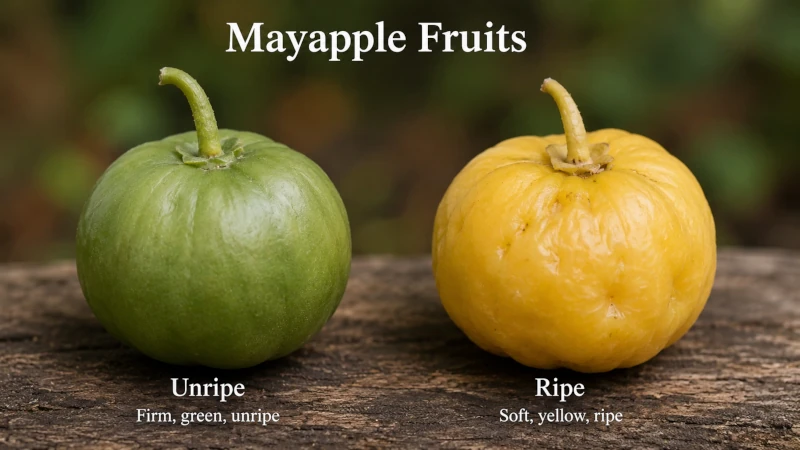
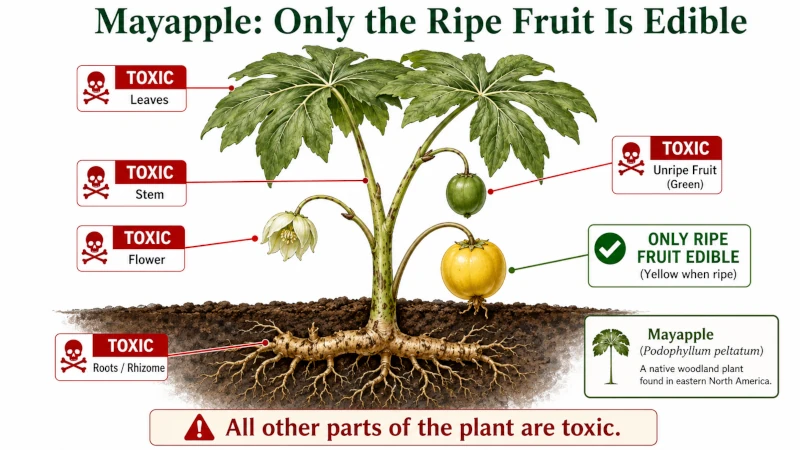
There’s a narrow exception worth knowing if you spend time in eastern woodlands. The fully ripe, soft yellow fruit is generally considered edible and can be eaten raw or made into jellies and beverages; it was an important food for Native Americans [Missouri Dept. of Conservation]. Everything else is poisonous — the leaves, stems, roots, rhizome, and unripe fruit, and even the seeds inside a ripe fruit [Cornell Botanic Gardens]. Eaten in excess, even the ripe fruit can prove toxic and act as a laxative. If you can’t be certain a fruit is fully ripe, or you can’t reliably remove the seeds, the safe choice is to leave it.
Safety, side effects, and who should stay away
Mayapple poisoning — from eating the wrong part, or absorbing too much resin through the skin — tends to begin in the gut and can spread from there. Ingesting the foliage, roots, or unripe fruit or seeds leads to severe purging gastroenteritis with vomiting [Cornell Botanic Gardens]. In more serious exposures, reported effects include abdominal pain, low platelet counts, abnormal liver function, unsteadiness, altered consciousness, and persistent tingling or numbness [LiverTox, 2022]. High enough doses can be fatal.
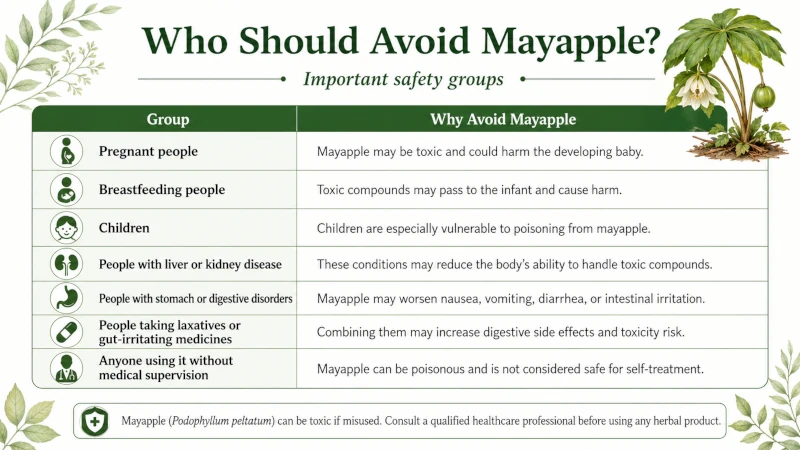
Who should avoid mayapple and its preparations entirely:
- If you are pregnant. Podofilox, podophyllin, and the wart treatment sinecatechins should not be used during pregnancy; podophyllin is linked to birth defects, fetal death, and stillbirth [CDC, 2021].
- If you are breastfeeding, without a clinician’s guidance [FDA label].
- If you’re tempted to treat warts at home with the raw plant or crude resin — wart treatment belongs with a clinician who can confirm the diagnosis and choose a safe formulation.
- Even handling matters: contact with the fresh rootstock can cause dermatitis in some people [Missouri Dept. of Conservation].
When to get urgent help: if you or someone else has swallowed any part of a mayapple beyond a little ripe fruit — or applied podophyllin or podofilox over a large area — and develops persistent vomiting, severe diarrhea, confusion, weakness, or numbness and tingling, seek medical care right away. In the U.S., Poison Control is reachable at 1-800-222-1222, 24 hours a day; call 911 for severe symptoms.
| Health Disclaimer This article is for general education and is not medical advice. Mayapple and its derivatives are potent and potentially toxic, and nothing here is a recommendation to use the plant or any preparation made from it. Talk with a qualified healthcare professional before using any herbal or natural product — especially if you are pregnant, breastfeeding, taking other medications, or managing a health condition. If you suspect poisoning, contact Poison Control or emergency services immediately. |
Frequently Asked Questions
Is the mayapple plant poisonous?
Can you eat mayapple fruit?
The fully ripe, soft yellow fruit is edible in small quantities and is sometimes made into jelly, but remove the seeds and avoid any fruit that’s still green or firm. Unripe fruit and the seeds are poisonous.
Does mayapple cure warts?
Not on its own. A purified derivative, podofilox, and the crude resin, podophyllin, are used to treat genital and skin warts — but these are regulated medicines, one applied at home by prescription, the other applied only by a clinician. The raw plant is not a safe wart treatment.
Is mayapple used to treat cancer?
Its derivatives are. Etoposide, a semisynthetic compound derived from mayapple, is FDA-approved for small cell lung cancer and testicular cancer, and teniposide is used for some childhood leukemias and brain tumors. The plant itself does not treat cancer.
References
- CDC. Anogenital Warts — STI Treatment Guidelines. View source
- FDA / RxList. Podocon-25 (podophyllin) prescribing information. View source
- NIH ClinicalInfo. Podofilox — patient drug record. View source
- RxList. Podofilox topical solution. View source
- Etoposide. StatPearls / NCBI Bookshelf. View source
- Topoisomerase Inhibitors. LiverTox / NCBI Bookshelf. View source
- Ba Jiao Lian (Podophyllum toxicity). LiverTox / NCBI Bookshelf. View source
- Drugs.com. Mayapple — professional monograph. View source
- Cornell Botanic Gardens. Mayapple. View source
- Missouri Department of Conservation. Mayapple field guide. View source
- Etoposide as a Key Therapeutic Agent in Lung Cancer. PMC, 2025. View source
