
If you drink milk, eat eggs, or start the day with fortified cereal, you are very likely getting enough riboflavin already. The richest vitamin B2 foods are dairy, eggs, organ meats, lean meats, and fortified grains, with mushrooms, soy foods, almonds, and cooked spinach as the strongest plant options [NIH ODS, 2022]. Most adults need only 1.1 to 1.3 mg a day, and one cup of plain yogurt delivers about half of that.
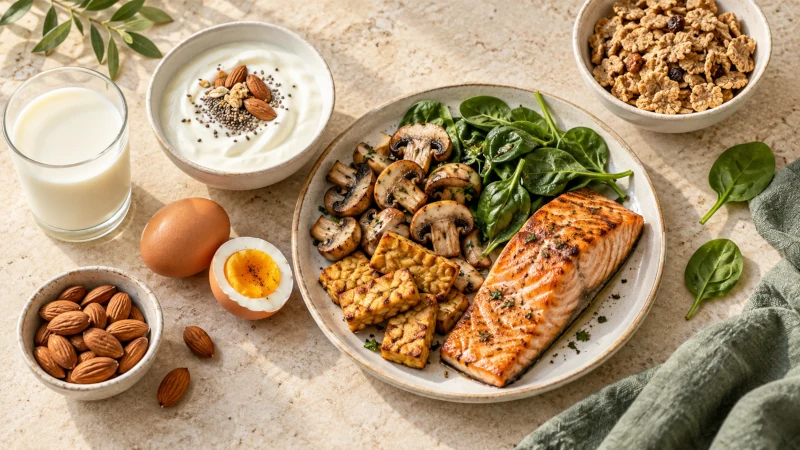
Where people fall short is predictable: they drop dairy and meat without replacing what those foods supplied. The numbers below show exactly which foods close that gap and which ones only sound impressive.
What vitamin B2 does in your body
Riboflavin is a water-soluble B vitamin. Your body turns it into two coenzymes, FAD and FMN, which cells use to make energy, grow, and break down fats, drugs, and steroids. It is also needed to turn the amino acid tryptophan into niacin, to activate vitamin B6, and to keep homocysteine at normal levels [NIH ODS, 2022].
You store very little of it. Whatever you do not use leaves in your urine, which is why a high-dose supplement can turn urine bright yellow [Harvard Nutrition Source, 2023]. For how riboflavin fits alongside the other B vitamins, see our B complex guide.
How much riboflavin do you need?
These are the Recommended Dietary Allowances set by the Food and Nutrition Board [NIH ODS, 2022]. Food labels use a single Daily Value of 1.3 mg for adults and children 4 and older.
| Age | Male | Female | Pregnancy | Breastfeeding |
| 1–3 years | 0.5 mg | 0.5 mg | — | — |
| 4–8 years | 0.6 mg | 0.6 mg | — | — |
| 9–13 years | 0.9 mg | 0.9 mg | — | — |
| 14–18 years | 1.3 mg | 1.0 mg | 1.4 mg | 1.6 mg |
| 19 and older | 1.3 mg | 1.1 mg | 1.4 mg | 1.6 mg |
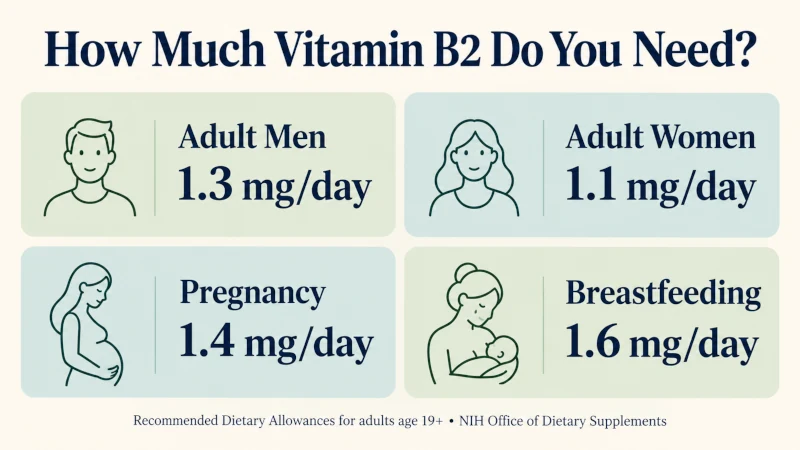
Most people in the U.S. clear these targets comfortably. In national survey data, fewer than 6% of people had riboflavin intakes below the average requirement, and average intake from food alone is about 2.5 mg a day for men and 1.8 mg for women [NIH ODS, 2022].
The best vitamin B2 foods, ranked by a real serving
Serving size changes everything. A food can be “rich” per 100 grams and still contribute little in the amount you actually eat. This table uses USDA figures, sorted by milligrams per typical serving.
| Food | Serving | Riboflavin (mg) | % DV* | Source |
| Beef liver, pan-fried | 3 oz | 2.9 | 223% | [NIH ODS, 2022] |
| Breakfast cereal fortified to 100% DV | 1 serving | 1.3 | 100% | [NIH ODS, 2022] |
| Instant oats, fortified, cooked | 1 cup | 1.1 | 85% | [NIH ODS, 2022] |
| Duck, meat only, roasted | 1 cup chopped (140 g) | 0.66 | 51% | [USDA SR28, 2016] |
| Yogurt, plain, fat-free | 1 cup | 0.6 | 46% | [NIH ODS, 2022] |
| Tempeh | 1 cup (166 g) | 0.59 | 46% | [USDA SR28, 2016] |
| Soymilk, unsweetened, fortified | 1 cup | 0.50 | 39% | [USDA SR28, 2016] |
| White mushrooms, stir-fried | 1 cup sliced (108 g) | 0.50 | 38% | [USDA SR28, 2016] |
| Milk, 2% | 1 cup | 0.5 | 38% | [NIH ODS, 2022] |
| Soybeans, mature, boiled | 1 cup (172 g) | 0.49 | 38% | [USDA SR28, 2016] |
| Spinach, boiled | 1 cup (180 g) | 0.43 | 33% | [USDA SR28, 2016] |
| Salmon, Atlantic, wild, cooked | 3 oz | 0.41 | 32% | [USDA SR28, 2016] |
| Beef tenderloin, grilled | 3 oz | 0.4 | 31% | [NIH ODS, 2022] |
| Clams, cooked | 3 oz | 0.4 | 31% | [NIH ODS, 2022] |
| Almonds, dry roasted | 1 oz | 0.3 | 23% | [NIH ODS, 2022] |
| Swiss cheese | 3 oz | 0.3 | 23% | [NIH ODS, 2022] |
| Egg, scrambled | 1 large | 0.2 | 15% | [NIH ODS, 2022] |
| Quinoa, cooked | 1 cup | 0.2 | 15% | [NIH ODS, 2022] |
| Ground beef, 85% lean, broiled patty | 3 oz | 0.15 | 12% | [USDA SR28, 2016] |
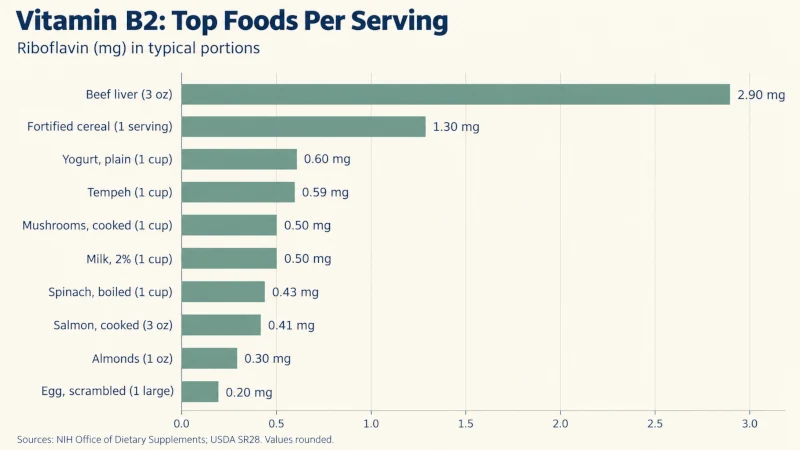
*% DV calculated against the 1.3 mg Daily Value. NIH figures are rounded to 0.1 mg; USDA figures are rounded to two decimals. USDA values are from the Standard Reference database (Release 28).
Animal-based vitamin B2 foods
Dairy: the biggest source for most people
Milk and milk drinks are the single largest contributor to riboflavin intake in U.S. adults [NIH ODS, 2022]. A cup of fat-free yogurt gives about 0.6 mg, a cup of 2% milk about 0.5 mg, and 3 ounces of Swiss cheese about 0.3 mg. In milk and eggs, riboflavin is present mostly in its free form, which your body absorbs about as well as the bound forms in other foods [NIH ODS, 2022].
Eggs
One large scrambled egg supplies about 0.2 mg, around 15% of the Daily Value [NIH ODS, 2022]. That is a useful contribution rather than a headline one, but eggs are cheap and easy to eat often. Our guide to egg nutrition and safety covers the rest of what is in them.
Liver, lean meat, and duck
Beef liver is in a class of its own at 2.9 mg per 3 ounces, more than twice the Daily Value [NIH ODS, 2022]. Liver is also very high in vitamin A, so it is a food to eat occasionally rather than daily. Roasted duck is a respectable source at about 0.66 mg per cup of meat [USDA SR28, 2016], and grilled beef tenderloin provides about 0.4 mg per 3 ounces [NIH ODS, 2022].
Ground beef is more modest than older lists suggest: about 0.15 mg in a 3-ounce broiled patty, or 12% of the Daily Value [USDA SR28, 2016]. Fine as part of the total, but not a reason to eat more burgers.
Fish and shellfish
Cooked wild Atlantic salmon has about 0.41 mg per 3 ounces [USDA SR28, 2016], while canned pink salmon has closer to 0.2 mg [NIH ODS, 2022]. Cooked clams come in at about 0.4 mg per 3 ounces [NIH ODS, 2022].
Plant-based vitamin B2 foods
Mushrooms
Mushrooms are one of the best vegetables for riboflavin. A cup of stir-fried white mushrooms has about 0.50 mg, and a cup of sliced grilled portabella about 0.49 mg [USDA SR28, 2016]. They shrink a lot as they cook, so a cup cooked is a realistic side dish.
Soybeans, tempeh, and fortified soymilk
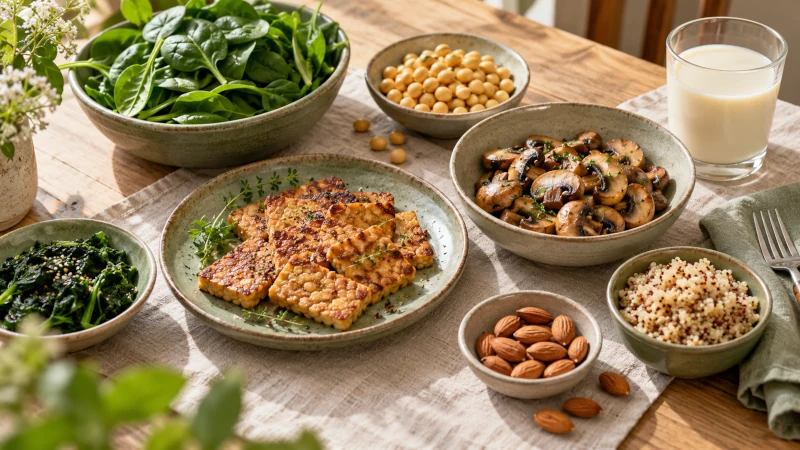
Tempeh is the standout soy food at roughly 0.59 mg per cup. Boiled mature soybeans give about 0.49 mg per cup, and a cup of unsweetened fortified soymilk about 0.50 mg [USDA SR28, 2016]. Check the label: soymilk riboflavin varies by brand and fortification. More on soybean nutrition is in our soybean guide.
Spinach and other cooked greens
A cup of raw spinach has only about 0.1 mg [NIH ODS, 2022], but a cup of boiled spinach packs about 0.43 mg because cooking collapses several cups of leaves into one [USDA SR28, 2016].
Almonds and seeds
An ounce of dry-roasted almonds provides about 0.3 mg, roughly a quarter of the Daily Value. Toasted sunflower seeds offer about 0.1 mg per ounce [NIH ODS, 2022].
Grains, bran, wheat germ, and buckwheat
This is where older vitamin B2 food lists overreach. USDA lists crude wheat germ at about 0.57 mg per cup (115 g) and wheat bran at about 0.34 mg per cup (58 g) [USDA SR28, 2016]. But nobody eats a cup of wheat germ. At a typical 2 tablespoons, that works out to roughly 0.07 mg for wheat germ and 0.04 mg for wheat bran (our calculation from the USDA cup values).
Roasted buckwheat groats contain about 0.44 mg per cup, measured dry [USDA SR28, 2016], so a normal cooked portion delivers less. Unfortified grains are generally minor sources: a half cup of cooked brown rice has essentially none. Most of the riboflavin people get from grains comes from fortification, which is why fortified cereals, breads, and enriched pasta are among the top contributors in U.S. diets [NIH ODS, 2022].
A plant-based day that reaches the RDA
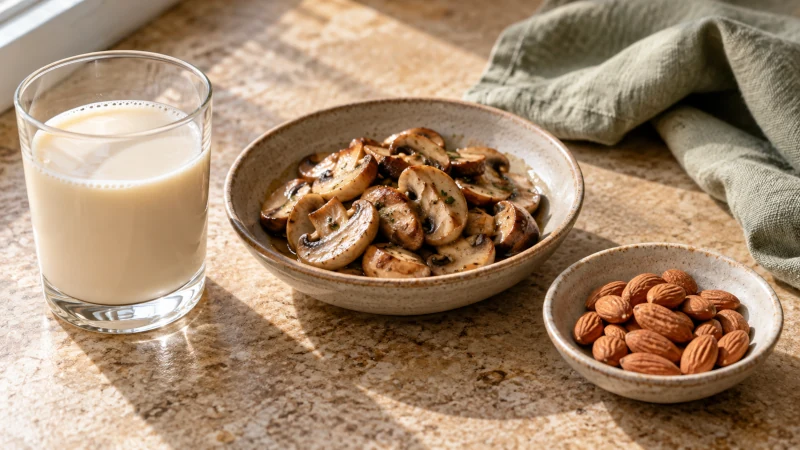
Here is one simple combination using the numbers above: a cup of fortified soymilk (0.50 mg), a cup of sautéed mushrooms (0.50 mg), and an ounce of almonds (0.3 mg). That totals about 1.3 mg, which meets the adult Daily Value before you count anything else on the plate. Add tempeh, cooked spinach, or a fortified cereal and you have a comfortable margin.
Keeping the riboflavin you buy: cooking and storage
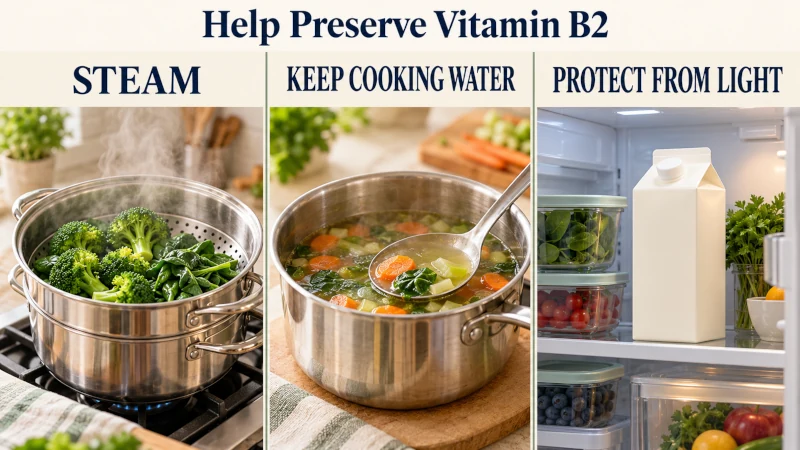
Riboflavin dissolves in water, so boiling pulls it into the cooking liquid. Foods boiled lose about twice as much as foods that are steamed or microwaved [NIH ODS, 2022]. Steam vegetables when you can, or use the cooking water in a soup or sauce.
Light is the other enemy. Ultraviolet and visible light break riboflavin down quickly, which is why milk is sold in opaque cartons and jugs rather than clear glass [NIH ODS, 2022]. Keep milk and yogurt covered and in the fridge.
Who may not be getting enough?
True riboflavin deficiency is extremely rare in the U.S. [NIH ODS, 2022]. The groups most likely to run low are:
- Vegans and people who eat little dairy. Milk, yogurt, cheese, eggs, and meat supply a large share of riboflavin for most people, so cutting them without replacements creates a real gap [NIH ODS, 2022]. Our guide to a well-planned vegetarian diet covers the other nutrients to watch.
- Vegetarian athletes. Exercise increases demand in riboflavin-using pathways, and professional sports nutrition groups advise these athletes to work with a sports dietitian [NIH ODS, 2022].
- Pregnant or breastfeeding women who rarely eat meat or dairy. Needs rise to 1.4 and 1.6 mg a day [NIH ODS, 2022].
- People with certain medical conditions. Thyroid hormone insufficiency can contribute to deficiency, and long phototherapy for newborn jaundice can deplete riboflavin [NIH ODS, 2022]. A rare genetic disorder, riboflavin transporter deficiency, blocks absorption and requires specialist treatment [NIH ODS, 2022].
Signs of vitamin B2 deficiency
Signs of deficiency include cracks and sores at the corners of the mouth, swollen and cracked lips, a sore throat, swelling of the mouth and throat, skin disorders, hair loss, and itchy, red eyes. Severe, long-lasting deficiency can lead to anemia and cataracts [NIH ODS, 2022].
Two things to keep in mind. First, people who are low in riboflavin are usually low in other nutrients too, so these signs may reflect several deficiencies at once [NIH ODS, 2022]. Second, early changes reverse readily once riboflavin is restored, but later changes such as cataracts rarely do [NIH ODS, 2022]. A blood or urine test, not a symptom checklist, confirms the diagnosis.
On the iron connection: riboflavin is involved in iron metabolism, and a UK trial in young women (RIBOFEM), listed in the NIH fact sheet’s references, reported that correcting a marginal riboflavin deficiency improved hematologic status [NIH ODS, 2022]. MedlinePlus notes that riboflavin may help iron supplements work better, but probably only in people who are short on riboflavin [MedlinePlus, 2020]. If you are dealing with low iron, our list of foods for anemia is the more useful starting point.
Vitamin B2 and migraine: what the evidence shows
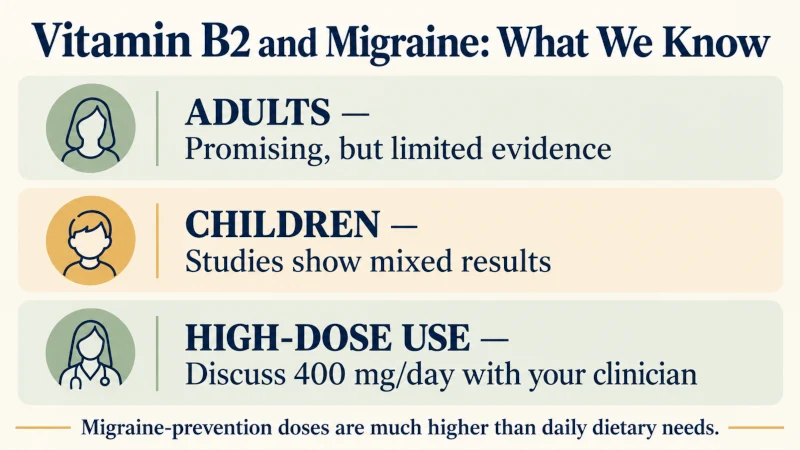
This is the one area where riboflavin is used as a treatment rather than a nutrient, and the evidence is real but limited.
- Adults: in a randomized trial of 55 adults with migraine, 400 mg of riboflavin a day cut attacks by about two per month compared with placebo [NIH ODS, 2022]. The benefit did not appear until after the first month and peaked around three months [Harvard Nutrition Source, 2023].
- Children: mixed. A retrospective study of 41 children found fewer and milder attacks on 200 or 400 mg a day, but two small randomized trials using 50 to 200 mg found no benefit over placebo [NIH ODS, 2022].
- Reviews and guidelines: a systematic review of 11 trials found mixed results, with modest benefit where it appeared [Harvard Nutrition Source, 2023]. In 2012 the American Academy of Neurology and American Headache Society rated riboflavin “probably effective” for preventing migraine [NIH ODS, 2022]; that guideline has since been retired [Harvard Nutrition Source, 2023]. The Canadian Headache Society recommends 400 mg a day while noting the evidence is low quality [NIH ODS, 2022].
The honest grade: promising, low-risk, and supported by a small amount of good adult data. Note the dose. At 400 mg, this is more than 300 times the adult RDA and cannot come from food. If you want to try it, do so with your doctor, give it a full three months, and keep a headache diary so you can tell whether it is working.
Riboflavin and cataracts
Cataracts can develop with severe, long-term deficiency [NIH ODS, 2022]. Beyond that, the evidence is mostly observational: people who eat more riboflavin seem to have a lower risk of cataracts, and some trials of riboflavin combined with niacin suggest a protective effect, which MedlinePlus rates as “possibly effective” [MedlinePlus, 2020]. That is not enough to recommend supplements for eye health in people who already eat well.
Safety, side effects, and medication interactions
From food, riboflavin has no known toxicity, partly because your gut can only absorb a limited amount at a time, little beyond about 27 mg in a single dose [NIH ODS, 2022]. For that reason no upper limit has been set. No adverse effects have been reported at 400 mg a day for at least three months, although the Food and Nutrition Board still urges caution with very large amounts [NIH ODS, 2022].
At supplement doses, the common effects are bright yellow-orange urine and, sometimes, diarrhea [MedlinePlus, 2020].
Interactions: the sources disagree. NIH’s Office of Dietary Supplements says riboflavin has no known clinically relevant interactions with medications [NIH ODS, 2022]. MedlinePlus lists several possible ones, most of uncertain importance [MedlinePlus, 2020]:
- Tetracycline antibiotics (such as demeclocycline, minocycline, tetracycline): riboflavin may reduce how much antibiotic you absorb. MedlinePlus suggests taking riboflavin 2 hours before or 4 hours after.
- Probenecid may raise riboflavin levels; phenobarbital may speed its breakdown; tricyclic antidepressants at very large doses may lower it; some anticholinergic “drying” medicines may increase absorption.
- Supplements: psyllium may reduce absorption from riboflavin supplements, and in people with MTHFR deficiency folic acid might worsen low riboflavin.
A sensible reading: these do not matter for riboflavin from food, but if you take a high-dose supplement alongside any of these medicines, ask your pharmacist to check timing.
Pregnancy and breastfeeding
Riboflavin is considered likely safe in pregnancy and breastfeeding at the recommended 1.4 and 1.6 mg a day; larger doses are rated possibly safe for short-term use [MedlinePlus, 2020]. Low riboflavin in pregnancy has been linked to a higher risk of preeclampsia, but evidence on whether supplements help is limited and mixed [NIH ODS, 2022]. Food and a standard prenatal vitamin are the right route for most people. High-dose riboflavin for migraine during pregnancy is a decision to make with your obstetric provider.
Who should check with a professional first
- Anyone planning to take high-dose riboflavin (for example, 400 mg for migraine).
- People taking tetracycline antibiotics, probenecid, phenobarbital, or tricyclic antidepressants.
- People with hepatitis, cirrhosis, or a blocked bile duct, because these conditions reduce riboflavin absorption [MedlinePlus, 2020].
- Parents considering riboflavin for a child’s migraines, since the pediatric evidence is mixed [NIH ODS, 2022].
- Anyone pregnant, breastfeeding, or with symptoms that suggest a deficiency.
When to get medical care
See a clinician if you have ongoing cracked mouth corners, a sore or swollen tongue, or sore throat that does not clear up, especially on a restricted diet. These signs usually mean more than one nutrient is low and deserve testing.
For headaches, seek medical help right away, and call 911 for a sudden, explosive headache, if [MedlinePlus, 2025]:
- it is the worst headache of your life, or comes on suddenly and violently;
- it comes with slurred speech, vision changes, trouble moving your arms or legs, loss of balance, confusion, or memory loss;
- it comes with fever, stiff neck, nausea, and vomiting, or follows a head injury;
- it gets worse over 24 hours, or headaches are new for you after age 50.
In a child, progressive hearing loss with trouble swallowing, breathing difficulty, or muscle weakness needs prompt specialist assessment. Riboflavin transporter deficiency is rare, but high-dose riboflavin can be life-saving when started soon after symptoms begin [NIH ODS, 2022].
| HEALTH DISCLAIMER: This article is for general education and is not a substitute for medical advice, diagnosis, or treatment. Nutrient deficiencies are confirmed with lab tests, not symptom lists, and several conditions look alike. Talk with your doctor, a registered dietitian, or a pharmacist before starting a supplement, especially at high doses, if you are pregnant or breastfeeding, giving supplements to a child, taking prescription medicines, or living with a chronic condition. If you have a sudden severe headache, trouble speaking, weakness, or confusion, call 911. |
Frequently Asked Questions
What food is highest in vitamin B2?
Beef liver, at about 2.9 mg per 3 ounces [NIH ODS, 2022]. Among everyday foods, fortified breakfast cereals, fortified instant oatmeal, yogurt, and milk are the biggest contributors.
What are the best vegan sources of riboflavin?
Tempeh, fortified soymilk, cooked mushrooms, boiled soybeans, cooked spinach, almonds, and fortified cereals [USDA SR28, 2016] [NIH ODS, 2022]. Combining two or three of them in a day can reach the RDA.
Can you get too much vitamin B2 from food?
No toxicity has been seen from food, and no upper limit has been set, because absorption is limited and the excess leaves in urine [NIH ODS, 2022].
Does cooking destroy vitamin B2?
Heat is less of a problem than water and light. Boiling leaches riboflavin into the cooking water, and light breaks it down, so steam or microwave vegetables and keep dairy covered [NIH ODS, 2022].
Should I take a riboflavin supplement?
Most people do not need one. A typical multivitamin already provides about 1.3 mg [NIH ODS, 2022]. High-dose riboflavin for migraine prevention is a separate, medication-like use to discuss with your doctor.
Why does riboflavin turn urine yellow?
Riboflavin is naturally yellow [NIH ODS, 2022]. Your body absorbs only a limited amount and excretes the rest, which colors urine bright yellow. It is harmless [Harvard Nutrition Source, 2023].
References
- National Institutes of Health, Office of Dietary Supplements. Riboflavin: Fact Sheet for Health Professionals. View source
- U.S. Department of Agriculture, Agricultural Research Service. USDA National Nutrient Database for Standard Reference, View source
- Harvard T.H. Chan School of Public Health. The Nutrition Source: Riboflavin – Vitamin B2. View source
- MedlinePlus (National Library of Medicine), from Natural Medicines Comprehensive Database. Riboflavin. View source
- MedlinePlus Medical Encyclopedia. Headache. View source


