
Arugula, spinach, lettuce, celery, beetroot and garden cress sit at the top of the list. Each can carry more than 2,500 mg of nitrate per kilogram of fresh weight. Broccoli, carrots and cauliflower land a full tier lower. Onions, potatoes and tomatoes barely register [Olas, 2024].
That ranking is the useful part, because your body converts some dietary nitrate into nitric oxide — the chemical signal your arteries use to relax. Eat enough of the right vegetables and blood pressure tends to drift down a little. The honest work is in “a little” and “enough,” and this page gives you both numbers rather than a vague nudge toward the salad bar.
The nitrate rich vegetables list, ranked by content
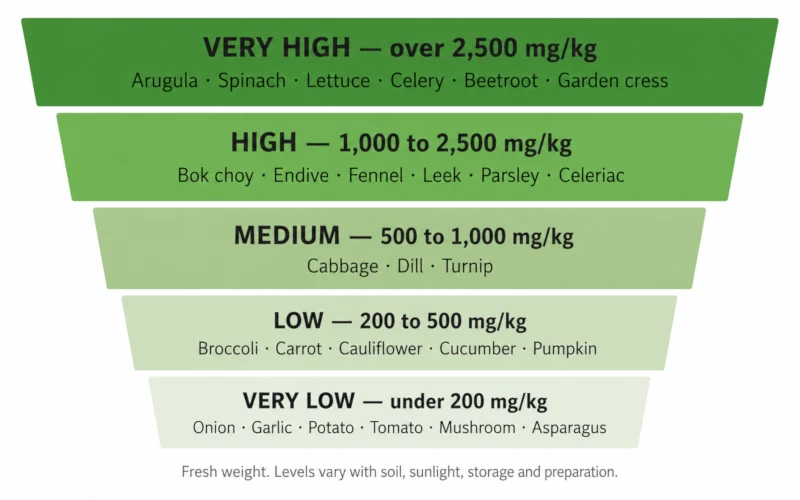
These bands come from a 2024 review of nitrate-rich vegetables, which grouped produce by measured nitrate concentration in fresh weight [Olas, 2024].
| Tier | Vegetables | Nitrate content |
| Very high | Celery, garden cress, chervil, lettuce, beetroot, spinach, arugula (rocket) | Over 2,500 mg/kg |
| High | Celeriac, Chinese cabbage (including bok choy), endive, fennel, leek, parsley | 1,000–2,500 mg/kg |
| Medium | Cabbage, dill, turnip | 500–1,000 mg/kg |
| Low | Broccoli, carrot, cauliflower, cucumber, pumpkin, chicory | 200–500 mg/kg |
| Very low | Artichoke, asparagus, garlic, onion, green bean, mushroom, pepper, potato, sweet potato, tomato | Under 200 mg/kg |
| Negligible | Meat (before curing) | Under 20 mg/kg |
Nitrate content bands for common vegetables, by fresh weight. Source: Olas, Foods 2024.
Reading the list without over-trusting it
Treat those bands as ranges, not label values. Nitrate in any given bunch of greens swings with soil type, sunlight, fertilizer, the nitrate in irrigation water, how it was shipped and stored, and how you cook it [Olas, 2024]. Two bags of spinach from the same store can differ meaningfully, and no packaging will tell you.
A few things worth pulling out of the table:
- Bok choy is Chinese cabbage, which puts it one tier below arugula and spinach rather than level with them. Still a good choice, just not a headline one.
- Pickled beets carry less nitrate than fresh beets, so the jar in the pantry is not a straight swap for the roasted ones [Olas, 2024].
- Radishes and Swiss chard are routinely grouped with nitrate-rich vegetables, but the review behind this ranking does not assign them a tier. Use them for variety; do not count on them to carry the load.
- Processed meat is not a shortcut. Uncured meat contains almost no nitrate naturally — the nitrate and nitrite in bacon and deli meat are added preservatives, arriving without the vitamin C and polyphenols that come packaged with vegetables [Olas, 2024].
How much do you actually have to eat?
This is where numbers help more than a longer list.
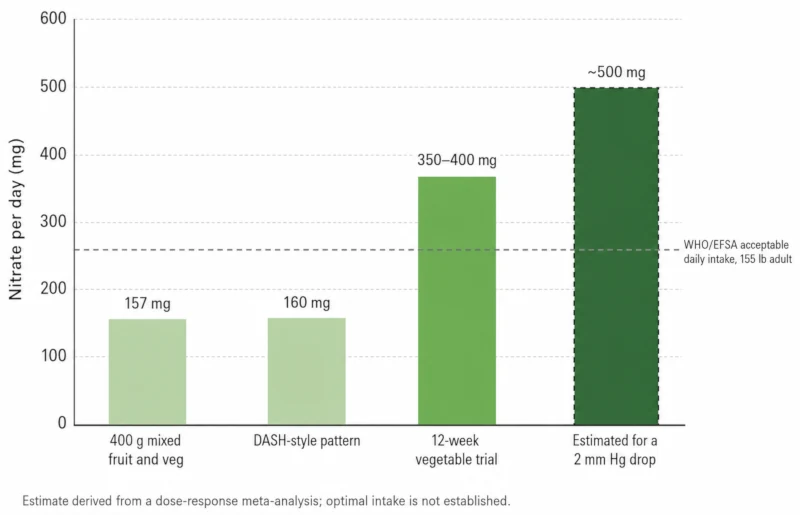
The largest pooled analysis to date — 75 randomized controlled trials covering 1,823 participants — found that each additional millimole of nitrate lowered medium-term systolic pressure by about 0.48 mm Hg. Working from that slope, the authors estimated it would take roughly 8 mmol of nitrate a day, on the order of 500 mg, to reach a 2 mm Hg reduction, which is the threshold usually treated as clinically meaningful [Norouzzadeh et al., 2025].
Ordinary eating gets you partway. A DASH-style pattern supplies around 160 mg of nitrate a day, and 400 g of mixed fruit and vegetables comes in near 157 mg [Olas, 2024]. So “eat more vegetables” and “eat a deliberately high-nitrate diet” are not the same instruction.
The most directly relevant test used real food. Over 12 weeks in the Netherlands, 77 adults with high or borderline blood pressure — average reading 144/87, average age 65 — were randomized to eat about 250 to 300 g of nitrate-rich vegetables daily (roughly 350 to 400 mg of nitrate), to take beetroot juice supplying 400 mg of nitrate, or to change nothing. Daytime systolic pressure in the vegetable group fell from 134 to 129 mm Hg. The beetroot juice group did not change [van der Avoort et al., 2021].
Read that last sentence twice. In a well-conducted trial, the people eating vegetables did better than the people drinking the concentrated supplement.
Where the guidance disagrees
The World Health Organization and the European Food Safety Authority set an Acceptable Daily Intake for nitrate at 3.7 mg per kilogram of body weight — about 260 mg a day for a 155-pound adult [Olas, 2024]. Many of the trial doses above exceed it.
Researchers in this field argue the limit does not transfer cleanly to vegetables. It was derived largely from nitrate in cured meat and drinking water, where nitrate can contribute to the formation of N-nitroso compounds; vegetables arrive with antioxidants that inhibit that chemistry [Olas, 2024] [Norouzzadeh et al., 2025]. That argument is widely held among nitrate researchers and is biologically reasonable. It has not been settled by regulators, and the meta-analysis authors say plainly that the optimal dose has not been established. Both things are true at once: vegetables are not the concern the limit was written for, and nobody can currently tell you a validated target intake.
What the evidence supports, and what it does not
| Claim | Strength | What it rests on |
| Dietary nitrate produces small, dose-related reductions in systolic blood pressure | Reasonably supported | Pooled analysis of 75 RCTs. GRADE certainty was moderate for acute and short-term systolic pressure, but only low for medium-term results because trials disagreed with each other (Norouzzadeh et al., 2025). |
| Whole nitrate-rich vegetables lower blood pressure in adults with elevated readings | Promising, not settled | One 12-week randomized trial with 25 people in the vegetable arm. Encouraging and directly on-topic, but a single modest trial (van der Avoort et al., 2021). |
| Beetroot juice specifically lowers blood pressure | Genuinely mixed | Pooled data show a medium-term systolic reduction peaking near 150 mL/day and then plateauing, yet individual trials — including the vegetable trial above — found no effect (Norouzzadeh et al., 2025; Olas, 2024). |
| Frequent antibacterial mouthwash blunts the pathway | Weak but consistent | A 3-day crossover in 15 treated adults, plus cross-sectional survey data. Small, short, and observational (Bondonno et al., 2015; Guo et al., 2025). |
| Vegetables can cure, reverse, or replace treatment for high blood pressure | Not supported | No evidence base. Current US guidance treats lifestyle as the foundation of care with medication when indicated, and sets a general target under 130/80 mm Hg (2025 AHA/ACC guideline). |
Two caveats belong with those numbers. The acute results showed statistical signs of publication bias, meaning small studies that found nothing may never have been published. And 70 of the 86 study arms used beetroot in some form rather than a mixed diet, so mapping the pooled estimate onto a plate of arugula is an approximation, not a calculation [Norouzzadeh et al., 2025].
Getting nitrate rich vegetables into ordinary meals
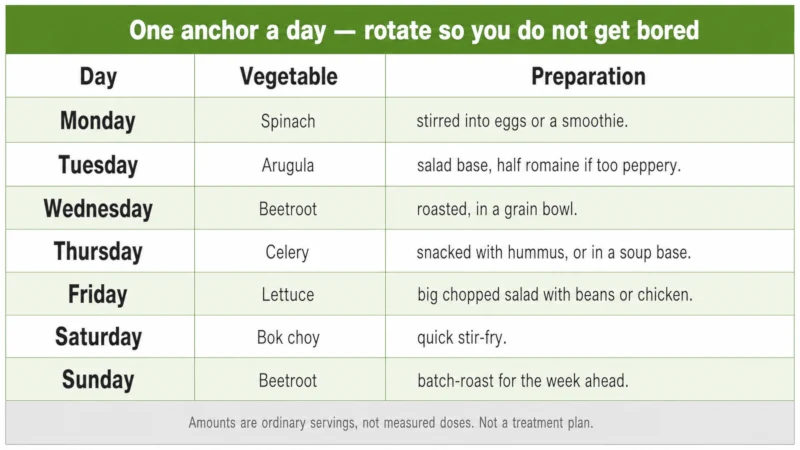
One anchor a day, rotated so you do not burn out on it, does most of the work. If you want a fuller set of meal patterns, the nitrate-rich grocery guide covers the week-to-week logistics.
| Meal | What to do | Why it works |
| Breakfast | A large handful of spinach into eggs, tofu scramble, or a berry smoothie | Adds a top-tier green without redesigning the meal |
| Lunch | Arugula or spring mix as the salad base; half arugula, half romaine if the pepperiness is too much | Arugula and lettuce both sit in the highest band |
| Snack | Celery with hummus, or sliced radishes | Celery is top-tier and needs no preparation |
| Dinner | Roasted beets in a grain bowl, or greens stirred into soup in the last minute | Beetroot is top-tier; late-added greens keep their texture |
| Batch prep | Roast beets once, refrigerate, use across three or four days | Turns beets from an aspiration into a default |
Two preparation details actually matter. Nitrate in beetroot and arugula juice begins degrading within 24 hours at room temperature, so juice is best refrigerated and drunk fresh rather than batched for the week [Olas, 2024]. And if you boil greens hard and pour the water down the sink, you pour some water-soluble compounds with it — a quick sauté or a late addition to soup avoids that.
Two habits work against the pathway from the other direction. Cigarette smoke can impair nitrate metabolism, and thiocyanate competes with nitrate for uptake by your salivary glands. Foods rich in phenolic compounds may push the other way, helping nitrite conversion in the stomach [Olas, 2024].
The step that happens in your mouth
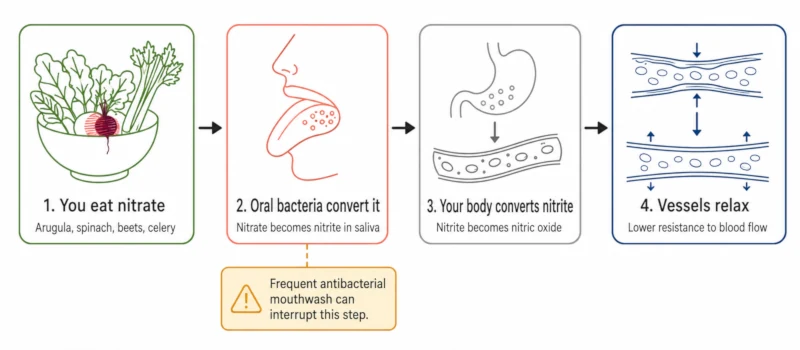
Part of this pathway is not really yours. Bacteria living on the back of your tongue perform the first conversion, turning nitrate from your saliva into nitrite, which your body then uses downstream [Olas, 2024]. Humans depend on those oral bacteria for this step more than most other mammals do.
Antibacterial mouthwash does not distinguish between bacteria you want and bacteria you do not. In a randomized crossover trial, 15 adults already being treated for high blood pressure used an antibacterial mouthwash for three days; oral nitrate reduction fell and systolic pressure rose slightly, with no change in diastolic [Bondonno et al., 2015]. Fifteen people over three days is a signal, not a verdict. A separate cross-sectional analysis found associations between frequent over-the-counter mouthwash use and markers of nitric oxide metabolism and inflammation, but a cross-sectional design cannot establish that mouthwash caused anything [Guo et al., 2025].
The practical version: if your dentist prescribed a rinse, keep using it and raise the question at your next visit. If you rinse twice a day out of habit and you are eating greens specifically for your blood pressure, cutting back is a low-risk experiment. The longer discussion of mouthwash and the oral microbiome walks through how to test it without confusing yourself.
Safety, side effects, and who should check first
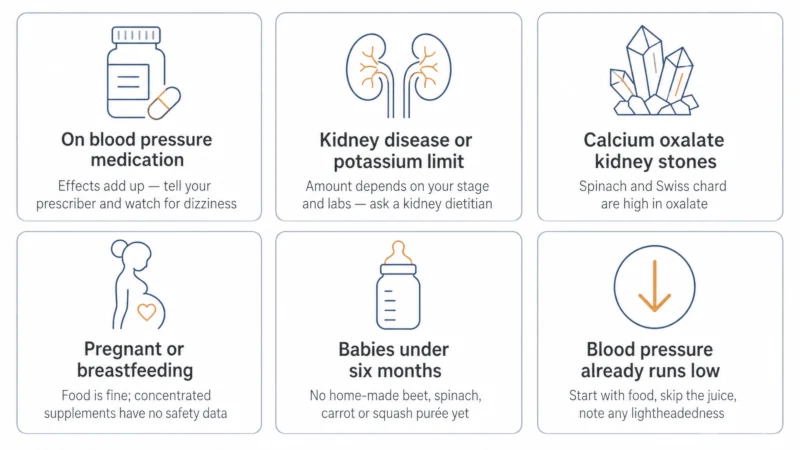
For most people, eating more vegetables is about as low-risk as health advice gets. The pooled safety analysis across 17 trials that reported adverse events found no increase compared with control groups (risk ratio 1.00) [Norouzzadeh et al., 2025]. A few groups still need a conversation first.
Common and harmless
Beeturia — pink or red urine, sometimes red stools — is the most frequently reported effect and does not indicate a problem. Trials also recorded occasional abdominal pain, diarrhea, nausea, headache and general stomach discomfort, mostly with concentrated beetroot products rather than food [Norouzzadeh et al., 2025].
If you take blood pressure medication
The effects add up. That can be a good thing, but it can also take you lower than intended. Tell your prescriber before you make daily greens a fixture, watch for dizziness or lightheadedness, and bring your home readings to your appointment. Concentrated beetroot powders and juices deserve a specific conversation with your doctor or pharmacist rather than a decision made in a supplement aisle — the supplement comparison page has more on that, including where the marketing outruns the evidence.
If you have kidney disease or a potassium limit
The National Kidney Foundation notes that most people with chronic kidney disease do not automatically have to limit leafy greens; the right amount depends on your stage, the type of dialysis if any, and your lab results. Potassium climbs once greens are cooked down — boiled Swiss chard, boiled bok choy, boiled beet greens and boiled, canned or frozen spinach all land in the high-potassium group [National Kidney Foundation, 2023]. Talk to your doctor or a kidney dietitian before you scale up.
If you form calcium oxalate kidney stones
Spinach and Swiss chard are high in oxalate [National Kidney Foundation, 2023]. That does not rule them out, but it is a reason to get individual advice rather than tripling your intake on your own. Arugula, lettuce and celery are alternatives worth raising with your doctor or dietitian.
If you are pregnant or breastfeeding
Eating vegetables is fine, encouraged, and not the question here. Concentrated nitrate is a different matter: the 2025 meta-analysis explicitly excluded pregnant and lactating women from the trials it pooled, so there is no dose-safety evidence to draw on [Norouzzadeh et al., 2025]. Keep it food-first and ask your doctor before starting a beetroot supplement.
If you are feeding a baby
Hold off on home-prepared purées containing beets, spinach, carrots, squash or green beans until after six months. Very young infants have limited capacity to reverse methemoglobin, the compound that forms when nitrate becomes nitrite in the body, and that protective enzyme system develops somewhere between three and six months. Children with G6PD deficiency or pyruvate kinase deficiency stay at higher risk past six months. The most common cause of the problem in the US is not vegetables at all — it is infant formula mixed with nitrate-containing well water, so have a private well tested [Nationwide Children’s Hospital, 2026].
If your blood pressure already runs low
Start with food rather than juice, keep portions ordinary, and note any lightheadedness. If you feel faint or unusually floaty, scale back and check your readings before you push further.
When to stop reading and call someone
| What you see | What to do |
| A reading over 180/120 mm Hg with chest pain, shortness of breath, back pain, numbness, weakness, vision changes, or trouble speaking | Call 911. Do not wait to see whether it settles. |
| A reading over 180/120 mm Hg with no symptoms | Wait a minute, take it again. If it stays there, contact your doctor promptly. |
| Readings staying elevated across one to two weeks of consistent measurement | Book an appointment and bring your log. This is not something a food change fixes on its own. |
| Repeated dizziness, fainting, or unusual fatigue after increasing vegetables — especially on blood pressure medication | Scale back and contact your prescriber. Your dose may need review. |
If you want your numbers to actually mean something, measure the same way each time: five minutes of quiet sitting, back supported, feet flat, arm at heart level, two readings a minute apart, same time of day [American Heart Association, 2025]. Judge the trend over two to four weeks, not any single reading. There is a step-by-step home measurement routine if you want the full method.
| HEALTH DISCLAIMER: This article about nitrate rich vegetables is for general education. It does not diagnose, treat, cure or prevent any disease, and it is not a substitute for care from your own doctor. Adding vegetables to your diet is a supportive habit, not a treatment for high blood pressure, and nothing here is a reason to stop or change prescribed medication. Talk with a doctor — or a registered dietitian or pharmacist where they are the better fit — before making a major change if you take blood pressure medication, have kidney disease or a potassium restriction, form calcium oxalate kidney stones, have a history of fainting or low blood pressure, or are pregnant or breastfeeding. If a reading is above 180/120 mm Hg and comes with chest pain, shortness of breath, back pain, numbness, weakness, vision changes or trouble speaking, call 911. |
Frequently Asked Questions
Which vegetable has the most nitrate?
No single vegetable holds the title reliably. Arugula, spinach, lettuce, celery, beetroot and garden cress all sit in the same top band, above 2,500 mg per kilogram, and the actual amount in any given bunch depends on growing and storage conditions more than on which of those six you picked [Olas, 2024]. Rotate them.
Does cooking destroy the nitrate?
Cooking changes it rather than destroying it, and gentle cooking is fine. The bigger loss comes from boiling greens hard and discarding the water. A quick sauté, or adding greens near the end of a soup, keeps more of what you are after.
Is beet juice better than eating beets?
Not necessarily, and possibly the opposite. In the 12-week trial that tested both, the group eating nitrate-rich vegetables saw daytime systolic pressure drop about 5 mm Hg while the beetroot juice group showed no change [van der Avoort et al., 2021]. Juice is more concentrated and easier to overdo, and some products add sugar. Whole beets also bring fiber.
Are the nitrates in vegetables the same as the ones in bacon?
Chemically similar, nutritionally not comparable. Uncured meat contains almost no nitrate; what is in cured meat was added. Vegetables deliver nitrate alongside vitamin C, polyphenols and betalains, which inhibit the formation of the N-nitroso compounds that drive the concern about processed meat [Olas, 2024]. Eating more spinach is not the same decision as eating more salami.
How long before I see a change in my blood pressure?
Some studies measure effects within hours, but a single reading tells you almost nothing. Give it two to four weeks of consistent daily measurement and look at the trend [American Heart Association, 2025]. If your readings stay high across that window, that is information for your doctor, not a sign to eat more greens.
Do I need a beetroot supplement?
Most people do not. The strongest whole-food evidence favors vegetables over the concentrated juice, food is easier to sustain, and supplements vary widely in actual nitrate content [van der Avoort et al., 2021] [Olas, 2024]. If you are on blood pressure medication and still want to try one, decide it with your doctor or pharmacist rather than on your own.
References
- Olas B. The Cardioprotective Role of Nitrate-Rich Vegetables. Foods. 2024;13(5):691. PMCID PMC10931520; PMID 38472804. View source
- Norouzzadeh M, Hasan Rashedi M, Ghaemi S, et al. Plasma nitrate, dietary nitrate, blood pressure, and vascular health biomarkers: a GRADE-assessed systematic review and dose-response meta-analysis of randomized controlled trials. Nutrition Journal. 2025;24(1):47. View source
- van der Avoort CMT, Ten Haaf DSM, Bongers CCWG, et al. Increasing Nitrate-Rich Vegetable Intake Lowers Ambulatory Blood Pressure in (pre)Hypertensive Middle-Aged and Older Adults: A 12-Wk Randomized Controlled Trial. The Journal of Nutrition. 2021;151(9):2667–2679. View source
- Bondonno CP, Liu AH, Croft KD, et al. Antibacterial Mouthwash Blunts Oral Nitrate Reduction and Increases Blood Pressure in Treated Hypertensive Men and Women. American Journal of Hypertension. 2015;28(5):572–575. PMID 25359409. View source
- Guo K, Joshipura K, Ricart K, et al. Association of over-the-counter mouthwash use with markers of nitric oxide metabolism, inflammation, and endothelial function — a cross-sectional study. Frontiers in Oral Health. 2025;6:1488286. PMCID PMC11841417. View source
- National Kidney Foundation. Leafy Green Vegetables. Last updated January 2, 2023. View source
- Nationwide Children’s Hospital. Homemade Baby Food: The Danger of Nitrates. Updated April 16, 2026. View source
- American Heart Association. Monitoring Your Blood Pressure at Home. Reviewed 2025. View source
- Jones DW, Ferdinand KC, Taler SJ, et al. 2025 AHA/ACC Multisociety Guideline for the Prevention, Detection, Evaluation and Management of High Blood Pressure in Adults. Hypertension. 2025;82(10):e212–e316. PMID 40811516. View source
