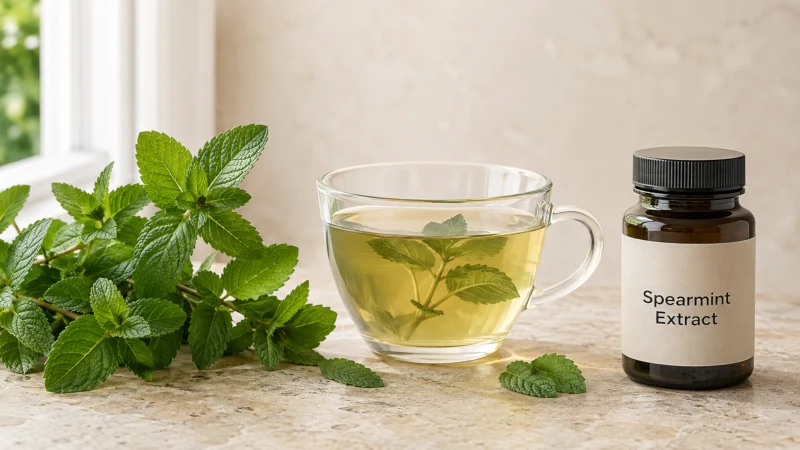
Spearmint has a few plausible, research-backed benefits, but the evidence is much narrower than long lists of herbal claims suggest. Small human trials have found changes in androgen levels in women with PCOS and hirsutism, improvements on some memory and attention tests with a standardized extract, and mixed improvement in knee-osteoarthritis symptoms with a high-rosmarinic-acid tea. Those findings are interesting, but they do not show that ordinary spearmint tea treats PCOS, arthritis, digestive disease, infection, fever, pneumonia, or cancer. The most useful way to think about the benefits of spearmint is to separate what has been tested in people from what remains traditional or preliminary.
What Is Spearmint?
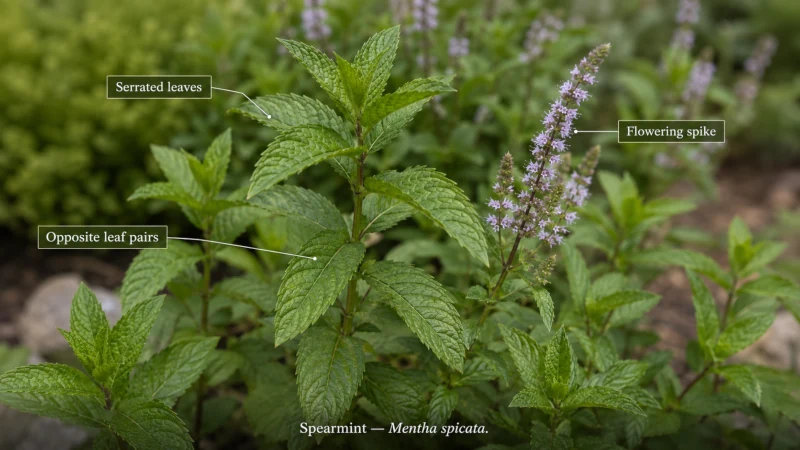
Spearmint is Mentha spicata, a perennial herb in the mint family. Royal Botanic Gardens, Kew lists Mentha spicata L. as the accepted species name. The older name Mentha viridis is treated as a synonym rather than a separate spearmint species. That distinction matters because older herbal references sometimes describe the two names as though they were different plants.
Spearmint and peppermint are related but not interchangeable. Peppermint has its own chemistry and a separate clinical evidence base, especially for enteric-coated peppermint oil. If digestive symptoms are your main concern, see the site’s peppermint benefits guide rather than assuming peppermint research proves the same effect for spearmint.
Benefits of Spearmint: Evidence at a Glance
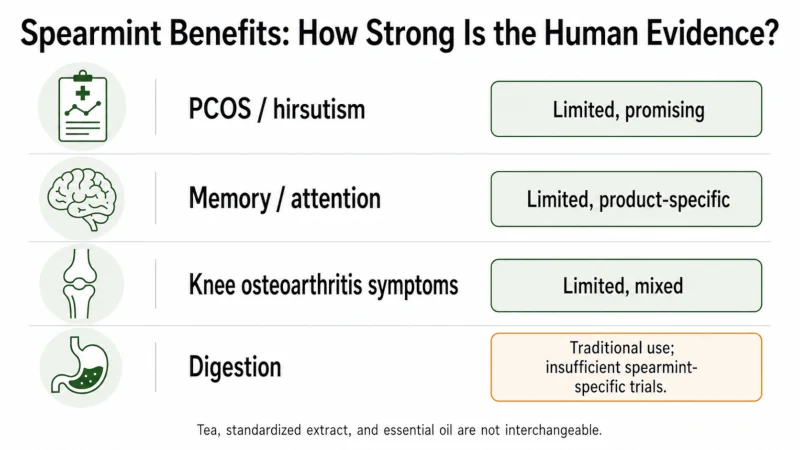
| Potential benefit | What human evidence shows | Evidence grade | Practical takeaway |
| PCOS-related hirsutism / androgen levels | One small 30-day RCT found lower free and total testosterone and improved self-reported hirsutism, but no significant objective hair-score change. | Limited, promising | Do not treat spearmint tea as a replacement for PCOS evaluation or established treatment. |
| Memory / attention | Two 90-day RCTs of a proprietary standardized extract found improvements in selected cognitive outcomes. | Limited, product-specific | Results apply to the studied extract, not automatically to tea or every supplement. |
| Knee osteoarthritis symptoms | One 16-week tea trial found some within-group improvements; several between-group outcomes were not significantly different. | Limited, mixed | Not enough evidence to recommend ordinary spearmint tea as arthritis treatment. |
| Digestion / nausea / gas | Traditional use is common, but modern clinical GI trials are mainly peppermint oil or other Mentha preparations. | Insufficient spearmint-specific evidence | A soothing cup is reasonable for many adults, but it is not a proven treatment for digestive disease. |
| Antioxidant / antimicrobial activity | Plant compounds show activity in laboratory or preclinical research. | Preclinical | Do not translate lab activity into claims that spearmint prevents or treats infection, cancer, or other diseases. |
The pattern is consistent: the more specific the claim, product, and population, the more useful the evidence becomes. A result from a standardized extract cannot simply be transferred to homemade tea, and a laboratory antioxidant finding is not the same as a proven health outcome in people.
1. Spearmint Tea May Lower Androgen Levels in Women With PCOS—but Evidence Is Limited
The most frequently cited human evidence for spearmint tea involves women with hirsutism related to polycystic ovary syndrome (PCOS). In a 30-day randomized controlled trial, 42 volunteers were assigned to spearmint tea twice daily or a placebo herbal tea; 41 completed the study. Free and total testosterone fell significantly in the spearmint group, and participants reported an improvement in hirsutism. However, the objective Ferriman-Gallwey hair-growth score did not improve significantly during the short trial [Grant, 2010].
What the 30-Day Trial Found
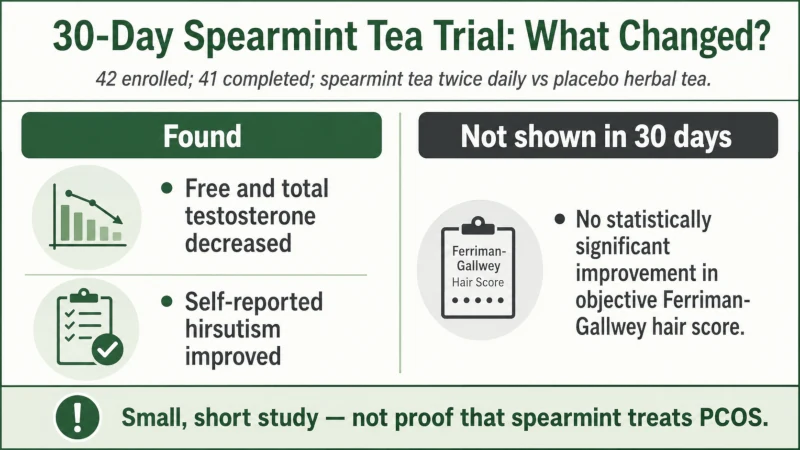
- Free and total testosterone decreased over the 30-day period in the spearmint-tea group.
- Self-reported hirsutism improved.
- Objective hair-growth scoring did not show a statistically significant difference between groups during the trial.
- The study was small and short, so it cannot establish long-term effectiveness or an ideal dose.
What It Did Not Prove
A change in a hormone measurement is not the same as proving that spearmint treats PCOS. PCOS is a complex condition that can involve irregular ovulation, metabolic risks, acne, excess hair growth, fertility concerns, and other symptoms. Current international guidance for PCOS discusses established options for hirsutism and encourages people using complementary therapies to tell their healthcare professional; spearmint is not presented as a standard first-line treatment [International PCOS Guideline, 2023].
If excess facial or body hair, irregular periods, acne, or fertility concerns are part of the reason you are considering spearmint, the site’s female disorders overview can help you frame the broader symptom picture. A medical evaluation is still important because similar symptoms can have causes other than PCOS.
2. Standardized Spearmint Extract May Support Memory and Attention
Two randomized trials have tested a proprietary, polyphenol-rich spearmint extract rather than ordinary tea. In one 90-day study of 90 adults with age-associated memory impairment, the 900 mg/day group improved on measures of quality of working memory and spatial working-memory accuracy compared with placebo [Herrlinger et al., 2018]. A separate 90-day trial in 142 healthy, recreationally active adults found improvements in sustained attention at days 30 and 90, with some earlier changes in complex attention; mood, sleep, and quality-of-life measures were not significantly different from placebo [Falcone et al., 2019].
These results are promising but product-specific. The studies used a standardized extract, and several authors were affiliated with the company associated with that extract. Industry involvement does not automatically make a study unreliable, but independent replication would strengthen confidence in the findings.
Why Extract Results Do Not Automatically Apply to Tea
A capsule containing a standardized amount of a plant extract is chemically different from a cup of tea. Growing conditions, processing, serving size, steeping time, and the specific cultivar can all change what ends up in the final product. NCCIH also cautions that supplements sold in stores or online may differ in important ways from the products used in research [NCCIH, 2020]. So it is reasonable to describe cognition as a potential benefit of a specific spearmint extract—not a proven effect of any spearmint tea or supplement.
3. High-Rosmarinic-Acid Spearmint Tea Has Limited Evidence for Knee Osteoarthritis Symptoms
A 16-week randomized, double-blind study compared tea made from a specially bred high-rosmarinic-acid spearmint with commercially available spearmint tea in adults with medically diagnosed knee osteoarthritis. Sixty-two people were randomized and data from 46 were analyzed. Pain decreased from baseline in the high-rosmarinic-acid group, while stiffness and physical-disability scores improved in both groups. Several between-group outcomes were not significantly different [Connelly et al., 2014].
That makes the evidence limited and mixed. The study does not establish ordinary grocery-store spearmint tea as an arthritis treatment, and it should not replace exercise, weight-management support when relevant, pain-management strategies, or medical care recommended for osteoarthritis.
4. Spearmint for Digestion: Traditional Use, but Direct Clinical Evidence Is Thin
Spearmint has a long traditional reputation for gas, cramping, nausea, and indigestion. The problem is that modern clinical research on digestive symptoms is dominated by peppermint oil, peppermint-and-caraway combinations, and other Mentha preparations—not plain spearmint tea. A 2025 systematic review of clinical trials across the Mentha genus found that most gastrointestinal studies used peppermint oil and concluded that more clinical trials are needed [Hirata et al., 2025].
So a cup of spearmint tea may be pleasant and may feel soothing, but “traditionally used for digestion” is a more accurate description than “proven to treat indigestion.” Persistent abdominal pain, vomiting, blood in the stool, unexplained weight loss, or symptoms that keep returning deserve medical evaluation rather than repeated self-treatment with herbs.
Spearmint Tea, Extract, and Essential Oil Are Not Interchangeable
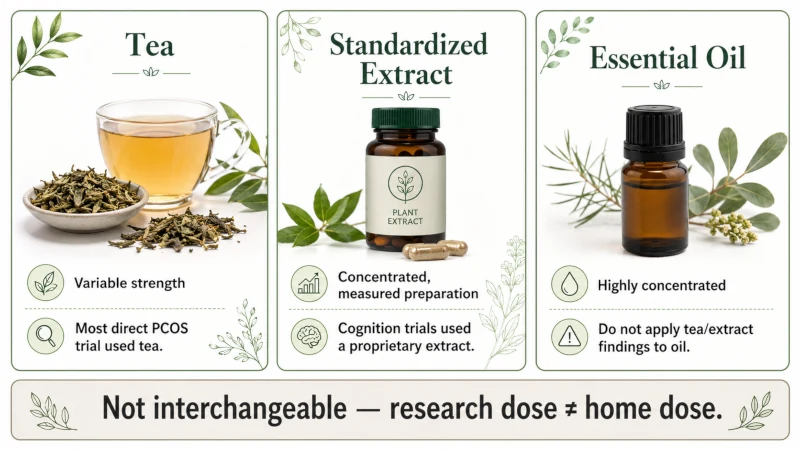
The word “spearmint” can refer to very different preparations. That makes form one of the most important details on a label or in a research paper.
| Form | What it is | What the evidence in this article can support |
| Culinary leaves / tea | Leaf material steeped or used in food; strength varies by product and preparation. | The 30-day PCOS/hirsutism study and 16-week osteoarthritis study used tea, but not necessarily the same tea sold at retail. |
| Standardized extract | A concentrated preparation manufactured to contain a defined composition or marker. | The cognition and 90-day tolerability studies used a specific proprietary dried aqueous extract. |
| Essential oil | A highly concentrated volatile-oil preparation. | The tea and extract findings in this article should not be applied to essential oil. |
This is also why old dosing charts that treat tea, tincture, fluid extract, powder, and essential oil as simple substitutes can be misleading. Modern human studies generally test one defined preparation under controlled conditions. Use the specific product label, and do not convert a research dose from one preparation into a home dose of another.
How to Use Spearmint More Safely
- For food or flavor: fresh or dried spearmint can be used as a culinary herb. This is a much lower and less concentrated exposure than a standardized supplement.
- For tea: if you enjoy spearmint tea, follow the package directions. Do not assume that the tea in a clinical trial had the same strength as a tea bag or homegrown infusion.
- For extracts or capsules: choose a product with a clear ingredient list and dose, and be cautious with broad claims such as “balances hormones” or “treats PCOS.” The site’s supplements hub provides broader buying and label-reading context.
- For essential oil: treat it as a concentrated product with a different safety profile. Do not use essential-oil research, tea research, and extract research interchangeably.
If you are shopping for concentrated products, see the site’s supplements and reviews hub for general quality and label-reading guidance.
Spearmint Side Effects, Interactions, and Who Should Be Cautious
Spearmint used as a food is not the same exposure as a medicinal-dose extract. In a 90-day randomized study, one dried aqueous spearmint extract at 600 or 900 mg/day was well tolerated, with no severe adverse events and no significant between-group differences in reported adverse effects [Lasrado et al., 2017]. That finding applies to that specific standardized extract and study duration; it does not prove that every spearmint supplement, essential oil, or high-dose preparation is equally safe.
Medication Interactions and Surgery
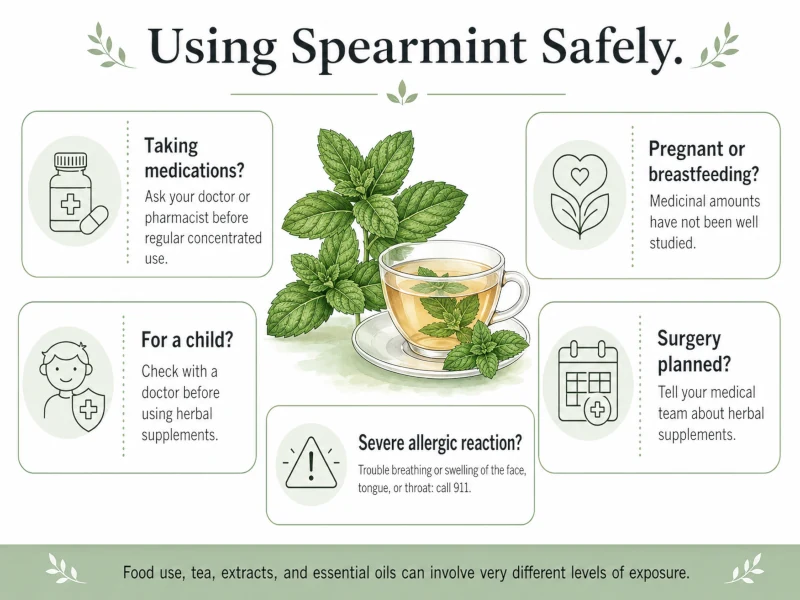
Spearmint-specific interaction data are limited. NCCIH notes more broadly that herbal supplements can interact with medicines and may pose risks for people with certain medical conditions or around surgery [NCCIH, 2020]. If you take prescription medication, use multiple supplements, have a chronic condition, or have surgery planned, ask your doctor or pharmacist before using a concentrated spearmint product regularly.
Pregnancy, Breastfeeding, and Children
Pregnancy and breastfeeding are situations where “natural” is not enough information. MotherToBaby notes that most herbal products have not been well studied during pregnancy or breastfeeding, while herbs used in food preparation in moderation are not expected to be a concern [MotherToBaby, 2025]. Because spearmint tea has shown hormone changes in a small human trial, medicinal or concentrated use during pregnancy, while trying to conceive, or while breastfeeding is best discussed with your doctor. NCCIH also notes that many dietary supplements have not been tested in children [NCCIH, 2020].
When to Get Urgent Medical Help
Stop using a spearmint product if you develop a concerning reaction. Trouble breathing or swallowing, fainting, or swelling of the face, tongue, or throat can be signs of a severe allergic reaction. Anaphylaxis is a medical emergency—call 911 [MedlinePlus, 2026].
| HEALTH DISCLAIMER: This article is for general education and information only. It does not diagnose, treat, cure, or prevent any disease and is not a substitute for medical advice. If you are pregnant or breastfeeding, giving an herbal product to a child, taking medication, preparing for surgery, managing a chronic condition, or considering spearmint for PCOS or another medical concern, talk with your doctor or pharmacist before using a concentrated tea, extract, tincture, or essential-oil product. Seek prompt medical care for severe, persistent, or worsening symptoms. |
Frequently Asked Questions
What are the main benefits of spearmint?
The best human evidence is limited but includes short-term changes in androgen levels in women with PCOS/hirsutism, improvements in some memory and attention tests with a proprietary standardized extract, and mixed symptom improvement in one knee-osteoarthritis tea trial. Digestive use is traditional, but direct spearmint-specific clinical evidence is thin.
Does spearmint tea lower testosterone?
A small 30-day randomized trial found lower free and total testosterone in women with PCOS-related hirsutism who drank spearmint tea twice daily. The trial was short, and objective hair-growth scores did not improve significantly, so this should not be treated as proof that spearmint is a PCOS treatment.
Is spearmint tea proven to treat PCOS?
No. Spearmint tea has limited preliminary evidence for changing androgen levels, but PCOS is a broader endocrine and metabolic condition. Current evidence-based PCOS guidance does not establish spearmint as a first-line treatment.
Is spearmint good for digestion?
What is the difference between spearmint and peppermint?
Spearmint is Mentha spicata. Peppermint is a different mint with its own chemistry and clinical evidence. Research on peppermint oil—especially for digestive conditions—should not be automatically applied to spearmint.
Is it safe to drink spearmint tea every day?
There is no universal evidence-based daily dose for every person or product. Ordinary tea and food use are less concentrated than extracts, but long-term medicinal use has not been well studied across all populations. People who are pregnant or breastfeeding, take medicines, have chronic conditions, or are giving herbs to children should discuss regular medicinal use with a doctor or pharmacist.
References
- Royal Botanic Gardens, Kew. “Mentha spicata L.” Plants of the World Online. Accessed August 23, 2026. View source
- Royal Botanic Gardens, Kew. “Mentha viridis (L.) L.” Plants of the World Online. Accessed August 23, 2026. View source
- Grant P. “Spearmint herbal tea has significant anti-androgen effects in polycystic ovarian syndrome. A randomized controlled trial.” Phytotherapy Research. 2010;24(2):186-188. PMID 19585478. DOI 10.1002/ptr.2900. View source
- Teede HJ, et al. “Recommendations From the 2023 International Evidence-based Guideline for the Assessment and Management of Polycystic Ovary Syndrome.” Journal of Clinical Endocrinology & Metabolism. 2023. DOI 10.1210/clinem/dgad463. View source
- Herrlinger KA, et al. “Spearmint Extract Improves Working Memory in Men and Women with Age-Associated Memory Impairment.” Journal of Alternative and Complementary Medicine. 2018;24(1):37-47. PMID 29314866. PMCID PMC5779242. DOI 10.1089/acm.2016.0379. View source
- Falcone PH, et al. “The attention-enhancing effects of spearmint extract supplementation in healthy men and women: a randomized, double-blind, placebo-controlled, parallel trial.” Nutrition Research. 2019;64:24-38. PMID 30802720. DOI 10.1016/j.nutres.2018.11.012. View source
- Connelly AE, et al. “High-rosmarinic acid spearmint tea in the management of knee osteoarthritis symptoms.” Journal of Medicinal Food. 2014;17(12):1361-1367. PMID 25058311. PMCID PMC4259186. DOI 10.1089/jmf.2013.0189. View source
- Hirata M, et al. “Investigating the Health Potential of Mentha Species Against Gastrointestinal Disorders—A Systematic Review of Clinical Evidence.” Pharmaceuticals. 2025;18(5):693. PMID 40430512. PMCID PMC12114791. DOI 10.3390/ph18050693. View source
- Lasrado JA, et al. “Safety and tolerability of a dried aqueous spearmint extract.” Regulatory Toxicology and Pharmacology. 2017;86:167-176. PMID 28286189. DOI 10.1016/j.yrtph.2017.03.005. View source
- National Center for Complementary and Integrative Health. “Dietary and Herbal Supplements.” Last updated February 2020; accessed August 23, 2026. View source
- MotherToBaby. “Herbal Products.” April 1, 2025. Accessed August 23, 2026. View source
- MedlinePlus Medical Encyclopedia. “Anaphylaxis.” Reviewed/updated 2026; accessed August 23, 2026. View source
