
If a seed packet, a bag of dried tea, and a 400-year-old herbal all mention Jerusalem sage, there is a fair chance they mean different plants. Two unrelated species carry the name. They sit in different botanical families, look nothing alike, and have completely different safety profiles.
The plant that old European herbals called Jerusalem sage is Pulmonaria officinalis — known today as common lungwort, a low woodland perennial in the borage family with white-spotted leaves. The plant sold in almost every North American garden center as Jerusalem sage is Phlomis fruticosa, a woolly, yellow-flowered Mediterranean shrub in the mint family.
Here is the honest headline before you read further: neither plant has been tested in a human clinical trial for any health condition. Lungwort’s traditional uses are real and thoroughly documented, but documented use is not demonstrated benefit. And because lungwort belongs to a plant family known for liver-toxic compounds, its safety questions deserve more of your attention than its benefit claims do.
Two plants, one name
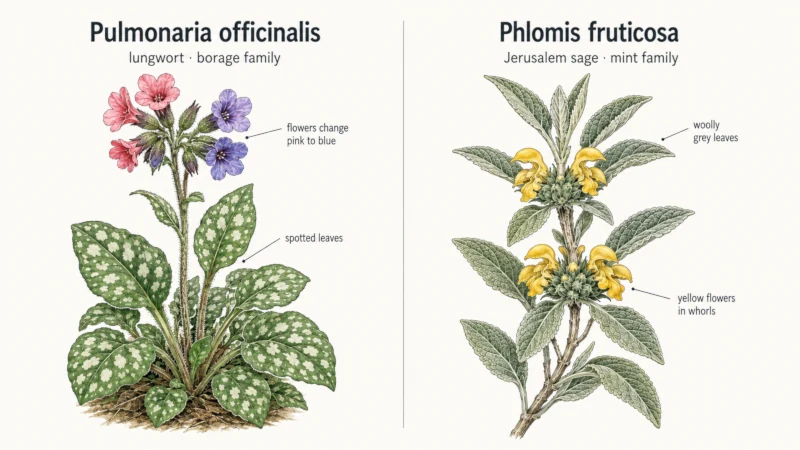
| Lungwort — the herbal one | Phlomis — the garden one | |
| Botanical name | Pulmonaria officinalis | Phlomis fruticosa |
| Family | Boraginaceae (borage) | Lamiaceae (mint) |
| What it looks like | Low woodland perennial, roughly a foot tall; oval leaves with white or pale-green spots; flowers open pink and turn violet-blue | Shrub 2–4 ft tall; woolly grey-green leaves; whorls of hooded bright-yellow flowers |
| Other common names | Lungwort, Jerusalem cowslip, spotted dog, soldiers-and-sailors | Simply Phlomis; sometimes shared with related species |
| Traditional medicinal use | Yes — coughs, sore throat, and catarrh in European folk medicine | Essentially none in the Western herbal record |
| Human clinical trials | None | None |
Health Canada’s regulatory monograph for lungwort lists “Jerusalem-sage” and “Jerusalem cowslip” among its accepted common names [Health Canada monograph on lungwort, 2025]. Missouri Botanical Garden’s plant database gives Jerusalem sage as the common name for Phlomis fruticosa[Missouri Botanical Garden Plant Finder]. Both are correct, which is exactly the problem.
If you have dried leaf in a bag and you are thinking about tea, everything below is about lungwort. If you have a shrub with yellow flowers in your yard, skip ahead to the section on Phlomis.
Where lungwort’s reputation came from
The name is a fossil of medieval medical reasoning. Lungwort’s leaves are dappled with pale spots, and physicians working under the doctrine of signatures — the belief that a plant’s appearance advertises its purpose — decided the spots resembled diseased lung tissue. The German botanist Leonhart Fuchs gave the genus its Latin name from pulmo, lung. Linnaeus later added officinalis, the marker for plants used in medicine [Chauhan et al., Applied Sciences, 2022].
So the entire reputation rests on a visual resemblance, not on anyone observing that the plant helped. That does not automatically make it useless — plenty of effective remedies were found by accident and rationalized afterward. But it does mean the tradition offers no evidence of its own, and everything has to be judged on what has been measured since.
What has been measured is modest. Health Canada permits lungwort leaf to be sold with traditional-use claims: as an expectorant for the symptoms of bronchitis and upper-respiratory mucus, as a demulcent for sore throat, as an astringent for diarrhea, and as a mild diuretic [Health Canada monograph on lungwort, 2025]. Read that carefully — it is a Canadian labelling permission based on documented historical use, not a finding that the plant works, and it carries no weight with US regulators.
Evidence rating: Traditional use — recognized in Canada for symptom relief on the basis of history, with no clinical trials behind it.
What the research actually shows
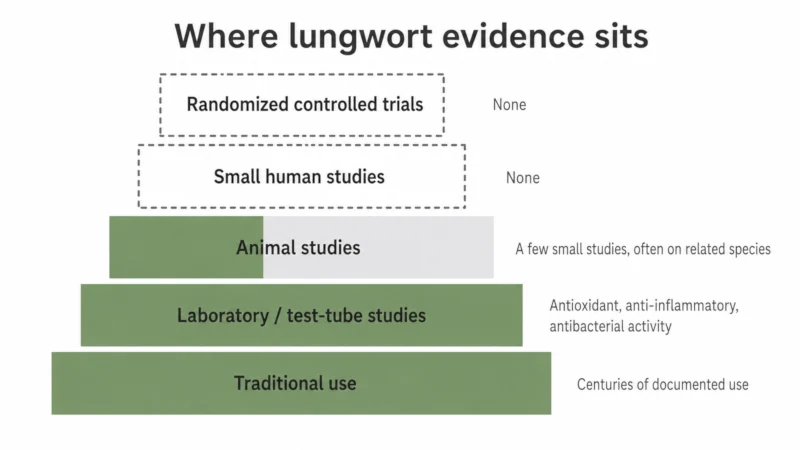
A 2022 review pulled together everything published on the genus. It catalogued more than 90 compounds — rosmarinic acid, chlorogenic acid, flavonoids, allantoin, mucilage, tannins — and summarized the biological work done on extracts. Its own conclusion is the most useful line in it: safety studies and clinical trials are missing for lungwort [Chauhan et al., Applied Sciences, 2022].
Here is what the individual findings amount to, and what each one is worth.
| What was studied | What was found | What kind of evidence |
| Antioxidant activity | Extracts scavenged free radicals in several test-tube assays; a compound called yunnaneic acid B was isolated as one contributor | In vitro only |
| Anti-inflammatory activity | Extracts inhibited COX-2, an inflammation enzyme, in laboratory assays and computer modelling | In vitro and in silico |
| Antibacterial activity | Methanol extract inhibited Staphylococcus aureus at 1–2 mg/mL — the researchers themselves describe this as not highly effective — though it did reduce bacterial adhesion and toxin release | In vitro only |
| Anti-anemic effect | An extract of a related species restored hemoglobin in iron-deficient rats | Animal, different species |
| Anticoagulant effect | Extract fractions reduced clotting activity in animal experiments | Animal, preliminary |
| Anticonvulsant effect | An extract of a related species altered brain activity in one rat model of epilepsy | Single animal study |
| Wound healing | Lungwort was one of three plants in an experimental wound dressing gel | Lab, combination product |
Two things are worth noticing. Several of the more interesting results come from related species rather than lungwort itself — a distinction that matters, as the safety section explains. And not one of these findings has been followed into a human study.
Evidence rating: Insufficient — plausible laboratory activity, nothing tested in people.
What Jerusalem sage cannot do
Some claims circulate about this plant that need answering directly, because acting on them causes harm.
It is not a treatment for tuberculosis, and it should not be used alongside one. Active TB is cured by a specific combination of antibiotics taken for four, six, or nine months depending on the regimen, and finishing that course exactly as prescribed is what prevents relapse and drug resistance [CDC on treating tuberculosis, 2025]. Adding an unstudied herb to that treatment introduces an unknown interaction risk for no established benefit. If TB is a possibility for you, that is a same-day medical conversation, not a tea.
It does not undo damage from smoking. No plant has been shown to clear tar, repair air sacs, or reverse lung damage. Quitting does more than any herb, and the benefits begin quickly. Our guide to herbs for the lungs sorts through which respiratory plants have real evidence behind them and which do not.
It is not a substitute for asthma or COPD medication. If you have a diagnosed lung condition, herbal additions belong in a conversation with the doctor managing your care — before you start, not after.
The safety question: lungwort and the borage family
This is the part of the story that older herbals leave out, and it is the reason to be careful.
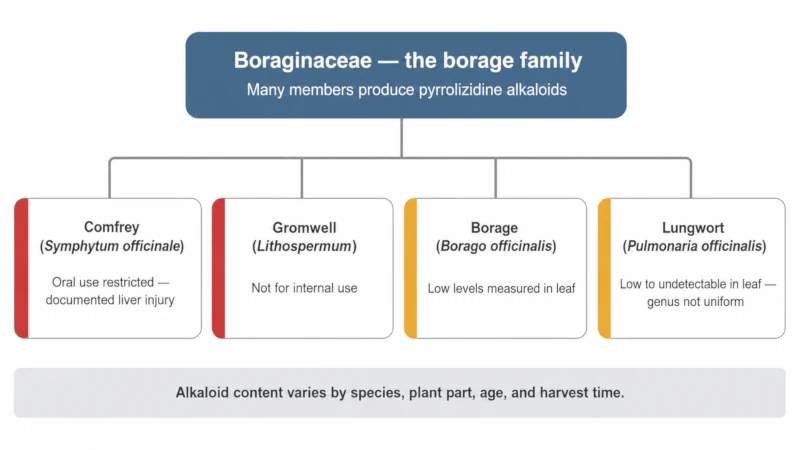
Lungwort belongs to the Boraginaceae, the plant family that includes comfrey, borage, and gromwell. Many members produce pyrrolizidine alkaloids (PAs) — compounds the liver converts into reactive metabolites that damage the cells lining small hepatic blood vessels. The result can be sinusoidal obstruction syndrome, a blockage of those vessels that at its worst progresses to liver failure. PAs have also been linked to liver cancer in animals, and infants are especially susceptible [NIH LiverTox on comfrey and pyrrolizidine alkaloids, 2022]. That is why oral comfrey was pulled from the US market and why gromwell carries the same warning.
The evidence on lungwort specifically is genuinely mixed
Sources disagree here, and it would be misleading to pick whichever answer sounds better.
- A 1984 Swiss analysis is repeatedly cited as finding no detectable PAs in samples of Pulmonaria officinalis [Lüthy et al., Pharmaceutica Acta Helvetiae, 1984]. The 2022 review reflects this, describing P. officinalis as considered PA-free.
- A 2002 study of the related Pulmonaria obscura found PAs of the lycopsamine type concentrated in roots and rhizomes, with only trace amounts in leaves and flowering parts [Haberer et al., Planta Medica, 2002]. Two of the alkaloids identified — intermedine and lycopsamine — are the same ones that appear in comfrey.
So the reasonable summary is this: the leaf of P. officinalis appears to be low in or free of these compounds, at least in the samples that have been tested. But the genus is not uniform, Pulmonaria species are hard to tell apart, and PA content varies with the plant part, its age, and when it was harvested [NIH LiverTox, 2022]. A bag of dried leaf bought online does not come with a species confirmation or an alkaloid assay.
A documented poisoning — and what it was really about
In 2007, Spanish physicians described three members of one family — a man of 76, his 42-year-old daughter, and his 14-year-old granddaughter — who developed anticholinergic poisoning after drinking an infusion made from Pulmonaria officinalis for a cold. Symptoms included dry mouth, blurred vision, urinary retention, dilated pupils, disorientation, and visual hallucinations. The teenager was hospitalized and recovered with supportive care. Because she kept drinking the infusion, doctors were able to trace the source and retrospectively diagnose the other two, one of whom had initially been assessed for new-onset dementia [Baca-García et al., European Journal of Psychiatry, 2007].
The authors are explicit that lungwort itself has no known atropine-like properties and conclude the infusion was almost certainly contaminated with another plant. The family told doctors they had not mentioned the tea because they assumed a natural remedy could not cause harm. That assumption is the actual lesson: with loose herbal material, what is in the bag is a real variable, and it is the one you cannot see.
Who should not use it
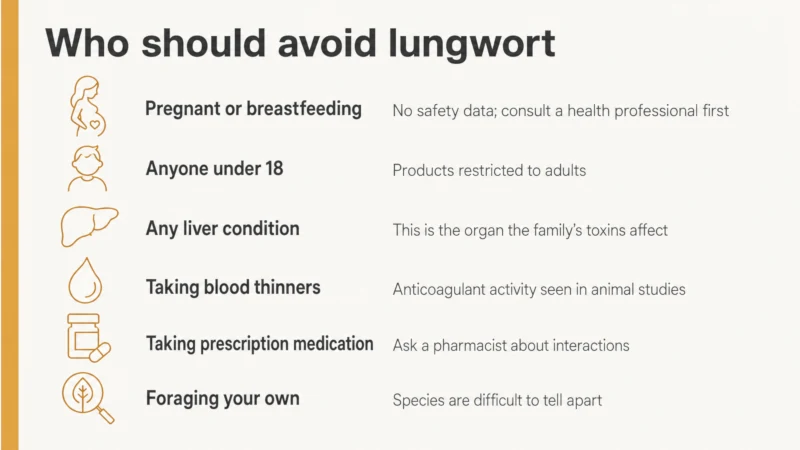
| If this is you | What to do |
| Pregnant or breastfeeding | Avoid. Health Canada’s monograph directs users to consult a health professional before use in pregnancy or breastfeeding, and pyrrolizidine alkaloids as a class can reach a fetus and appear in breast milk. |
| Under 18 | Avoid. The Canadian monograph restricts lungwort products to adults 18 and older. |
| Any liver condition, or heavy alcohol use | Avoid. This is the organ the family’s known toxins affect. |
| Taking a blood thinner | Talk to a pharmacist or doctor first. Extracts have shown anticoagulant activity in animal experiments, so the theoretical interaction is worth raising. |
| Taking any prescription medication | Mention it to your pharmacist. Herbal products are not screened for interactions before sale. |
| Foraging it yourself | Don’t. Pulmonaria species are difficult to distinguish, and the species differ in alkaloid content. |
Side effects reported with ordinary use are mild. The Canadian monograph notes that a diuretic effect may occur, which mainly means more trips to the bathroom. Contact with the plant’s bristly leaves irritates some people’s skin. Serious harm, where it has been documented, has come from contaminated material rather than from lungwort itself.
If you decide to use it anyway
Some readers will want to try it regardless, and the practical details matter more than a blanket warning.
- Dose. Health Canada’s monograph sets 2 to 4 grams of dried leaf, up to three times a day, for adults 18 and over, with diuretic use limited to occasional only [Health Canada monograph on lungwort, 2025]. Older herbals list considerably stronger decoctions; those figures do not trace back to any regulatory or clinical source, so they are not repeated here.
- Buy, don’t forage. Choose a supplier that names the species on the label and publishes third-party testing. In the US, FDA is not authorized to approve dietary supplements for safety or effectiveness before they reach the market [FDA on using dietary supplements], so the manufacturer’s own quality controls are what stand between you and a mislabelled bag.
- Keep it short. Days, not months. Sustained daily use is where nearly all documented harm from PA-containing plants sits.
- Tell your pharmacist. Especially before surgery, and especially if you take anything regularly.
- Consider a better-documented option. If what you want is something soothing for a dry, scratchy cough, mullein does the same demulcent job, has EU regulatory recognition for that specific use, and carries none of the borage-family baggage.
The other Jerusalem sage: Phlomis fruticosa
If your Jerusalem sage is the shrub, the picture is simpler. Phlomis fruticosa is a Mediterranean evergreen in the mint family, grown for its silver-grey foliage and tiered whorls of yellow flowers [Missouri Botanical Garden Plant Finder]. The leaves smell faintly of sage when crushed, but it is not a sage and is not used as one.
Laboratory work on the Phlomis genus has found a rich polyphenol profile — verbascoside, rosmarinic acid, forsythoside A, caffeoylquinic acids — with measurable antioxidant activity in test-tube assays. The researchers behind one of the larger 2025 analyses describe the genus’s therapeutic applications as underexplored [Gheibi et al., Scientific Reports, 2025], which is a fair summary. There is no established medicinal use for the shrub, no dose, and no human data. Enjoy it as a drought-tolerant garden plant that bees like. Don’t brew it.
Evidence rating: Insufficient — interesting plant chemistry, no medicinal application established in people.
When to stop self-treating and get medical care

A cough is usually nothing. Sometimes it isn’t, and the difference is worth knowing.
Call 911 or go to an emergency room now if you have:
- Severe difficulty breathing, or breathlessness at rest
- Blue or grey lips, face, or fingertips
- Chest pain or tightness along with breathlessness
- Confusion or difficulty staying awake
Be seen the same day — urgent care or your doctor’s office:
- Coughing up blood, even a small amount
- High fever with a productive cough and feeling genuinely unwell
- Yellowing of the skin or eyes, dark urine, persistent nausea, or pain in the upper-right abdomen after taking any herbal product — these can signal liver injury, and they should not be waited out
- Symptoms that improved and then clearly turned worse
Book with your primary care provider within a few days for:
- A cough lasting more than three weeks
- Unexplained weight loss, night sweats, or drenching fevers
- Repeated chest infections
A persistent cough has a long list of possible causes — infection, reflux, medication side effects, asthma, clots, and tumors among them. None of that can be sorted out from a tea cabinet.
| HEALTH DISCLAIMER: This article is for general education and information. It is not medical advice, it is not a diagnosis, and it is not a recommendation to use Jerusalem sage — under either botanical name — for any condition. Nothing here is intended to diagnose, treat, cure, or prevent disease. Talk to a doctor, pharmacist, or registered dietitian before starting any herbal product, particularly if you are pregnant or breastfeeding, caring for a child, taking prescription medication, or living with a liver condition. Herbal products in the United States are not reviewed for safety or effectiveness before they are sold, and “natural” describes where a compound came from, not how safely it behaves. Seek immediate medical care for severe breathing difficulty, chest pain, coughing up blood, or bluish lips or skin. |
Frequently Asked Questions
Is Jerusalem sage the same thing as lungwort?
It can be. Jerusalem sage is one of several old common names for Pulmonaria officinalis, the plant usually called lungwort today. Confusingly, the same name is also the standard common name for Phlomis fruticosa, an unrelated Mediterranean shrub. Check the botanical name on the label or plant tag — that is the only reliable way to know which one you have.
Is lungwort tea safe to drink?
For a healthy adult, occasional use at ordinary amounts has no documented pattern of harm, and Health Canada permits it as a traditional herbal product for adults 18 and older. The real risks are indirect: lungwort belongs to a plant family known for liver-toxic alkaloids, related species do contain them, and a documented poisoning was traced to a contaminated lungwort infusion. Avoid it entirely in pregnancy, in children, and with any liver condition.
Does Jerusalem sage help with tuberculosis?
No. Active TB is treated with a specific antibiotic regimen taken for four to nine months, and completing it as prescribed is what cures the infection and prevents drug resistance. There is no evidence that any herb helps, and adding an untested one to TB treatment risks interactions with the medications doing the actual work. Suspected TB needs urgent medical assessment.
What is the difference between lungwort the plant and lungwort the lichen?
They are entirely different organisms that ended up sharing a name. Pulmonaria officinalis is a flowering plant in the borage family. Lobaria pulmonaria is a lichen. Both picked up the name from the doctrine of signatures, and both appear in old herbals, sometimes in the same paragraph. Neither has clinical evidence behind it, but they are not interchangeable and their safety profiles are not the same.
Can I use the Phlomis shrub from my garden to make tea?
There is no reason to. Phlomis fruticosa has no meaningful history of medicinal use in Western herbalism, no established preparation or dose, and no human safety data. Laboratory studies have found antioxidant compounds in the genus, which is a long way from a reason to drink it.
Are there better-evidenced options for a cough?
Yes, though the bar across this whole category is low. For children over 12 months, honey has the strongest trial evidence of anything commonly used at home. Mullein flower has EU regulatory recognition for sore throat with a dry cough. Neither treats an underlying illness, but both are better supported than lungwort and neither raises the borage-family question.
References
- Health Canada, Natural and Non-prescription Health Products Directorate. “Lungwort — Pulmonaria officinalis, Oral.” Natural Health Product monograph, December 19, 2025. → View source
- Chauhan S, Jaiswal V, Cho Y-I, Lee H-J. “Biological Activities and Phytochemicals of Lungworts (Genus Pulmonaria) Focusing on Pulmonaria officinalis.” Applied Sciences, 2022;12(13):6678. DOI: 10.3390/app12136678. → View source
- Haberer W, Witte L, Hartmann T, Dobler S. “Pyrrolizidine alkaloids in Pulmonaria obscura.” Planta Medica, 2002;68(5):480–482. DOI: 10.1055/s-2002-32088 (PMID 12058336). → View source
- Lüthy J, Brauchli J, Zweifel U, Schmid P, Schlatter C. “Pyrrolizidine alkaloids in medicinal plants of Boraginaceae: Borago officinalis L. and Pulmonaria officinalis L.” Pharmaceutica Acta Helvetiae, 1984;59(9–10):242–246 (PMID 6483923). Article in German. → View source
- Baca-García E, Blasco-Fontecilla H, Blanco C, Díaz-Sastre C, Pérez-Rodríguez MM, Sáiz-Ruiz J. “Acute atropine intoxication with psychiatric symptoms by herbal infusion of Pulmonaria officinalis (Lungwort).” The European Journal of Psychiatry, 2007;21(2):93–97. → View source
- National Institute of Diabetes and Digestive and Kidney Diseases. “Comfrey.” LiverTox: Clinical and Research Information on Drug-Induced Liver Injury. Updated May 24, 2022. Bookshelf ID NBK548370. → View source
- Centers for Disease Control and Prevention. “Treating Tuberculosis.” CDC, updated April 17, 2025. → View source
- U.S. Food and Drug Administration. “Information for Consumers on Using Dietary Supplements.” FDA. → View source
- Gheibi SA, Alirezalu A, Shirzad H, Iaccarino N, Romano F, Amato J, Alipour H. “Phytochemical profiling, antioxidant potential, and UHPLC-HRMS analysis of Phlomis genus aerial parts for therapeutic applications.” Scientific Reports, 2025;15:6732. DOI: 10.1038/s41598-025-89055-4 (PMC11861611). → View source
- Missouri Botanical Garden. “Phlomis fruticosa.” Plant Finder database. → View source
