
If you came here because you read that gromwell dissolves kidney stones or works as a natural contraceptive, here’s the honest version before you brew anything: those reputations are old, the evidence behind them is thin or strictly preclinical, and the plant belongs to a family known for toxins that can damage your liver. The real, modern interest in gromwell isn’t a tea you drink at all — it’s a red pigment called shikonin that’s used on the skin.
That doesn’t make gromwell uninteresting. It has a genuine place in herbal history and some real pharmacology. It just needs to be talked about carefully.
“Gromwell” is actually three different plants
A lot of confusion about gromwell comes from the name covering several species in the Lithospermum genus, all in the borage family (Boraginaceae). They are not interchangeable.
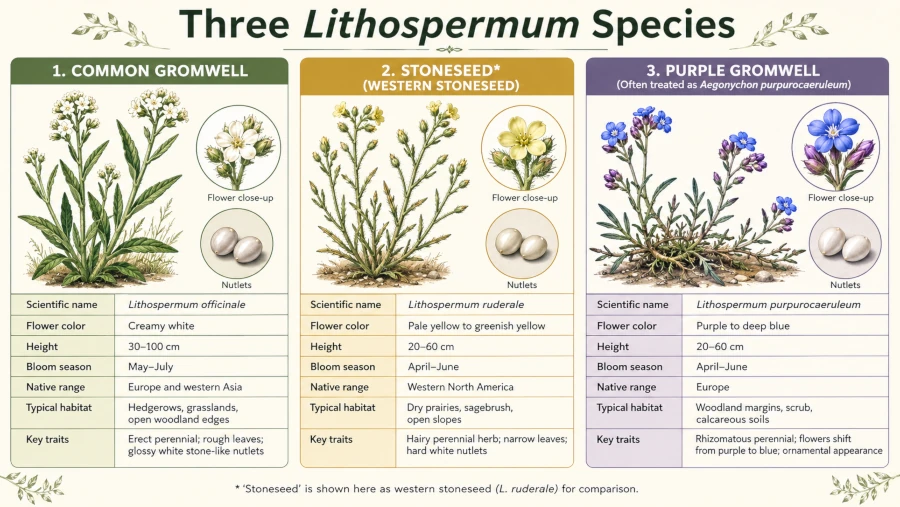
- Common (European) gromwell — Lithospermum officinale. The plant in most old European herbals, with hard, pearly seeds. This is the one tied to the kidney-stone folklore.
- Stoneseed — Lithospermum ruderale. A North American species used by some Indigenous peoples, and the one studied for effects on reproductive hormones.
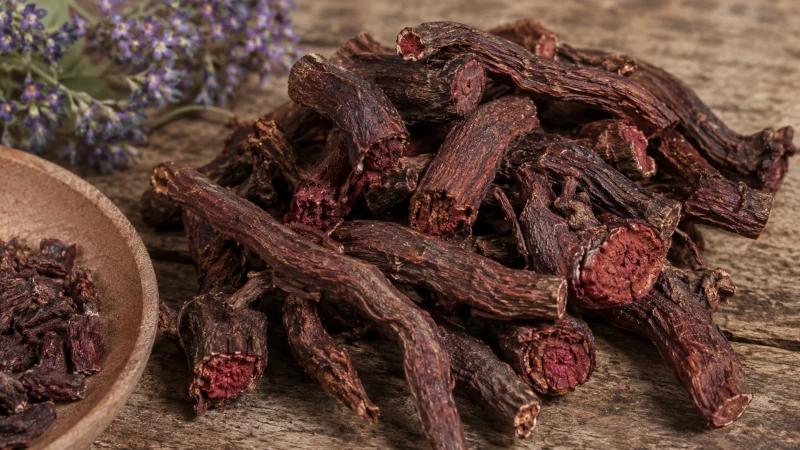
- Purple or red gromwell — Lithospermum erythrorhizon, known as zicao in Chinese medicine and shikon in Japanese. Its dark-red root is the source of shikonin and is the only one with a meaningful modern research base — almost all of it about the root used topically.
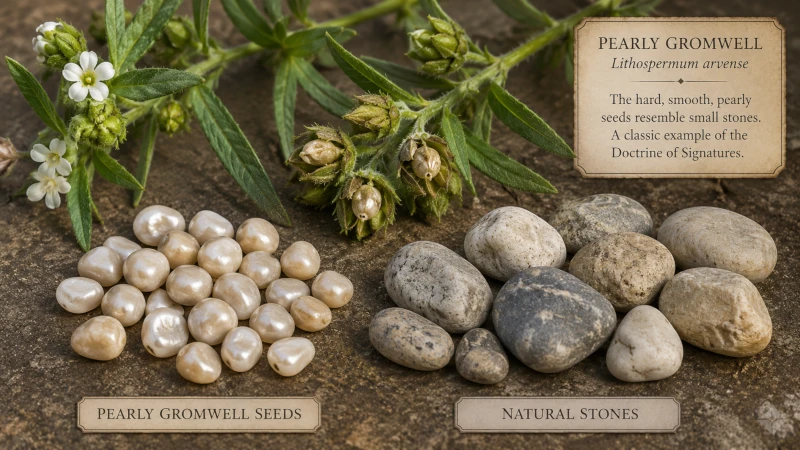
The name itself hints at the oldest claim. Lithospermum comes from the Greek for “stone seed,” and the seeds really do look like tiny polished pebbles. That resemblance is where a lot of this story begins.
Quick botanical facts
| Family | Boraginaceae (borage family) |
| Common species | L. officinale (common gromwell), L. ruderale (stoneseed), L. erythrorhizon (purple/red gromwell, zicao) |
| Other names | Common gromwell; herbe aux perles (French); mijo de sol (Spanish) |
| Habitat | Common gromwell grows in chalky soils across Europe; uncommon in North America |
| Parts used | Seeds and leaves (European tradition); root (East Asian tradition) |
| Active compounds of interest | Shikonin and derivatives (root); lithospermic acid and other polyphenols |
What gromwell was traditionally used for
The kidney-stone story
The idea that gromwell breaks up kidney stones is genuinely ancient — the Greek physician Dioscorides recommended the seeds for stones nearly two thousand years ago. But the reasoning behind it is worth knowing, because it tells you how much weight to give it. The belief grew out of the doctrine of signatures, the old notion that a plant’s appearance reveals its medical use. The seeds look like little stones, so they were assumed to dissolve stones. That’s an aesthetic argument, not a clinical one.
There’s no reliable human evidence that gromwell seeds or leaves dissolve kidney stones or “sand” in the urine. If you’re dealing with stones, the things with actual evidence behind them are unglamorous — staying well hydrated, adjusting diet depending on stone type, and following your doctor’s guidance. A gromwell infusion isn’t a substitute, and given the liver concerns below, it isn’t a harmless thing to experiment with either. (If you’re trying to lower your risk through diet, our guide to foods that can contribute to kidney stones is a more practical starting point.)
Gout, “diuretic” claims, and digestion
Older herbals also recommended gromwell for gout and renal colic, describing it as a uricosuric diuretic — something that helps the body clear uric acid. And because the plant has a sour note, it was used as a bitter to wake up the appetite and support digestion.
These are traditional uses, not demonstrated effects. The plant’s hard seeds are high in silica and mineral content, which is partly why they’re so stony, but mineral content in a seed doesn’t translate into a treatment for gout or stones. Treat these as folklore the herb carried, not as reasons to take it.
What modern research on gromwell health benefits actually shows
Two threads of real science run through gromwell, and it helps to keep them separate from the folklore.
Shikonin and the skin — the strongest evidence
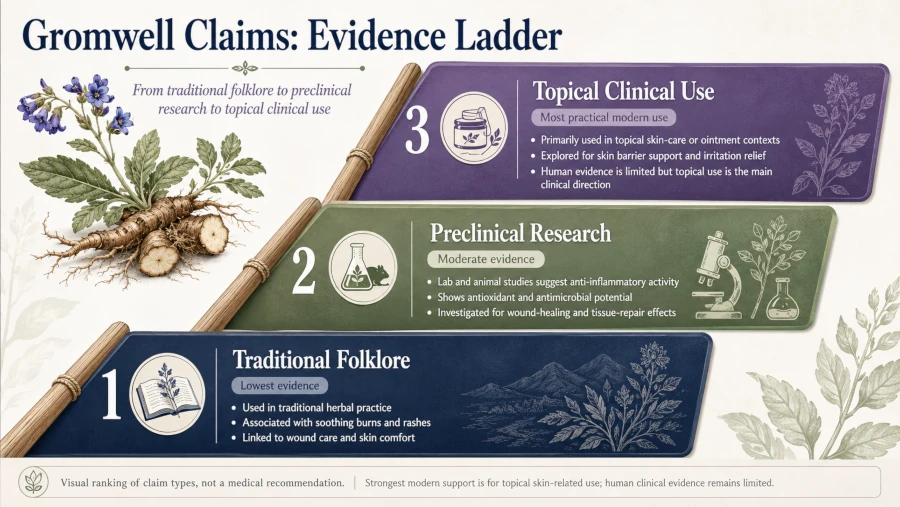
The purple-rooted species, L. erythrorhizon (zicao), has been used in Chinese and Japanese medicine for centuries to treat burns, cuts, rashes, and other skin problems, and it’s still part of standardized topical preparations — zicao ointment appears in the Chinese Pharmacopoeia [Pharmacol Res review, 2019]. The active compounds are shikonin and its derivatives, the red naphthoquinone pigments in the root.
In laboratory and animal studies, shikonin shows anti-inflammatory, antimicrobial, and wound-healing activity, and it’s being investigated for skin conditions like eczema and psoriasis as well as for anticancer effects [shikonin skin-repair review, 2023]; [L. erythrorhizon psoriasis systematic review, 2022]. This is promising, but read the fine print: most of it is preclinical (cells and animals) or based on traditional topical formulas, not large human trials of gromwell taken by mouth. The reasonable summary is that shikonin from purple gromwell is an interesting topical compound under active study — not a proven oral medicine.
The hormone research — interesting, but preclinical
Stoneseed (L. ruderale) earned a reputation as a folk contraceptive, and unlike the kidney-stone claim, this one did get into the lab. Extracts were shown decades ago to suppress the release of luteinizing hormone (LH) in cell cultures and to disrupt the reproductive cycle in mice and other animals, with the activity traced to a polyphenol called lithospermic acid [Findley, 1980]; [Findley, 1981].
Here’s the honest framing. That work is real, but it’s from the 1940s through the 1980s, and it’s almost entirely in vitro and in animals. There are no human trials establishing gromwell as a contraceptive, no usable dose, and no safety data for that purpose. Using it as birth control would be both unreliable and — because of the liver issue below — genuinely risky. It’s a scientific curiosity, not a method.
The pyrrolizidine alkaloid problem: gromwell and your liver
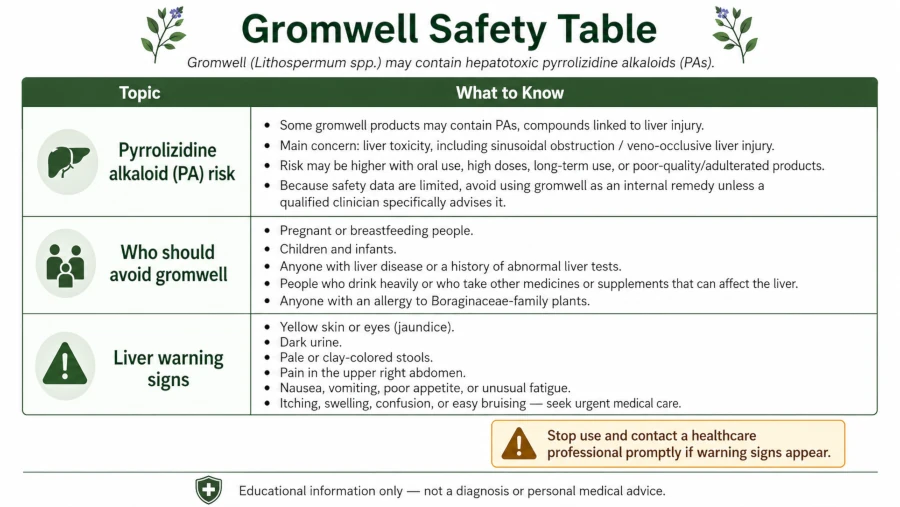
Gromwell belongs to the Boraginaceae family, which is one of the main plant families that produce pyrrolizidine alkaloids (PAs) — and Lithospermum species are among the more PA-heavy members [Toxins review, 2021]. Many PAs are hepatotoxic: the liver converts them into reactive compounds that damage liver cells and can block the small veins in the liver, causing a serious condition called hepatic sinusoidal obstruction syndrome (formerly veno-occlusive disease). Some are also linked to cancer in animal studies [NIH LiverTox]; [Toxins review, 2021].
You can see how seriously regulators take this family by looking at comfrey, another Boraginaceae herb. In 2001 the U.S. FDA advised supplement makers to pull comfrey products — and explicitly any other product that is “a source of pyrrolizidine alkaloids” — off the market because of liver-damage reports [FDA, 2001]; [MSKCC]. The American Herbal Products Association recommends that PA-containing botanicals be labeled for external use only. Gromwell sits squarely in that cautionary category, which is why the old advice to drink a strong seed-and-leaf infusion several times a day is exactly the kind of thing to avoid.
The practical takeaway: don’t take gromwell internally as a home remedy. If you ever consider any Lithospermum product, the species, the dose, and the PA content all matter, and that’s a conversation for a qualified professional — not a brew-it-yourself decision.
Who should not use gromwell at all
- Anyone who is pregnant or breastfeeding. PAs can cross the placenta and appear in breast milk, and they’re associated with birth defects in research on this class of compounds. Avoid completely.
- Infants and children. Their livers are especially vulnerable to PAs.
- Anyone with liver disease or who drinks heavily.
- Anyone taking medications processed by the liver — including many prescription drugs — because of the added strain and possible interactions. If you take regular medication, treat gromwell as a potential interaction risk and ask a pharmacist or doctor first.
When to talk to a healthcare professional, and red flags
Talk to a doctor before using any gromwell product, and especially before taking anything internally. Stop and seek medical care promptly if, after using an herbal product, you notice signs of liver trouble: yellowing of the skin or eyes, dark urine, pale stools, persistent nausea or vomiting, unusual tiredness, or pain and swelling in the upper-right belly. PA-related liver injury can be serious and can come on after the exposure, so don’t wait it out. For general guidance on judging herbal products, the NCCIH page on using dietary supplements wisely is a reliable starting point.
| IMPORTANT — HEALTH DISCLAIMER This article is for general education and information only. It is not medical advice and is not a substitute for diagnosis, treatment, or guidance from a qualified healthcare professional. Herbal products are not tested or regulated the way prescription medicines are, and “natural” does not mean safe. Do not use gromwell — particularly internally — without speaking to your doctor or pharmacist first, and never use it to replace treatment for a diagnosed condition. If you are pregnant, breastfeeding, give care to a child, take regular medication, or have any liver or kidney condition, the cautions above apply directly to you. |
Frequently Asked Questions
Is gromwell safe to drink as a tea?
Taking gromwell internally isn’t advisable as a home remedy. It belongs to a plant family that contains pyrrolizidine alkaloids, which can damage the liver, and regulators have flagged PA-containing herbs as unsafe for oral use. If you’re considering any internal use, talk to a healthcare professional first.
Does gromwell really dissolve kidney stones?
There’s no reliable human evidence that it does. The claim comes from the centuries-old “doctrine of signatures” — the seeds look like tiny stones, so they were assumed to dissolve stones. For actual stone prevention, hydration and diet changes matched to your stone type are the evidence-based steps; see a doctor for recurring stones.
What is gromwell (zicao) used for in Chinese medicine?
The root of purple gromwell, Lithospermum erythrorhizon, is used topically for skin problems such as burns, cuts, and rashes. Its active compounds, shikonins, show anti-inflammatory and wound-healing activity in lab and animal studies, and it appears in standardized topical ointments.
Was gromwell ever used as a contraceptive?
Stoneseed (L. ruderale) was a traditional folk contraceptive, and old laboratory studies found that its extracts suppress reproductive hormones in cells and animals. But there are no human trials, no established dose, and real toxicity concerns, so it is not a usable or safe contraceptive.
Who should avoid gromwell completely?
Anyone pregnant or breastfeeding, infants and children, people with liver disease, and anyone taking medications metabolized by the liver should avoid it. When in doubt, don’t use it without professional guidance.
References
- U.S. Food and Drug Administration. FDA Advises Dietary Supplement Manufacturers to Remove Comfrey Products From the Market (advisory, July 6, 2001). Parallel FTC enforcement action. View source
- National Institute of Diabetes and Digestive and Kidney Diseases. LiverTox: Comfrey. NCBI Bookshelf. View source
- Memorial Sloan Kettering Cancer Center. Comfrey (About Herbs database). View source
- Pyrrolizidine alkaloid–induced hepatotoxicity review. Toxins. 2021. PMC8540779. View source
- Fu PP, Xia Q, Chou MW, Lin G. Detection, hepatotoxicity, and tumorigenicity of pyrrolizidine alkaloids in Chinese herbal plants and herbal dietary supplements. J Food Drug Anal. 2007;15(4). DOI 10.38212/2224-6614.2392. View source
- Findley WE. The antigonadotropic activity of Lithospermum ruderale. II. Inhibition of LRF-induced gonadotropin release in vitro. Contraception. 1981;23(2):157–162. View source
- Findley WE, Jacobs BR. The antigonadotropic activity of Lithospermum ruderale. I. Lack of steroid-like activity at the receptor level. Contraception. 1980;21(2):199–205. View source
- Pharmacological properties and derivatives of shikonin — a review. Pharmacological Research. 2019. View source
- Pharmacological effects of shikonin and its potential in skin repair: a review. 2023. PMC10745356. View source
- Evidence and potential mechanism of action of Lithospermum erythrorhizon and its active components for psoriasis (systematic review). 2022. PMC9128614. View source
- NCCIH. Using Dietary Supplements Wisely. View source
- U.S. FDA. Information for Consumers on Using Dietary Supplements. View source
