
Field eryngo is a spiny, thistle-like herb with a long reputation as a urinary “flushing” remedy. Here’s the honest answer on Eryngium campestre: its uses as a diuretic and kidney herb are real history, but they rest on folk practice and animal studies, not trials in people. Nobody has set a safe dose, and the main supplement database rates the evidence for every common use as insufficient [TRC Natural Medicines, 2026].
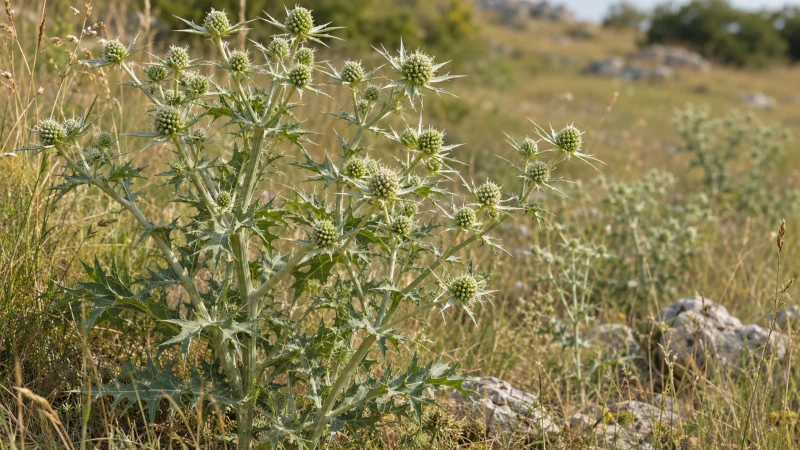
The plant is still worth knowing. Its roots are packed with soap-like compounds called saponins, it has produced some interesting results in rodents, and it is the plant the prized king oyster mushroom grows on.
What Eryngium campestre is
Eryngium campestre belongs to the carrot family (Apiaceae), even though its stiff, prickly leaves and round flower heads make it look like a thistle. Its English names include field eryngo, Watling Street thistle, Daneweed and hundred-headed thistle [BSBI, 2010]. It is a rigid, pale-green perennial up to about 75 cm tall that flowers from July to September, usually in dry, open grassland, roadsides and waste ground, often on chalky soils [BSBI, 2010].
Its native range runs from Europe to the Caucasus and northwest Africa, reaching Türkiye, Iran and Iraq. It has been introduced to Britain, Denmark, Sweden, New Zealand and a few places in North America, including Maryland, New Jersey and Québec [POWO, 2026]. Across much of southern Europe it is common enough to be treated as a farm weed. In Britain it is rare and listed as Critically Endangered [BSBI, 2010].
How to tell it from sea holly
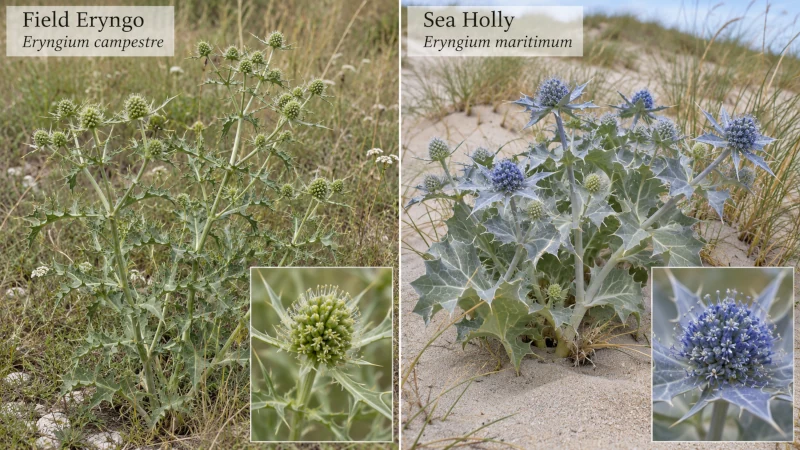
Its better-known cousin, sea holly (Eryngium maritimum), grows on coastal dunes. The two can grow side by side, but sea holly is usually smaller with blue flower heads, while field eryngo’s heads stay green [BSBI, 2010]. In 17th-century England, sea holly roots were candied into sweets called “eryngoes” and credited with tonic and aphrodisiac powers [Oxford Plants 400].
Herbal books often treat the two species as interchangeable. They aren’t the same plant, and the research below is specific to E. campestre.
The king oyster mushroom connection
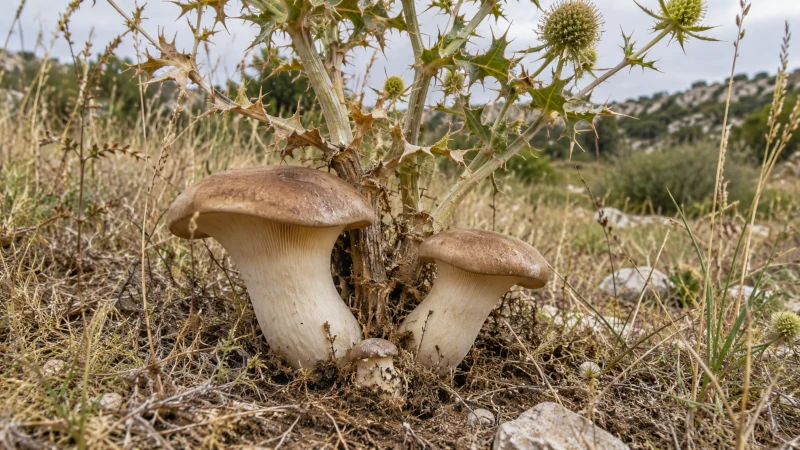
If you’ve cooked king oyster mushrooms (Pleurotus eryngii), you’ve eaten something named after this plant. In the wild, especially in Spain, the mushroom fruits at the base of field eryngo stems, tucked among the plant’s dead lower leaves. Mycologists argued for years about whether it simply lived there or attacked the plant. A 2023 field and greenhouse study settled much of it: the fungus behaves as a parasite that can kill its host [Carlavilla & Manjón, 2023]. Today the mushroom is cultivated worldwide.
What’s in the plant
The roots are a rich source of triterpene saponins, compounds that foam in water the way soap does. The above-ground parts contain flavonoids such as kaempferol, quercetin and rutin, along with coumarins, caffeic and chlorogenic acids, and an essential oil dominated by germacrene D [Erdem et al., 2015].
Saponins are usually named as the reason eryngo makes you urinate more. It’s a plausible idea that no study has confirmed in this species. A plant’s chemistry tells researchers where to look. It doesn’t tell you what a cup of tea will do in your body.
Eryngium campestre benefits: what the evidence shows
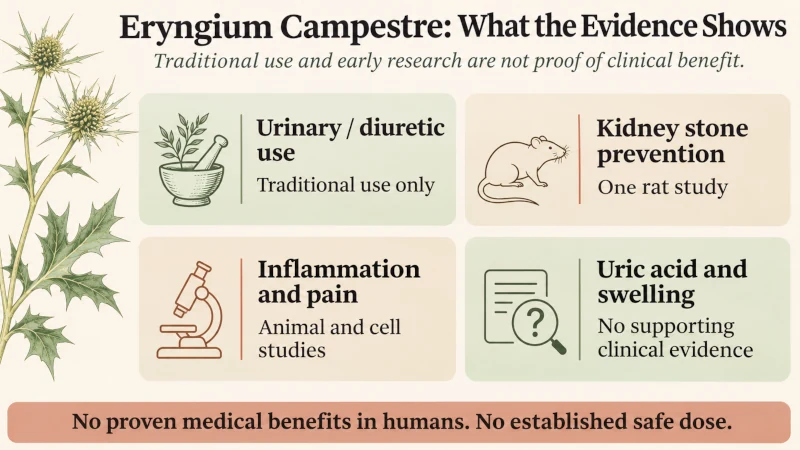
Every claimed benefit of field eryngo rests on tradition, cell studies or rodents. When reviewers searched for clinical trials of Eryngium plants in 2015, they found none, and they noted that only a handful of toxicity studies existed [Erdem et al., 2015].
| Claim | What supports it | Evidence grade |
| Diuretic; “flushing” the urinary tract | Turkish and European folk use [Erdem et al., 2015]. No study found that measured urine output. | Traditional only |
| Preventing kidney stones | One rat study using an extract of the leaves and stems [Safari et al., 2019] | Animal only |
| Reducing inflammation and pain | Mouse, rat and cell studies [Küpeli et al., 2006]; [Bouzidi et al., 2017]; [Atay Balkan et al., 2020] | Early laboratory and animal evidence |
| Cough, stimulant, aphrodisiac | Turkish folk use [Erdem et al., 2015] | Traditional only |
| Lowering uric acid or treating gout | Herbal tradition; no studies found | Unsupported |
| Treating leg or ankle swelling (edema) | Herbal tradition; no studies found | Unsupported — and risky to self-treat |
Diuretic and urinary use: tradition only
In Turkish folk medicine, field eryngo is used as a diuretic, cough remedy, stimulant and aphrodisiac [Erdem et al., 2015]. Natural Medicines, the database behind WebMD’s supplement pages, rates the evidence as insufficient for urinary tract infections, kidney stones, prostate inflammation, cough and bronchitis [TRC Natural Medicines, 2026]. We couldn’t find a single study that measured urine output after taking E. campestre, in people or in animals.
Some herbal sources recommend eryngo tea for swollen legs and ankles. That kind of swelling can come from heart, kidney or liver problems, and it needs a diagnosis rather than a tea. Our guide to urinary conditions and when they need a doctor explains why. If you want plants with better-studied urinary effects, start with our comparison of herbal remedies for the urinary system.
Kidney stones: one rat study
The most relevant study gave rats ethylene glycol, a chemical that makes calcium oxalate crystals form in the kidneys. Some groups also received a water extract of field eryngo’s above-ground parts at 100, 200 or 400 mg per kg of body weight. After 30 days, rats given the extract had fewer crystal deposits in their kidneys and lower levels of two inflammatory markers, IL-1β and IL-6. The effect was strongest at the highest dose and when the extract was started at the same time as the chemical [Safari et al., 2019].
That’s a reasonable lead, not a treatment. The study used 64 male rats, an artificially triggered condition, and an extract of leaves and stems rather than the root tea people traditionally drink. It didn’t test whether eryngo dissolves stones that already exist. For people, fluids and stone-specific diet changes have the real evidence, and our guide to foods that raise kidney stone risk walks through them.
Inflammation and pain: animal and cell studies
A 2006 study compared extracts of eight Turkish Eryngium species in mice. Ethanol extracts of every species but one, including E. campestre, reduced swelling and pain responses [Küpeli et al., 2006]. In Algerian work, a butanol extract of the leaves and stems reduced experimentally induced paw swelling in rats at 250 and 500 mg/kg, an effect the authors compared to the drug diclofenac; the root extract lowered induced fever [Bouzidi et al., 2017]. In cell culture, a root extract cut production of the inflammatory messengers IL-6 and IL-1α by about 36% and 44% [Atay Balkan et al., 2020].
None of this has been tested in people, and a concentrated lab extract is not a home-brewed tea. The 2006 study also carries a quiet warning: a potent extract of a related species caused stomach damage in the mice [Küpeli et al., 2006]. “Anti-inflammatory” and “gentle” are not the same thing.
The “appetizer root” mix-up
Some herbal books call eryngo root an appetizer. That looks like a garbled version of “aperient,” an old pharmacy term for medicines thought to clear internal obstructions. The 1771 Encyclopaedia Britannica lists eryngo among the five “lesser aperient roots,” alongside grass, madder, capers and chamomile [Encyclopaedia Britannica, 1771]. The label reflects 18th-century medical theory, not a tested effect on appetite.
Plants once grouped this way have aged very differently. Our madder guide explains why that root is no longer considered safe to swallow, while our spiny restharrow guide covers a urinary root tea that European regulators accept for traditional use.
How eryngo has been used, and why there’s no reliable dose
Traditionally, the root was brewed as a tea or decoction, and the young shoots and leaves were eaten as a wild vegetable. Older herbal books give root-tea recipes, but no reference body has set a safe or effective dose for any eryngo product. Natural Medicines states that there isn’t enough scientific information to determine one [TRC Natural Medicines, 2026].
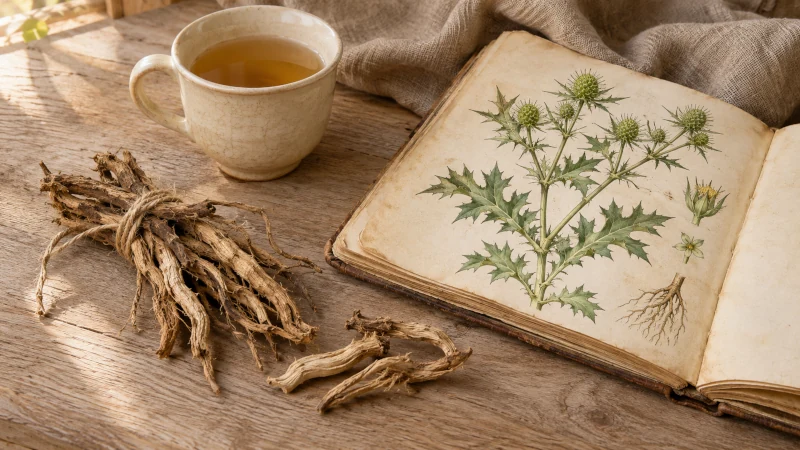
So this page doesn’t give a dose. If you’re still considering eryngo, talk to a pharmacist first, especially if you take any regular medicine, and stop if you notice stomach upset or a rash.
Safety, side effects, and who should avoid it
There isn’t enough reliable information to know whether eryngo is safe to take by mouth [TRC Natural Medicines, 2026]. The few toxicity studies on Eryngium compounds found cell-damaging effects, mainly at high doses, and reviewers have called for proper toxicity testing before any clinical use [Erdem et al., 2015].
Side effects and allergy
No side effects have been formally documented for field eryngo, largely because it hasn’t been studied in people. Large amounts of one eryngo species have been linked to nausea and vomiting [TRC Natural Medicines, 2026]. Because it belongs to the carrot family, eryngo may cause reactions in people allergic to celery, fennel, dill or related plants [TRC Natural Medicines, 2026].
Who should not use it
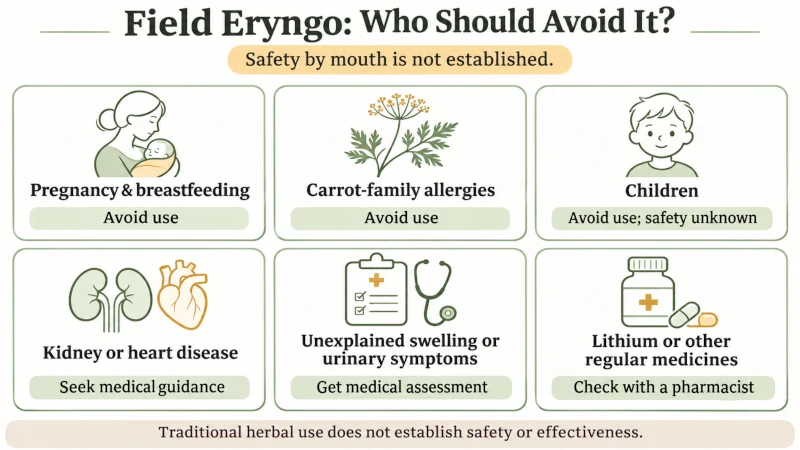
- Pregnant or breastfeeding people. Safety isn’t known, so avoid it [TRC Natural Medicines, 2026].
- Anyone allergic to carrot-family plants such as celery, fennel or dill [TRC Natural Medicines, 2026].
- Children. There is no safety information for children.
- People with kidney disease, heart failure or unexplained swelling. A plant used to increase urination is a poor fit when your fluid balance needs medical management.
- Anyone with symptoms of a urinary infection or kidney stone. Those need assessment first (see below).
Medication interactions
Here the reference sources disagree. WebMD’s current Natural Medicines monograph lists no known interactions [TRC Natural Medicines, 2026]. RxList, which draws on the same database family, rates lithium as a moderate interaction: if eryngo acts like a water pill, it could slow how fast your body clears lithium and push levels up [RxList, 2026]. That warning is framed as a possibility, not a confirmed effect. If you take lithium, a prescription diuretic or blood pressure medicine, ask your prescriber or pharmacist before using eryngo.
A note on foraging
In Britain field eryngo is rare and red-listed, so leave it where it grows [BSBI, 2010]. Elsewhere, only harvest plants you can identify with certainty, and stay away from sprayed fields and busy roadsides.
When to stop and get medical care
Urinary symptoms are where home treatment can go wrong quickly, because a bladder infection can spread to the kidneys. Seek care right away if you have signs of a kidney infection [NIDDK, 2024]:
- fever and chills
- pain in your back, side or groin
- cloudy, dark, bloody or foul-smelling urine
- frequent, painful urination
- nausea or vomiting
Get emergency care if any of these come with confusion, rapid breathing or heart rate, severe pain or shortness of breath. Those can be signs of sepsis, which can be life-threatening [NIDDK, 2024].
For day-to-day kidney and bladder support, the steps with real evidence are plain ones: enough fluid, and the foods that support bladder and kidney health.
| HEALTH DISCLAIMER: This article is for general education and is not medical advice. Eryngium campestre is a traditional herb, not a proven treatment for any condition, and its safety when taken by mouth has not been established. Don’t use it to self-treat a suspected urinary tract infection, kidney stone, swelling, kidney disease or heart failure. Talk to your doctor or pharmacist before using it, especially if you are pregnant or breastfeeding, have allergies to carrot-family plants, or take regular medication such as lithium, diuretics or blood pressure medicines. Urinary symptoms with fever, back or side pain, or blood in the urine need prompt medical care. |
Frequently Asked Questions
Is Eryngium campestre the same as sea holly?
No. Sea holly is Eryngium maritimum, a coastal dune plant that is usually smaller with blue flower heads. Field eryngo grows inland in dry grassland and keeps green flower heads [BSBI, 2010]. Research on one shouldn’t be assumed to apply to the other.
Does field eryngo work as a diuretic?
It has a long history of use as one, but no study we could find has measured its effect on urine output in people or animals. Natural Medicines rates the evidence for its urinary uses as insufficient [TRC Natural Medicines, 2026].
Can eryngo dissolve kidney stones?
There’s no human evidence that it can. One rat study found an extract reduced crystal buildup when given while stones were being chemically induced [Safari et al., 2019]. That isn’t the same as dissolving a stone you already have, which needs medical assessment.
Is eryngo safe during pregnancy or breastfeeding?
Its safety hasn’t been established, so the standard advice is to avoid it while pregnant or breastfeeding [TRC Natural Medicines, 2026].
Why is the king oyster mushroom named after this plant?
In the wild, the king oyster mushroom (Pleurotus eryngii) grows at the base of Eryngium plants, especially field eryngo. Research published in 2023 found it acts as a parasite on the plant [Carlavilla & Manjón, 2023].
References
- Ingram M. Species account: Eryngium campestre (L.), Field Eryngo. View source
- Plants of the World Online. Eryngium campestre L. View source
- Carlavilla JR, Manjón JL. The king oyster mushroom Pleurotus eryngii behaves as a necrotrophic pathogen of Eryngium campestre. Italian Journal of Mycology. View source
- Erdem SA, Nabavi SF, Orhan IE, Daglia M, Izadi M, Nabavi SM. Blessings in disguise: a review of phytochemical composition and antimicrobial activity of plants belonging to the genus Eryngium. DARU Journal of Pharmaceutical Sciences. View source
- Küpeli E, Kartal M, Aslan S, Yesilada E. Comparative evaluation of the anti-inflammatory and antinociceptive activity of Turkish Eryngium species. Journal of Ethnopharmacology. View source
- Bouzidi S, Benkiki N, Hachemi M, Haba H. Investigation of in vitro antioxidant activity and in vivo antipyretic and anti-inflammatory activities of Algerian Eryngium campestre L. View source
- Atay Balkan İ, Taşkın T, Acar Şah E, Akaydın G, Yeşilada E. Comparative study of the anti-inflammatory, antioxidant and urease inhibitory activities of Eryngium kotschyi Boiss. and E. campestre L. var. virens (Link) Weins extracts. View source
- Safari H, Esmaeili S, Naghizadeh MS, Falahpour M, Malekaneh M, Anani Sarab G. The effects of aqueous extract of Eryngium campestre on ethylene glycol-induced calcium oxalate kidney stone in rats. View source
- Therapeutic Research Center (Natural Medicines). Eryngo — uses, side effects, and more. View source
- RxList. Eryngo: health benefits, side effects, uses, dose and precautions (Natural Medicines Comprehensive Database ratings). View source
- Encyclopaedia Britannica, 1st ed. (1771), vol. 1: “Aperients.” National Library of Scotland digitisation, transcribed edition. View source
- Penny J. Eryngium spp. (Sea hollies). Oxford University Plants 400, University of Oxford Herbaria. View source
- National Institute of Diabetes and Digestive and Kidney Diseases. Symptoms & causes of kidney infection (pyelonephritis). View source


