
If you’ve come across spiny restharrow in a tea blend or an old herbal, here’s the short answer. The dried root of Ononis spinosa is brewed as a tea to make you pass more urine, which flushes the urinary tract during minor bladder complaints. European regulators accept that use, but only as a traditional one: it rests on long, consistent use, and no study in patients has tested restharrow root on its own [EMA, 2025c]. It doesn’t dissolve kidney stones, cure a bladder infection, or treat swelling from heart or kidney disease.
That still leaves a plant worth understanding. It has a defined dose, a short list of people who shouldn’t take it, and a couple of interesting lab findings. It also has a folk reputation that runs well ahead of the science in places, and the job here is to keep those two things apart.
What spiny restharrow is
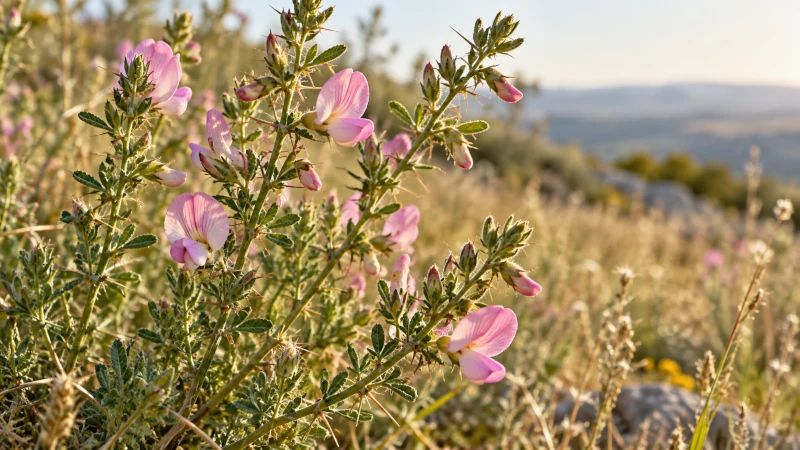
Spiny restharrow is a thorny, woody-based perennial in the legume family, Fabaceae — the same family as peas and beans [Nechita et al., 2026]. It grows about 10 to 80 cm tall, carries pink, pea-like flowers through summer, and anchors itself with a stubborn taproot that can reach around 60 cm [Plantura, 2022]. The common names hint at that root. “Restharrow” and the French arrête-bœuf — literally “stops the ox” [EMA, 2014] — both point to a plant farmers struggled to plough through.
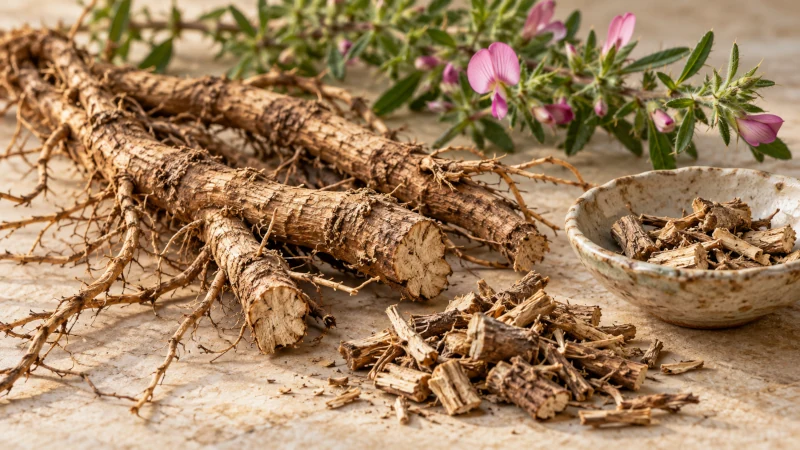
It grows wild across much of Europe, North Africa and parts of western and central Asia, usually in dry, sunny grassland [Nechita et al., 2026].
| Quick facts | |
| Botanical name | Ononis spinosa L. (Fabaceae) |
| Other names | Restharrow; Hauhechel (German); bugrane, arrête-bœuf (French); gatuña (Spanish) [EMA, 2014] |
| Part with official standing | Dried root (Ononidis radix), taken as a tea |
| Main constituents | Isoflavones such as ononin and other formononetin glycosides; the triterpene α-onocerin; a little essential oil, mainly trans-anethole; phenolic acids and saponins [EMA, 2025b] |
| Regulatory status (EU) | Traditional herbal medicinal product for minor urinary complaints, adults and adolescents over 12 [EMA, 2014] |
Check the label for Ononis spinosa. European regulators originally gathered data on both spiny restharrow and field restharrow (Ononis arvensis), but the monograph they adopted covers O. spinosa root only [EMA, 2025c]. Older herbals also used the leaves and flowers; those parts have no official monograph.
Spiny restharrow benefits, graded by the evidence
Restharrow belongs to a group of traditional “flushing” herbs alongside goldenrod, Java tea and birch leaf; this comparison of herbal remedies for the urinary system shows where each one stands. For restharrow specifically, the table gives the short version and the sections below explain each grade.
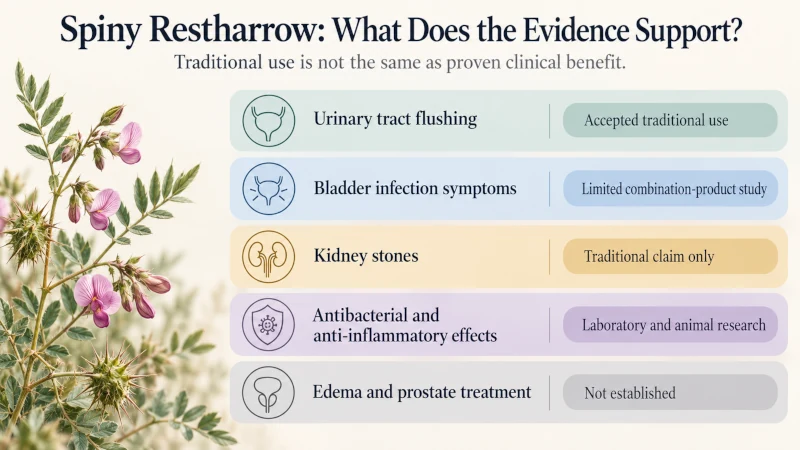
| Claim | What supports it | Grade |
| Increasing urine flow to flush the urinary tract in minor complaints | Long traditional use; older rat and rabbit studies [EMA, 2025b] | Accepted traditional use — no trials of restharrow alone |
| Easing symptoms of uncomplicated bladder infection | One placebo-controlled trial of a three-herb tablet [Vahlensieck et al., 2019] | Limited — can’t be credited to restharrow |
| Preventing or dissolving kidney stones | Folk and historical use [EMA, 2025b] | Traditional only — no human evidence |
| Anti-inflammatory, antibacterial, wound healing | Cell and animal studies [Nechita et al., 2026] | Early laboratory evidence |
| Treating edema or prostate problems | No study of restharrow alone | Unsupported |
Flushing the urinary tract in minor complaints — accepted traditional use
This is the use regulators recognize. The EU monograph adopted in 2014 describes restharrow root tea as a traditional herbal medicine used to increase the amount of urine and flush the urinary tract, as an adjuvant in minor urinary complaints [EMA, 2014]. “Adjuvant” matters: it means alongside proper care, not instead of it.
Traditional use is a real regulatory category with set doses and warnings. It means a product has been used safely for at least 30 years, including 15 in the EU, and that its effect is considered plausible. For restharrow, the European Medicines Agency says plainly that no studies in patients have been carried out [EMA, 2025c].
The animal data are old and modest. In a 1981 rat study, a restharrow infusion raised five-hour urine output to 21.4 ml, against 15.1 ml with water and 17.9 ml with the reference drug theophylline, and increased sodium loss. A 1993 study found an ethanol extract roughly doubled urine output in rodents when given by mouth, but did nothing when injected [EMA, 2025b]. The agency’s own assessors note that more recent research on the effect, and on how it works, doesn’t exist.
A revised monograph released for consultation in 2025, and not yet final, would reword the indication as relief of symptoms of minor urinary complaints in addition to drinking enough fluid [EMA, 2025a]. The water you drink with the tea is doing much of the work.
Bladder infections — one trial, and it wasn’t restharrow alone
The only placebo-controlled human trial involving restharrow root tested a tablet that combined dry extracts of restharrow root (80 mg), Java tea and goldenrod. It ran in 1991–92 in 200 women with uncomplicated lower urinary tract infection. A 2019 re-analysis reported faster symptom relief with the herbal tablet. In the subgroup with usable urine cultures (122 women), 15.3% of the herbal group needed antibiotics during the week, compared with 49.2% on placebo [Vahlensieck et al., 2019].
Three caveats. It was a combination, so restharrow’s share of any effect can’t be separated out, a point EMA’s assessors also make [EMA, 2025b]. The analysis was done after the fact, on data collected almost three decades earlier. And both the trial and the paper were funded by the product’s manufacturer. It’s a reason to run a modern trial, not a reason to skip treatment for an infection. The other two ingredients have their own evidence profiles: see Java tea (orthosiphon) and goldenrod.
Kidney stones — tradition only
Restharrow’s stone reputation is ancient. Dioscorides and Pliny described the root as breaking or expelling stones, and Central European pharmacopoeias listed it for kidney gravel well into the 20th century [EMA, 2025b]. None of that has been tested in people. Some herbal guides still say the plant dissolves stones; there is no human evidence that it does.
The EU monograph’s accepted indication is minor urinary complaints — kidney gravel isn’t part of it [EMA, 2014]. Stones are managed by stone type, and diet and fluid intake are the levers with real evidence behind them. This guide to which foods actually raise kidney stone risk is a better place to start than any tea.
Anti-inflammatory, antibacterial and wound-healing effects — lab and animal only
A 2026 review of 34 studies found anti-inflammatory, antimicrobial, wound-healing and pain-relieving activity for spiny restharrow extracts, almost all of it in cell cultures and rodents. The authors concluded that well-designed clinical studies are still needed [Nechita et al., 2026]. The more interesting findings:
- Bacterial adhesion. A hot-water root extract reduced the ability of urinary E. coli to stick to human bladder cells in the lab, without killing the bacteria [Deipenbrock et al., 2020]. Nobody has shown this happens in human urine.
- Antibacterial activity. An extract of the leaves and flowers was active against eight bacterial strains in the lab and weakened Staphylococcus aureus biofilms [Stojković et al., 2020]. Results across studies are inconsistent, and one found some extracts actually boosted the growth of certain bacteria [Nechita et al., 2026].
- Wounds and inflammation. Root extracts sped wound closure and reduced paw swelling in rats [Nechita et al., 2026]. There are no human wound studies.
That’s the real status of the traditional gargles for sore throats and washes for slow-healing wounds: a plausible tradition with test-tube support, and nothing more. A wound that won’t heal, or a sore throat with a fever, belongs with a clinician.
Claims the evidence doesn’t support
- Treating swelling (edema). This one matters most. Swelling from heart or kidney disease is a reason not to use restharrow: the monograph lists conditions that require reduced fluid intake, such as severe heart or kidney disease, as a contraindication [EMA, 2014].
- Prostate problems. No study of restharrow alone was found. A small clinical study of a multi-herb supplement containing restharrow reported better urinary symptoms in men, but reviewers note restharrow’s contribution can’t be determined [Nechita et al., 2026].
- Curing a urinary infection. Not established — see the trial above.
How restharrow root tea is used
The EU monograph sets the reference dose for adults, older adults and adolescents over 12 [EMA, 2014]:
| EU monograph reference | |
| Preparation | Herbal tea (infusion) of the cut, dried root |
| Amount per cup | 2–3 g of root in 150 ml of boiling water (the 2025 draft revision allows 2–4 g) [EMA, 2025a] |
| How often | Up to 3–4 times a day |
| Daily maximum | 12 g |
| How long | See a doctor if symptoms last longer than one week |
| Children under 12 | Not recommended |
| Alongside it | Drink plenty of fluid |
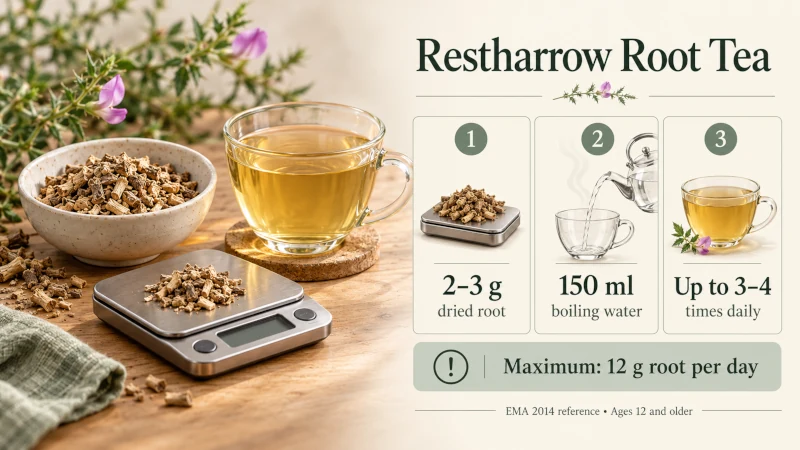
Teaspoons are an unreliable measure. Polish products declared 2–3 g per teaspoon of cut root, but measured amounts ran to 3.5–5 g [EMA, 2025b]. A small kitchen scale removes the guesswork.
Two practical points come from the older research. Steep it rather than boil it hard: rat experiments in the 1930s suggested part of the active material is volatile, and the effect weakened the longer the root was boiled. And use it in short runs. A former German standard authorization advised drinking it for only a few days at a time, because the effect wears off, then taking a break of several days [EMA, 2025b].
Some older herbal guides recommend decoctions of 50–60 g of root per liter, three or four cups a day. Depending on cup size, that’s roughly two to five times the 12 g daily maximum in the monograph. Stick to the monograph dose, and drink the tea earlier in the day — it’s meant to make you urinate more, and a late cup may wake you at night.
Safety, side effects, and who should avoid spiny restharrow
Side effects and safety signals
The monograph lists no known side effects at recommended doses [EMA, 2014]. When regulators searched the EU adverse-reaction database in 2023, they found one report: a 74-year-old woman with previous stomach surgery who developed stomach pain, nausea and vomiting that cleared after she stopped. A global database search added one case of belching. Three Italian reports, one of them acute hepatitis, involved supplements combining restharrow with many other herbs and medicines, so no link to restharrow could be confirmed [EMA, 2025b].
Two laboratory findings keep this from being a clean bill of health. In a test on human white blood cells, an ethanol extract of the root increased markers of chromosome damage; the method was non-standard and the result has never been repeated, and EMA describes its relevance to people as undetermined [EMA, 2025b]. Standard genotoxicity, reproductive-toxicity and cancer tests have not been done [EMA, 2014].
Separately, in one rat study a water extract failed to protect the liver from a toxic chemical and appeared to worsen liver enzymes [Nechita et al., 2026]. Neither finding shows harm in people. Together they’re a good reason to keep courses short, stick to the tea rather than concentrated extracts, and remember that a short list of reports is not the same thing as safety data.
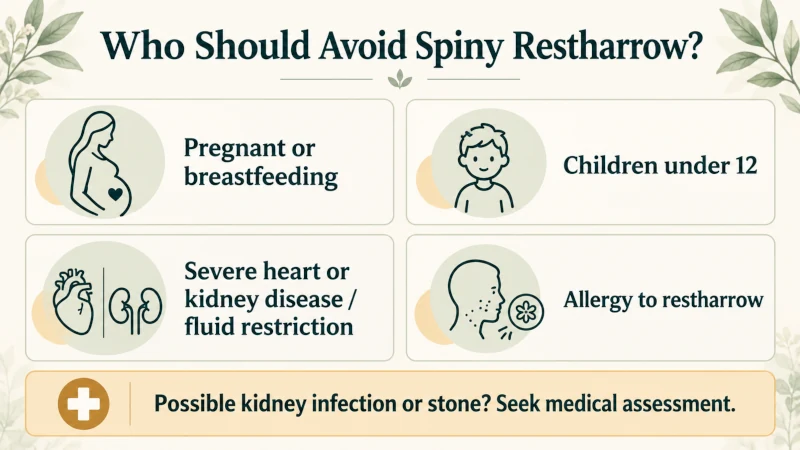
Who should not use it
- Anyone allergic to restharrow [EMA, 2014].
- Anyone told to limit fluids, including people with severe heart or kidney disease, and anyone with swelling caused by heart or kidney problems [EMA, 2014].
- People who are pregnant or breastfeeding — safety hasn’t been established, so use isn’t recommended [EMA, 2014].
- Children under 12 [EMA, 2014].
- Anyone with signs of a kidney infection or kidney stone (see below) — those need assessment, not a tea.
Medication interactions
None have been reported [EMA, 2014], and EMA notes there are no restharrow-specific interaction data at all [EMA, 2025b]. That’s an absence of study, not proof of safety. As a precaution based on how the tea works rather than on reported cases, check with your doctor or pharmacist first if you take prescription diuretics (“water pills”), lithium, or blood pressure medicines.
When to stop and get medical care
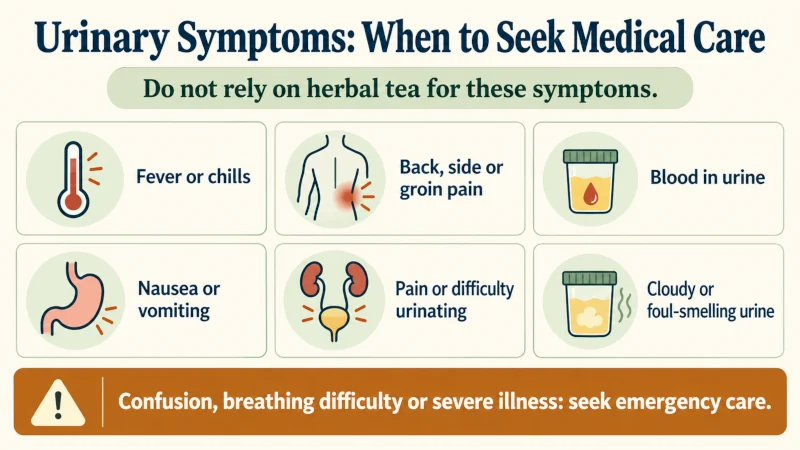
Urinary symptoms are one area where self-care can go wrong quickly, because a bladder infection that isn’t treated can spread to the kidneys [NIDDK, 2024]. See a health professional promptly if you have:
- Fever or chills with urinary symptoms
- Sharp pain in your back, side, lower abdomen or groin
- Pink, red or brown urine
- Nausea or vomiting
- Pain when urinating, a constant urge to go, or being unable to pass more than a little urine
- Cloudy or bad-smelling urine
Confusion, rapid breathing or heartbeat, shortness of breath or severe pain alongside a fever can signal sepsis, which can be life-threatening. Get emergency care [NIDDK, 2024].
The monograph also advises seeing a doctor if fever, painful urination, spasms or blood in the urine appear while you’re using the tea, or if symptoms last more than a week [EMA, 2014]. If you’re a man with urinary symptoms, pregnant, or living with diabetes, kidney disease, a urinary catheter or a weakened immune system, it’s sensible to get medical advice from the start rather than self-treat. For a wider view, see which urinary problems herbs can help with — and which need a doctor.
| HEALTH DISCLAIMER: This article is general education, not medical advice, and it isn’t a substitute for diagnosis or treatment by a qualified clinician. Spiny restharrow is a traditional herbal product, not a proven treatment for any disease. Don’t use it to self-treat a suspected urinary tract infection, kidney stone, kidney disease or heart failure. Talk to your doctor or pharmacist before using it if you’re pregnant or breastfeeding, take regular medication, or have heart, kidney or liver disease. Urinary symptoms with fever, back or side pain, or blood in the urine need prompt medical assessment. |
Frequently Asked Questions
Does spiny restharrow dissolve kidney stones?
No. The stone-breaking reputation goes back to ancient writers, but it has never been tested in people, and the EU monograph doesn’t include kidney stones or gravel in its accepted use [EMA, 2014; EMA, 2025b]. Stone treatment depends on the type of stone, so it needs a diagnosis.
Can restharrow tea treat a urinary tract infection?
No. Its accepted use is as an adjuvant in minor urinary complaints. The one positive trial tested a three-herb tablet, not restharrow alone [Vahlensieck et al., 2019]. A bladder infection that isn’t treated can spread to the kidneys, so see a clinician if you think you have one [NIDDK, 2024].
How long can I drink restharrow tea?
The monograph says to see a doctor if symptoms last more than a week while you’re using it [EMA, 2014]. Older German guidance suggested drinking it for only a few days at a time, because the effect fades with continued use [EMA, 2025b]. There’s no long-term safety data.
Is common restharrow the same plant?
They’re close relatives — some botanists treat common restharrow (Ononis repens) as a subspecies of spiny restharrow [Plantura, 2022]. The EU monograph covers only Ononis spinosa root, so look for that name on the label [EMA, 2014].
Is spiny restharrow safe during pregnancy or breastfeeding?
Use isn’t recommended. Its safety in pregnancy and breastfeeding hasn’t been established, and no reproductive-toxicity tests have been done [EMA, 2014].
References
- European Medicines Agency, Committee on Herbal Medicinal Products. View source
- European Medicines Agency, HMPC. Draft European Union herbal monograph on Ononis spinosa L., radix — Revision 1. View source
- European Medicines Agency, HMPC. Draft assessment report on Ononis spinosa L., radix — Revision 1. View source
- European Medicines Agency. Ononidis radix — herbal medicinal product (overview page). Last updated 2 June 2025. View source
- Vahlensieck W, Lorenz H, Schumacher-Stimpfl A, Fischer R, Naber KG. View source
- Deipenbrock M, Sendker J, Hensel A. Aqueous root extract from Ononis spinosa exerts anti-adhesive activity against uropathogenic Escherichia coli. View source
- Nechita V-I, Tărău A-P, Şuster A-I, Nechita M-A, Toiu A, Benedec D, Hanganu D, Siserman C, Drugan C, Oniga I. View source
- Stojković D, Drakulić D, Gašić U, Zengin G, Stevanović M, Rajčević N, Soković M. Ononis spinosa L., an edible and medicinal plant: View source
- National Institute of Diabetes and Digestive and Kidney Diseases. Symptoms & Causes of Kidney Stones. Last reviewed May 2017. View source
- National Institute of Diabetes and Digestive and Kidney Diseases. Symptoms & Causes of Kidney Infection (Pyelonephritis). View source
- Plantura Magazine (Kati). Restharrow: species, cultivation & health benefits. 2022. Used for plant description only. View source


