
Juniper plant berries are best known for giving gin its sharp, piney bite, but they also carry centuries of use as a folk remedy — and the honest picture of the juniper berries benefits is narrower than most websites suggest. Two uses have enough traditional backing that Europe’s medicines regulator formally recognises them: nudging the body to pass more urine, and easing mild indigestion [EMA, 2023]. Almost everything else you may read — that the berries cure tuberculosis, diabetes, or cancer — traces back to old herbals or to lab dishes and rodents, not to studies in people.
The short version: as a food and a spice, juniper berries are safe for most adults [Drugs.com, 2025]. As a short-term herbal remedy, they may have a mild diuretic and digestive effect. They are not a treatment for any disease, they should be avoided in pregnancy and in kidney disease, and they aren’t meant to be taken for more than about two weeks at a stretch.
What juniper berries actually are
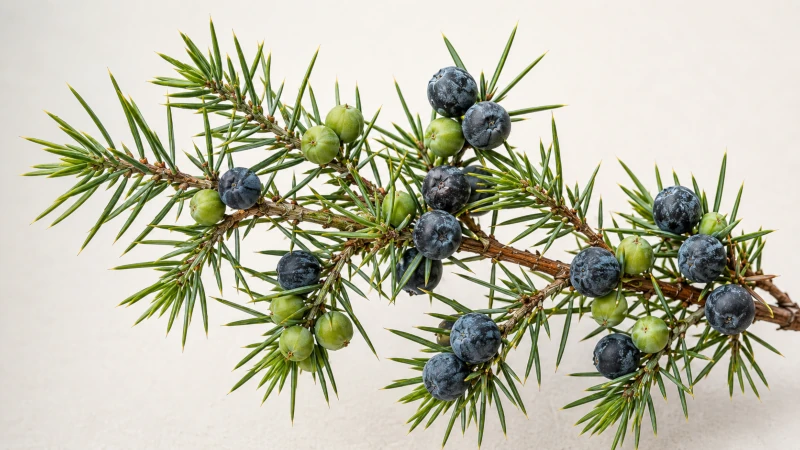
Juniper (Juniperus communis) is an evergreen shrub in the cypress family that grows across Europe, Asia, and North America. Its “berries” aren’t true berries at all — they’re small female seed cones that take two to three years to ripen from green to a dusty blue-black [Drugs.com, 2025].
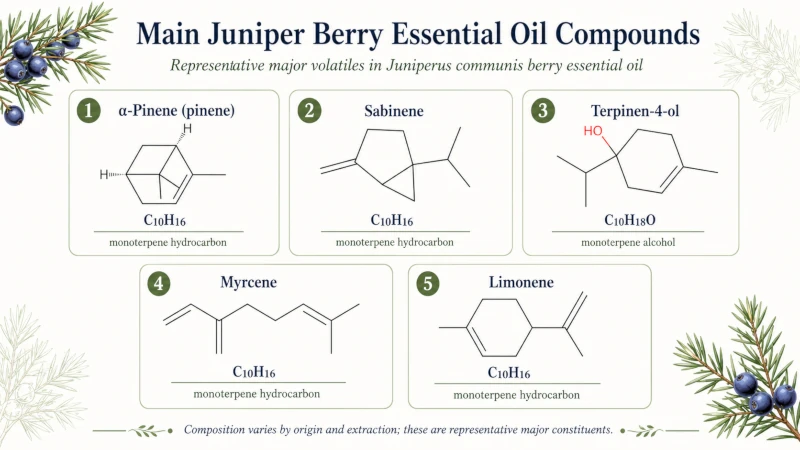
The berries owe their smell and most of their activity to an essential oil that makes up roughly 0.5 to 2 percent of their weight. That oil is dominated by monoterpenes — alpha- and beta-pinene, sabinene, limonene, myrcene, and terpinen-4-ol. The berries also hold a large amount of natural sugar, plus flavonoids, organic acids, and some vitamin C [J. communis review, 2022]. Terpinen-4-ol is the compound usually credited with juniper’s effect on the kidneys.
What the evidence says about juniper plant berries benefits
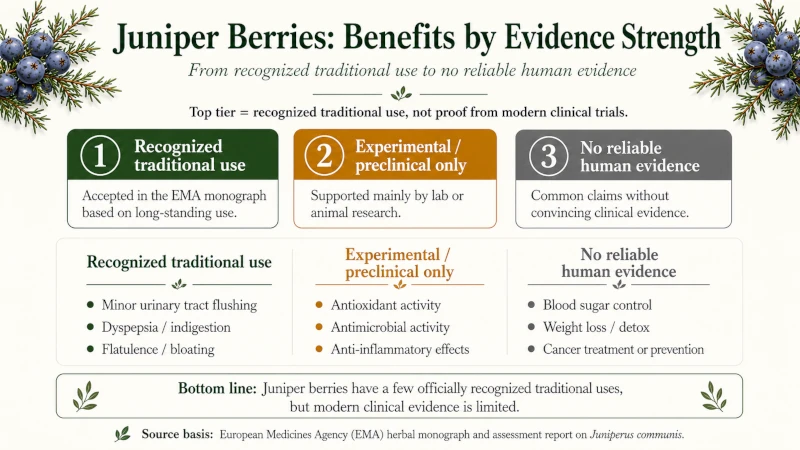
It helps to sort the claims by how much support they have, because the gap between “traditional use” and “proven in people” is wide here.
| Traditional claim | What the evidence actually is | How strong it is |
| Increases urine, flushes the urinary tract | Recognised long-standing use plus animal data; no robust human trials | Traditional use; limited |
| Eases mild indigestion and gas | Recognised long-standing use by EU and German regulators | Traditional use |
| Antioxidant, anti-inflammatory, antimicrobial | Test-tube and animal studies of the essential oil only | Early-stage / preclinical |
| Lowers blood sugar | Helped diabetic rats in some studies; one clinical reference warns it may raise glucose in people | Not established; conflicting |
| Cures tuberculosis, cancer, gonorrhoea, diabetes | Folklore repeated by old herbals; no credible support | No evidence |
A mild “water pill” effect
This is juniper’s best-documented use. The European Medicines Agency lists it as a traditional herbal medicine to increase urine output and flush the urinary tract in minor complaints [EMA, 2023]. “Traditional use” is a specific, honest label: it means the recognition rests on long-standing use rather than modern clinical trials. In rats, a 10 percent water infusion of the berries raised urine output by about 43 to 44 percent over two to three days [J. communis review, 2022]. The effect is an aquaretic one — more water, little salt loss — so it is not a stand-in for prescription diuretics used in heart or kidney conditions.
If your interest is urinary support more broadly, it’s worth reading about other herbal remedies for the urinary system and the everyday foods that support bladder and kidney health. Juniper sits alongside herbs such as bearberry (uva-ursi) and buchu in that traditional category, though none of them replaces antibiotics when an infection is present.
Settling the stomach
Juniper’s second recognised use is digestive. Both the EU regulator and Germany’s Commission E accept the berries for the symptomatic relief of dyspepsia and flatulence [EMA, 2023]. The bitter, aromatic oil is thought to stimulate digestion and ease gas. As with the urinary use, this is recognised traditional use, not a claim backed by large human trials.
Antioxidant and anti-inflammatory activity — mostly in the lab
Juniper’s monoterpene-rich oil shows antioxidant, anti-inflammatory, and antibacterial or antifungal activity in test tubes and in animals [J. communis review, 2022]. That’s biologically interesting, but it hasn’t been confirmed in people. Activity in a petri dish or a mouse routinely fails to translate into a measurable benefit for a human taking the herb, so treat these as leads rather than reasons to use juniper.
Blood sugar — promising in rodents, unsettled in people
The animal data are intriguing and a little contradictory. A 1994 study in Planta Medica found that a juniper berry decoction (about 125 mg of berries per kilogram) lowered blood glucose and reduced deaths in diabetic rats over 24 days [Sánchez de Medina et al., 1994]. Related juniper species have cut glucose by roughly a quarter in similar rat models. But there are no human trials, and at least one clinical drug reference cautions that juniper may actually raise blood glucose in some people with diabetes [Drugs.com, 2025]. The practical takeaway is simple: don’t use juniper to manage diabetes, and don’t assume it lowers blood sugar.
How juniper berries are used
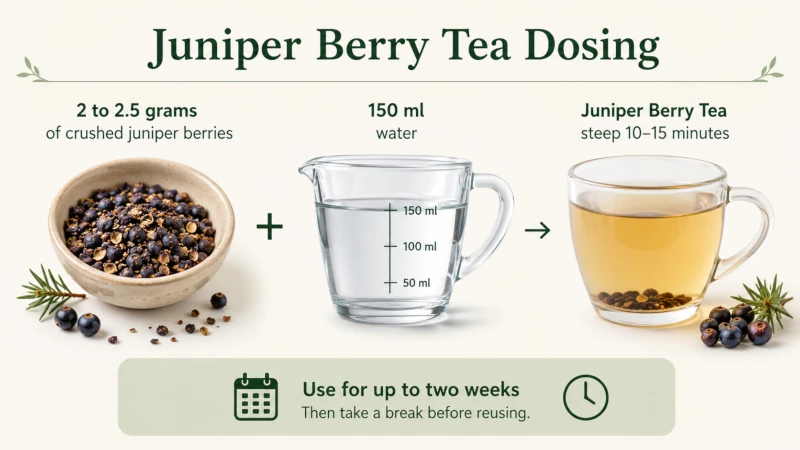
In the kitchen, juniper berries season game, sauerkraut, pâtés, and marinades, and they flavour gin. Used this way, in normal food amounts, they’re considered safe for most adults [Drugs.com, 2025]. As a remedy, the traditional preparations and the amounts recognised by the EU regulator are:
- Tea (infusion): 2.0–2.5 g of crushed berries steeped in 150 ml of boiling water, taken 1–3 times a day for urinary support, or up to 4 times a day for digestion [EMA, 2023].
- Tincture (1:5): 1–2 ml, three times daily.
- Liquid extract (1:1): 2–4 ml, three times daily.
Two cautions matter more than the exact dose. First, duration: don’t self-treat with juniper for longer than two weeks without medical advice [EMA, 2023]. Second, juniper essential oil is highly concentrated and is not the same as the culinary berry; it shouldn’t be swallowed casually or used undiluted. The regulator also advises against use in anyone under 18 because there isn’t enough safety data.
Safety, side effects, and who should avoid juniper
In food amounts, juniper is generally well tolerated. As a remedy, the most likely issues are stomach upset and, with high or prolonged doses, irritation of the urinary tract. Applied undiluted to the skin, the pure oil can cause irritation or blistering [Drugs.com, 2025].
The kidney question, untangled
Older texts warned that juniper damages the kidneys through terpinen-4-ol. The picture is more nuanced. A controlled rat study testing purified juniper oil and terpinen-4-ol for 28 days found neither harmed kidney function or structure at the doses given [Schilcher & Leuschner, 1997].
Historic reports of kidney injury were linked to poor-quality or adulterated oils high in irritant terpene hydrocarbons — not to clean berry preparations. Even so, because juniper increases urine flow and the human data are thin, the sensible course is caution: the EU regulator advises against use in severe kidney disease such as interstitial nephritis [EMA, 2023]. This is also why juniper is the wrong tool for kidney stones; if stones are a concern, it’s more useful to know which foods can trigger kidney stones.
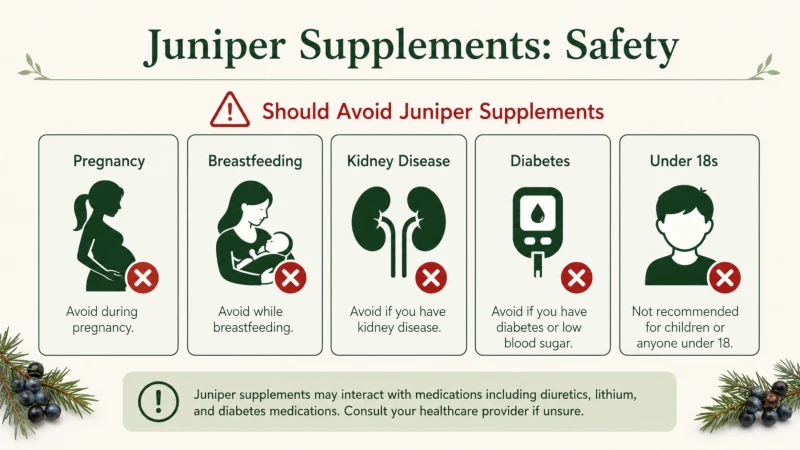
Who should avoid juniper
- Pregnant or breastfeeding people. Juniper has a long reputation as a uterine stimulant, animal studies point to anti-fertility effects, and safety hasn’t been established, so it is not recommended [EMA, 2023].
- Anyone with kidney disease. Avoid, given the diuretic effect and limited data.
- Children and teenagers under 18. Not recommended, due to a lack of safety data.
- People with diabetes or on glucose-lowering medication. Skip the supplement; juniper’s effect on blood sugar is unpredictable.
- Anyone facing surgery. Stop juniper supplements well beforehand because of possible blood-sugar effects.
Interactions and red flags
Officially, no drug interactions are confirmed [EMA, 2023], but in theory juniper could add to the effect of prescription diuretics and could disturb blood-sugar control, so check with a pharmacist if you take either kind of medicine.
Finally, know when self-care isn’t enough. If you’re using juniper for urinary symptoms and you develop fever, chills, back or flank pain, painful urination, or blood in the urine, stop and seek medical care — these can signal a kidney infection that needs antibiotics, not a herbal flush [EMA, 2023]. The same goes if symptoms last beyond two weeks or keep coming back.
| Health Disclaimer This article is for general education only and is not medical advice, diagnosis, or treatment. Juniper is not a substitute for care from a qualified health professional. Talk to your doctor or pharmacist before using juniper berries, juniper tea, or juniper essential oil as a remedy — especially if you are pregnant or breastfeeding, have kidney disease or diabetes, take prescription medication, or are caring for a child. If you have urinary symptoms with fever, back pain, or blood in the urine, seek medical care rather than self-treating. |
Frequently Asked Questions
Are juniper berries safe to eat?
For most adults, yes — in the small amounts used to season food or flavour drinks. Concentrated supplements and essential oil are a different matter and carry the cautions above.
Can you eat juniper berries straight off the bush?
Culinary juniper comes from Juniperus communis, and its ripe berries are the ones used in cooking. Not every juniper is edible, though — some species, such as Juniperus sabina, are toxic. Don’t forage unless you can positively identify the plant.
Do juniper berries help with a UTI?
They’re traditionally used to increase urine flow, not to cure an infection. A urinary tract infection — especially with fever or blood in the urine — needs medical assessment and often antibiotics.
How long can I take juniper?
As a self-care remedy, no longer than about two weeks without medical advice [EMA, 2023].
Does juniper lower blood sugar?
Only in animal studies, and the results conflict — one clinical reference even warns it may raise glucose in some people. Don’t rely on it for blood-sugar control.
References
- European Medicines Agency, Committee on Herbal Medicinal Products. European Union herbal monograph on Juniperus communis L., galbulus (pseudo-fructus), Revision 1. 2023. → View source
- European Medicines Agency. Juniperi galbulus (pseudo-fructus) — herbal medicinal product overview. → View source
- Drugs.com. Juniper — professional natural products monograph. Reviewed 2025. → View source
- Review of Juniperus communis bioactive compounds and biomedical activities. PMC, 2022. → View source
- Schilcher H, Leuschner F. The potential nephrotoxic effects of essential juniper oil. Arzneimittelforschung. 1997. → View source
- Sánchez de Medina F, et al. Hypoglycemic activity of juniper berries. Planta Medica. 1994. → View source
