
Most claims you’ll read about knotweed benefits trace back to centuries-old folk use, not to modern clinical trials — and that gap is the whole story. Common knotgrass, the plant this article covers, has a long record as a mild remedy for coughs, raw throats, and sluggish urine flow, and European regulators do accept a narrow set of its traditional uses. What it has never been shown to do is cure, reverse, or treat any disease. A few of its oldest reputed uses are also genuinely unsafe to try at home.
This page sorts the supported from the merely traditional, gives the doses that licensed herbal-tea products actually use, and is clear about where the evidence runs out.
First, the name problem: two very different “knotweeds”
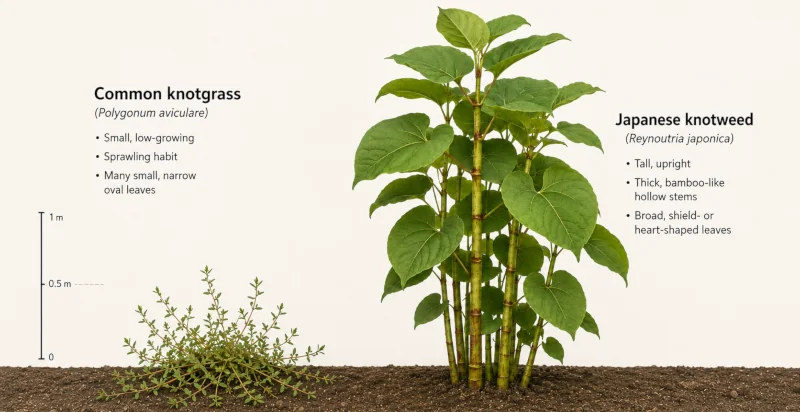
“Knotweed” gets attached to two plants that share almost nothing beyond a family name. Mixing them up is the single biggest source of confusion online.
- Common knotgrass — Polygonum aviculare L. A low, wiry weed that creeps along paths and roadsides. This is the herb behind the traditional cold, throat, and urinary uses, and the one with a European herbal monograph. It is the subject of this article.
- Japanese knotweed — Reynoutria japonica (also sold as Fallopia japonica or Polygonum cuspidatum). A tall, bamboo-like invasive marketed mainly as a resveratrol source and in some Lyme-disease protocols. Different plant, different chemistry, different (and separate) evidence base. It is not covered here.
If you bought a product for resveratrol or Lyme support, you almost certainly have Japanese knotweed, and the rest of this page won’t apply to it.
Common knotgrass at a glance
| Item | Detail |
| Botanical name | Polygonum aviculare L. (family Polygonaceae) |
| Part used | The flowering aerial parts (stems, leaves, flowers), dried — known in pharmacy as Polygoni avicularis herba |
| Other names | Knotgrass, prostrate knotweed, birdweed, pigweed, nine-joints, sparrow tongue, centinodia, Renouée des oiseaux |
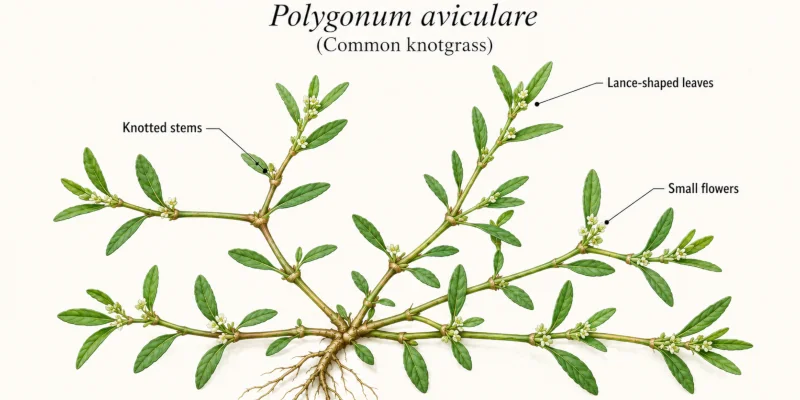
| Looks like | A hairless, sprawling annual with thin knotted stems, small lance-shaped leaves, and tiny white-to-pink flowers tucked where the leaves meet the stem |
| Where it grows | Roadsides, paths, yards, and poor or trampled soils across most of the temperate world |
| Main actives | Flavonol glucuronides (including avicularin and quercitrin), tannins, silicic acid, and mucilage |
Knotgrass is so good at surviving foot traffic that one of its old names is “doorweed.”
What’s actually inside the plant
Three groups of compounds explain most of what knotgrass is traditionally used for. Flavonoids — chiefly flavonol glucuronides such as avicularin and quercitrin, plus quercetin and kaempferol derivatives — are the dominant constituents; in analyzed samples total flavonoids ranged from about 0.70% to 2.20% of the dried herb [Med Chem Res review, 2023]. These are the compounds responsible for its antioxidant activity in the lab.
Tannins give the herb a mild astringent, drying quality — the same property that makes strong tea feel tightening in the mouth. Silicic acid (a soluble form of silicon) and mucilage round out the profile. None of this is exotic, and none of it makes knotgrass a potent drug; these are gentle, food-adjacent constituents.
Knotweed benefits: what the evidence supports
The honest summary is short. A European regulator recognizes three traditional uses; one small human study looked at gum inflammation; everything else is laboratory or animal work. Here is each tier, in plain terms.
Recognized traditional uses (the strongest formal standing it has)
The European Medicines Agency’s herbal committee reviewed knotgrass and issued a monograph accepting it as a traditional herbal medicinal product for three narrow purposes [EMA, 2016]:
- Relief of the symptoms of a common cold.
- Symptomatic treatment of minor inflammation in the mouth or throat (used as a gargle).
- As an adjuvant in minor urinary complaints, to increase urine output and help flush the urinary tract.
One phrase does a lot of work here: traditional use. In EU law that label means a remedy has been used safely for at least 30 years (15 of them in Europe) and its effect is considered plausible — not that controlled trials have proven it works [EMA summary, 2016]. The committee was explicit that there is insufficient clinical-trial evidence and that its conclusions rest on long-standing use. So these are reasonable, low-risk uses for minor, self-limiting complaints — not demonstrated cures.
The one human study: gum inflammation
The closest thing to a clinical trial is a small study in 60 male dental students who used a knotgrass extract mouth rinse (1 mg/mL) twice daily for two weeks. Gum inflammation scores fell over the 14 days, though dental plaque actually rose during the same period [Gingivitis RCT, 2001]. The EMA looked at this study and concluded the reporting was too incomplete to draw firm conclusions from [EMA assessment report, 2016]. Read it as a hint, not proof.
Laboratory and animal findings (promising, but not proof for people)
Most of the impressive-sounding claims about knotgrass come from this tier. In test tubes its flavonoids scavenge free radicals and protect DNA from oxidative damage [Hsu, 2007], and the herb shows antioxidant and peroxynitrite-quenching activity tied to its flavonoid content [flavonoid analysis, 2014]. In animals, an extract sped skin-wound closure in mice [wound-healing study, 2016], and a rhizome extract reduced kidney scarring in a rat model of diabetic kidney disease [Yoon, 2021]. Laboratory work also supports the anti-inflammatory and antibacterial effects the EMA noted [EMA, 2016].
These results are real, but they are early. A compound that protects cells in a dish or heals a mouse’s skin has cleared a very low bar compared with helping a person. Treat them as reasons for further study, not as benefits you can count on.
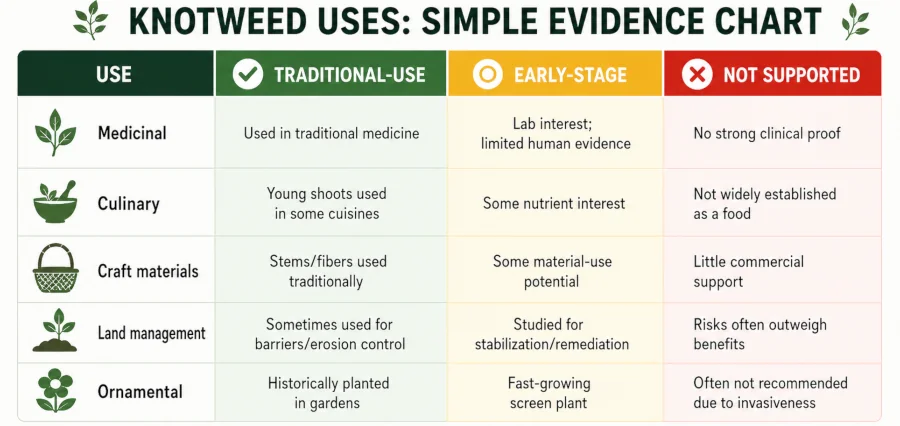
Evidence at a glance
| Reputed use | What the evidence actually is | Strength |
| Common cold symptoms | Accepted by the EMA on the basis of long traditional use; no confirming clinical trials | Traditional use |
| Sore mouth or throat (gargle) | Traditional-use registration, plus one small, incompletely reported gum-inflammation study | Traditional / very limited |
| Mild diuretic to flush the urinary tract | Accepted for minor urinary complaints on traditional grounds only | Traditional use |
| Antioxidant, anti-inflammatory | Consistent test-tube and some animal data | Early-stage (lab/animal) |
| Wound healing, kidney protection | Single animal studies | Early-stage (animal) |
| Stopping internal bleeding; treating TB, cancer, ulcers | Historical folk use only; no support, and potentially dangerous to rely on | Not supported |
The old “stops bleeding” reputation — and why not to lean on it
Knotgrass earned much of its fame as a styptic. The first-century writer Dioscorides recommended it for people coughing up blood and for heavy menstrual bleeding, and the herb’s astringent tannins do tighten tissue. In the 1800s it was even sold to people with tuberculosis because it seemed to calm the bleeding in their lungs.
That history is exactly why it deserves a warning rather than a recommendation. Quieting the bleeding did nothing about the tuberculosis underneath it — the herb masked a symptom while a deadly disease advanced. The same logic holds today.
Coughing up blood, blood in vomit or stool, and heavy or unexplained menstrual bleeding are red flags, not problems to manage with tea. They can signal infection, ulcers, or cancer. Reaching for a mild astringent instead of getting checked can cost critical time. Modern regulators do not endorse knotgrass for any kind of internal bleeding, and neither does this page.
How knotgrass is traditionally prepared and dosed
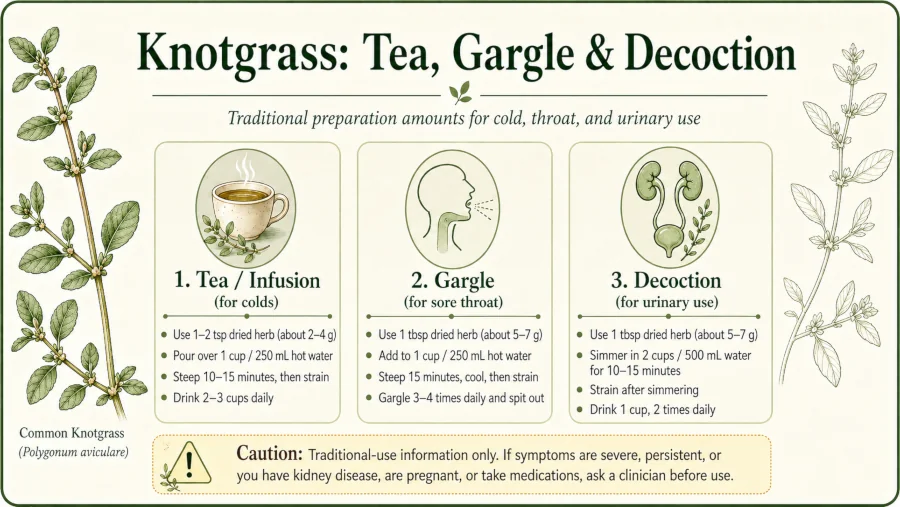
The figures below come straight from the EMA monograph for licensed knotgrass-herb products and apply to adults and adolescents over 12 only [EMA, 2016]. They are not a prescription — a quick word with a pharmacist before you start is sensible, especially for the urinary use.
| Use | Typical preparation | How often |
| Common cold | 1.5–2 g of cut dried herb in 150 mL boiling water, steeped as a tea | 3–4 times a day (4.5–8 g daily) |
| Sore mouth or throat | 1.5 g in 200–250 mL water as a decoction, cooled, used to gargle | 4–5 times a day (6–7.5 g daily) |
| Urinary flushing | 3 g in 200 mL water as a decoction; keep fluid intake up | 2 times a day (6 g daily) |
On timing: if cold or throat symptoms last more than a week, or urinary symptoms more than two weeks, or if anything worsens, stop and see a clinician [EMA, 2016]. For sore throats, gentler kitchen options such as honey, warm salt-water gargles, or a cloves infusion are also worth considering.
A note on the old advice to “drink as much as you like — knotgrass has no toxic effects.” That claim is not supported. The EMA records that tests for reproductive toxicity, genetic damage, and cancer-causing potential have simply never been done on this herb [EMA, 2016]. “No reported problems” is not the same as “proven safe at any dose.” Stay within the amounts above.
Safety, side effects, and who should skip it
At the time of its review, the EMA had no reported side effects on file for knotgrass-herb medicines [EMA summary, 2016]. That is reassuring for short-term use at traditional doses, but the absence of reports partly reflects how little it has been formally studied. A few groups should avoid it or check first.
Who should avoid knotgrass
- Children under 12 — use has not been established and is not recommended.
- People who are pregnant or breastfeeding — safety has not been established, so use is not recommended.
- Anyone told to limit fluids — for example with severe heart or kidney disease — should not use the urinary “flushing” approach, which depends on drinking more water.
- Anyone allergic to knotgrass or other Polygonaceae plants.
Possible interactions
No drug interactions have been formally reported [EMA, 2016], but two cautions follow from basic pharmacology rather than from studies. Tannin-rich teas can blunt the absorption of iron and of some medications if taken at the same time, so separate them by a couple of hours. And because knotgrass is mildly diuretic, combining large amounts with prescription water pills or with lithium is a reasonable thing to clear with a pharmacist first. These are sensible precautions, not documented dangers.
When to see a doctor instead of self-treating
Stop the herb and seek care if, during use:
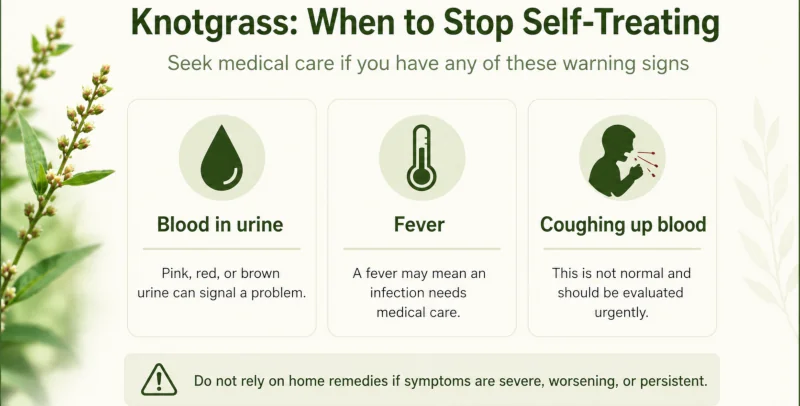
- You develop a fever, painful or burning urination, flank pain, spasms, or blood in your urine — these point to a urinary infection that needs proper treatment.
- A cough, sore throat, or cold runs past the one-week mark or gets worse, or a urinary complaint runs past two weeks.
- You ever cough up or vomit blood, see blood in your stool, or have heavy unexplained bleeding — treat these as urgent, not as something for an herb.
Realistic expectations
Knotgrass is a gentle traditional remedy for minor, short-lived complaints. At best it may take a little edge off cold symptoms, soothe a raw throat as a gargle, or nudge urine output. It is not a tonic to take indefinitely, not a treatment for any diagnosed disease, and not a substitute for seeing a clinician when something doesn’t settle. Herbs in the same gentle category — for instance nasturtium, another plant with a folk reputation for urinary support — carry the same caveat: mild help at most, and no replacement for medical care.
| Health Disclaimer: This article is for general education only and is not medical advice. It is not a substitute for diagnosis, treatment, or guidance from a qualified healthcare professional. Knotgrass (Polygonum aviculare) is a traditional remedy for minor complaints; it has not been proven to treat, cure, or prevent any disease. Do not use it to manage internal bleeding, a persistent cough, a suspected infection, or any serious symptom. If you are pregnant, breastfeeding, under 12, taking prescription medication, or living with a chronic condition, talk to a doctor or pharmacist before using any herbal product. Seek prompt medical care for red-flag symptoms such as coughing up or vomiting blood, blood in the urine or stool, high fever, or heavy unexplained bleeding. |
Frequently Asked Questions
Is knotweed the same as Japanese knotweed?
No. This article is about common knotgrass (Polygonum aviculare), a small roadside herb. Japanese knotweed (Reynoutria japonica) is a tall invasive plant grown for resveratrol and used in some Lyme protocols. They are different plants with different uses.
What is knotgrass tea actually good for?
Can knotgrass stop bleeding?
It has an old folk reputation as a styptic because of its tannins, but there is no reliable evidence it controls bleeding, and modern regulators do not endorse it for that. Any internal bleeding is a medical emergency, not a job for an herb.
Is it safe to drink every day?
Short-term use at traditional doses has no reported side effects, but long-term safety has not been studied, and tests for reproductive, genetic, and cancer-related risks were never done [EMA, 2016]. Use it for short bouts of minor symptoms rather than as a daily habit.
Who shouldn’t use it?
Children under 12, anyone pregnant or breastfeeding, people who must limit fluids (such as those with severe heart or kidney disease), and anyone allergic to it. If you take regular medication, check with a pharmacist first.
References
- Pamplona-Roger GD. Encyclopedia of Medicinal Plants. Editorial Safeliz, 2000 (print; historical/traditional reference). → View source
- European Medicines Agency, Committee on Herbal Medicinal Products. European Union herbal monograph on Polygonum aviculare L., herba (EMA/HMPC/143658/2015). 2016. → View source
- European Medicines Agency. Polygoni avicularis herba (knotgrass herb): summary for the public. 2016. → View source
- European Medicines Agency, HMPC. Assessment report on Polygonum aviculare L., herba (EMA/HMPC/143659/2015). 2016. → View source
- Clinical effect of a Mexican sanguinaria extract (Polygonum aviculare L.) on gingivitis. (60 male students; oral rinse, 2 weeks.) PMID 11137347. 2001. → View source
- Medicinal uses, phytochemistry, pharmacology, and taxonomy of Polygonum aviculare L.: a comprehensive review. Medicinal Chemistry Research. DOI 10.1007/s00044-023-03021-1. 2023. → View source
- Hsu C-Y. Antioxidant activity of extract from Polygonum aviculare L. Biological Research. PMID 16874403. 2007. → View source
- Simultaneous quantification and peroxynitrite-scavenging activities of flavonoids in Polygonum aviculare L. herb. PMID 24270289. 2014. → View source
- Polygonum aviculare L. and its active compounds activate the Wnt/β-catenin pathway and induce cutaneous wound healing (mouse study). PMID 26929003. 2016. → View source
- Yoon J-J, et al. Protective effects of ethanolic extract from rhizome of Polygoni avicularis against renal fibrosis and inflammation in a diabetic nephropathy model (rat study). Int J Mol Sci. DOI 10.3390/ijms22137230. 2021. → View source
