
The best-supported mango health benefits are the plain nutritional ones. A cup of fresh mango gives you about two-thirds of a day’s vitamin C, a useful amount of folate, some fiber, and the orange carotenoids your body turns into vitamin A, all for roughly 100 calories [USDA, 2026]. That makes mango a good fruit to eat. It doesn’t make it a treatment.
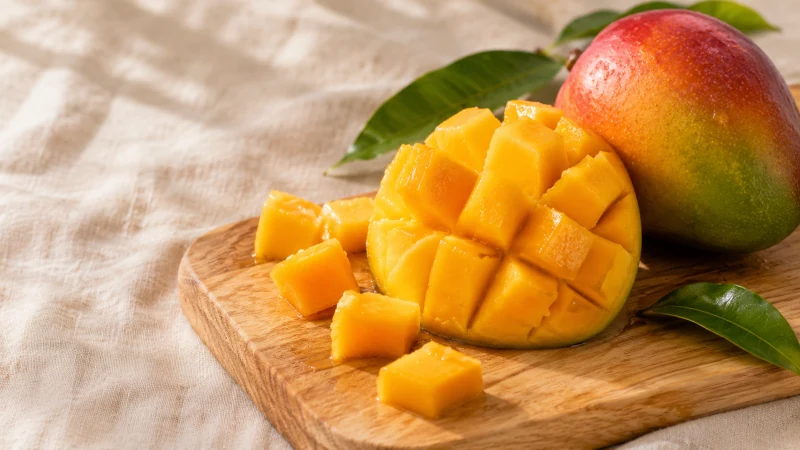
Small human trials suggest mango may ease constipation and may be kinder to blood sugar and insulin than a processed sweet snack. Those studies are short, small, and mostly paid for by the mango industry, so read them as promising. Claims that mango treats eczema, restores failing eyesight, or clears arteries have no good human evidence behind them. And a few people need to take care with it: anyone on a potassium limit for kidney disease, people taking warfarin, and people who react to poison ivy.
Mango nutrition facts: what’s in a cup
Mango flesh is about 83% water. Nearly all of its calories come from carbohydrate, mostly natural sugars (sucrose, fructose and glucose), with very little protein or fat [USDA, 2026]. Here is what one cup of fresh pieces, about 165 grams, provides.
| Nutrient | Amount per cup (165 g) | Share of Daily Value |
| Calories | about 99 | – |
| Carbohydrate | about 25 g | – |
| Total sugars | about 23 g | – |
| Fiber | about 2.6 g | – |
| Vitamin C | about 60 mg | about 67% |
| Folate | about 71 mcg | about 18% |
| Vitamin A (as carotenoids) | about 89 mcg RAE | about 10% |
| Vitamin E | about 1.5 mg | about 10% |
| Potassium | about 277 mg | about 6% |
| Sodium | about 2 mg | under 1% |
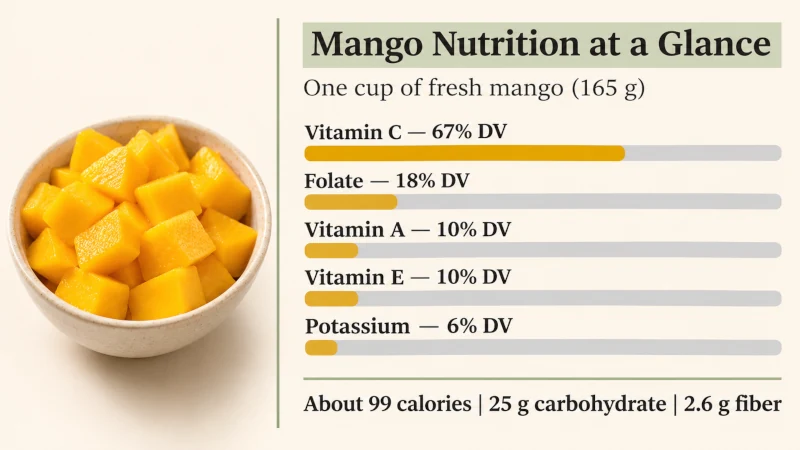
Amounts are scaled from USDA values per 100 g [USDA, 2026]. Percentages are calculated against the FDA Daily Values listed in the NIH fact sheets for each nutrient [NIH ODS, 2025] [NIH ODS, 2018] [NIH ODS, 2022a] [NIH ODS, 2026] [NIH ODS, 2022b].
Vitamin C is the headline. One cup supplies about 60 mg against a Daily Value of 90 mg [NIH ODS, 2025].
The vitamin A story is more modest than mango’s color suggests. The fruit holds no ready-made vitamin A. It supplies beta-carotene, and your body needs about 12 micrograms of beta-carotene from food to make a single microgram of vitamin A [NIH ODS, 2022a]. The NIH’s food table lists a whole mango at 112 mcg RAE, or 12% of the Daily Value [NIH ODS, 2022a]. That is a helpful contribution, though carrots and cantaloupe both deliver more per serving.
Vitamin E is a small extra: half a cup of sliced mango has 0.7 mg, about 5% of the Daily Value [NIH ODS, 2026].
One botanical detail matters later. Mango (Mangifera indica) belongs to the Anacardiaceae family, which also includes cashew, pistachio and poison ivy [Berghea et al., 2021].
Mango health benefits, ranked by evidence
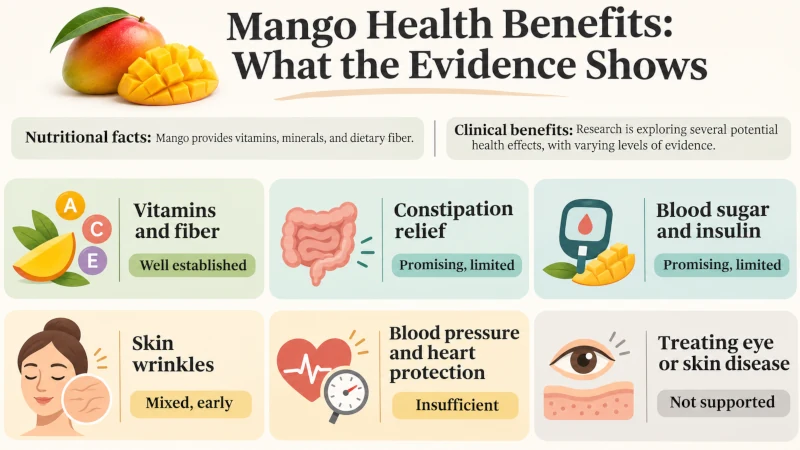
Most of what gets said about mango mixes solid nutrition with hopeful extrapolation. This table separates them.
| Claim | What the evidence is | Rating |
| Supplies vitamin C, folate, fiber and carotenoids | Food composition data, plus well-understood roles for these nutrients | Well established |
| Eases constipation | One four-week pilot trial comparing mango with a fiber supplement | Promising, limited |
| Gentler on blood sugar and insulin than a processed sweet snack | Two small trials in adults with overweight or obesity, both industry-funded | Promising, limited |
| Reduces wrinkles | One pilot study with no mango-free comparison group; the larger portion did worse | Mixed, early |
| Lowers blood pressure | Evidence for potassium itself is inconclusive; a 12-week mango trial found no change | Insufficient |
| Protects arteries or prevents heart disease | Fruit-rich diets are linked with lower risk; antioxidant pills failed in trials; no mango trial has measured heart outcomes | Insufficient for mango itself |
| Treats eczema, night blindness or other eye disease | No human trials of mango located for these uses | Not supported |
Vitamin C, folate and fiber: the solid ground
Your body needs vitamin C to build collagen, the protein that holds skin and connective tissue together and helps wounds heal. Vitamin C also improves absorption of the iron found in plant foods [NIH ODS, 2025]. Eat mango alongside beans or lentils and you get a little more out of them.
Folate deserves more attention than it gets. A cup of mango provides roughly 71 mcg, around 18% of the 400 mcg Daily Value [USDA, 2026] [NIH ODS, 2018]. Add about 2.6 grams of fiber and you have a sweet food that brings something with it.
Digestion and constipation
In a pilot trial, adults with chronic constipation ate 300 grams of mango a day for four weeks or took an equivalent amount of fiber. Both groups improved. The mango group did better on stool frequency, consistency and shape, and showed lower levels of two inflammation markers in the blood [Venancio et al., 2018]. The authors call it a pilot and ask for larger studies, and the National Mango Board, an industry group, has described the research as partly funded by it.
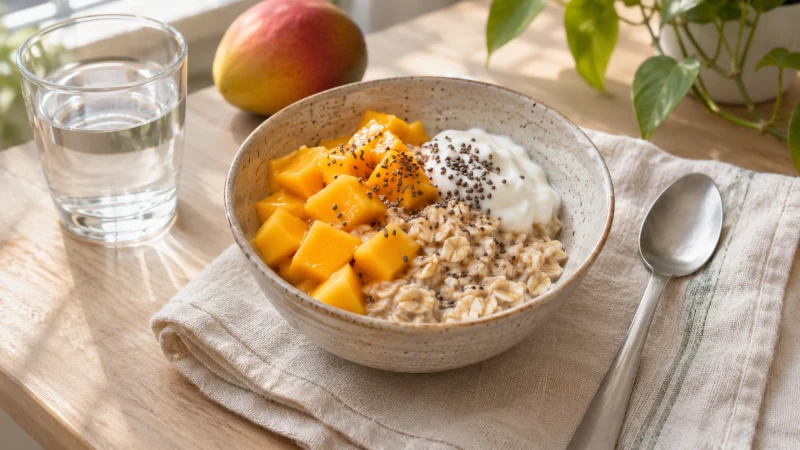
So mango is a reasonable thing to try if you’re mildly backed up, alongside water and other high-fiber foods for digestion. Prunes are the better-known fruit for this job, and the evidence on prunes and plums is worth a look too.
Blood sugar and insulin
Mango is sweet, so this is the question people worry about most. Two trials are reassuring, with caveats.
In a four-week randomized trial, adults with overweight or obesity and low-grade inflammation ate about a cup of mango twice a day or a calorie-matched Italian ice. Forty-eight people finished. Those eating mango ended with lower fasting insulin and a better insulin-resistance score (HOMA-IR 2.28 versus 4.67). Fasting glucose did not differ between groups, and neither did the inflammation markers the researchers had expected to move [Pett et al., 2025].
A 12-week crossover trial compared a daily 100-calorie mango snack with 100 calories of low-fat cookies. Blood glucose and C-reactive protein fell during the mango period. Body weight, blood pressure, insulin and cholesterol did not change [Rosas et al., 2022].
Both studies were funded by the National Mango Board, both were small, and both compared mango with a sugary processed snack. What they show is that swapping cookies for mango looks like a good trade. They don’t show that adding mango to your diet treats or prevents diabetes.
Skin
Vitamin C’s role in collagen is established [NIH ODS, 2025]. Whether eating mango visibly changes your skin is a separate question, and the one study on it is hard to read. Twenty-eight postmenopausal women with fair skin ate either 85 grams or 250 grams of Ataulfo mango four times a week for 16 weeks. In the smaller-portion group, deep wrinkles on one side of the face measured 23% less severe at eight weeks and 20% less at 16 weeks. In the larger-portion group, several wrinkle measures got worse. There was no group that ate no mango, and the study was funded by the National Mango Board [Fam et al., 2020].
That is an interesting pilot, and nothing more yet. No human trial supports eating mango to treat eczema or other skin conditions, and eating large amounts for your skin has no backing at all.
Heart and blood pressure
People who eat more fruit and vegetables tend to have less cardiovascular disease. A 2017 review of 95 observational studies found that pattern [NCCIH, 2023]. Mango fits comfortably into that kind of diet, which is the honest case for it.
The stronger claim, that mango’s antioxidant vitamins protect artery walls, runs into a problem. When vitamin C, vitamin E and beta-carotene were tested as supplements in large trials, they did not prevent cardiovascular disease, and the U.S. Preventive Services Task Force recommends against beta-carotene or vitamin E supplements for that purpose [NCCIH, 2023] [NIH ODS, 2026]. Whatever benefit fruit provides, it doesn’t reduce to those three vitamins. For the bigger picture, see foods for healthy arteries.
On blood pressure, mango is naturally very low in sodium and contributes some potassium. But the NIH describes the evidence that potassium lowers blood pressure as suggestive, not conclusive [NIH ODS, 2022b], and the 12-week mango trial above found no change in blood pressure [Rosas et al., 2022]. Some herbal sources also call mango a diuretic; none of the sources reviewed for this article supports that. If you have hypertension or heart disease, mango is a fine food to include. It is not part of your treatment.
Eyes
Vitamin A is necessary for vision, and night blindness is the earliest sign of deficiency. In the United States, though, frank deficiency is rare, with under 1% of people showing low blood levels [NIH ODS, 2022a]. Mango helps you meet your needs. No evidence shows it treats night blindness from other causes, optic nerve damage, or a blocked retinal artery, and none of the popular herbs for eye health is proven to restore vision either.
How much mango to eat, and how to eat it
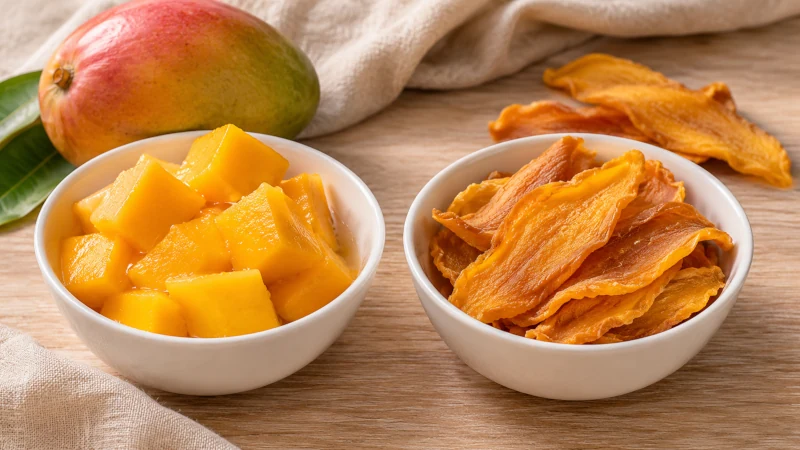
Most adults are advised to eat 1½ to 2 cups of fruit a day [USDA MyPlate, n.d.]. A cup of mango covers half of that or more, and there’s no reason it can’t be a daily habit if it fits your carbohydrate needs.
Fresh is the best way to eat it. A good mango has little fiber and a smooth, aromatic pulp reminiscent of a peach; a poor one is stringy, with a turpentine edge. Mangos are picked green, so let a firm one ripen on the counter until it gives slightly, then move it to the refrigerator.
Wash the fruit under running water before you cut it, even though you won’t eat the peel, so the knife doesn’t carry dirt and bacteria into the flesh. Keep cut mango refrigerated at 40°F or below [FDA, 2024].
Dried mango is the same fruit with the water removed, which makes it easy to overeat: half a cup of dried fruit counts as a full cup [USDA MyPlate, n.d.]. Check labels on dried mango, nectar, jams and fruit canned in syrup for added sugar.
Mango side effects and who should be careful
For most people mango causes no problems. These are the exceptions.
Allergy and skin reactions

The peel, and roughly the first 5 millimeters of flesh beneath it, contain compounds related to urushiol, the irritant in poison ivy and poison oak. In sensitive people, contact can cause an itchy, blistering rash around the mouth or on the hands, sometimes the first time they handle a mango. This is rare: one review found only 37 published cases. A history of poison ivy reactions has been linked to it in some studies, though not all [Berghea et al., 2021].
If that sounds like you, have someone else peel the fruit, cut the flesh well away from the skin, and don’t bite into the peel.
Mango can also cause immediate allergic reactions, from an itchy mouth to hives, wheezing and, rarely, anaphylaxis. Mouth itching is more likely in people with birch or mugwort pollen allergy, and mango shares allergens involved in latex–fruit reactions [Berghea et al., 2021].
Diabetes and carbohydrate counting
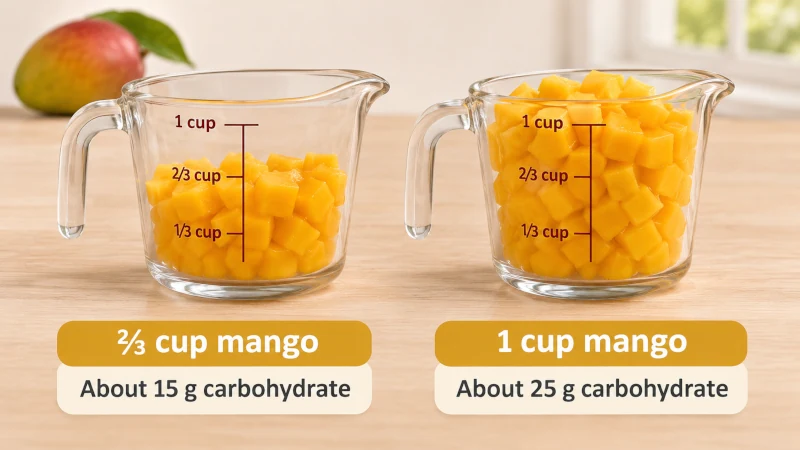
You don’t have to avoid mango because it tastes sweet. What affects blood sugar most is the total carbohydrate you eat, and one fruit serving for meal planning is the amount containing about 15 grams of carbohydrate [Mayo Clinic, 2025]. By USDA figures that is about 100 grams of mango, or roughly two-thirds of a cup [USDA, 2026]. A full cup is closer to 25 grams. Count it, check your own glucose response, and ask your diabetes care team if you’re unsure where it fits.
Kidney disease and potassium
A cup of mango has about 277 mg of potassium [USDA, 2026], and the National Kidney Foundation lists a medium mango among higher-potassium fruits, meaning 200 mg or more per serving [National Kidney Foundation, 2023]. If you’ve been told to limit potassium, or you take an ACE inhibitor, an ARB or a potassium-sparing diuretic and have reduced kidney function [NIH ODS, 2022b], ask your kidney dietitian how much mango fits your plan. Not everyone with kidney disease needs to restrict it.
Warfarin
The evidence here is limited and worth knowing about. Case reports, and a small study of 15 people on long-term warfarin, describe INR readings rising after people ate one to three mangos a day for anywhere from five days to a month, then settling after they stopped. In that study, average INR was 4.57 during mango intake and 2.45 afterward [Rattanasuwan et al., 2025]. A 2025 review lists more than one mango a day as a possible warfarin potentiator while stressing that the evidence is too thin for firm conclusions [Talasaz et al., 2025].
If you take warfarin, an occasional serving is unlikely to matter, but don’t start eating several mangos a day without telling your anticoagulation clinic.
Pregnancy and breastfeeding
Mango eaten as food is an ordinary part of a pregnancy or breastfeeding diet, and its folate is a small plus: the recommended intake rises to 600 mcg a day in pregnancy [NIH ODS, 2018]. It doesn’t replace a prenatal vitamin. Wash the fruit before cutting [FDA, 2024]. Everything here is about the fruit; concentrated mango leaf, bark or seed extracts sold as supplements are different products, and nothing in this article speaks to their safety.
When to get medical help
- Call emergency services for trouble breathing, swelling of the tongue or throat, widespread hives, or faintness after eating mango.
- Treat sudden vision loss as an emergency. No food will fix it, and delay can cost sight.
- Contact your prescriber promptly if you take warfarin and notice unusual bruising, nosebleeds, or blood in urine or stool.
- See a clinician for a rash that blisters or spreads, constipation that lasts more than a few weeks, or constipation with blood, weight loss or severe pain.
| HEALTH DISCLAIMER: This article is for general education. It is not medical advice and cannot diagnose or treat any condition. Mango is a food, and no food replaces prescribed treatment. If you have diabetes, kidney disease, a food allergy, or take warfarin or blood pressure medicine, or if you are pregnant or breastfeeding, talk with your doctor, pharmacist or a registered dietitian before making significant changes to what you eat. |
Frequently Asked Questions
Can I eat mango every day?
Yes, for most people. A cup a day fits within the 1½ to 2 cups of fruit most adults are advised to eat [USDA MyPlate, n.d.]. The exceptions are covered above: potassium limits, warfarin, allergy, and carbohydrate targets if you have diabetes.
Can you eat mango skin?
There’s no good reason to. The peel carries the highest concentration of the compounds that cause mango rash in sensitive people [Berghea et al., 2021], and it is tough and bitter. Peel it and eat the flesh.
Is dried mango as healthy as fresh?
It is the same fruit in a much smaller package. Half a cup of dried fruit counts as a whole cup [USDA MyPlate, n.d.], so the sugar and calories add up quickly, and many brands add sugar on top. Treat it as a small portion and read the label.
Does mango help with weight loss?
Not directly. In the two snack trials, people eating mango didn’t lose weight. In one, the group eating a calorie-matched frozen dessert gained about 0.9 kg over four weeks while the mango group held steady [Pett et al., 2025]; in the other, weight didn’t change during the mango period [Rosas et al., 2022]. Mango is a sensible replacement for sweets. It isn’t a weight-loss food.
References
- Berghea EC, Craiu M, Ali S, Corcea SL, Bumbacea RS. Contact Allergy Induced by Mango (Mangifera indica): A Relevant Topic? Medicina (Kaunas). View source
- Fam VW, Holt RR, Keen CL, Sivamani RK, Hackman RM. Prospective Evaluation of Mango Fruit Intake on Facial Wrinkles and Erythema in Postmenopausal Women: A Randomized Clinical Pilot Study. View source
- U.S. Food and Drug Administration. Selecting and Serving Produce Safely. View source
- Mayo Clinic Staff. Diabetes diet: Should I avoid sweet fruits? View source
- National Kidney Foundation. Potassium in Your CKD Diet. View source
- National Center for Complementary and Integrative Health. Antioxidant Supplements: What You Need To Know. View source
- NIH Office of Dietary Supplements. Folate: Fact Sheet for Health Professionals. View source
- NIH Office of Dietary Supplements. Vitamin A and Carotenoids: Fact Sheet for Health Professionals. View source
- NIH Office of Dietary Supplements. Potassium: Fact Sheet for Health Professionals. View source
- NIH Office of Dietary Supplements. Vitamin C: Fact Sheet for Health Professionals. View source
- NIH Office of Dietary Supplements. Vitamin E: Fact Sheet for Health Professionals. View source
- Pett KD, Alex PG, Weisfuss C, Sandhu A, Burton-Freeman B, Edirisinghe I. Mango Consumption Is Associated with Increased Insulin Sensitivity in Participants with Overweight/Obesity and Chronic Low-Grade Inflammation. View source
- Rattanasuwan P, Lertpongpipat P, Hiranchatchawal N, et al. Metabolic insights into the warfarin-mango interaction: View source
- Rosas M, Pinneo S, O’Mealy C, et al. Effects of fresh mango consumption on cardiometabolic risk factors in overweight and obese adults. View source
- Talasaz AH, McGonagle B, HajiQasemi M, et al. Pharmacokinetic and Pharmacodynamic Interactions between Food or Herbal Products and Oral Anticoagulants: View source
- U.S. Department of Agriculture, Agricultural Research Service. View source
- U.S. Department of Agriculture. MyPlate: Fruits. View source
- Venancio VP, Kim H, Sirven MA, Tekwe CD, Honvoh G, Talcott ST, Mertens-Talcott SU. Polyphenol-rich Mango (Mangifera indica L.) Ameliorate Functional Constipation Symptoms in Humans beyond Equivalent Amount of Fiber. View source


