If you have just been diagnosed, the list of foods to avoid with celiac disease comes down to a single protein: gluten. Remove every source of it, completely and for life, and your small intestine can heal. Keep eating it — even amounts too small to taste — and the damage continues, whether or not you feel sick [NIDDK, 2022].
The rule is simple. The hard part is that gluten hides in foods you would never suspect, from soy sauce to some medicines. Below are the six foods to avoid, the sneaky sources that trip people up, and two foods you may have been told to skip that you probably do not need to.
| The short version Avoid wheat, barley, and rye, plus anything made from them. Skip regular oats unless they are certified gluten-free, avoid beer and malt drinks, and read labels on processed foods, where gluten hides most often. There is no safe small amount and no cheat day. |
What celiac disease is, in plain terms
Celiac disease is an autoimmune condition. When you eat gluten — the protein in wheat, barley, and rye — your immune system responds by attacking the lining of your small intestine [Mayo Clinic, 2022]. Over time that flattens the villi, the tiny folds that absorb nutrients, which is why untreated celiac disease can lead to anemia, bone loss, and vitamin deficiencies.
It is not the same as a wheat allergy or non-celiac gluten sensitivity. With gluten sensitivity you may feel bloated or tired after eating gluten, but there is no lasting intestinal damage [NIDDK, 2022]. The only treatment for celiac disease is a strict, lifelong gluten-free diet — no pill, no cheat day [Columbia, 2024].
One thing to settle before you change anything: get tested first. Celiac blood tests and the confirming biopsy only work while you are still eating gluten. Cut it out beforehand and the results can come back falsely normal [Mayo Clinic, 2022].
The 6 foods to avoid with celiac disease
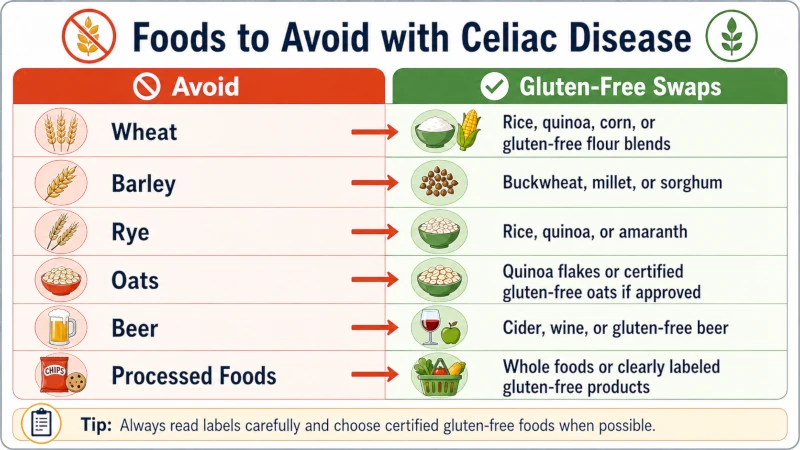
Three grains carry the gluten that triggers celiac disease: wheat, barley, and rye. The other three items on this list are simply where those grains hide.
1. Wheat — in all its disguises
Wheat is the obvious one, but it travels under many names. Bread, pasta, cereal, crackers, cakes, cookies, pizza, and most baked goods contain it. So do ingredients that never spell out “wheat”: semolina, durum, spelt, farro, einkorn, kamut, couscous, bulgur, and triticale, a wheat-rye cross [Celiac Disease Foundation]. Wheat flour also works as a thickener in gravies, sauces, and soups. If a label lists any of these, the food is off the table.
2. Barley and malt
Barley contains gluten, and it is easy to miss because it usually shows up as “malt.” Malt is made from barley, so malt syrup, malt extract, malt flavoring, malted milk, and malt vinegar all carry gluten [Celiac Disease Foundation]. Barley also turns up in some soups, stews, and breakfast cereals.
3. Rye
Rye is the third gluten grain. You will find it in rye bread, pumpernickel, some crispbreads and crackers, and a few cereals. It is less common than wheat, but the rule is identical — avoid it entirely. If bread is what you will miss, our guide to digestive problems with bread walks through gluten-free and lower-gluten alternatives.
4. Regular oats
Oats cause the most confusion. Pure oats do not naturally contain the gluten that harms people with celiac disease. The problem is contamination: oats are grown, harvested, and milled alongside wheat and barley, so standard oats pick up enough gluten to cause a reaction. In one published assessment, none of three common U.S. oat brands could be relied on to be gluten-free [Thompson, 2004].
Two practical points. Eat only oats labeled “gluten-free,” which under U.S. rules must test below 20 parts per million of gluten [FDA, 2023]. And note that a small share of people with celiac disease react to oats even when certified pure, so reintroduce them slowly and watch for symptoms [Health Canada].
5. Beer and malt beverages
Most beer is brewed from barley, which puts it on the avoid list whether or not it contains alcohol [Mayo Clinic, 2024]. Ales, lagers, and malted drinks share the problem. Plain wine and distilled spirits are generally gluten-free because distillation removes the protein, but “gluten-removed” beers are a grey area and best approached with caution. When in doubt, choose a drink that was never made from a gluten grain.
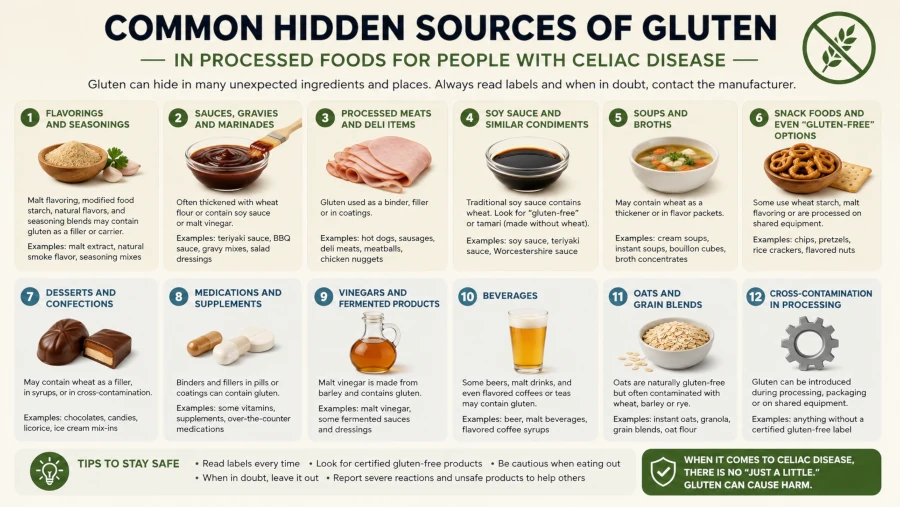
This is where most accidental exposure happens. Gluten is used as a thickener, binder, and flavoring in foods that have nothing to do with bread: soy sauce (usually made with wheat), many salad dressings and marinades, canned soups and bouillon, processed deli meats and sausages, imitation seafood, seasoned chips, and gravy mixes [Harvard Health]. Sausages and other processed meats deserve a special flag, since they often use wheat flour or gluten as a binder. The only reliable defense is reading the ingredient list every time, because recipes change without warning.
Use this quick reference when you are shopping or clearing out the pantry.
| Avoid | Where it hides | Naturally gluten-free swap |
| Wheat | Bread, pasta, baked goods, semolina, spelt, couscous, sauce thickeners | Rice, corn, quinoa, certified GF pasta |
| Barley | Malt syrup, malt vinegar, malted drinks, some soups and cereals | Buckwheat, millet, sorghum |
| Rye | Rye bread, pumpernickel, some crackers and cereals | Certified GF bread, corn tortillas |
| Regular oats | Oatmeal, granola, many cereal and snack bars | Certified gluten-free oats |
| Beer / malt drinks | Ale, lager, malt beverages | Wine, cider, distilled spirits (check labels) |
| Processed foods | Soy sauce, dressings, deli meats, sausages, soups, seasoned snacks | Single-ingredient whole foods; GF-labeled products |
Two foods you were probably told to avoid (but may not need to)
A lot of older advice tells people with celiac disease to cut dairy and fat. For most people, that is not necessary once the gut starts to heal.
Dairy. A damaged intestinal lining can temporarily make less lactase, the enzyme that digests milk sugar. That may cause bloating or loose stools after dairy in the early months, but it usually fades as the intestine recovers on a gluten-free diet [Columbia, 2024]. If plain dairy bothers you at first, lactose-free milk and yogurt (often better tolerated) are easy stand-ins. If those early weeks bring frequent loose stools, our list of foods that help with diarrhea may make the transition gentler.
Fat. Greasy, foamy, floating stools — called steatorrhea — happen when a damaged intestine cannot absorb fat properly [NIDDK, 2022]. That is a sign of active disease, not a reason to follow a low-fat diet forever. As the lining heals, fat absorption returns to normal. Eating gentle, fiber-friendly foods that support the intestines can help while your gut recovers.
The takeaway: the food you must avoid is gluten. If dairy or fatty meals cause trouble early on, that is usually temporary — talk to a dietitian before cutting whole food groups for life.
How to read a gluten-free label
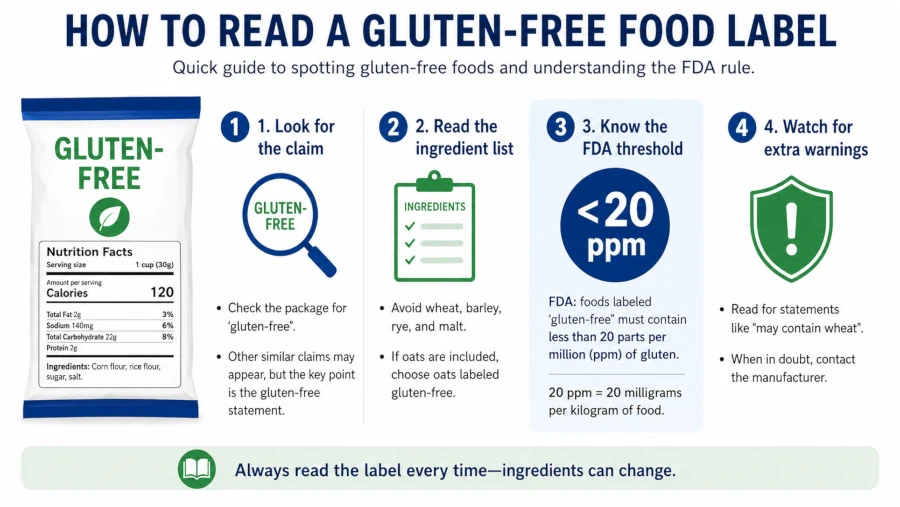
In the U.S., the FDA only allows a food to be labeled “gluten-free” if it contains less than 20 parts per million of gluten [FDA, 2023]. The same threshold applies to “no gluten,” “free of gluten,” and “without gluten.” That level is low enough that most people with celiac disease can eat these foods safely [FDA, 2023].
A few label habits worth building:
- A “gluten-free” claim is your fastest green light — but still scan the ingredients [Celiac Disease Foundation].
- “Contains wheat” is a quick red flag. Its absence does not guarantee safety, because barley and rye are not on the U.S. top-allergen list [Celiac Disease Foundation].
- “Wheat-free” does not mean “gluten-free.” A wheat-free food can still contain barley or rye.
- Watch for malt, brewer’s yeast, and “modified food starch” derived from wheat.
Cross-contact: the gluten you cannot see
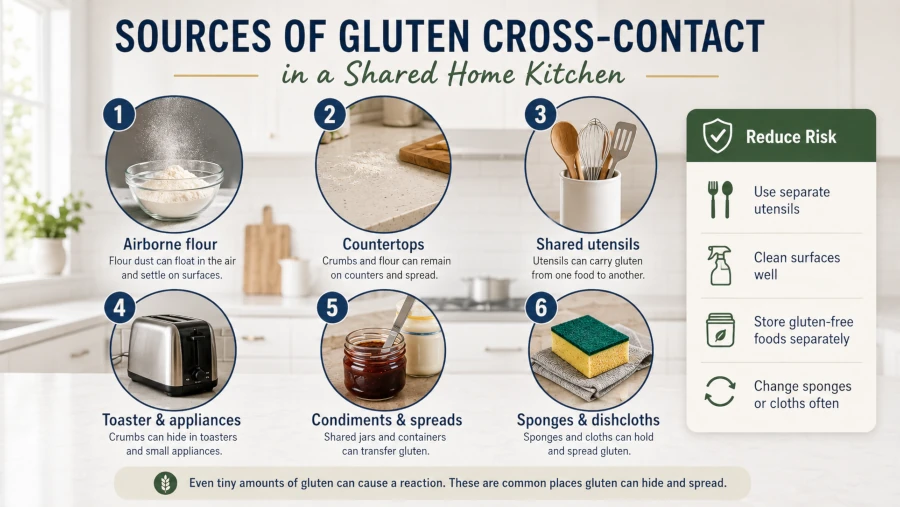
Even careful shopping will not help if gluten sneaks in during cooking. Cross-contact happens when gluten-free food touches a gluten surface or utensil [Celiac Disease Foundation]. Common culprits at home: a shared toaster, a spoon used in regular pasta water, a knife double-dipped into butter or jam after touching bread, and flour drifting through the air, which can settle on surfaces for hours [Celiac Disease Foundation]. Keep a dedicated toaster or toaster bags, separate condiment jars, and clean pans. Eating out, ask how a dish is prepared and whether fried foods share a fryer with breaded items.
What you can still eat
Plenty. Naturally gluten-free foods include all fresh meat, fish, eggs, fruits, vegetables, legumes, nuts, and plain dairy [MedlinePlus]. Gluten-free grains and substitutes include rice, corn, quinoa, buckwheat, millet, amaranth, sorghum, and certified gluten-free oats [Columbia, 2024]. For a fuller rundown of pantry staples and surprising safe foods, see our list of naturally gluten-free foods.
When to see a doctor
A gluten-free diet resolves most celiac symptoms, but some situations need medical attention rather than self-care.
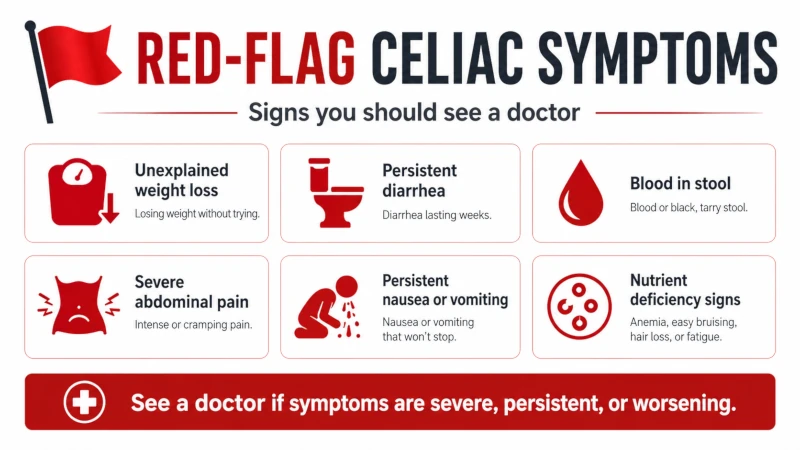
See a doctor if you have:
- ongoing diarrhea, unexplained weight loss, or signs of anemia such as fatigue, pale skin, or breathlessness
- symptoms that persist or come back despite a careful gluten-free diet, which can point to hidden gluten or, rarely, refractory celiac disease [NIDDK, 2022]
Seek urgent care for severe abdominal pain, repeated vomiting, or signs of dehydration. And remember the order of operations: get tested before going gluten-free, because removing gluten first can mask celiac disease and make an accurate diagnosis harder [Mayo Clinic, 2022].
| Health disclaimer This article is for general education only and is not a substitute for professional medical advice, diagnosis, or treatment. Celiac disease needs to be diagnosed and managed with a qualified clinician, and you should get tested before starting a gluten-free diet. If you are pregnant, breastfeeding, or have another medical condition, talk with your doctor or a registered dietitian before making major dietary changes. Always seek the advice of a healthcare professional with any questions about your health. |
Frequently Asked Questions
Can people with celiac disease ever eat oats?
Often, yes — but only oats labeled gluten-free, which are processed to avoid contamination with wheat and barley [FDA, 2023]. A small number of people react to oats even when pure, so add them back slowly and watch for symptoms [Health Canada].
Is a little gluten now and then okay?
No. Even trace amounts can keep the immune reaction going and damage the small intestine, often without any noticeable symptoms [NIDDK, 2022]. There is no safe occasional dose.
Do I have to give up dairy if I have celiac disease?
Usually not for good. Some people have temporary trouble with milk sugar early on because the damaged gut makes less lactase, but that typically improves as the intestine heals [Columbia, 2024]. Lactose-free options help in the meantime.
Is “wheat-free” the same as “gluten-free”?
No. A wheat-free product can still contain barley or rye, both of which have gluten. Look for a “gluten-free” label, not just “wheat-free” [Celiac Disease Foundation].
How long until I feel better after going gluten-free?
Many people notice symptoms easing within a few weeks, though full healing of the small intestine can take months to a couple of years, especially in adults [Mayo Clinic, 2024]. Consistency matters more than speed.
References
- National Institute of Diabetes and Digestive and Kidney Diseases. Celiac Disease (2022). → View source
- National Institute of Diabetes and Digestive and Kidney Diseases. Celiac Disease: Symptoms & Causes (2022). → View source
- Mayo Clinic. Celiac disease: Symptoms and causes (2022). → View source
- Mayo Clinic. Gluten-free diet (2024). → View source
- Celiac Disease Foundation. Sources of Gluten. → View source
- Celiac Disease Foundation. Label Reading & the FDA. → View source
- U.S. Food and Drug Administration. Gluten and Food Labeling (2023). → View source
- Health Canada. Gluten-related disorders and celiac disease. → View source
- Harvard Health Publishing. Celiac disease diet: Avoiding foods that contain gluten. → View source
- Columbia University Celiac Disease Center. Nutrition Center (2024). → View source
- MedlinePlus. Learn about gluten-free diets. → View source
- Thompson T. Gluten Contamination of Commercial Oat Products in the United States. N Engl J Med (2004). → View source
