
The Boneset plant (Eupatorium perfoliatum) is a bitter, wetland-growing plant that’s been used in North America since long before European settlement to bring down fevers, ease flu symptoms, and calm the aching that comes with a bad cold. That track record is real. What’s thinner is the modern research behind it — boneset has barely been studied in people, and most of what herbalists say about it rests on tradition rather than clinical trials. Here’s what boneset actually is, what the evidence supports, what’s still just tradition, and the genuine safety question — around liver-affecting compounds — that’s worth knowing before you try it.
What Is Boneset?
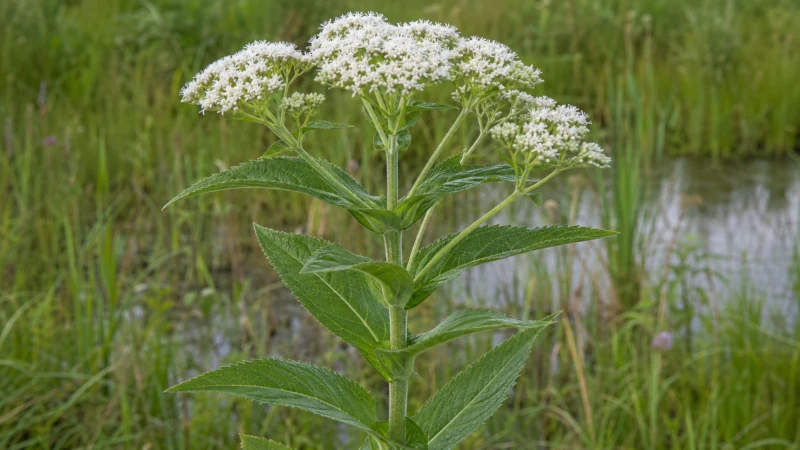
Boneset is the common name for Eupatorium perfoliatum, a hairy, clump-forming perennial in the daisy family (Asteraceae). [Missouri Botanical Garden] It grows several feet tall in wet meadows, marshes, and stream banks across the eastern half of the US and Canada. [NC State Extension] Its most recognizable feature is its leaves: they clasp the stem in opposite pairs that fuse at the base, so the stem appears to grow straight through the leaf — which is where the species name perfoliatum (“through the leaf”) comes from. [Missouri Botanical Garden] Small clusters of fuzzy white flowers appear from late summer into fall.
Other common names include thoroughwort, feverwort, agueweed, and sweating plant. [RxList] The leaves and flowering tops are the parts used medicinally, usually as a tea or tincture. [PeaceHealth]
A Long History as a Fever Remedy
Indigenous peoples across eastern North America used boneset for fevers and infections long before it entered colonial folk medicine, and settlers adopted the plant from them. [Wikipedia] By the 19th century, it had become a widely used home remedy for colds, flu, and a mosquito-borne illness then called “breakbone fever” — now recognized as dengue — whose severe joint and muscle pain is the likely source of the plant’s common name. [Missouri Botanical Garden]
What’s Actually in Boneset
Boneset contains a mix of sesquiterpene lactones (including compounds called euperfolin, euperfolitin, and eufoliatin), polysaccharides, and flavonoids. [PeaceHealth] In one laboratory study, a boneset polysaccharide stimulated immune cell activity in a test tube, which is often cited as a possible explanation for the plant’s traditional use against colds and flu. [PeaceHealth] Separately, extracts of the plant — along with an isolated flavonoid called eupafolin — reduced inflammatory signaling in cultured immune cells exposed to a bacterial irritant. [Maas et al., 2011]
Worth flagging up front: that’s cell-culture evidence, not evidence from people. A clinical-reference database used by hospital systems rates boneset’s support for cold and flu relief at its lowest confidence tier — traditional use, with essentially no clinical trial behind it. [PeaceHealth]
What the Evidence Says About Boneset’s Benefits
Fever, Sweating, and the Common Cold
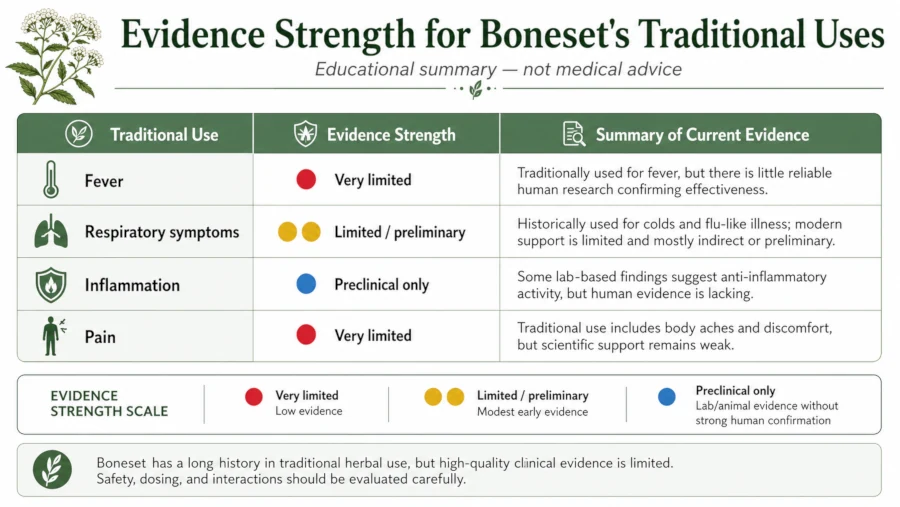
Boneset’s signature traditional use is as a diaphoretic — something that promotes sweating — taken warm at the first sign of a cold or flu to help “break” a fever. [PeaceHealth] This is a traditional-use claim; no clinical trial has tested whether boneset tea actually shortens a fever or a cold. The one human study that exists tested something different: a small, older trial compared a homeopathic dilution of boneset against aspirin for common cold symptoms. [RxList, citing Gassinger et al., 1981] A homeopathic dilution is far weaker than a tea or tincture, so that result doesn’t say anything about the herbal-strength product sold today — and a single decades-old trial wouldn’t be conclusive either way.
If you’re weighing boneset against other cold-and-flu options with more research behind them, this site’s herb-by-herb breakdown is worth a look. Boneset isn’t the only plant used this way, either — borage works through a similar sweat-inducing mechanism in European folk medicine.
Respiratory Symptoms
Boneset has long been used for productive coughs and general chest congestion. [Missouri Botanical Garden] [RxList] Like the fever use, this rests on tradition rather than controlled human research. If food-based support during a fever interests you alongside any herbal approach, this site’s fever-foods guide covers the dietary side.
Inflammation — Lab Evidence Only
The clearest modern research on boneset is at the cellular level. Extracts and the isolated compound eupafolin reduced nitric oxide production and several inflammatory cytokines in immune cells stimulated with a bacterial toxin. [Maas et al., 2011] Interestingly, that same study didn’t confirm the immune-stimulating effect that older folklore claims — it found anti-inflammatory activity instead. [Maas et al., 2011] That’s a useful clarification: boneset’s lab-confirmed mechanism looks more like calming an inflammatory response than “boosting” immunity, and those aren’t the same thing. None of this has been tested in people with an actual cold, flu, or inflammatory condition.
Aches and Pains
The “bone-set” name reflects old folk use for the deep muscle and joint aches of breakbone fever, not a demonstrated pain-relieving effect. [Missouri Botanical Garden] Herbalists still use it this way, but there’s no trial measuring pain relief from boneset specifically.
What Boneset Doesn’t Have Good Evidence For
Older write-ups sometimes list boneset for constipation, water retention, or general digestive support. A clinical evidence database rates every one of these as insufficient evidence to rate — not disproven, just not studied enough to say either way. [RxList] It’s also worth being direct about one thing: no herb, including boneset, prevents or treats COVID-19 or any other serious viral infection. In 2020, the FDA issued warning letters to several companies for marketing boneset-containing products — including one sold as “Coronavirus Boneset Tea” — with illegal claims that they could prevent or treat COVID-19. [FDA, 2020]
Safety, Side Effects, and Who Should Avoid Boneset
Boneset’s biggest safety question isn’t a rare allergic reaction — it’s a class of naturally occurring plant chemicals.
The Pyrrolizidine Alkaloid Question
Several plants closely related to boneset are known to contain pyrrolizidine alkaloids (PAs), compounds that can damage the liver with repeated exposure. Whether boneset itself contains meaningful amounts was, for years, genuinely disputed.
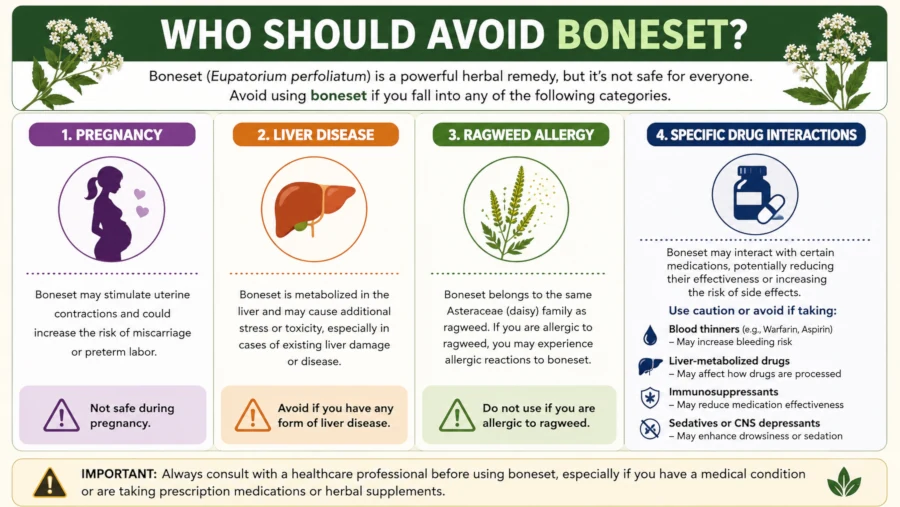
A 2018 chemical analysis largely settled the question: testing 49 boneset samples found detectable dehydropyrrolizidine alkaloids in all of them, at low but variable concentrations, with alcohol tinctures and hot-water infusions containing the highest levels. [Colegate et al., Phytochemical Analysis, 2018] The researchers concluded this is reason for caution until the actual risk at typical consumer doses is better defined. [Colegate et al., 2018] No human liver-injury case has been directly linked to boneset specifically, and older clinical-reference guidance rated its PA content as “minimal” [PeaceHealth] — but the more recent chemical analysis is more rigorous, and both sources agree on the practical takeaway: don’t use boneset long-term, and avoid it entirely if you have any liver condition.
Drug Interactions
Sources disagree here, and it’s worth naming the disagreement rather than picking a side. One hospital-affiliated database reports no established drug interactions for boneset. [PeaceHealth] A separate evidence database flags a specific, biologically plausible one: medications that induce the liver enzyme CYP3A4 — including carbamazepine, phenobarbital, phenytoin, rifampin, and rifabutin — could increase the toxic breakdown products of boneset’s compounds. [RxList] Given the PA question above, the more cautious position makes sense: if you take any of these medications, skip boneset or check with a pharmacist first.
Pregnancy and Breastfeeding
Every source that addresses this agrees: don’t use boneset if you’re pregnant or breastfeeding. [PeaceHealth] [RxList] Safety data doesn’t exist for this population, and the PA content adds an extra reason for caution.
Allergies
Boneset belongs to the daisy family, so if you’re allergic to ragweed, chrysanthemums, marigolds, or daisies, it can cross-react. [RxList]
Digestive Effects and General Precautions
Nausea and vomiting are the most commonly reported side effects, more often from the fresh plant than the dried herb. [PeaceHealth] Beyond that: don’t take boneset continuously for more than six months, and skip it if your fever is already above 102°F (38.9°C) — get medical care instead. [PeaceHealth] If your main complaint is a headache rather than a feverish cold, it’s worth knowing which headache patterns need medical attention rather than self-treating with an herbal tea.
How Boneset Is Traditionally Prepared
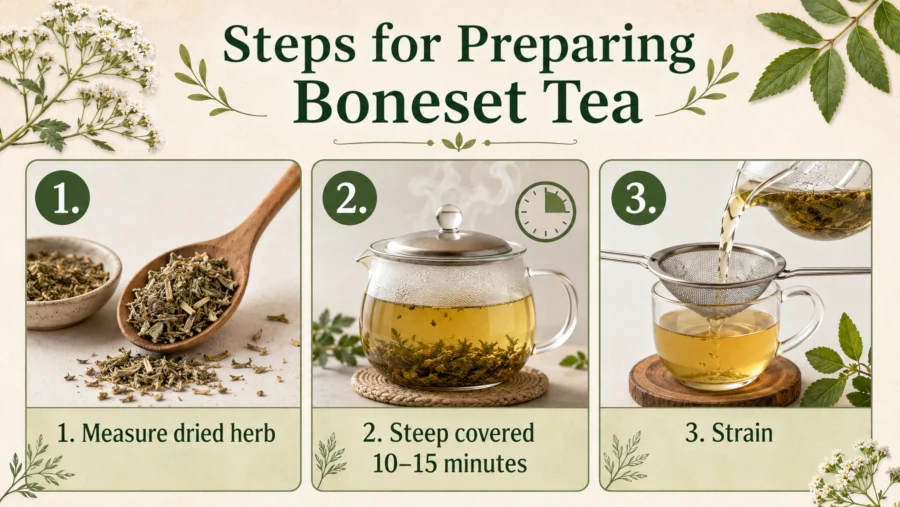
Dosing information for boneset is limited and isn’t standardized the way an over-the-counter medication is. [RxList] The most commonly cited traditional preparation is:
- Tea (infusion): ¼ to ½ teaspoon (roughly 1–2 grams) of dried herb per cup of boiling water, steeped covered for 10 to 15 minutes. Up to three cups (about 750 mL) a day. The tea is quite bitter. [PeaceHealth]
- Tincture: ¼ to ¾ teaspoon (roughly 1–4 mL), up to three times a day. [PeaceHealth]
Because supplement potency varies by brand, and because dried herb, hot-water infusions, and alcohol tinctures don’t necessarily carry the same PA load, [Colegate et al., 2018] treat any dosing figure as a rough traditional guideline rather than a clinically established dose. Buying from a reputable supplier and checking with a healthcare provider or pharmacist first is a reasonable extra step given the open questions above.
When to See a Doctor Instead
An herbal tea is not a substitute for medical evaluation when an illness looks serious. Get medical care — urgently, if needed — for:
- A fever above 103°F (39.4°C), or any fever in an infant under 12 weeks
- Difficulty breathing or shortness of breath
- A stiff neck, severe headache, or confusion alongside fever
- A fever that improves and then returns or worsens
- Symptoms lasting more than 10 days without improvement
- Higher-risk situations where flu treatment matters most — age 65 and up, pregnancy, a chronic condition, or a weakened immune system
| Health Disclaimer: This article is for general educational and informational purposes only and is not a substitute for professional medical advice, diagnosis, or treatment. Boneset has not been well studied in humans and carries specific liver-safety considerations. Always consult a qualified healthcare provider before using boneset or any herbal remedy — especially if you are pregnant, breastfeeding, have liver disease, or take prescription medication. Do not use boneset to self-treat a high fever or a serious infection; seek medical care instead. |
Frequently Asked Questions
Does boneset actually break a fever?
There’s no clinical trial testing this in humans. Its reputation as a fever remedy comes from traditional use and its diaphoretic (sweat-inducing) effect, not controlled research. [PeaceHealth] If a fever is high or doesn’t respond to standard care, that’s a reason to see a doctor rather than rely on herbal tea.
Is herbal boneset the same as homeopathic boneset products?
No. Homeopathic Eupatorium perfoliatum products are diluted far beyond the concentration of a tea or tincture, and the one small trial on homeopathic boneset doesn’t tell you anything about the herbal-strength product. [RxList]
Can I take boneset every day, long-term?
No — sources that address duration recommend against continuous use beyond six months, largely because of the pyrrolizidine alkaloid content. [PeaceHealth] [Colegate et al., 2018]
Is boneset safe with other medications?
Possibly not. It may interact with liver-enzyme-inducing medications like certain seizure drugs and antibiotics. [RxList] Check with a pharmacist if you take any prescription medication.
Who definitely shouldn’t take boneset?
Anyone pregnant or breastfeeding, anyone with liver disease, and anyone allergic to ragweed or related plants. [PeaceHealth] [RxList]
References
- PeaceHealth Health Information Library. “Boneset.” Healthwise/TraceGains content, last reviewed 05-24-2015. https://www.peacehealth.org/medical-topics/id/hn-2052000
- RxList. “Boneset: Health Benefits, Side Effects, Uses, Dose & Precautions.” Content sourced from the Natural Medicines Comprehensive Database. https://www.rxlist.com/supplements/boneset.htm
- Colegate SM, Upton R, Gardner DR, Panter KE, Betz JM. “Potentially toxic pyrrolizidine alkaloids in Eupatorium perfoliatum and three related species. Implications for herbal use as boneset.” Phytochemical Analysis. 2018;29(6):613–626. https://pubmed.ncbi.nlm.nih.gov/29968391/
- Maas M, Deters AM, Hensel A. “Anti-inflammatory activity of Eupatorium perfoliatum L. extracts, eupafolin, and dimeric guaianolide via iNOS inhibitory activity and modulation of inflammation-related cytokines and chemokines.” Journal of Ethnopharmacology. 2011;137(1):371–381. https://pubmed.ncbi.nlm.nih.gov/21669270/
- Missouri Botanical Garden. “Eupatorium perfoliatum — Plant Finder.” https://www.missouribotanicalgarden.org/PlantFinder/PlantFinderDetails.aspx?taxonid=277187
- NC State Extension. “Eupatorium perfoliatum.” NC State Extension Gardener Plant Toolbox. https://plants.ces.ncsu.edu/plants/eupatorium-perfoliatum
- Wikipedia. “Eupatorium perfoliatum.” https://en.wikipedia.org/wiki/Eupatorium_perfoliatum
- U.S. Food and Drug Administration. “Fraudulent Coronavirus Disease 2019 (COVID-19) Products.” https://www.fda.gov/consumers/health-fraud-scams/fraudulent-coronavirus-disease-2019-covid-19-products
