
The chaparral plant (Larrea tridentata) is a hardy desert shrub with a long history in traditional medicine — and a serious safety problem that anyone considering it should know about first. Chaparral has been linked to cases of severe liver injury, including liver failure that required a transplant, and in 1992 the U.S. Food and Drug Administration warned the public not to consume it [NIH LiverTox, 2022] [National Academies review, 2005].
That warning still matters, because the chaparral plant is sold online today as a tea, tincture, and capsule, often alongside confident promises about antioxidants, “detox,” immunity, and even cancer. This guide lays out what the plant actually is, what people have traditionally used it for, what the science does and doesn’t support, and — most importantly — the safety facts and warning signs that should shape any decision. The short version: the evidence for benefit is weak, the evidence for harm is real, and this is a plant to approach with caution and a doctor’s input rather than a home remedy to reach for on your own.
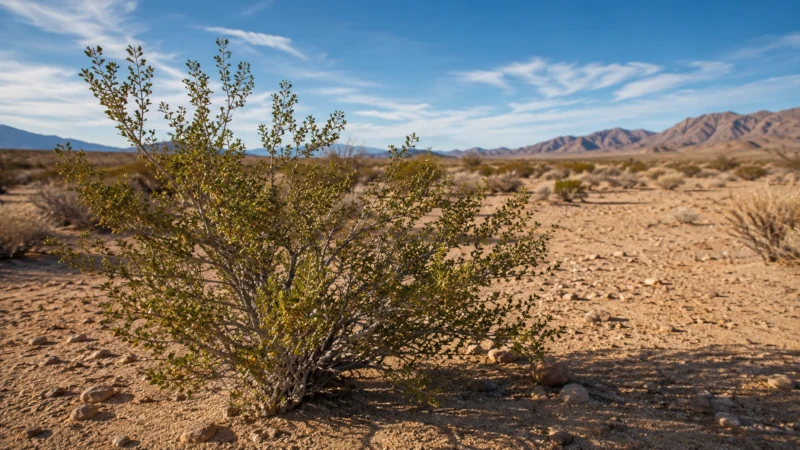
What Is the Chaparral Plant?
Chaparral comes from the creosote bush, an evergreen desert shrub known botanically as Larrea tridentata (older sources also use the name Larrea divaricata). It grows across the arid Southwest of the United States and northern Mexico and goes by several common names: creosote bush, greasewood, hediondilla — “little smelly one,” for its strong odor — and gobernadora [National Academies review, 2005] [Memorial Sloan Kettering, 2021]. Its small, resin-coated leaves give off a distinctive smell after rain and leave a slightly oily feel, which is where the “greasewood” nickname comes from.
That resin holds chaparral’s most-discussed compound: nordihydroguaiaretic acid, or NDGA, a plant lignan that can make up roughly a tenth of the dry leaf weight [National Academies review, 2005]. NDGA is a potent antioxidant in the laboratory, and it sits behind most of chaparral’s health claims — and most of its safety concerns.
What Chaparral Has Traditionally Been Used For
Native peoples of the Southwest have used chaparral for centuries, most often as a tea brewed from the dried leaves and twigs. Traditional uses included colds, bronchitis and other breathing problems, menstrual cramps, and digestive complaints, plus topical use as a poultice for wounds, joint pain, and arthritis [National Academies review, 2005] [Memorial Sloan Kettering, 2021]. More recently it has been sold in capsules, tinctures, and salves and promoted for a much wider range of purposes, from “blood cleansing” and immune support to cancer.
Long traditional use tells you a plant mattered to people. It does not tell you the plant is safe or effective by modern standards — and in chaparral’s case, the tested evidence and the marketing claims turn out to be two very different things.
What the Evidence Actually Shows
Here is the honest summary: despite centuries of use and a lot of laboratory interest in NDGA, chaparral has not been shown to treat, cure, or prevent any medical condition in people [NIH LiverTox, 2022] [Memorial Sloan Kettering, 2021]. Most of the supporting research is preclinical — test tubes and animals — and in the one area where it was formally tested in patients, cancer, it failed.
| Claim | What the evidence shows | Strength |
| Antioxidant activity (NDGA) | NDGA scavenges free radicals in laboratory tests; no evidence this produces a health benefit when taken by people. | Lab only |
| Antimicrobial, antiparasitic, antiviral | Chaparral extracts and NDGA act against some bacteria, fungi, parasites, and viruses in the test tube; not shown to work as a treatment in people. | Lab only |
| Anti-inflammatory / arthritis | Long topical folk use plus some anti-inflammatory activity in lab models; no reliable human evidence. | Traditional / lab |
| Cancer | A clinical trial found chaparral ineffective as an anticancer agent; NDGA has been studied in the lab but is not an approved treatment. | Tested, not effective |
| Immune “boosting” | No human evidence that chaparral strengthens immunity. | Insufficient |
| “Detox” / liver cleanse | No evidence chaparral cleanses or supports the liver — and it has been linked to serious liver damage. | Insufficient / contradicted |
On the antioxidant point: NDGA really is a strong antioxidant in a test tube, and it was once even used as a food preservative for that reason [National Academies review, 2005]. But an antioxidant effect in a dish does not translate into a proven benefit for aging or disease when swallowed, and the FDA later removed NDGA from its “Generally Recognized as Safe” list [Memorial Sloan Kettering, 2021].
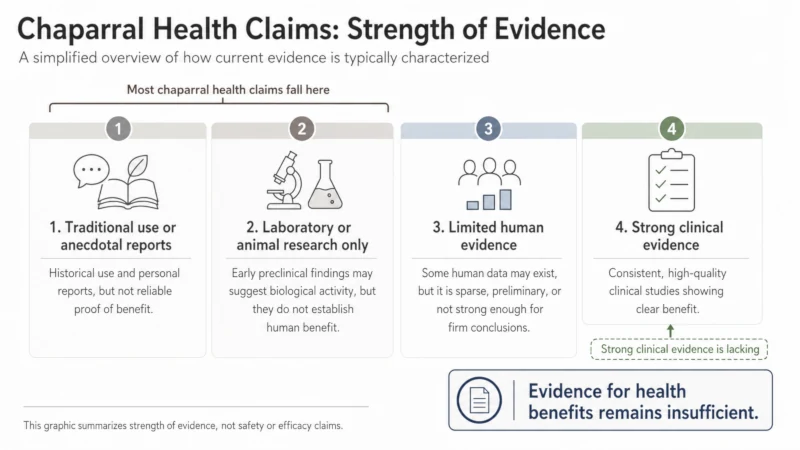
On infections: laboratory studies do suggest NDGA and chaparral extracts can act against certain bacteria, fungi, parasites, and viruses [Memorial Sloan Kettering, 2021]. That is a long way from a safe, effective treatment. A serious infection needs a real diagnosis and proven medicine; treating one with chaparral means risking liver damage while the infection itself goes untreated.
On cancer and “detox,” the gap between claim and evidence is widest. A clinical trial found chaparral ineffective as an anticancer agent [Memorial Sloan Kettering, 2021], and there is no evidence it “detoxifies” or supports the liver. The detox claim is a particular irony here, because the best-documented thing chaparral does to the liver is harm it.
For the joint and inflammation problems that drew many people to chaparral in the first place, there are far better-studied options. Our guide to an anti-inflammatory rheumatoid arthritis diet walks through approaches that actually have evidence behind them.
The Real Concern: Chaparral and Liver Damage
This is the part that matters most. Starting in 1990, doctors began publishing reports of people who developed acute hepatitis after taking chaparral, and more than two dozen such cases have now appeared in the medical literature, mostly from the United States, Canada, and Australia [NIH LiverTox, 2022].
In the most thorough review, researchers examined 18 chaparral-related illness reports submitted to the FDA between 1992 and 1994. Thirteen showed liver toxicity, typically appearing as jaundice with sharply elevated liver enzymes weeks to months after starting the herb. Most people recovered after stopping — but four developed cirrhosis (permanent liver scarring), and two needed a liver transplant [Sheikh et al., 1997] [NIH LiverTox, 2022]. In several cases, symptoms returned when the person resumed chaparral, which is strong evidence the herb was the cause [NIH LiverTox, 2022].
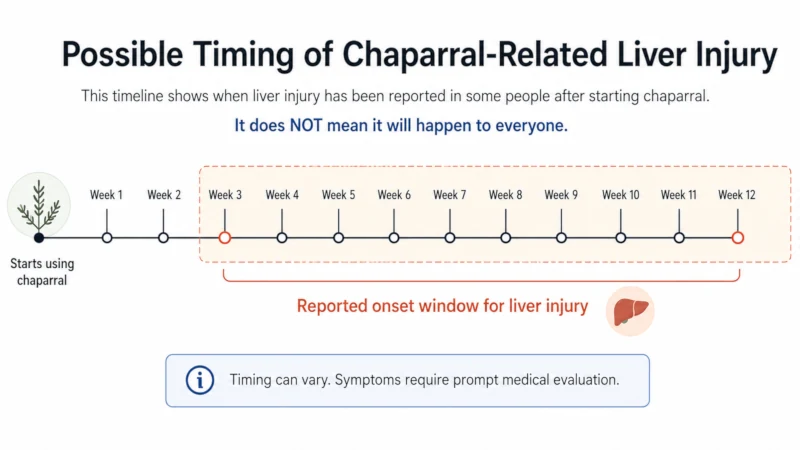
The injury usually shows up within about 3 to 12 weeks of daily use, though it has appeared both sooner and much later [NIH LiverTox, 2022]. The NIH’s drug-induced liver injury database, LiverTox, classifies chaparral as a “likely” cause of clinically apparent liver injury — rare, but real and sometimes severe [NIH LiverTox, 2022].
This is what prompted regulators to act. In December 1992, the FDA issued a public warning advising people not to buy or consume chaparral because of its link to acute toxic hepatitis, and advising anyone taking it to stop and see a physician [National Academies review, 2005]. Many sellers pulled it from shelves, though it remains available online today [NIH LiverTox, 2022].
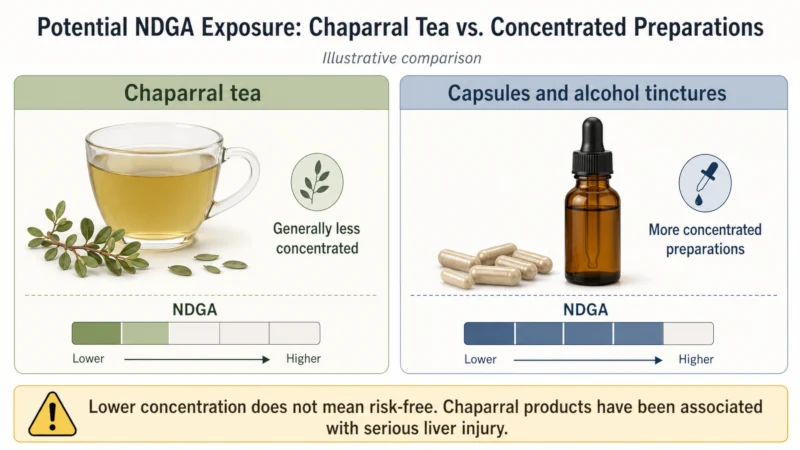
A fair account also includes the uncertainty. Some experts note that the case reports have limits — the exact products often were not chemically analyzed, and several affected people had other risk factors such as prior alcohol use or existing liver disease — and native populations reportedly drank chaparral tea for generations without documented liver problems [National Academies review, 2005]. Preparation may be part of the explanation: traditional water-brewed tea contains very little NDGA, while the capsules and alcohol-based tinctures tied to most injury cases concentrate it [National Academies review, 2005]. But “the exact mechanism isn’t settled” is not the same as “it’s safe.” The reviewers who weighed all of this still concluded that the concern about liver toxicity is real and warrants caution [National Academies review, 2005].
Other Reported Risks
- Kidneys: Some people who regularly drank chaparral tea developed kidney cysts and, in isolated reports, kidney cancer; NDGA also damages the kidneys in animal studies [Memorial Sloan Kettering, 2021] [National Academies review, 2005].
- Digestive upset: Nausea, vomiting, and diarrhea have been reported.
- Skin and allergy: Contact with chaparral can cause rashes, and swallowing it has been associated with allergic reactions. Stop and seek care if you develop hives, swelling, or trouble breathing.
Who Should Not Use Chaparral
Given the risks, some people should avoid chaparral entirely — and realistically, the safest choice for most people is not to take it internally at all. Avoid chaparral if you:
- Are pregnant or trying to conceive — it has not been shown safe and was historically used to affect pregnancy [National Academies review, 2005].
- Are breastfeeding.
- Have any liver disease or a history of hepatitis.
- Have kidney disease.
- Take prescription medications, especially any processed by the liver.
- Are scheduled for surgery.
- Are a child, or would be giving it to one.
Medication Interactions
Chaparral’s compounds are handled by the same liver enzyme systems that process many prescription drugs, so combining them can be a problem — both by adding to the liver’s workload and by potentially changing how a medication is metabolized [National Academies review, 2005]. If you take anything regularly, from blood thinners to everyday prescriptions, tell your doctor or pharmacist before using any chaparral product. This matters doubly because the herb’s own liver risk can be hard to tell apart from a drug reaction.
Warning Signs That Need Urgent Attention
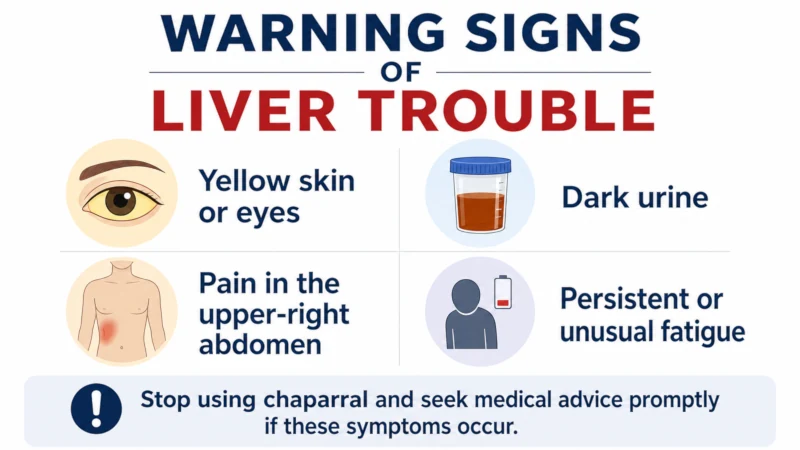
If you have taken chaparral in any form and notice signs of liver trouble, stop immediately and get medical care. Contact your doctor or go to urgent care — and call 911 or go to the emergency room for severe symptoms — if you develop:
- Yellowing of the skin or the whites of the eyes (jaundice)
- Dark urine or pale, clay-colored stools
- Pain or tenderness in the upper right abdomen
- Unusual fatigue, nausea, or loss of appetite that will not go away
- Easy bruising or bleeding
- Signs of an allergic reaction — hives, swelling of the face or throat, or difficulty breathing (call 911)
Liver injury from chaparral is often reversible if the herb is stopped early, so this is not something to wait out [NIH LiverTox, 2022].
For everyday liver health, the useful moves are ordinary ones — limiting alcohol, being cautious with supplements, and eating well. Our roundup of foods that support liver health is a friendlier starting point than any “cleansing” herb.
A Plant Worth Respecting — and Approaching Carefully
Chaparral is a striking desert plant with a genuine place in traditional medicine and a real presence in modern laboratories. But “traditional” and “natural” are not the same as “safe,” and here the evidence is unusually one-sided: no proven benefit in people, and documented cases of serious, occasionally life-threatening liver injury.
If you are drawn to chaparral for a specific problem — joint pain, an infection, immune support — that problem deserves an approach that works and will not put your liver at risk. Chaparral joins a short list of traditional botanicals, like sassafras, whose safety story only became clear once they were studied closely. Talk any interest in it through with a healthcare professional before taking a single dose.
| Health Disclaimer: This article is for general educational and informational purposes only and is not medical advice, diagnosis, or treatment. Chaparral has been associated with serious liver injury, and the U.S. Food and Drug Administration has warned the public against consuming it. Nothing here is a recommendation to use chaparral. Always talk with a qualified healthcare professional — your doctor or pharmacist — before using any herb, supplement, or natural remedy, especially if you are pregnant or breastfeeding, take medications, or have a liver, kidney, or other health condition. If you have taken chaparral and feel unwell, stop and seek medical care. |
Frequently Asked Questions
Is the chaparral plant safe to take?
For most people, no — not as an internal remedy. Chaparral has been linked to serious liver damage, including cases that led to cirrhosis or a liver transplant, and the FDA has warned the public against consuming it [NIH LiverTox, 2022] [National Academies review, 2005]. If you are considering it for any reason, talk to your doctor first.
What is chaparral used for?
Traditionally it was used for colds and respiratory complaints, digestive problems, and — applied to the skin — wounds and joint pain. Today it is marketed for antioxidant, immune, “detox,” and anticancer purposes, but it has not been shown to treat any medical condition in people [Memorial Sloan Kettering, 2021].
Does chaparral really damage the liver?
Yes. Doctors have documented more than two dozen cases of liver injury linked to chaparral, ranging from elevated liver enzymes to hepatitis, cirrhosis, and liver failure requiring a transplant. It typically appears within about 3 to 12 weeks and is often reversible if the herb is stopped early [NIH LiverTox, 2022] [Sheikh et al., 1997].
Is chaparral tea safer than capsules?
Traditional water-brewed tea contains much less NDGA than capsules or alcohol-based tinctures, and most reported liver-injury cases involved capsules or extracts [National Academies review, 2005]. But “less concentrated” is not “safe” — chaparral tea has still been linked to kidney problems, and no form has been shown to be a safe, effective treatment.
Can I use chaparral while pregnant or breastfeeding?
No. Chaparral has not been shown to be safe in pregnancy or breastfeeding and should be avoided entirely [National Academies review, 2005].
What warning signs should make me stop chaparral and seek care?
Yellowing skin or eyes, dark urine, pale stools, upper-right abdominal pain, and persistent nausea or fatigue can all signal liver trouble. Stop the herb and get medical care promptly if any of these appear.
References
- National Institute of Diabetes and Digestive and Kidney Diseases. “Chaparral.” LiverTox: Clinical and Research Information on Drug-Induced Liver Injury. Updated May 25, 2022 (PMID 31643676). → View source
- Memorial Sloan Kettering Cancer Center. “Chaparral — Purported Benefits, Side Effects & More.” Integrative Medicine “About Herbs” database. Updated February 11, 2021. → View source
- Institute of Medicine and National Research Council. “Prototype Focused Monograph: Review of Liver-Related Risks for Chaparral” (Appendix J). Dietary Supplements: A Framework for Evaluating Safety. Washington, DC: National Academies Press, 2005. → View source
- Sheikh NM, Philen RM, Love LA. “Chaparral-associated hepatotoxicity.” Archives of Internal Medicine. 1997;157(8):913–919 (PMID 9129552). → View source
