Search for the health benefits of the tobacco plant and you will find pages happy to promise you something. The truthful answer is shorter than any of them: for your body, there are none. No health authority anywhere recognizes a medicinal use for Nicotiana tabacum, and no form of tobacco — smoked, chewed, sniffed, or brewed into a tea — has been shown to make you healthier.
That is not the whole story, and the rest of it is stranger than the myth. Real tobacco plant benefits do exist — they just have nothing to do with putting tobacco in your body. The plant’s close relatives have been engineered into living factories that grow human medicines, including a COVID-19 vaccine that a national regulator approved. The tobacco plant has helped human health. It has never done so by being consumed.
The short answer, claim by claim
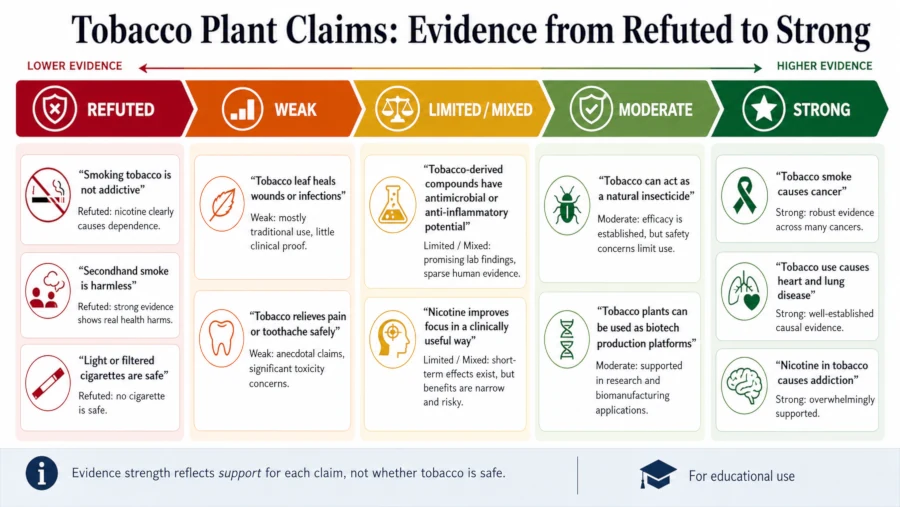
Here is where each common claim actually stands. Notice that nothing in the first column earns a “strong” rating for benefit.
| Claim about the tobacco plant | Strength of evidence | What the evidence actually shows |
| Tobacco relieves asthma, headaches, or lung disease | None — refuted | A 16th–19th century belief. Smoking damages the airways; it does not treat them. |
| Tobacco leaf poultices heal wounds, boils, or bites | Traditional use only | Documented in traditional practice; no clinical evidence of benefit, and nicotine is absorbed through skin. |
| Nicotine protects against Parkinson’s disease | Tested and failed | The observation was real. The randomised trial found no benefit and a trend toward faster decline. |
| Lobelia (“Indian tobacco”) helps you quit | None | Cochrane found no long-term evidence of benefit; the large short-term trial found none either. |
| Nicotine replacement helps people stop smoking | Strong | This is nicotine used to get off nicotine — not a benefit of tobacco. |
| Tobacco plants can be used to manufacture medicines | Strong | Real, approved, and genuinely important — see below. Not something you can consume. |
| Some form of tobacco is safe if you avoid smoke | Refuted | WHO: all forms are harmful; there is no safe level of exposure. |
Where the idea of a medicinal tobacco plant came from
Blame Jean Nicot. As the French ambassador in Lisbon in the 1500s, he became convinced tobacco was a wonder drug, pushed its seeds across France, and ended up with the alkaloid named after him. European physicians ran with it. For three centuries tobacco was prescribed for headaches, toothache, and even asthma — which, in hindsight, is roughly like prescribing a house fire for a chill.
The tradition goes far deeper than Nicot, though. Peoples across the Americas used tobacco for something like 8,000 years: smoked in ceremony, applied to the skin as poultices for boils, sores, and bruises, brewed into teas taken as a laxative or to force vomiting, ground into snuff, even blown as smoke into the ear for earache [UTEP Herbal Safety, tobacco]. That history is real, and it deserves to be described accurately rather than mined for marketing.
But look closely at what most of those uses were. An emetic makes you vomit. A purgative empties your bowels. Those are not a plant healing you; they are a plant poisoning you, and the dramatic “effect” the user felt was the toxicity itself. Long traditional use tells you a plant is potent. It does not tell you it is good for you.
Some noticed early. Writing in Testimonies for the Church (vol. 3, 1875), Ellen G. White called tobacco a slow, insidious poison whose effects were harder to clear from the body than alcohol’s — a blunt verdict roughly eighty years before the medical consensus caught up with it.
What the tobacco plant actually does to your body
Nicotine is why tobacco is hard to put down. The World Health Organization describes it as highly addictive and harmful in its own right — particularly for children, adolescents, and young adults whose brains are still developing — and notes that nicotine use raises cardiovascular risk [WHO tobacco and nicotine fact sheet, 2026].
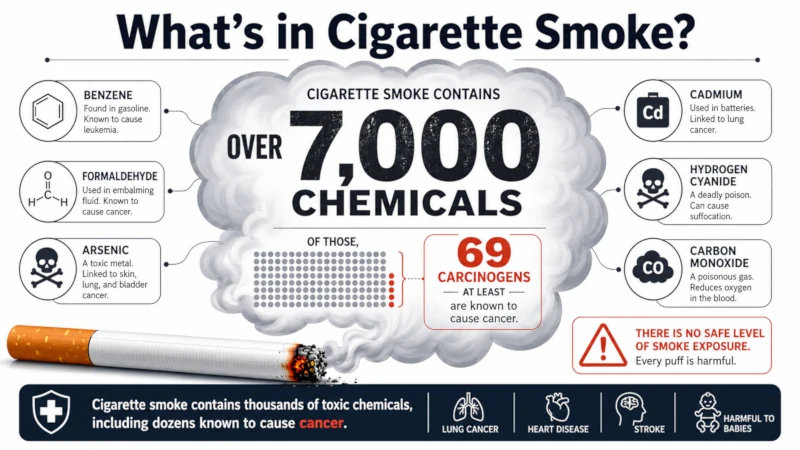
But nicotine is not what kills most people who use tobacco. Burning is. Cigarette smoke carries more than 7,000 chemicals, at least 69 of which cause cancer [CDC on smoking and cancer, 2024]. Smoking causes roughly one in three cancer deaths in the United States. Cigarette smoke and secondhand exposure together account for nearly nine in ten lung cancer deaths, and a person who smokes is about 25 times more likely to develop lung cancer than a person who does not.
Worldwide, WHO attributes more than 7 million deaths a year to tobacco, including over 1.6 million non-smokers who simply breathed someone else’s smoke [WHO, 2026]. On the question people most want a loophole for, WHO leaves none: all forms of tobacco are harmful, and there is no safe level of exposure. That covers cigars, waterpipe, heated tobacco and roll-your-own — and it covers chewing tobacco and snuff, which swap lung damage for a different set of cancers (see our guide to the dangers of smokeless tobacco).
The one real tobacco plant benefit — and you cannot smoke it
Here is the part almost nobody searching for this topic knows about, and it is the genuinely good news.
Tobacco plants are extraordinarily easy to infect with engineered bacteria and viruses. That is a disaster if you are a farmer and a gift if you are a biologist, because it means you can slip a gene into a tobacco leaf, wait a few days, and harvest whatever protein you asked it to make. The field is called plant molecular farming, and the workhorse is Nicotiana benthamiana — a wild Australian cousin of cultivated tobacco rather than the crop itself.
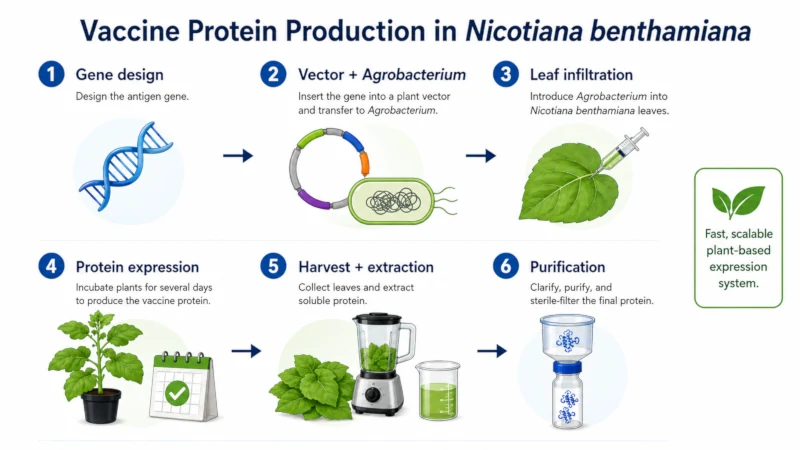
This is not a hypothetical. In February 2022 Health Canada authorised Covifenz, a COVID-19 vaccine built from virus-like particles grown in these plants — the first authorised COVID-19 vaccine to use a plant-based protein technology. In clinical trials it was 71% effective against symptomatic infection and 100% effective against severe disease [Health Canada, 2022]. A year later its manufacturer’s parent company decided the commercial case had evaporated and wound the business down, so the vaccine is no longer produced [Mitsubishi Chemical Group, 2023]. The science worked. The market did not.
Keep the distinction sharp, because this is exactly where misleading pages get slippery: the plant is the equipment, not the medicine. A tobacco leaf that has been engineered to grow a vaccine protein is a bioreactor, in the same way a stainless-steel vat is a bioreactor. Nothing about that gives tobacco itself a health benefit, any more than penicillin makes mould a superfood.
Is nicotine itself a medicine?
There are two honest answers, and they point in opposite directions.
Yes — in one narrow, well-established way
Nicotine replacement therapy — patches, gum, lozenges, inhalers, nasal spray — is a legitimate, effective medicine. WHO states that counselling and medication together can more than double a tobacco user’s chance of quitting successfully [WHO, 2026]. But read what that actually is: nicotine used as a scaffold to climb off nicotine. It treats dependence on tobacco. It is not a benefit of tobacco.
No — the most promising lead was tested, and it failed
For decades, epidemiologists kept finding the same odd signal: people who smoke develop Parkinson’s disease less often than people who don’t. Animal studies suggested nicotine might protect dopamine neurons. It was a serious hypothesis, seriously pursued.
So the German and U.S. Parkinson Study Groups ran the trial. NIC-PD randomised 163 people with early, untreated Parkinson’s across 24 centres to a transdermal nicotine patch (up to 28 mg/day) or placebo for 52 weeks. Nicotine did not slow the disease. If anything, the nicotine group declined slightly faster, and side effects were more common [Oertel et al., NEJM Evidence, 2023]. This is what a promising lead looks like when it is properly tested and comes back empty — and it is the strongest evidence available on the most-hyped supposed benefit of tobacco’s active compound.
Lobelia (“Indian tobacco”) is not a loophole
Lobelia (Lobelia inflata), sold as “Indian tobacco” or “asthma herb,” contains lobeline — a partial nicotine agonist. It has been marketed for generations as the herbal way to quit smoking, on the theory that you swap a strong addiction for a weak one and then taper off.
It does not work. The Cochrane review found no trials with long-term follow-up showing that lobeline helps anyone stop smoking, and the one large short-term trial detected no benefit either. Lobeline can also cause dizziness, nausea, and vomiting, and lobeline tablets and lozenges can irritate the throat [Cochrane review, lobeline for smoking cessation, 2022]. If you want plants that have actually been studied for the respiratory tract, that is a real conversation — see our guide to herbs for the lungs. Lobelia is not one of the wins.
If you grow or handle tobacco: the risk nobody mentions
You do not have to smoke tobacco to be poisoned by it. Nicotine crosses skin.
Workers who plant, cultivate, and harvest tobacco can develop green tobacco sickness — acute nicotine poisoning absorbed straight through the skin. The risk climbs when nicotine on the leaves dissolves into rain, dew, or sweat. Symptoms are nausea and vomiting, plus dizziness, headache, and cramps, and they may not appear until hours after the work is done. In one NIOSH-funded study, about a quarter of tobacco harvesters in North Carolina fields developed it in a single season [OSHA / NIOSH on green tobacco sickness]. People new to handling tobacco are at higher risk, and children and adolescents are more sensitive still.
If you handle tobacco leaves for any reason, the protective measures are unglamorous and they work:
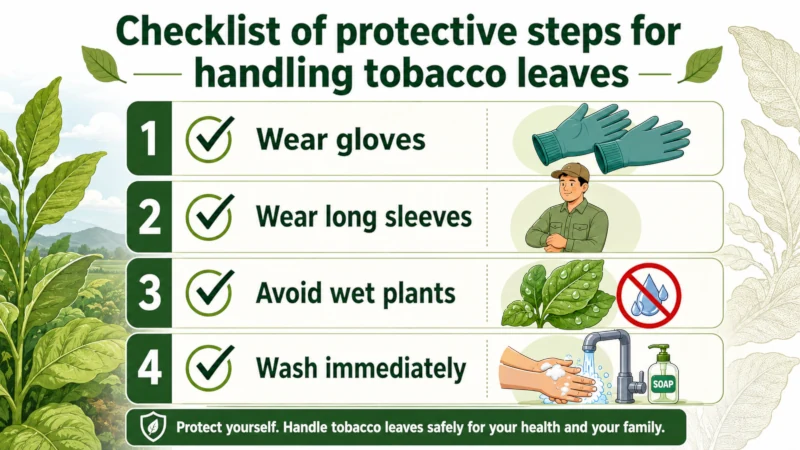
- Do not work with wet tobacco. Wet clothing stops protecting you and starts dosing you.
- Wear gloves, long sleeves, and long trousers; change out of wet clothes rather than pushing on.
- Wash with soap and water immediately afterwards — this removes up to 96% of the nicotine on the skin [OSHA / NIOSH].
- Tell any clinician you see that you have been handling tobacco. Green tobacco sickness is routinely mistaken for heat illness or pesticide poisoning.
About that “two cigars will kill you” figure
You will see it everywhere: 50 to 60 mg of nicotine is a fatal dose for an adult. It is almost certainly wrong. A 2014 review in Archives of Toxicology traced that number back through a chain of circular citations to a 1906 German textbook, which in turn rested on dubious self-experiments from the 1850s. Re-examining the actual poisoning literature, the author concluded it likely takes more than half a gram of swallowed nicotine to kill an adult [Mayer, Archives of Toxicology, 2014].
Correcting the number is not the same as offering reassurance. Children are far smaller and far more sensitive, concentrated nicotine liquids and pouches are genuinely dangerous, and non-fatal nicotine poisoning is miserable and can require hospital care. If someone — especially a child — has swallowed tobacco, a nicotine pouch, or e-liquid, in the United States call Poison Control on 1-800-222-1222 immediately, and call 911 if they are drowsy, seizing, or struggling to breathe.
And no, do not make tobacco insecticide
Nicotine really does kill insects; that much of the folklore is true. It is also no longer permitted as a pesticide in the United States. The EPA cancelled the last registered nicotine pesticide product effective 1 January 2014, with sale of remaining stock barred at the end of that year [EPA product cancellation order, Federal Register]. Homemade “tobacco tea” garden sprays sit entirely outside that safety framework and deliver nicotine to your skin while you mix and spray them.
Who should avoid tobacco in every form
There is no medically approved use of tobacco, so this list is less “who should avoid it” than “who is at particular risk if they don’t”:
- Anyone who is pregnant or breastfeeding. Nicotine crosses the placenta and passes into breast milk; UTEP’s herbal safety monograph is unequivocal that tobacco should not be used in any form during pregnancy and lactation [UTEP].
- Children and adolescents. Nicotine affects the developing brain, and early exposure strongly predicts long-term dependence [WHO].
- Anyone with heart disease, high blood pressure, or a history of stroke. Nicotine raises heart rate and blood pressure and increases cardiovascular risk.
- Anyone with a previous head, neck, or oral cancer. Continued tobacco use raises the risk of a second primary cancer.
- People taking prescription medicines. Smoking alters how the body clears a number of drugs. Ask a pharmacist rather than guessing.
Red flags: when to get medical help now
Call emergency services (911 in the US) for:
- Chest pain or pressure, severe breathlessness, or fainting.
- Sudden weakness on one side, sudden trouble speaking or seeing, or sudden loss of balance — possible stroke.
- Suspected nicotine poisoning with drowsiness, seizures, confusion, or difficulty breathing — especially in a child.
Book a medical or dental appointment promptly for:
- A cough that has lasted more than three weeks, or any coughing up of blood.
- Persistent hoarseness, difficulty swallowing, or a lump in the neck.
- A mouth ulcer, white or red patch, or sore that has not healed within two weeks.
- Unexplained weight loss.
The benefit that is actually available to you
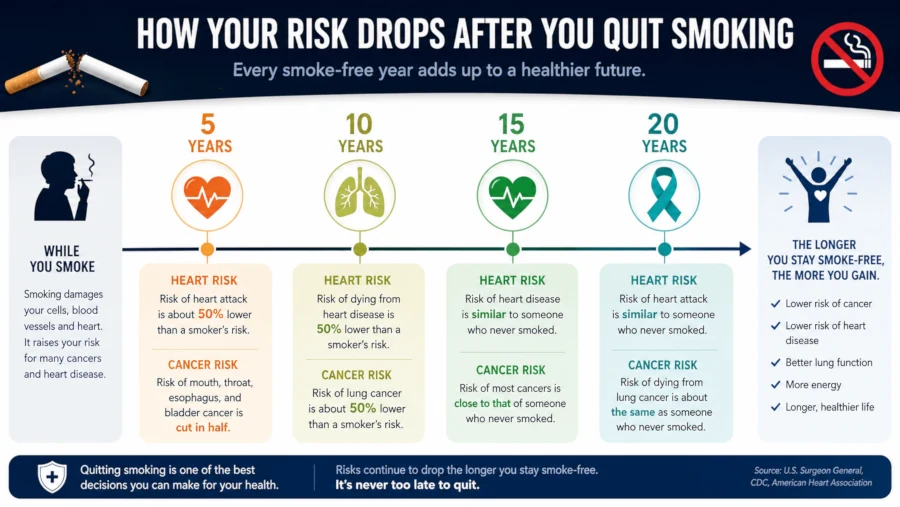
If you came here hoping the tobacco plant had something to offer, it does — but the offer runs in the other direction. The gains are in stopping, and they are large, specific, and measurable.
Five to ten years after quitting, the added risk of cancers of the larynx, mouth, and pharynx drops by half. Ten to fifteen years after quitting, the added risk of lung cancer drops by half. Twenty years out, the risk of several of these cancers falls close to that of someone who never smoked [CDC, 2024]. Quitting lowers the risk of twelve different cancers, and it helps even people who have already been diagnosed with one.
You do not have to do it on willpower alone, and choosing help is not a failure of nerve — it is how the odds improve. Our practical, evidence-based quit plan walks through setting a quit date, handling cravings, and the seven FDA-approved medicines available. If food is part of how you get through the first weeks, what to eat while you quit is a reasonable place to start. In the United States, free confidential coaching is available around the clock on 1-800-QUIT-NOW.
The tobacco plant is a remarkable organism. It has taught us an enormous amount, and it may yet grow medicines that save lives. It has simply never been medicine itself — and the best thing it can do for you is nothing at all.
| Health Disclaimer: This article is for general education and information only. It is not medical advice and is not a substitute for diagnosis, treatment, or guidance from a qualified healthcare professional. Nothing described here is intended to diagnose, treat, cure, or prevent any disease. No form of tobacco is recommended for any health purpose. If you are pregnant or breastfeeding, have heart disease, high blood pressure, diabetes, or any chronic condition, or take prescription medicines, speak with your doctor or pharmacist before changing your tobacco use or starting a cessation medicine. Seek emergency care for chest pain, severe breathing difficulty, signs of stroke, or suspected nicotine poisoning. In the United States, Poison Control can be reached 24/7 on 1-800-222-1222, and free confidential quit-smoking coaching on 1-800-QUIT-NOW. |
Frequently Asked Questions
Does the tobacco plant have any medicinal uses at all?
Not for you. There is no recognised medicinal use of tobacco in modern medicine. Its documented traditional uses — poultices, emetic teas, snuff — are historical and were often producing toxicity rather than healing. The plant’s genuine modern value is as a manufacturing platform in laboratories, which is not something a person can access by consuming it.
Are “natural,” “organic,” or additive-free cigarettes safer?
No. The chemistry that causes most of the harm comes from burning tobacco leaf, not from additives. Cigarette smoke contains more than 7,000 chemicals and at least 69 known carcinogens regardless of how the tobacco was grown. WHO’s position applies to every form: there is no safe level of exposure.
Is nicotine the part that causes cancer?
Mostly no, and this distinction matters. Nicotine is what makes tobacco addictive and it raises cardiovascular risk, but the carcinogens are overwhelmingly produced by burning and curing the leaf. That is why nicotine replacement therapy is considered a legitimate medicine while cigarettes are not — and why “it’s only the nicotine” is a bad reason to keep smoking.
Can I use a tobacco leaf poultice on a wound, boil, or insect bite?
It is not advisable. The practice is traditional and well documented, but there is no clinical evidence it helps, and nicotine is absorbed readily through skin — especially broken skin. Tobacco handlers develop nicotine poisoning from intact skin alone.
Is growing tobacco at home dangerous?
Handling it can be. Green tobacco sickness is acute nicotine poisoning from skin contact with the leaves, and it is more likely when the plants are wet with rain, dew, or sweat. Wear gloves and long sleeves, avoid handling wet plants, wash thoroughly afterwards, and keep children away from the leaves.
Does chewing tobacco or snuff give the benefits without the smoke?
There are no benefits to preserve, and smokeless tobacco carries its own risks — cancers of the mouth, oesophagus, and pancreas, plus heavy nicotine dependence. US law requires every package to warn that it is not a safe alternative to cigarettes.
References
- World Health Organization. “Tobacco and nicotine” (fact sheet), 26 June 2026. → View source
- Centers for Disease Control and Prevention. “Health Effects of Cigarettes: Cancer.” Office on Smoking and Health, updated 17 September 2024. → View source
- Mayer B. “How much nicotine kills a human? Tracing back the generally accepted lethal dose to dubious self-experiments in the nineteenth century.” Archives of Toxicology, 2014;88(1):5–7. DOI: 10.1007/s00204-013-1127-0. → View source
- Stead LF, Hughes JR. “Lobeline for smoking cessation.” Cochrane Database of Systematic Reviews, CD000124. DOI: 10.1002/14651858.CD000124.pub2. → View source
- Occupational Safety and Health Administration / NIOSH. “Green Tobacco Sickness.” U.S. Department of Labor. → View source
- U.S. Environmental Protection Agency. “Nicotine; Product Cancellation Order.” Federal Register, 3 June 2009 (74 FR 26695); cancellation effective 1 January 2014. → View source
- Health Canada. “Health Canada authorizes Medicago COVID-19 vaccine for adults 18 to 64 years of age.” Statement, 24 February 2022. → View source
- Mitsubishi Chemical Group. “Overseas Consolidated Subsidiary, Medicago to Cease Operations.” Press release, 3 February 2023. → View source
- Gonzalez Stuart A. “Tobacco” (herbal fact sheet). UTEP Herbal Safety, University of Texas at El Paso. → View source
- Oertel WH, Müller HH, Unger MM, et al. “Transdermal Nicotine Treatment and Progression of Early Parkinson’s Disease” (NIC-PD). NEJM Evidence, 2023;2(9):EVIDoa2200311. PMID: 38320207. → View source
- White EG. Testimonies for the Church, vol. 3, p. 569 (1875). Ellen G. White Estate
