Losing your keys is not the same as losing your way home. That single distinction is the heart of memory health in seniors — and most of the memory slips that frighten older adults fall on the harmless side of the line. Blanking on a name that comes back an hour later, walking into a room and forgetting why, needing a list more often than you used to: these happen at every age, and on their own they rarely signal disease.
What matters is the pattern, not the occasional lapse. The National Institute on Aging draws the line clearly — forgetting which day it is and remembering it later is ordinary aging, while losing track of the season entirely, or struggling to follow a conversation, is the kind of change worth checking [National Institute on Aging, 2023].
Normal aging or something more?
As we get older, the brain changes along with the rest of the body. Recall gets a little slower, and names or appointments slip more easily. These are usually signs of mild forgetfulness, not a serious problem. The test the Alzheimer’s Association and CDC both use is simple: memory loss that disrupts daily life is not a typical part of aging [CDC, 2024].
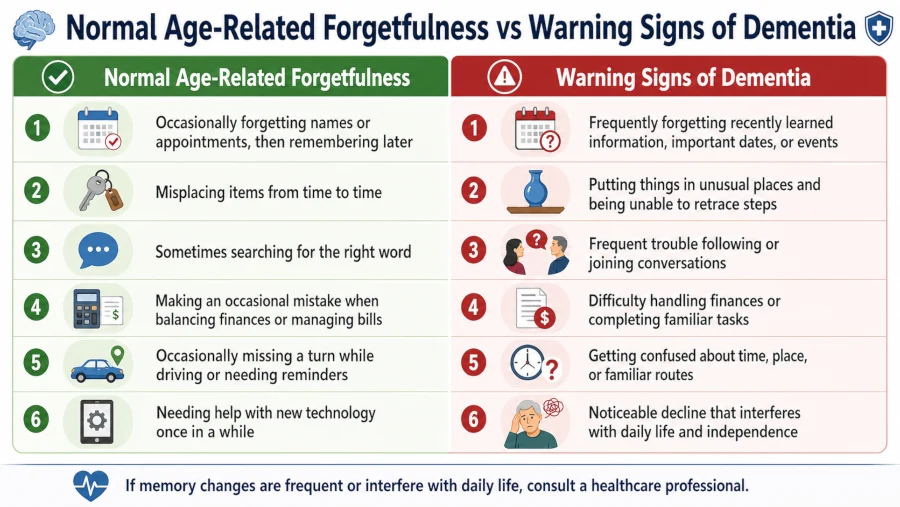
Dementia is a different thing entirely, and it is not a normal part of getting older. It’s a loss of thinking, remembering, and reasoning severe enough to interfere with everyday life — and memory is only one piece. People with dementia may also struggle with language, judgment, or attention, and some go through noticeable personality changes [National Institute on Aging, 2023].
| Ordinary aging | Possible sign of dementia |
| Making a bad decision once in a while | Poor judgment and decisions much of the time |
| Missing a monthly payment | Trouble managing bills at all |
| Forgetting the day and remembering it later | Losing track of the season or year |
| Sometimes struggling to find a word | Trouble following or joining a conversation |
| Misplacing things and retracing your steps | Misplacing things often and being unable to find them |
Source: National Institute on Aging, 2023.
Mild cognitive impairment: the middle ground
Between normal aging and dementia sits a condition called mild cognitive impairment, or MCI. People with MCI have more memory or thinking trouble than others their age — losing things often, missing appointments, reaching for words that won’t come — but they can still take care of themselves and handle daily life [National Institute on Aging, 2021].
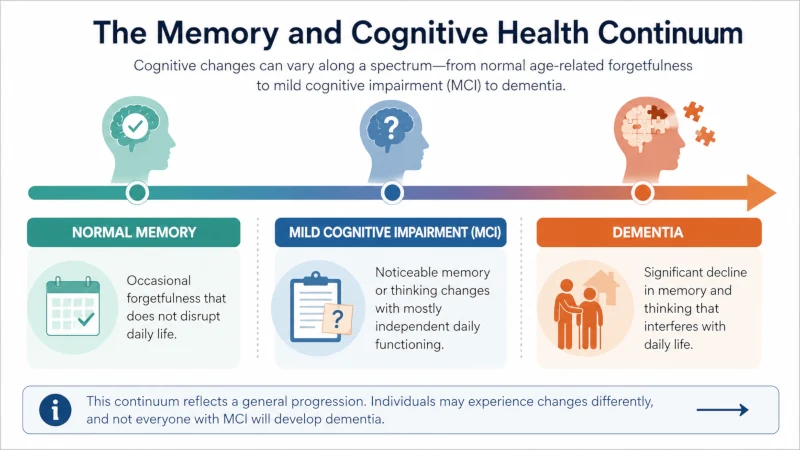
The number that surprises people cuts both ways. An estimated 10 to 20% of people aged 65 or older with MCI go on to develop dementia within a year — which means most do not, and in many people the symptoms hold steady or even improve [National Institute on Aging, 2021]. Conditions like diabetes, depression, and stroke can raise the risk. Because MCI can sometimes be an early warning, the guidance is to see a doctor every 6 to 12 months so changes can be tracked over time.
What actually causes memory changes as you age
Some slowing is simply built into a healthy aging brain. But plenty of memory problems have nothing to do with aging or dementia — and many of those are treatable, sometimes fully reversible once the cause is found. The National Institute on Aging lists several culprits worth ruling out [National Institute on Aging, 2023]:
- Medication side effects (a very common and fixable cause)
- Thyroid, kidney, or liver problems
- Low levels of vitamin B12
- Depression, anxiety, or the strain of grief and major life change
- Sleep problems
- Drinking too much alcohol
- Head injury, infections, or blood clots in the brain
This is exactly why a new memory complaint deserves a real check-up rather than quiet resignation. Sometimes the fix is as simple as changing a prescription or treating a thyroid problem.
How to protect memory health in seniors
Here’s the genuinely hopeful part. In 2024, the Lancet Commission on dementia estimated that up to 45% of dementia cases worldwide could, in theory, be prevented or delayed by addressing 14 risk factors across a person’s life [Alzheimer Europe / Lancet Commission, 2024].
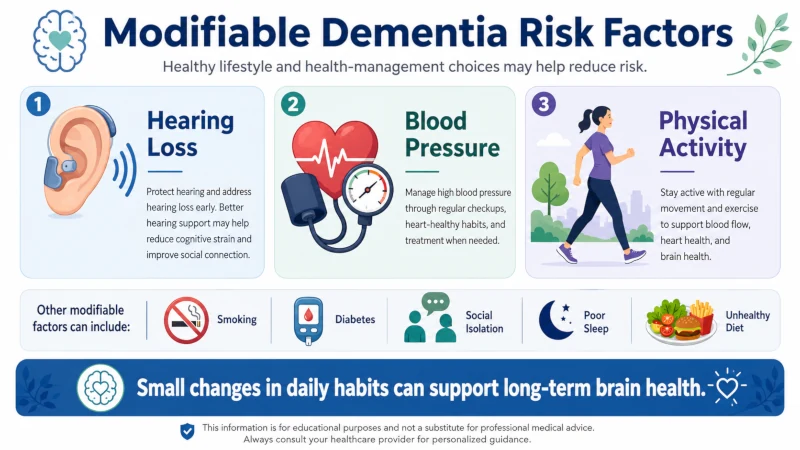
Read that figure carefully: it’s a population-level estimate of what might be possible if whole societies eliminated these risks, not a personal guarantee that you can erase your own risk by 45%. The evidence is largely from observational studies, so it shows association, not proof. Even so, almost every factor on the list is something you — or your health system — can act on: less education early in life, hearing loss, high LDL cholesterol, depression, head injury, physical inactivity, diabetes, smoking, high blood pressure, obesity, excessive alcohol, social isolation, air pollution, and untreated vision loss.
Translated into everyday terms, that points to a handful of habits with real backing.
Move your body regularly
Physical inactivity is on the modifiable-risk list, and staying active is one of the steadiest recommendations for both mind and body [National Institute on Aging, 2023]. You don’t need a gym — regular walking counts.
Treat blood pressure, cholesterol, and blood sugar
High blood pressure, high midlife LDL cholesterol, and diabetes all appear among the 14 risk factors [Alzheimer Europe, 2024]. Controlling them protects your brain’s small blood vessels along with your heart. If you’re working on this, our guide to managing blood pressure covers dietary and lifestyle steps to discuss with your doctor.
Get your hearing and vision checked
Two of the most actionable — and most overlooked — factors are hearing loss and untreated vision loss. The 2024 Commission specifically recommends making hearing aids and eye tests accessible, because correcting these may help lower dementia risk [Alzheimer Europe, 2024]. Book the hearing test you’ve been putting off.
Sleep, mood, and staying connected
Aim for roughly seven to eight hours of sleep, get help if low mood lingers for weeks, and stay socially engaged — isolation and depression both sit on the risk list, and staying connected supports memory and mood together [National Institute on Aging, 2023]. Learning new skills helps keep the mind active, too.
Eat well — and go easy on alcohol
A generally healthy, heart-friendly diet supports brain health. On alcohol, the guidance has shifted, and it’s worth being blunt: the National Institute on Aging advises avoiding or limiting alcohol, and excessive drinking is one of the Commission’s 14 risk factors [National Institute on Aging, 2023]; [Alzheimer Europe, 2024]. There is no good evidence that drinking improves memory, so the old “a glass is good for you” line does not hold up here.
Do memory supplements work?
The short answer: no supplement has been shown to prevent dementia, and you should be skeptical of any product that promises to [National Institute on Aging, 2023].
Ginkgo biloba is the most-studied example, so it’s a fair test case. In the Ginkgo Evaluation of Memory study — more than 3,000 adults aged 75 and older, followed for a median of six years — ginkgo was no better than a placebo at preventing dementia or Alzheimer’s disease [NCCIH, 2025]. More broadly, the National Center for Complementary and Integrative Health concludes ginkgo hasn’t been shown to be effective for any condition it’s been studied for. There’s weak, inconsistent evidence that higher doses might modestly ease existing dementia symptoms, but that’s a different and much smaller claim than prevention, and the research quality is low [NCCIH, 2025].
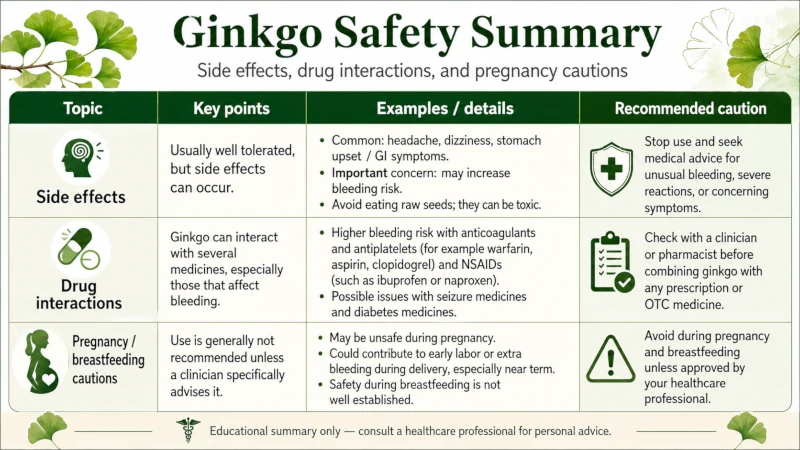
Supplements also aren’t risk-free. Ginkgo can cause dizziness, stomach upset, and headache, and — more seriously — it can raise the risk of bleeding, especially for people taking blood thinners such as warfarin; it may interact with other medicines as well. It may be unsafe in pregnancy, with a possible risk of early labor or bleeding around delivery, and little is known about using it while breastfeeding [NCCIH, 2025].
Who should be especially cautious with ginkgo or similar products: anyone on anticoagulants or several medications at once, anyone scheduled for surgery, and people who are pregnant or breastfeeding. Talk to a doctor or pharmacist before starting.
One honest nuance: a few nutrients matter because a deficiency can cause memory problems — low vitamin B12 is on NIA’s list of reversible causes. Correcting a genuine deficiency your doctor has identified is worthwhile. That’s not the same as taking “brain” pills on top of an already adequate diet, which hasn’t been shown to help.
When to see a doctor about memory
Talk with a doctor if you or someone close to you notices any of these [National Institute on Aging, 2023]; [Alzheimer’s Association, 2024]:
- Asking the same questions over and over
- Getting lost in places you used to know well
- Trouble following recipes or familiar directions
- Growing confusion about time, people, or places
- Slipping self-care — not eating, not bathing, or behaving unsafely
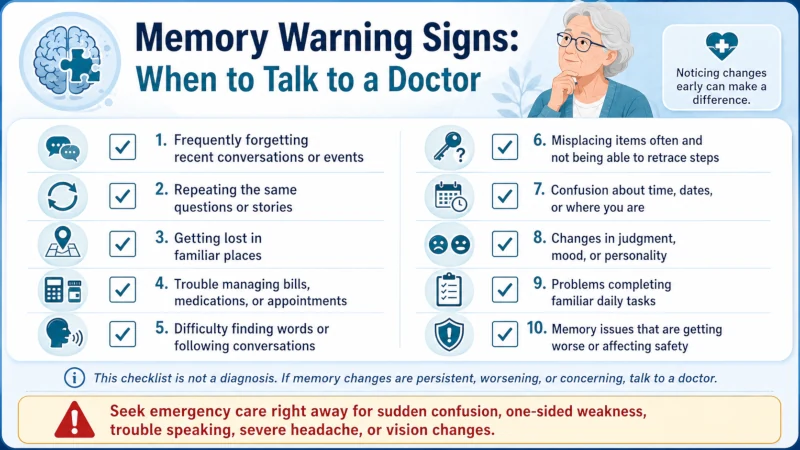
Some memory symptoms are emergencies. Sudden confusion or sudden memory loss — or memory changes alongside sudden weakness, trouble speaking, drooping on one side of the face, vision loss, or a severe headache — can be signs of a stroke. Call emergency services right away. Memory changes after a fall or head injury also warrant prompt medical attention.
Getting evaluated is worth it even when it feels frightening. Some causes are reversible, and when it is dementia, an early diagnosis opens the door to treatments that may ease symptoms, time to plan, and access to support [Alzheimer’s Association, 2024]. The Alzheimer’s Association runs a free 24/7 helpline at 800-272-3900.
Be skeptical of “brain boosters”
Pills, supplement blends, and brain-training games are marketed hard to older adults with promises of sharper memory or dementia prevention. The National Institute on Aging’s warning is worth repeating: these can be unsafe, a waste of money, or both, and some may even interfere with treatments you actually need [National Institute on Aging, 2023]. Run any product past your doctor before spending money on it.
| Health disclaimer This article is for general education and information only. It is not medical advice and is not a substitute for diagnosis or treatment by a qualified healthcare professional. Memory symptoms have many possible causes, and only a clinician who can evaluate you directly can tell you what is going on. Do not start, stop, or change any medication or supplement based on this page alone. If you are pregnant, breastfeeding, taking prescription medicines, or living with a chronic condition, talk with your doctor or pharmacist before using any herbal product or supplement. If you or someone else has sudden confusion, sudden memory loss, or possible stroke symptoms, call emergency services immediately. |
Frequently Asked Questions
Is forgetfulness a normal part of aging?
Usually, yes. Occasionally forgetting a name or misplacing your keys and then finding them is ordinary at any age. The concern is memory loss that disrupts daily life — getting lost in familiar places, or trouble managing everyday tasks — which is not typical aging and is worth a doctor’s visit.
What’s the difference between MCI and dementia?
People with mild cognitive impairment have more memory trouble than expected for their age but can still handle daily life on their own. Dementia is more severe and interferes with everyday functioning. MCI sometimes progresses to dementia, but often it doesn’t — and can stay stable or improve.
Can I prevent dementia?
There’s no guaranteed way to prevent it, and no drug or supplement that does. But the 2024 Lancet Commission estimates that addressing 14 risk factors — such as high blood pressure, hearing loss, physical inactivity, smoking, and excessive alcohol — could theoretically prevent or delay up to 45% of dementia cases at the population level. Healthy habits genuinely tilt the odds in your favor.
Does ginkgo biloba improve memory?
The best evidence says no — a large six-year study found ginkgo no better than placebo at preventing dementia. There’s only weak, inconsistent evidence it might slightly ease existing dementia symptoms. It can also increase bleeding risk and interact with medications, so check with your doctor first.
When should memory problems be treated as an emergency?
Sudden confusion or memory loss, or memory changes with sudden weakness, trouble speaking, facial drooping, vision loss, or a severe headache, can signal a stroke — call emergency services immediately. Memory changes after a head injury also need prompt care.
References
- National Institute on Aging (NIA/NIH). Memory Problems, Forgetfulness, and Aging. View source
- National Institute on Aging (NIA/NIH). What Is Mild Cognitive Impairment? View source
- Alzheimer Europe. 2024 Lancet Commission underscores the potential for dementia risk reduction (summarizing Livingston G, et al., The Lancet, 2024). View source
- National Center for Complementary and Integrative Health (NCCIH/NIH). Ginkgo: Usefulness and Safety. View source
- Alzheimer’s Association. 10 Early Signs and Symptoms of Alzheimer’s. View source
- Centers for Disease Control and Prevention. Signs and Symptoms of Alzheimer’s Disease. View source
- Mayo Clinic. Memory loss: When to seek help. View source
