
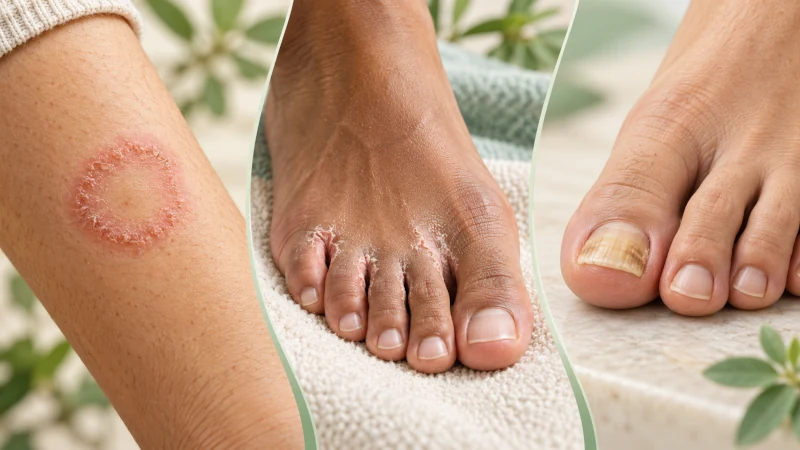
Most skin fungus is common, irritating, and very treatable. Ringworm, athlete’s foot, jock itch, tinea versicolor, and yeast rashes in skin folds are all fungal infections of the skin, and the ones on the body usually clear with an over-the-counter antifungal used for long enough [CDC, 2026b]. Two exceptions are worth knowing before you buy anything: an infection on the scalp or in the nails needs a prescription, because creams can’t reach the fungus there [CDC, 2026b].
One more thing before you open the medicine cabinet. Don’t put a steroid anti-itch cream, such as hydrocortisone, on a rash that might be fungal. The CDC warns that steroids weaken the skin’s ability to fight the fungus, can let ringworm spread, and change how the rash looks, which makes it harder to diagnose later [CDC, 2026b].
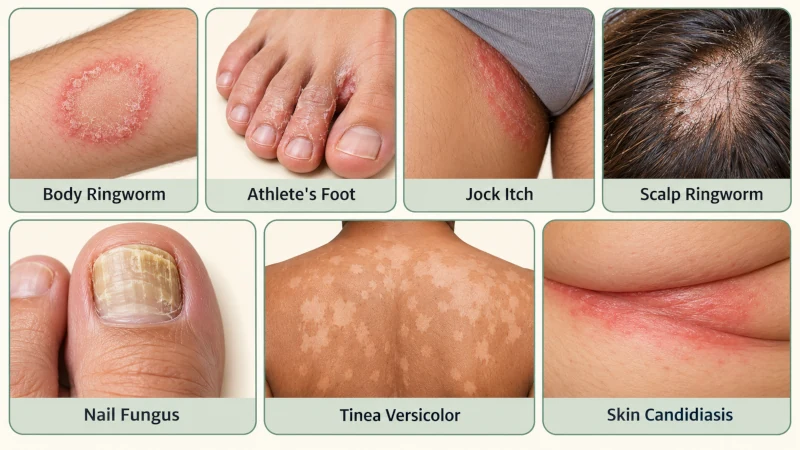
The main fungal infections of the skin at a glance
Different fungi cause different problems, and the right treatment depends on which one you have and where it is.
| Infection | Caused by | What you may notice | Usual first step |
| Ringworm of the body (tinea corporis) | Dermatophyte fungi | Itchy, scaly, often ring-shaped rash; red on light skin, gray or brown on darker skin [CDC, 2026a] | OTC antifungal cream for 2–4 weeks [CDC, 2026b] |
| Athlete’s foot (tinea pedis) | Dermatophyte fungi | Itchy, scaly or peeling skin on the feet, often between the toes | OTC antifungal [CDC, 2026b] |
| Jock itch (tinea cruris) | Dermatophyte fungi | Itchy rash in the groin | OTC antifungal [CDC, 2026b] |
| Scalp ringworm (tinea capitis) | Dermatophyte fungi | Scalp infection; common in children [Chen et al., 2016] | Prescription pills for 1–3 months [CDC, 2026b] |
| Fungal nail infection (onychomycosis) | Mostly dermatophytes | Nails change color, thicken, and break easily [CDC, 2026a] | Testing first, then usually prescription pills [CDC, 2026b] |
| Tinea versicolor | Malassezia yeast | Lighter or darker patches with fine scale, mostly trunk, neck, upper arms [StatPearls, Tinea Versicolor] | Antifungal shampoo or cream [AAD, Tinea versicolor treatment] |
| Skin candidiasis | Candida yeast | Itchy or burning rash with skin breakdown, often in warm skin folds [CDC, 2026c] | Keep the area dry; antifungal treatment |
Ringworm: athlete’s foot, jock itch, and body rashes
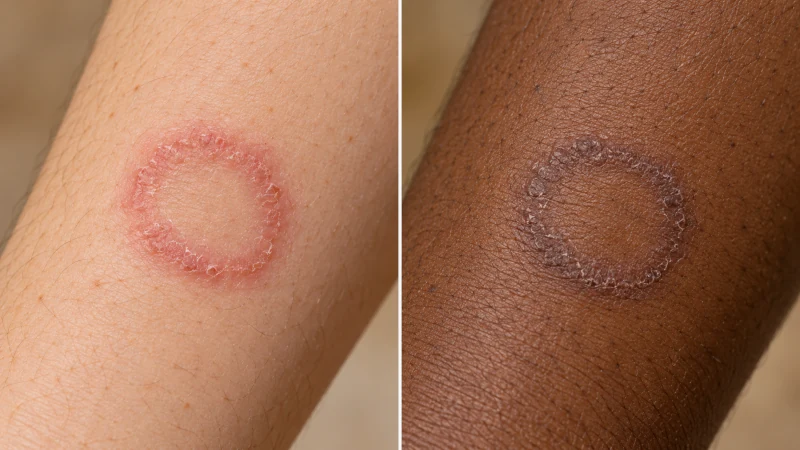
Ringworm has nothing to do with worms. It’s caused by fungi, mainly Trichophyton, Microsporum, and Epidermophyton, and it gets its name from the ring-shaped, itchy rash it often leaves [CDC, 2026a]. Doctors name each type “tinea” plus the body part, which is why athlete’s foot is tinea pedis and jock itch is tinea cruris. Most fungal nail infections belong to the same family [CDC, 2026a].
How ringworm spreads
It passes easily: skin-to-skin contact with an infected person or animal, shared towels and bedsheets, and shared floors like locker rooms and public bathrooms [CDC, 2026a]. Your risk goes up if you walk barefoot in public showers, play contact sports like wrestling, wear tight shoes and socks, sweat heavily, or spend time with an infected pet. People with weakened immune systems are more likely to get it and can have a harder time clearing it [CDC, 2026a].
Treating ringworm on the skin
For athlete’s foot, jock itch, and ringworm on the body, an OTC antifungal is usually enough. Look for clotrimazole, miconazole, terbinafine, or ketoconazole, and apply it for 2 to 4 weeks [CDC, 2026b]. The part people skip is the most important: keep using it for the full time on the label, even after the itch stops and the skin looks better [CDC, 2026b].
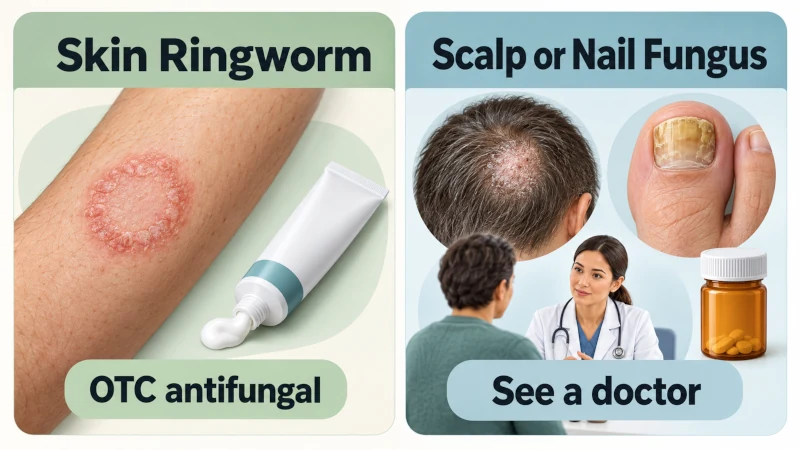
The evidence here is strong. A Cochrane review of randomized trials found plenty of support for OTC antifungal creams, lotions, and gels for athlete’s foot, with azoles, butenafine, tolnaftate, and ciclopirox all effective [Crawford & Hollis, 2007]. If a rash hasn’t improved after a full course, that’s your cue to get it looked at rather than switching creams again.
Habits that lower your risk
- Keep skin clean and dry, especially between the toes and in skin folds [CDC, 2026a].
- Wear sandals or shower shoes in locker rooms and public showers [CDC, 2026a].
- Change socks and underwear every day, and don’t share towels, socks, or sports gear [CDC, 2026a].
- Wash your hands after handling pets, and keep fingernails short and clean [CDC, 2026a].
- Avoid skin-to-skin contact, including intimate contact, with anyone who has a known or suspected infection [CDC, 2026a].

Scalp ringworm: why creams aren’t enough
Scalp ringworm (tinea capitis) is common and contagious in children. The fungus lives down at the root of the hair follicle, where creams don’t reach, so it always needs medicine taken by mouth [Chen et al., 2016]. The CDC lists griseofulvin, terbinafine, itraconazole, and fluconazole as prescription options, usually for 1 to 3 months [CDC, 2026b].
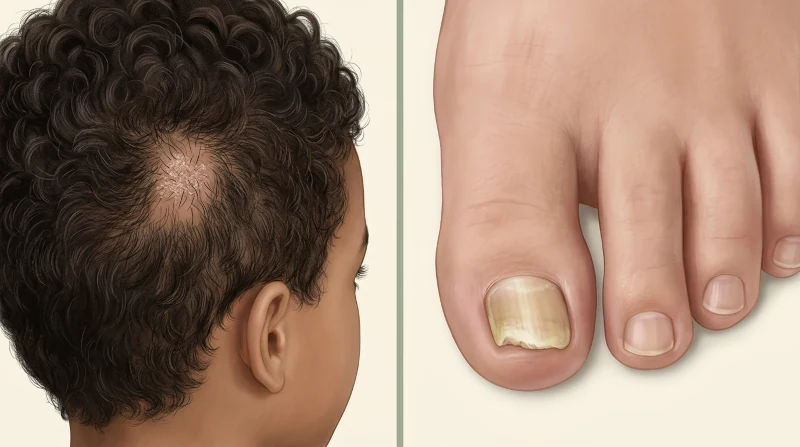
Which pill works best depends on the fungus. A Cochrane review found terbinafine, itraconazole, and fluconazole at least as effective as griseofulvin for Trichophyton infections, while griseofulvin did better than terbinafine for Microsporum [Chen et al., 2016]. The reviewers also said more and better studies are needed, so your doctor may test a sample to choose.
A flaky, itchy scalp has several possible causes besides fungus. If you’re unsure, our guide to telling scalp psoriasis from dandruff walks through the look-alikes. Smooth, round bald patches without scaling point toward a different problem altogether, explained in our article on alopecia areata and patchy hair loss.
Fungal nail infections
Infected nails often change color, thicken, and break easily. Toenails are hit far more often than fingernails [CDC, 2026a]. But nails also change shape and color after injuries and for other reasons, so the CDC advises getting tested before you start treatment [CDC, 2026b].
This is the slowest fungal infection to fix. Prescription pills are usually the best treatment, and clearing the infection can take several months to a year. Even after treatment it can come back, and people with diabetes are at higher risk of that happening [CDC, 2026b]. Topical treatments for toenails have much thinner evidence than creams for athlete’s foot [Crawford & Hollis, 2007]. With oral terbinafine, tablets are typically taken for 6 weeks for fingernails and 12 weeks for toenails, and the nail may not look cured until months later, because a healthy nail has to grow in [MedlinePlus, Terbinafine].
Tinea versicolor: patches that won’t tan
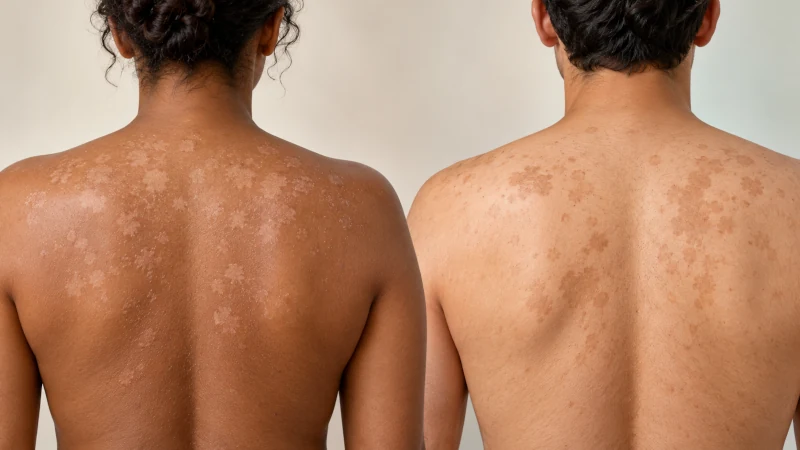
Everyone carries yeast on their skin. Tinea versicolor happens when one type, Malassezia, overgrows [AAD, Tinea versicolor overview]. Unlike ringworm, it isn’t caused by a dermatophyte, and it isn’t contagious [StatPearls, Tinea Versicolor]. It’s one of the most common skin conditions in tropical and subtropical climates, where some people have it year-round [AAD, Tinea versicolor overview]. It isn’t harmful, but the discoloration bothers a lot of people.
Look for small patches that are lighter or darker than the surrounding skin, with a fine scale, mostly on the trunk, neck, and upper arms. They usually itch only slightly, if at all [StatPearls, Tinea Versicolor].
Treatment is mostly topical: antifungal shampoos, soaps, creams, or lotions containing selenium sulfide, ketoconazole, or pyrithione zinc. A dermatologist may prescribe pills when the patches are widespread, thick, or keep returning [AAD, Tinea versicolor treatment]. Oral terbinafine, which works well for nail fungus, doesn’t work for tinea versicolor [StatPearls, Tinea Versicolor].
Here’s what trips people up. The yeast dies quickly, but your skin may stay lighter or darker for weeks or months afterward. That isn’t treatment failure; color returns on its own, and avoiding a tan helps it even out. Because it tends to come back in warm, humid weather, using a medicated cleanser once or twice a month during those months can help prevent it [AAD, Tinea versicolor treatment].
Yeast (candida) infections in skin folds
Candida is a yeast that lives on everyone’s skin and in the mouth, throat, and vagina, usually without causing trouble. It becomes an infection when it grows out of control. On the skin, that typically looks like an itchy or burning rash with skin breakdown [CDC, 2026c].
Skin folds are where it settles: the armpits, belly folds, under the breasts, and the groin. Heat, friction, and trapped moisture irritate the skin there, and Candida is a common secondary infection on top of that irritation. Obesity and diabetes both make fold rashes more likely [StatPearls, Intertrigo]. If blood sugar is part of the picture, our guide to diabetes-friendly foods for steadier blood sugar is a practical place to start alongside your care team.
People with weakened immune systems are at greater risk for every type of candidiasis. Vaginal yeast infections are linked to recent antibiotics, pregnancy, birth control pills, and unmanaged diabetes [CDC, 2026c]. For skin folds, the first job is keeping the area dry; drying agents can help reduce moisture [StatPearls, Intertrigo]. For a closer look at what does and doesn’t help with candida more broadly, see our evidence review of natural remedies for candida.
Natural remedies: what the evidence shows
Tea tree oil is the natural option with the most research for skin fungus, and the results are mixed. In a 1992 trial of 104 people with athlete’s foot, a 10% tea tree oil cream eased scaling, itching, and burning about as well as tolnaftate, a standard antifungal. But it didn’t clear the fungus any better than placebo: cultures turned negative in 30% on tea tree oil, 21% on placebo, and 85% on tolnaftate [Tong et al., 1992].
Stronger solutions did better. In a 2002 trial, 158 people with athlete’s foot between the toes applied 25% or 50% tea tree oil, or placebo, twice a day for 4 weeks. Marked improvement was seen in 72% (25% oil) and 68% (50% oil), versus 39% on placebo. The fungus cleared on culture in 64% of the 50% group, versus 31% on placebo. About 4% of people using tea tree oil developed moderate to severe skin inflammation, which settled after they stopped [Satchell et al., 2002].
Our read: limited, mixed evidence from two small, older trials, at concentrations much stronger than most shelf products. OTC antifungals have a far larger body of evidence behind them [Crawford & Hollis, 2007]. If you still want to try tea tree oil, patch-test it on a small area first, stop if a rash appears, and never swallow it. Our review of herbs for skin issues covers tea tree oil safety in more detail.
Vinegar soaks, garlic, and coconut oil also circulate widely as fungal remedies. We didn’t find quality human trials supporting them for skin fungus, so we can’t recommend them as treatment. The everyday habits above, especially keeping skin dry, are better supported.
Who should be extra careful
- People with diabetes. Nail infections come back more often [CDC, 2026b], and fold rashes are more likely [StatPearls, Intertrigo]. Get skin problems on the feet checked early rather than waiting them out.
- Anyone with a weakened immune system. Higher risk of ringworm and of all types of candidiasis, and infections can be harder to clear [CDC, 2026a] [CDC, 2026c].
- Pregnancy and breastfeeding. Tell your doctor before starting any antifungal pill. With terbinafine, MedlinePlus advises telling your doctor if you’re pregnant or planning to be, and not breastfeeding while taking it [MedlinePlus, Terbinafine]. Ask a pharmacist before using OTC creams too.
- Children. Scalp ringworm needs a prescription, so don’t rely on creams [CDC, 2026b]. Keep essential oils out of reach.
- People taking antifungal pills. Oral terbinafine can rarely cause liver injury. Call your doctor right away for nausea, loss of appetite, extreme tiredness, vomiting, pain in the upper right belly, dark urine, pale stools, or yellowing skin or eyes. It can also change taste or smell, sometimes permanently. Tell your doctor about liver disease and other medicines, including cimetidine; lab tests are usually ordered before and during treatment [MedlinePlus, Terbinafine].
- Tea tree oil users. Skin inflammation is the main risk, and it affected about 1 in 25 people in the larger trial [Satchell et al., 2002].
When to see a doctor
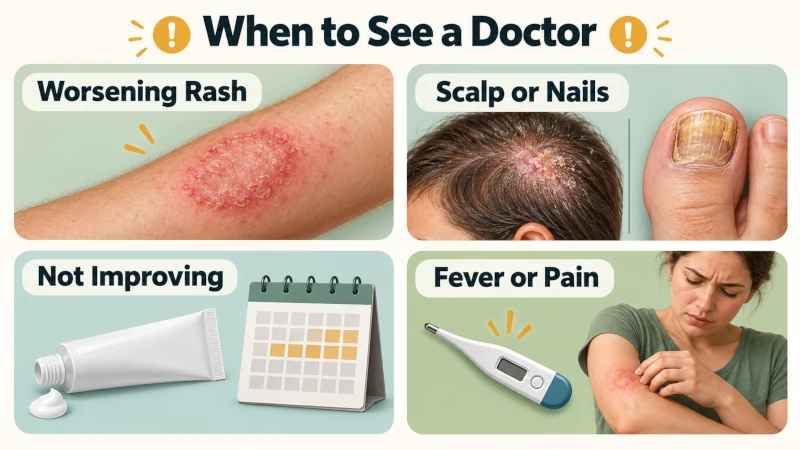
It’s reasonable to contact a healthcare provider for any suspected ringworm, since they can confirm the cause and speed up the right treatment [CDC, 2026b]. Don’t wait if any of these apply:
- You suspect ringworm on the scalp or a fungal nail infection [CDC, 2026b].
- The rash is more severe or widespread than usual, or it hasn’t cleared after a full course of treatment [CDC, 2026b].
- You’ve had contact with someone with a severe infection, or you’ve traveled recently. Drug-resistant ringworm has been spreading abroad, with some U.S. cases, so mention your travel history [CDC, 2026b].
- You have fever and chills, or pain or trouble swallowing alongside a yeast infection [CDC, 2026c].
- You have diabetes or a weakened immune system and a new skin infection.
- Get same-day care if the area becomes hot, swollen, increasingly painful, oozes pus, or you develop a fever. Those can signal a bacterial infection on top of the fungal one.
| HEALTH DISCLAIMER: This article is for general education and is not medical advice. It doesn’t replace diagnosis or treatment from a qualified healthcare professional. Many rashes look alike, and some that resemble fungus are something else entirely. Talk with a doctor, dermatologist, or pharmacist before starting treatment, especially if you are pregnant or breastfeeding, treating a child, have diabetes or a weakened immune system, have liver disease, or take other medicines. Natural products such as tea tree oil can irritate skin and should never be swallowed. If a rash spreads quickly, becomes hot, swollen, or painful, or comes with a fever, seek medical care promptly. In an emergency, call 911. |
Frequently Asked Questions
Are fungal skin infections contagious?
Ringworm, including athlete’s foot and jock itch, spreads through skin contact with people or animals and through shared towels and floors [CDC, 2026a]. Tinea versicolor is not contagious [StatPearls, Tinea Versicolor]. Candida already lives on everyone’s skin; infections happen when it overgrows [CDC, 2026c].
How long does antifungal cream take to work?
For skin ringworm, plan on 2 to 4 weeks, and keep applying it for as long as the label directs even once the rash looks better [CDC, 2026b].
Can I use hydrocortisone cream on ringworm?
No. Steroid creams can make ringworm worse, help it spread, and change its appearance so it’s harder to diagnose [CDC, 2026b].
Why are my tinea versicolor spots still pale after treatment?
The yeast clears fast, but skin color can take weeks or months to return. Avoiding a tan helps your skin tone even out [AAD, Tinea versicolor treatment].
Does tea tree oil cure athlete’s foot?
Sometimes, in limited trials. A 50% solution cleared the fungus in 64% of people versus 31% on placebo [Satchell et al., 2002], but a 10% cream didn’t beat placebo at clearing the fungus [Tong et al., 1992]. OTC antifungals have stronger evidence [Crawford & Hollis, 2007].
Do I need to see a doctor for a fungal nail?
Yes. Nails change for many reasons, so testing comes first, and the most effective treatment is usually a prescription pill [CDC, 2026b].
References
- Centers for Disease Control and Prevention. Ringworm Basics. View source
- Centers for Disease Control and Prevention. Treatment of Ringworm. View source
- Centers for Disease Control and Prevention. Candidiasis Basics. View source
- American Academy of Dermatology. Tinea versicolor: Overview. View source
- American Academy of Dermatology. Tinea versicolor: Diagnosis and treatment. View source
- Tinea Versicolor. In: StatPearls [Internet]. Treasure Island (FL): StatPearls Publishing. View source
- Intertrigo. In: StatPearls [Internet]. Treasure Island (FL): StatPearls Publishing. View source
- Crawford F, Hollis S. Topical treatments for fungal infections of the skin and nails of the foot. View source
- Chen X, Jiang X, Yang M, González U, Lin X, Hua X, Xue S, Zhang M, Bennett C. Systemic antifungal therapy for tinea capitis in children. View source
- Satchell AC, Saurajen A, Bell C, Barnetson RS. Treatment of interdigital tinea pedis with 25% and 50% tea tree oil solution: a randomized, placebo-controlled, blinded study. View source
- Tong MM, Altman PM, Barnetson RS. Tea tree oil in the treatment of tinea pedis. View source
- MedlinePlus. Terbinafine. U.S. National Library of Medicine (AHFS Patient Medication Information). View source


