
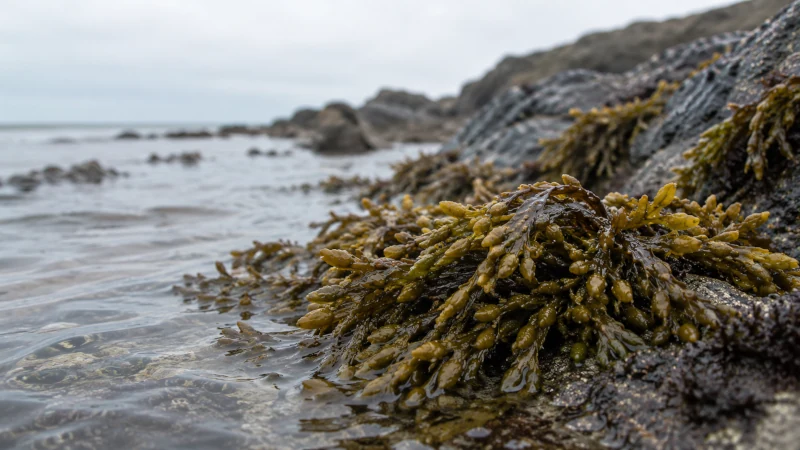
If you are weighing the Fucus vesiculosus benefits you have read about — usually weight loss, a faster metabolism, or smoother skin — here is the honest headline: bladderwrack is a nutritious brown seaweed with one clearly real property (it is a concentrated, highly variable source of iodine), and almost none of the dramatic claims made for it hold up in human trials. People take Fucus vesiculosus for thyroid problems, obesity, and aging skin, but there is no good clinical evidence that it treats any of them [NIH ODS, 2024] [Drugs.com, 2026]. That same iodine is also the reason it can do harm, especially if you have a thyroid condition.
This is a careful walk through what the research actually supports, what it doesn’t, how people use the seaweed, and — most importantly for a plant this rich in iodine — who should stay away from it and when to call a professional.
What Fucus vesiculosus (bladderwrack) actually is
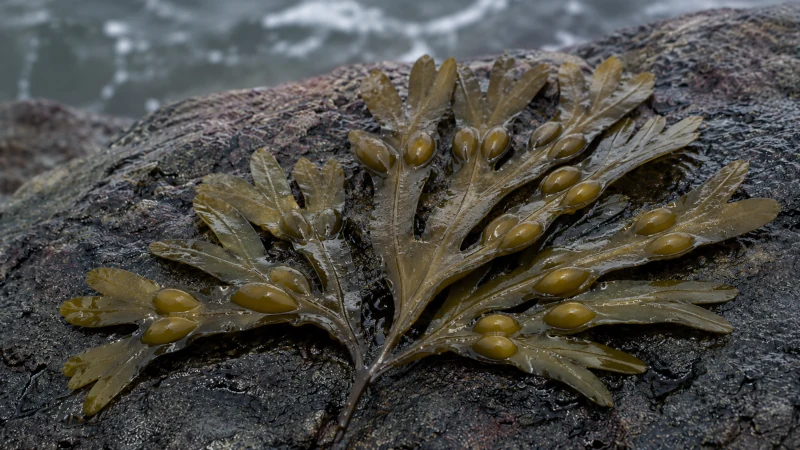
Fucus vesiculosus — commonly called bladderwrack, sea ware, black tang, or rockweed — is a brown seaweed in the Fucaceae family that grows along the rocky Atlantic coasts of Europe and North America. You can recognize it by the paired air bladders along its fronds that keep it floating upright underwater. It has been eaten and used medicinally for centuries, and diets rich in seaweed are a normal part of life in several coastal cultures [Drugs.com, 2026]. It is a close relative of the kelp used in traditional cooking and supplements, and the two share both a mineral profile and the same central caveat about iodine.
What’s inside it
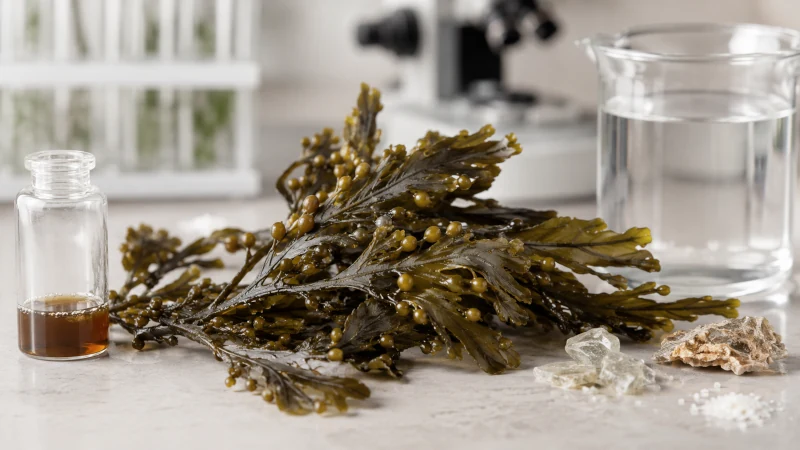
Like most seaweeds, bladderwrack is mostly fiber, complex sugars, minerals, and vitamins. The constituents that get the most research attention are alginic acid (a gel-forming, water-holding polysaccharide), fucoidan (a sulfated polysaccharide studied in the lab for immune and anticancer activity), fucoxanthin (a carotenoid), and phlorotannins (polyphenol antioxidants). It also supplies calcium, magnesium, potassium, and — the headline mineral — iodine [Drugs.com, 2026]. One detail matters more than any other: the amount of every one of these compounds, iodine included, swings widely depending on where and when the seaweed was harvested [Drugs.com, 2026].
Fucus vesiculosus benefits: what the evidence actually shows
The most useful thing a page like this can do is separate what is established from what is hopeful. Here is the short version before the detail.
| Claim | Strength of evidence | What that means |
| Source of iodine | Well established | It genuinely contains iodine — often a lot, and in unpredictable amounts. |
| Blood-sugar / metabolic markers | Limited & mixed | Small trials, often of seaweed blends, hint at modest glucose effects — not weight loss. |
| Skin firmness (applied to skin) | Limited | A couple of small topical studies, usually of mixtures — not the seaweed alone, and not taken by mouth. |
| Weight loss / fat burning | Not supported | No human trial shows bladderwrack causes fat loss. |
| Curing cellulite, wrinkles, obesity | Not supported | Traditional cosmetic use only; no clinical proof. |
| Anticancer / antimicrobial / antioxidant | Early (lab/animal) | Interesting test-tube findings for fucoidan; no clinical trials in people. |
Iodine and the thyroid — real, but a double-edged sword
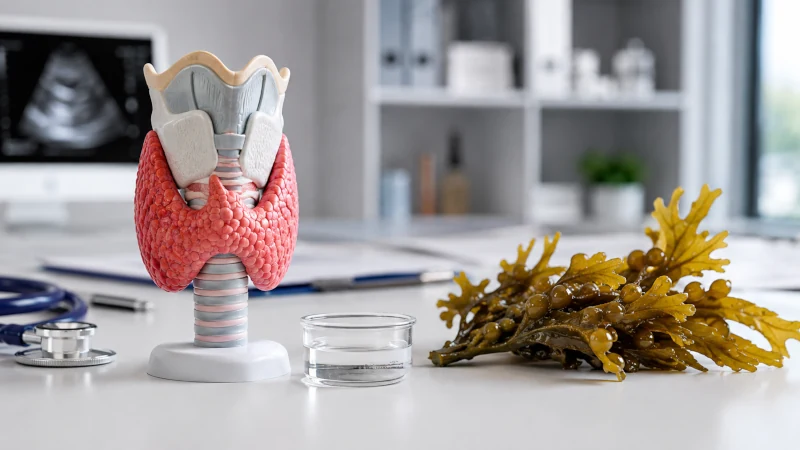
Your thyroid needs iodine to make the hormones that regulate metabolism, and bladderwrack supplies it. That is the kernel of truth behind every “thyroid support” and “metabolism” claim. The problem is dose and consistency. Iodine follows a U-shaped curve: too little causes thyroid problems, and so does too much [NIH ODS, 2024]. Because a seaweed’s iodine content is so variable, a bladderwrack supplement can deliver anywhere from a sensible amount to thousands of times the daily upper limit — and there is no way to know from the label [American Thyroid Association, 2013].
This is why doctors treat seaweed “thyroid boosters” with caution rather than enthusiasm. In someone with a healthy thyroid, an occasional culinary amount is usually fine. In someone with an underactive or overactive thyroid, Hashimoto’s, nodules, or a family history of thyroid disease, extra iodine can tip the balance and trigger either an underactive or an overactive thyroid [NIH ODS, 2024] [Drugs.com, 2026]. Most hypothyroidism in the United States is not caused by iodine deficiency, so “more iodine” is rarely the fix people assume it is.
Blood sugar and metabolic markers — early, and mostly from blends
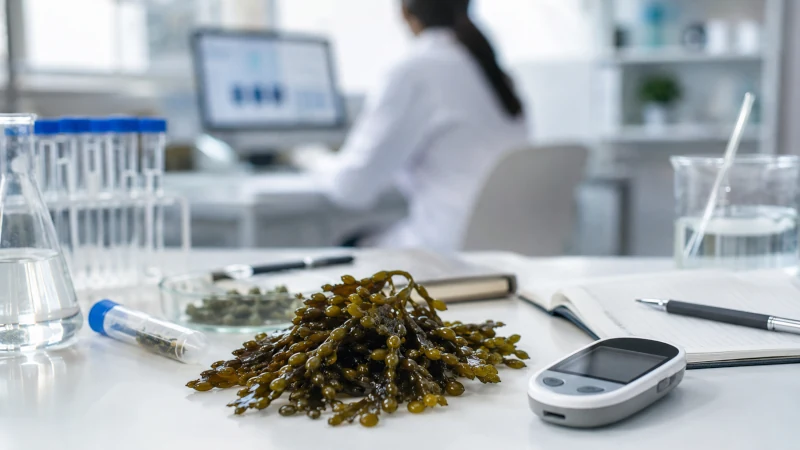
The most legitimate modern research on bladderwrack is about blood sugar, not weight. In one 10-week trial, a Fucus vesiculosus extract at 1,200 mg a day in 76 adults with overweight or obesity improved fasting glucose and insulin — but showed no change in inflammatory or safety markers, and, notably, was not a weight-loss result [Drugs.com, 2026]. Other small studies used seaweed combinations (Fucus vesiculosus plus Ascophyllum nodosum, sometimes with added chromium), which makes it impossible to credit bladderwrack alone, and a single-dose study found no effect on post-meal glucose versus placebo [Drugs.com, 2026]. Read together: a plausible, early signal for glycemic markers, from small and often mixed-ingredient trials. Promising is the right word; proven is not.
Skin — limited, topical, and usually not bladderwrack alone
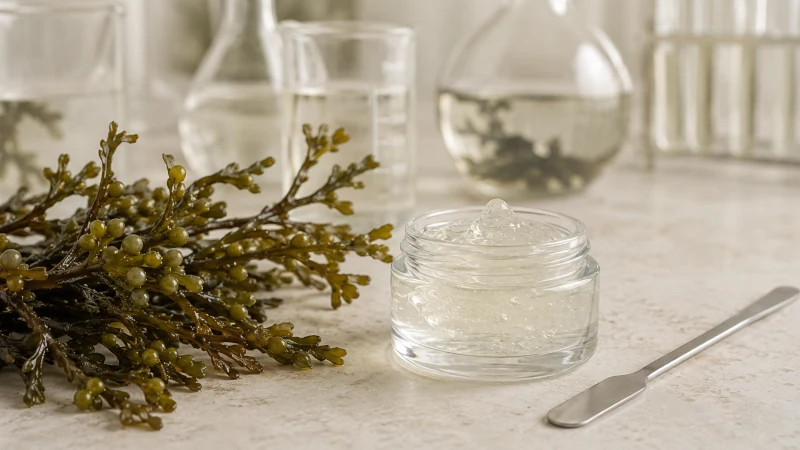
The “firmer skin” idea comes from a small number of studies where the seaweed was applied to the skin, not swallowed. In one, a 12-week cream containing Fucus vesiculosus alongside retinol, conjugated linoleic acid, and other actives increased collagen and reduced the appearance of cellulite — but because it was a multi-ingredient formula, the result cannot be pinned on bladderwrack [Drugs.com, 2026]. A separate small study of a 1% Fucus gel reported improved skin elasticity over five weeks [Drugs.com, 2026]. That is the entire evidence base for the skin claims, and none of it supports taking bladderwrack by mouth to smooth cellulite or erase wrinkles.
Digestion and the feeling of fullness
Bladderwrack’s alginic acid swells with water, and some seaweed studies report a sense of fullness and softer stools, likely from that gel-forming fiber [Drugs.com, 2026]. This is the mechanism behind the old “appetite suppressant” reputation. It is a reasonable digestive effect, but feeling full for an hour is a long way from a proven weight-loss tool.
Antioxidant, antimicrobial, and anticancer laboratory work
Fucoidan and the seaweed’s polyphenols show antioxidant, antimicrobial, and anti-proliferative activity in test tubes and animals, which is why bladderwrack appears in a lot of hopeful headlines [Drugs.com, 2026]. None of this has been confirmed in human clinical trials. These are leads for researchers, not reasons to take a supplement.
What bladderwrack has NOT been shown to do
Some of the most confident claims online — including in older versions of articles like this one — are the ones with the least support.
Melt fat or cause weight loss
No human trial shows bladderwrack causes fat loss [Drugs.com, 2026], and clinical research on seaweeds for weight loss has generally failed to confirm a benefit [WebMD, 2026]. Any quick drop on the scale from a seaweed product is far more likely to be appetite or water than fat — the same trap seen with diuretic teas, where the scale moves because of fluid, not body composition. There is a darker irony here, too: if a bladderwrack product contained enough iodine to noticeably affect metabolism, that amount would also be enough to risk an overactive thyroid.
Cure cellulite, wrinkles, or stretch marks
The original framing of this seaweed as a treatment for cellulitis, wrinkles, and stretch marks is not backed by clinical evidence. The only human skin data involve topical mixtures, and they measure modest cosmetic changes — not a cure for any skin condition [Drugs.com, 2026]. (Worth noting: “cellulitis,” a serious bacterial skin infection, is a medical emergency treated with antibiotics and has nothing to do with the cosmetic “cellulite” the seaweed is marketed for.)
Safely “boost” a sluggish thyroid on its own
Self-treating a thyroid problem with an unstandardized dose of iodine-rich seaweed is exactly what endocrinologists warn against. Bladderwrack can interfere with prescription thyroid medication and can push thyroid function in either direction [Drugs.com, 2026] [NIH ODS, 2024]. A suspected thyroid problem is a reason to get blood tests, not a reason to buy seaweed. For context on how other plants are traditionally — and often unprovenly — tied to metabolism, see this overview of herbs said to support metabolism.
How people use bladderwrack (and sensible expectations)
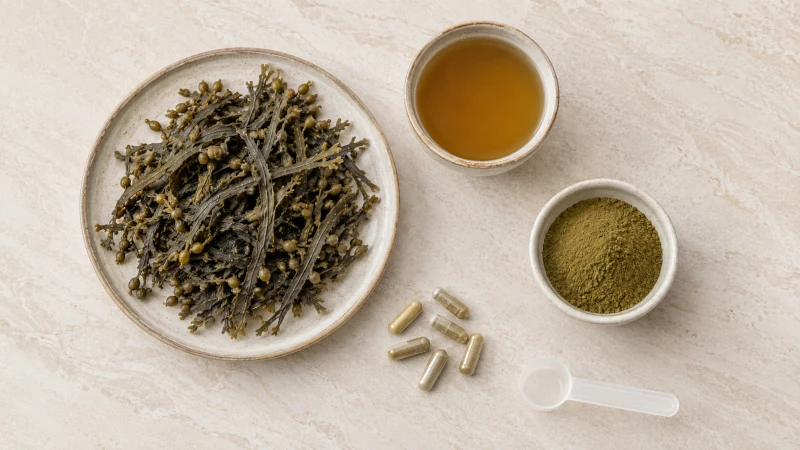
Bladderwrack is sold as a dried seaweed for tea, as a powder, and in capsules; it is also eaten as a vegetable in some cuisines. Here is the honest part: there are no reliable clinical dosing recommendations for bladderwrack, because the trials needed to establish them don’t exist [Drugs.com, 2026]. Any dose on a product label is the manufacturer’s choice, not a medically established one, and — because iodine content varies so much — two capsules of the “same” dose can deliver very different amounts of iodine.
If you and your healthcare provider decide a culinary amount is reasonable for you, the guardrails that matter are about iodine, not the seaweed itself. The American Thyroid Association advises against iodine or kelp supplements that provide more than 500 mcg of iodine a day, and warns that many kelp products contain iodine at up to several thousand times the daily upper limit [American Thyroid Association, 2013]. Choose products that state their iodine content and are third-party tested for heavy metals — and if a label can’t tell you how much iodine is inside, treat that as a reason to skip it.
Iodine reference amounts (all sources combined, per day)
| Group | Recommended (RDA) | Upper limit (UL) |
| Adults | 150 mcg | 1,100 mcg |
| Pregnant teens & women | 220 mcg | 1,100 mcg |
| Breastfeeding teens & women | 290 mcg | 1,100 mcg |
| Children 9–13 years | 120 mcg | 600 mcg |
| Teens 14–18 years | 150 mcg | 900 mcg |
Source: NIH Office of Dietary Supplements, Iodine Fact Sheet for Consumers (2024). The upper limit includes iodine from food, drinks, and supplements combined; it does not apply to people taking iodine under medical supervision.
Safety, side effects, and interactions
This is the part that deserves the most attention, because the risks of bladderwrack are better documented than its benefits.
The iodine problem
Too much iodine can cause an enlarged thyroid (goiter), thyroid inflammation, and either an underactive or overactive thyroid; extremely large single doses can cause burning of the mouth and throat, stomach upset, and worse [NIH ODS, 2024]. Transient hypothyroidism from the iodine in seaweed has been reported [Drugs.com, 2026]. People most vulnerable to iodine excess include those with existing thyroid disease, newborns, the elderly, and pregnant or breastfeeding women [American Thyroid Association, 2013]. Iodine can also aggravate acne and reduce iron absorption in some people.
Heavy metals
Seaweed absorbs what is in the water around it, so bladderwrack can concentrate heavy metals such as arsenic, lead, and cadmium depending on where it was harvested [Drugs.com, 2026]. Here the sources differ in emphasis: the medically reviewed Drugs.com monograph calls the toxicity risk largely theoretical and notes that clear case reports are lacking, while other clinical references point to older published cases of kidney injury and elevated arsenic linked to seaweed or kelp products [Drugs.com, 2026] [WebMD, 2026]. The practical takeaway is the same either way — sourcing and third-party testing matter, and “natural” does not mean “clean.”
Drug interactions to raise with your pharmacist
| Medication / class | Why it matters |
| Thyroid drugs (levothyroxine; antithyroid drugs like methimazole) | Added iodine can interfere with thyroid replacement and antithyroid therapy, changing how well they work [NIH ODS, 2024] [Drugs.com, 2026]. |
| Blood thinners / antiplatelets (e.g., warfarin) | Fucoidan has heparin-like activity, so an additive bleeding effect is theoretically possible [Drugs.com, 2026]. |
| Lithium | Iodine-containing products can affect thyroid function in people on lithium; a case of hyperthyroidism has been reported [Drugs.com, 2026]. |
| ACE inhibitors & potassium-sparing diuretics | Taking iodide (e.g., from kelp/seaweed) with these can raise blood potassium [NIH ODS, 2024]. |
| Amiodarone, lamotrigine, and CYP450-metabolized drugs | Theoretical interactions flagged from animal or lab data; discuss before combining [Drugs.com, 2026]. |
Pregnancy and breastfeeding
Avoid bladderwrack if you are pregnant or breastfeeding. The concerns are concrete: excess iodine, possible heavy-metal contamination, and reported effects on estrogen and menstrual-cycle length [Drugs.com, 2026]. Excess iodine in a nursing mother can also affect the infant’s thyroid [Drugs.com, 2026]. If you need iodine in pregnancy or lactation, the established route is a prenatal supplement with a measured 150 mcg of iodine as potassium iodide — not seaweed [NIH ODS, 2024].
Who should avoid bladderwrack

- Anyone with a thyroid condition — hyperthyroidism, hypothyroidism, Hashimoto’s, Graves’ disease, or thyroid nodules.
- Anyone taking thyroid medication, blood thinners, lithium, or the other drugs listed above (check first).
- Pregnant or breastfeeding women, and children.
- People with kidney disease, or anyone with a known iodine or seaweed sensitivity.
- Anyone scheduled for surgery or for a thyroid scan / radioactive-iodine treatment (a low-iodine diet excludes kelp and seaweed products) [NIH ODS, 2024].
Red flags — when to see a healthcare professional
Stop bladderwrack and talk to a clinician promptly if you notice any of the following, which can signal iodine-driven thyroid trouble or another problem that needs real evaluation:
- A new or growing swelling at the base of the neck (possible goiter).
- Racing or irregular heartbeat, tremor, unexplained weight loss, heat intolerance, or anxiety (possible overactive thyroid).
- Fatigue, unexplained weight gain, cold intolerance, or constipation (possible underactive thyroid).
- Unusual bruising or bleeding, especially if you take a blood thinner.
- Any thyroid symptoms during pregnancy, or if you are managing a known thyroid or kidney condition.
A suspected thyroid disorder is diagnosed with simple blood tests (such as TSH and T4). That is the right next step — not a stronger supplement.
| HEALTH DISCLAIMER: This article is for general educational and informational purposes only and is not a substitute for professional medical advice, diagnosis, or treatment. Fucus vesiculosus (bladderwrack) is a traditional herbal product, not an approved treatment for any disease. Do not use it to self-treat a thyroid condition, obesity, or any other medical problem. Because its iodine content is high and unpredictable, talk with a qualified healthcare provider before using it — especially if you have a thyroid or kidney condition, take any medication, or are pregnant or breastfeeding. If you develop neck swelling, heart-rhythm changes, unexplained weight change, or other concerning symptoms, seek medical care. |
Frequently Asked Questions
Does bladderwrack help you lose weight?
There is no clinical evidence that bladderwrack causes fat loss, and research on seaweeds for weight loss has generally not confirmed a benefit [Drugs.com, 2026] [WebMD, 2026]. Any short-term change on the scale is more likely appetite or water than fat.
Is bladderwrack good for the thyroid?
It supplies iodine, which the thyroid needs — but more iodine is not automatically better. Too much can cause an underactive or overactive thyroid, and the dose in supplements is unpredictable. If you have any thyroid condition, avoid it and talk to your doctor [NIH ODS, 2024] [American Thyroid Association, 2013].
How much bladderwrack is safe to take?
There is no established clinical dose [Drugs.com, 2026]. The relevant limit is iodine: the American Thyroid Association advises against iodine or kelp supplements providing more than 500 mcg of iodine a day, and the adult daily upper limit from all sources is 1,100 mcg [American Thyroid Association, 2013] [NIH ODS, 2024].
Can I take bladderwrack while pregnant or breastfeeding?
No — avoid it. The concerns are excess iodine, possible heavy-metal contamination, and reported hormonal effects. For iodine needs in pregnancy or lactation, use a prenatal supplement with 150 mcg of iodine as potassium iodide instead [NIH ODS, 2024] [Drugs.com, 2026].
Does bladderwrack interact with medications?
It can. The most important are thyroid medications, blood thinners, lithium, and drugs affected by potassium levels. Check with your pharmacist before combining bladderwrack with any prescription medicine [NIH ODS, 2024] [Drugs.com, 2026].
Is bladderwrack the same as kelp?
They are different seaweeds but close relatives with similar mineral profiles, and both are notable (and variable) sources of iodine. The same iodine cautions apply to each.
References
- National Institutes of Health, Office of Dietary Supplements. Iodine: Fact Sheet for Consumers. Updated May 1, 2024. [View source]
- American Thyroid Association. Statement on the Potential Risks of Excess Iodine Ingestion and Exposure. 2013. [View source]
- Drugs.com. Bladderwrack (Fucus vesiculosus): Uses, Benefits & Dosage. Medically reviewed; updated July 22, 2026. [View source]
- WebMD. Bladderwrack (Fucus vesiculosus): Overview, Uses, Side Effects, Dosing. [View source]
