Rosemary oil is not going to fill in a patchy beard. No clinical trial has ever tested it on facial hair — not one. What exists is a single scalp study in men with pattern baldness, some encouraging work in mice, and an enormous amount of social media. The counter-argument doing the rounds is just as thin: the warning that rosemary oil for beard growth actually backfires, because it blocks DHT, rests on laboratory findings that have never been shown to happen on a human face. Below is what the research supports, what it doesn’t, and what rosemary oil is actually useful for if you keep it in your grooming kit.
Rosemary oil for beard growth: where the evidence stands
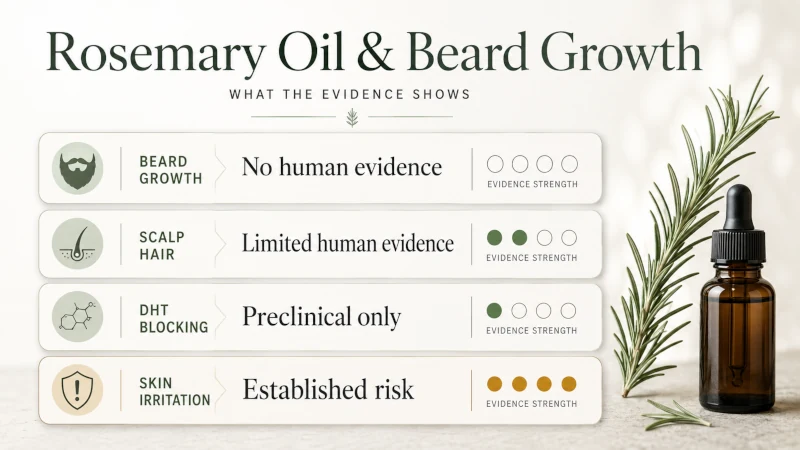
| Claim | What the evidence looks like |
| Rosemary oil grows facial hair | No human evidence. No published trial in beards. |
| Rosemary oil helps scalp hair in pattern baldness | Limited. One 6-month randomized trial, 100 men, no placebo group [Panahi, 2015]. |
| Rosemary extract inhibits 5-alpha-reductase | Preclinical only. Test-tube and mouse work using leaf extract, not the essential oil [Murata, 2013]. |
| Rosemary oil blocks DHT in your face and stunts your beard | No evidence either way. Plausible on paper; never measured in humans. |
| Rosemary oil can irritate or sensitize skin | Well established. Contact dermatitis is a recognized reaction [EMA, 2024]. |
The one human study everyone is quoting
The trial behind nearly every rosemary oil claim online is a 2015 randomized comparison in the journal Skinmed. Researchers assigned 100 people with androgenetic alopecia — pattern hair loss — to either rosemary oil or minoxidil 2%, 50 in each group, and followed them for six months with standardized photography. Neither group had gained hair at three months. By six months, both groups had a significant increase in hair count compared with baseline, and there was no significant difference between them. Scalp itching went up in both groups, but was more frequent with minoxidil [Panahi, 2015].
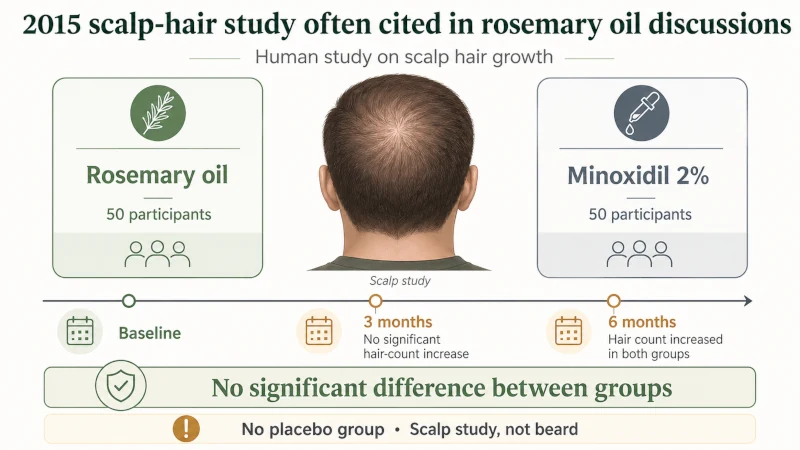
That result is interesting. It is also frequently oversold. The trial had no placebo arm, so we cannot separate the oil from the massage, the vehicle, or six months of regression to the mean. It used minoxidil 2%, not the 5% strength most men actually buy. It ran on scalps. And it was a single trial that has not been replicated at a larger scale.
Reviews of herbal hair treatments keep landing in the same place: promising signals, weak study designs. A 2025 review in Skin Appendage Disorders covering rosemary alongside saw palmetto, pumpkin seed oil and others concluded the research is limited by “small sample sizes, and short treatment durations” and called for properly designed randomized trials [Ahmed, 2025]. A 2024 review devoted largely to rosemary oil made the point more bluntly: finasteride and minoxidil remain the only FDA-approved treatments for pattern hair loss [Bin Rubaian, 2024].
The DHT question, and why beards are different
Here is where the beard conversation gets its energy.
Dihydrotestosterone (DHT) is made from testosterone by an enzyme called 5-alpha-reductase. On a genetically susceptible scalp, DHT shrinks follicles. On the face, it does close to the opposite. When researchers cultured dermal papilla cells — the signaling cells at the base of a follicle — from beard follicles and from non-balding scalp follicles and fed them testosterone, meaningful amounts of DHT were recovered inside the beard cells but not the scalp cells. The authors linked this to a long-standing clinical observation: men with 5-alpha-reductase deficiency grow poor beards [Thornton, 1993].
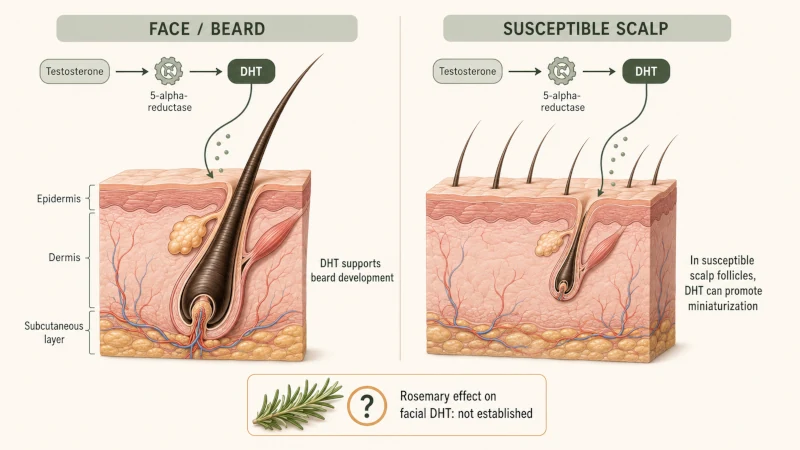
So DHT is not the villain in facial hair. It is closer to the fuel.
Now the rosemary side. In a 2013 study, researchers applied Rosmarinus officinalis leaf extract to mice whose hair regrowth had been interrupted by testosterone, and regrowth improved. In test tubes, the same extract inhibited 5-alpha-reductase by 82.4% at 200 µg/mL and 94.6% at 500 µg/mL, and the active compound was identified as 12-methoxycarnosic acid [Murata, 2013].
Two details get lost when this study is repeated online. The first is that it used a leaf extract, not the essential oil sold as rosemary oil — same plant, different preparations, different chemistry. The second is that inhibiting an enzyme in a dish is not the same as lowering DHT inside human facial skin, at cosmetic concentrations, through a beard. Nobody has measured that.
Which means the confident version of the warning — rosemary oil will shrink your beard — is an inference stacked on an inference. It is a reasonable thing to be curious about. It is not a finding. If you already have a full beard and the idea bothers you, using the oil on your scalp and not your jaw costs you nothing.
What rosemary oil can realistically do for a beard
Set growth aside and the picture improves, because most beard complaints are skin complaints.
The skin under a beard gets dry, flaky and itchy when it is not moisturized, and dead cells and product build up in a way they don’t on bare skin. Dermatologists’ beard advice is consistently unglamorous: wash daily with a gentle cleanser, moisturize, exfoliate lightly if you get ingrown hairs, and stop touching your beard [AAD, Healthy Beard]. A diluted oil is a reasonable moisturizer and a pleasant one, and the carrier oil is doing much of that work.
The 2015 trial’s authors gave rosemary’s effect on microcapillary perfusion — blood flow through the smallest vessels — as their reason for testing it in the first place [Panahi, 2015]. That is a plausible mechanism. It is not a promise, and nobody has checked whether it does anything visible on a jaw.
One more honest note about massage, since it is bundled into every oil routine. In a small study, nine men who massaged their scalps for four minutes a day for 24 weeks showed a modest increase in hair thickness, from 0.085 mm to 0.092 mm [Koyama, 2016]. Nine men, no control group, scalp not beard. It is a hint, not a result — but it costs nothing and it is part of what any oil routine delivers.
How to use it without irritating your face
Facial skin is thinner and more reactive than scalp skin, and it is the part of you people look at. Dilution is not optional.
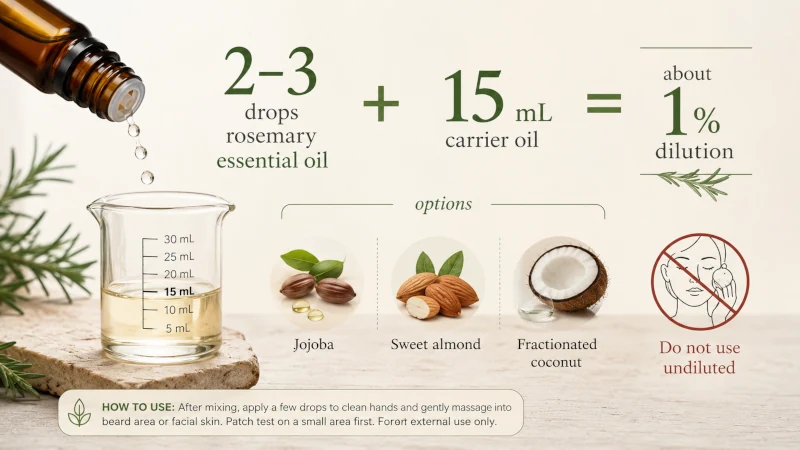
Dilute it. Mix 2–3 drops of rosemary essential oil into 15 ml (about one tablespoon) of a carrier oil — jojoba, sweet almond, or fractionated coconut. That works out to roughly 1%, which is a conventional starting point for facial skin. Never apply the neat essential oil to your face. For reference, European regulators describe cutaneous rosemary oil preparations at 6–10% for muscular and joint use — much stronger, and not for faces [EMA, 2024].
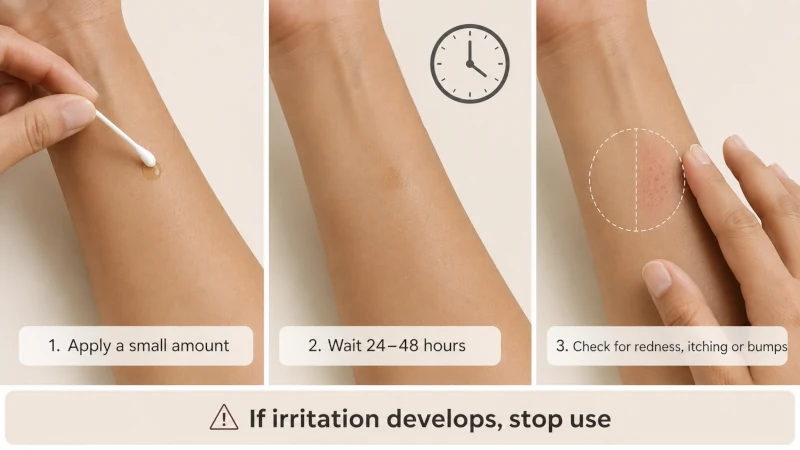
Patch test first. Put a little of the diluted blend on your inner forearm and leave it 24–48 hours. Redness, itching or small bumps means stop.
Work it into the skin, not only the hair. A few drops into your palms, worked into the skin under the beard and then out through the hair, once or twice a day. A minute of gentle massage while you do it is free.
Give it three to six months before you judge it — and judge it on comfort, itch and flaking rather than density, because that is what it has a plausible shot at improving. Do not apply it to broken or irritated skin [EMA, 2024].
Side effects, interactions, and who should skip it
Rosemary is a common cosmetic ingredient, and most people tolerate diluted rosemary oil on skin without trouble. The reactions that do occur are worth knowing.
- Allergic contact dermatitis and skin irritation are recognized reactions to rosemary oil; asthma has also been reported. European regulators list hypersensitivity to rosemary as a contraindication and advise against applying it to broken or irritated skin [EMA, 2024]. If you develop a persistent itchy rash, stop and ask about patch testing — it is the test that identifies which ingredient is responsible.
- Eyes and mouth. The same monograph says contact with the eyes should be avoided and that rosemary oil should not be applied near mucous membranes [EMA, 2024]. A moustache sits directly above your lip, so apply sparingly and wash your hands afterwards.
- Medication interactions. The EU monograph reports none for rosemary oil applied to skin [EMA, 2024]. Swallowing essential oil is a different matter, and rosemary oil is not for internal use; if you take anticoagulants or other long-term medication and are considering rosemary supplements by mouth, ask a pharmacist first.
- Pregnancy and breastfeeding. The EU monograph states that safety in pregnancy and lactation “has not been established” and that use is not recommended in the absence of sufficient data [EMA, 2024]. That guidance is for medicinal preparations rather than a drop in a beard oil, but it is the standard authorities apply.
- Under-18s. Use in children and adolescents under 18 has not been established for the same reason [EMA, 2024].
- Skip it if you have a known allergy to rosemary, or eczema, rosacea, seborrheic dermatitis or actively inflamed skin on your face, unless a clinician tells you otherwise. If you have reacted to other mint-family plants such as basil, sage or lavender, mention that before you try it.
When patchiness is medical, not cosmetic
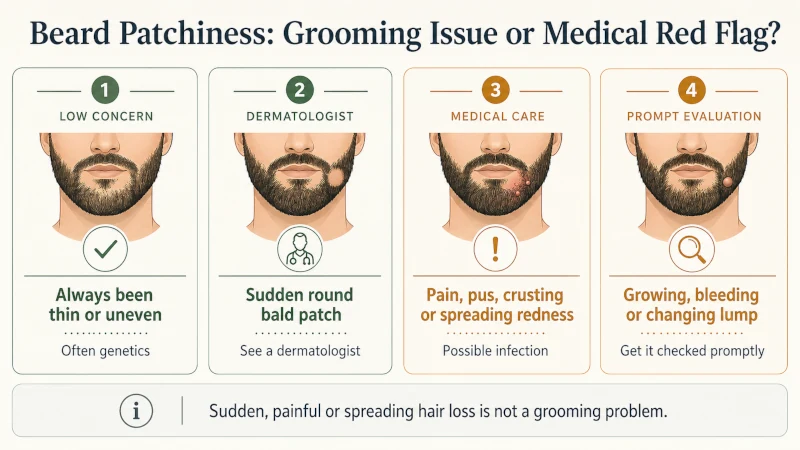
A beard that has always been thin in the same places is usually genetics, and no oil changes that. Hair that disappears is a different matter.
See a doctor or a board-certified dermatologist if you notice:
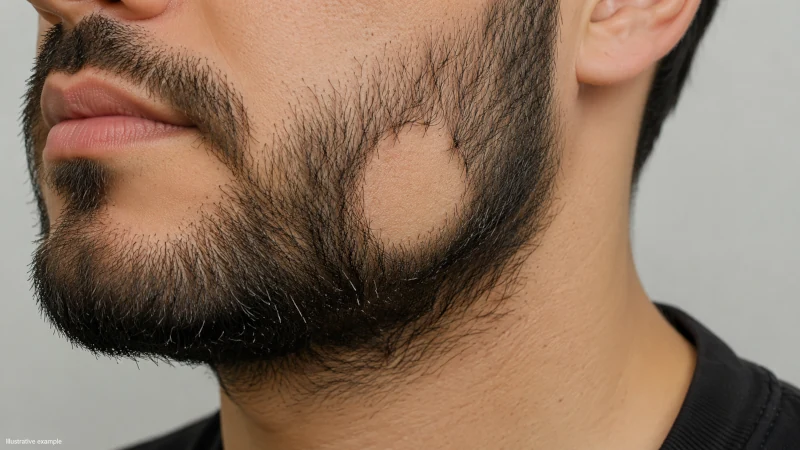
- Smooth, round bald patches appearing in the beard over days or weeks — the beard presentation of alopecia areata, which the AAD calls alopecia barbae. There is no cure, but treatment can regrow hair, and left alone the loss may stay the same or get worse [AAD, Alopecia Areata].
- Painful, pus-filled bumps, spreading redness, or crusting — signs of folliculitis or infection.
- Scaling, scarring or shiny skin where hair used to be, which can point to scarring hair loss.
- Hair loss on the scalp, eyebrows or body at the same time.
- Any lump in the beard area that is growing, bleeding or changing. The AAD’s advice on that is to make an appointment immediately [AAD, Beard Problems].
Sudden, widespread or painful hair loss is not a job for beard oil.
Options with more evidence behind them
Topical minoxidil. The strongest beard-specific evidence there is. A randomized, double-masked, placebo-controlled study of 3% minoxidil lotion for beard enhancement was published in The Journal of Dermatology in 2016 — as a short letter, so the reported detail is thin, but the design is the best available for facial hair [Ingprasert, 2016]. Minoxidil is not FDA-approved for facial hair, it can irritate skin, and it needs continuous use. The AAD’s own beard guidance is to talk to a dermatologist before trying it, precisely because of that irritation risk [AAD, Beard Problems].
Prescription treatment for alopecia barbae. If the cause is alopecia areata, this is a medical problem with medical treatments, and newer ones are regrowing hair for people whom older treatments failed [AAD, Alopecia Areata]. Worth a dermatology referral rather than improvisation.
Beard transplantation. Surgical relocation of follicles, usually from the back of the scalp, for permanent gaps that don’t respond to anything topical. Permanent, expensive, and only as good as the surgeon — this is a considered decision, not a next step.
Boring fundamentals. Enough sleep, enough protein, treating any underlying skin condition, and not shaving over inflamed skin. If you want to compare rosemary against other natural options, we’ve graded them elsewhere in our guide to natural remedies for hair loss and in our overview of the evidence on rosemary generally.
| Health disclaimer: This article is for education only and is not medical advice. It cannot account for your medical history, medications, or skin conditions. Talk to a qualified healthcare professional — a doctor, dermatologist or pharmacist — before starting any herbal or essential oil remedy, especially if you are pregnant or breastfeeding, take prescription medication, or have a skin condition. Nothing described here diagnoses, treats, cures or prevents any disease. If you develop a spreading rash, a painful infection, or sudden hair loss, seek medical care rather than self-treating. |
Frequently Asked Questions
How long does rosemary oil take to work on a beard?
There is no answer from research, because no study has measured it on facial hair. The scalp trial that people cite saw nothing at three months and a measurable change at six [Panahi, 2015]. If you use it, give it three to six months and judge it on itch, flaking and comfort rather than density.
Does rosemary oil block DHT and ruin beard growth?
Not proven in either direction. Rosemary leaf extract inhibits 5-alpha-reductase in test tubes and helped hair regrowth in mice [Murata, 2013], and beard follicles do depend on DHT [Thornton, 1993]. But nobody has shown that diluted rosemary essential oil lowers DHT in human facial skin. If it worries you, keep the oil on your scalp.
Can I put rosemary oil straight on my beard?
No. Undiluted essential oil on facial skin risks irritation and allergic contact dermatitis. Mix 2–3 drops into 15 ml of a carrier oil, and don’t apply it to broken or irritated skin [EMA, 2024].
Is rosemary oil or minoxidil better for a patchy beard?
Minoxidil is the only one of the two with beard-specific trial evidence [Ingprasert, 2016]. It is also off-label on the face and can irritate skin, which is why the AAD says to talk to a dermatologist first [AAD, Beard Problems]. Rosemary oil is the gentler, lower-expectation option.
My beard has round bald patches. Is that normal?
No, and it is not a grooming problem. Smooth, round patches appearing over days or weeks suggest alopecia areata affecting the beard, which the AAD calls alopecia barbae. It is treatable, and left alone it may stay the same or get worse [AAD, Alopecia Areata]. See a dermatologist rather than reaching for oil.
References
- Panahi Y, Taghizadeh M, Marzony ET, Sahebkar A. Rosemary oil vs minoxidil 2% for the treatment of androgenetic alopecia: a randomized comparative trial. Skinmed. 2015;13(1):15–21. PMID 25842469. View source
- Murata K, Noguchi K, Kondo M, et al. Promotion of hair growth by Rosmarinus officinalis leaf extract. Phytother Res. 2013;27(2):212–217. DOI 10.1002/ptr.4712. PMID 22517595. View source
- Thornton MJ, Laing I, Hamada K, Messenger AG, Randall VA. Differences in testosterone metabolism by beard and scalp hair follicle dermal papilla cells. Clin Endocrinol (Oxf). 1993;39(6):633–639. PMID 8287580. View source
- European Medicines Agency, Committee on Herbal Medicinal Products. European Union herbal monograph on Rosmarinus officinalis L., aetheroleum. Final, Revision 1, adopted 29 May 2024. View source
- American Academy of Dermatology. A dermatologist’s top tips for a healthy beard. View source
- American Academy of Dermatology. DIY treatment for 5 common beard problems. View source
- American Academy of Dermatology. Hair loss types: alopecia areata overview. View source
- Ahmed A, Alali AM, Abdullah E, Alharbi MN, Alayoubi HM. Herbal remedies for hair loss: a review of efficacy and safety. Skin Appendage Disord. 2025;11(4):360–371. PMID 40771449. View source
- Bin Rubaian NF, Alzamami HFA, Amir BA. An overview of commonly used natural alternatives for the treatment of androgenetic alopecia, with special emphasis on rosemary oil. Clin Cosmet Investig Dermatol. 2024;17:2495–2503. PMID 39524109. View source
- Ingprasert S, Tanglertsampan C, Tangphianphan N, Reanmanee C. Efficacy and safety of minoxidil 3% lotion for beard enhancement: a randomized, double-masked, placebo-controlled study. J Dermatol. 2016;43(8):968–969. PMID 26893270. View source
- Koyama T, Kobayashi K, Hama T, Murakami K, Ogawa R. Standardized scalp massage results in increased hair thickness by inducing stretching forces to dermal papilla cells in the subcutaneous tissue. Eplasty. 2016;16:e8. PMID 26904154. View source
- National Center for Complementary and Integrative Health. Aromatherapy. Last updated January 2020. View source
