
Common buckthorn (Rhamnus cathartica) is a thorny European shrub whose small black berries have been used as a laxative for centuries — the species name cathartica literally means “purging.” The berries work, and they work hard. That is exactly the problem. The same compounds that empty the bowel can also trigger fierce cramping, vomiting, and dangerous fluid loss, which is why physicians stopped recommending the berries for people generations ago.
What common buckthorn actually is
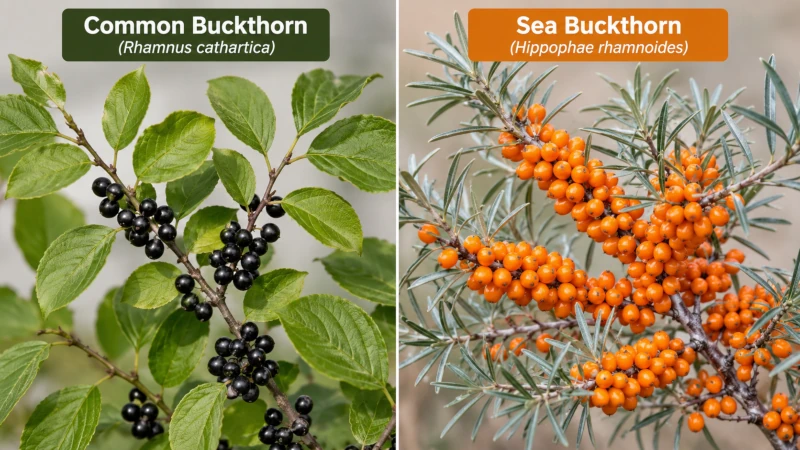
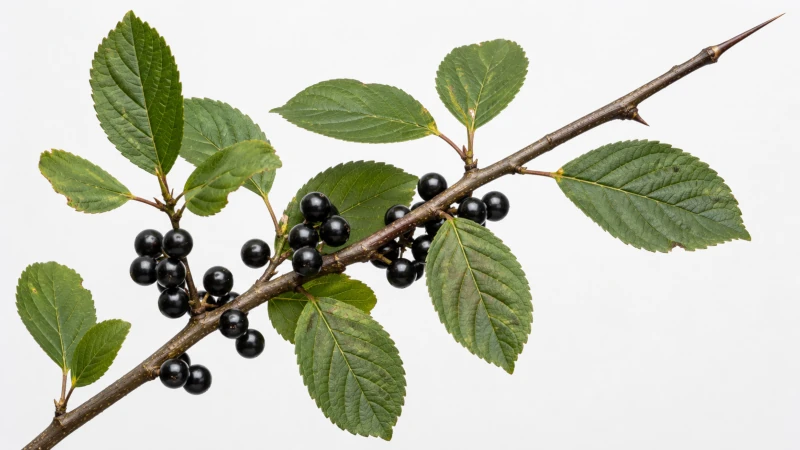
Common buckthorn is a deciduous shrub or small tree in the Rhamnaceae family, reaching roughly 6–7.5 m (20–25 ft). It is native to Europe, northwest Africa, and western Asia, and was brought to North America in the early 1800s as an ornamental hedge. It spread fast and is now treated as an invasive weed across much of the northern United States and Canada [NC State Extension]. Only female plants carry the familiar pea-sized black berries, which ripen in autumn and cling to the branches well into winter [Woodland Trust].
One point causes endless confusion: common buckthorn is not sea buckthorn. Sea buckthorn (Hippophae rhamnoides) is an unrelated plant in a different family (Elaeagnaceae), grown for its tart orange, vitamin-rich berries. If you came looking for the orange “superfruit,” that is a different plant with a very different safety profile. The plant described here is the black-berried purgative.
It is, though, a close relative of other laxative plants: glossy or alder buckthorn (Frangula alnus) and cascara sagrada (Rhamnus purshiana). They share the same active chemistry, which turns out to matter a great deal for safety.
A long history as a harsh purgative
The laxative reputation of common buckthorn goes back to medieval Europe. Anglo-Saxon medical texts recorded its use, and in the 13th century Welsh physicians prescribed the juice of the berries to relieve constipation [Univ. of Toronto Scarborough]. By the 18th and 19th centuries it appeared in North American pharmacy references, sometimes worked into a sweetened syrup — at one point even a children’s syrup flavored with ginger and allspice.
That practice did not survive. Human use was abandoned because the berries are simply too violent, draining fluid and causing dehydration [Univ. of Toronto Scarborough]. The plant lingered a little longer in veterinary use, where it was sometimes given as a purgative for animals such as dogs.
How common buckthorn works
The berries are rich in anthraquinone glycosides — chemical cousins of the active compounds in senna, aloe, and cascara. Among those identified in Rhamnus cathartica are glucofrangulin and emodin [Oriental Journal of Chemistry, 2015]. After you swallow them, gut bacteria free the active forms, which irritate the lining of the colon, speed up its muscle contractions (peristalsis), and pull water into the bowel. The result is a forced, often urgent bowel movement within a few hours.
This category has a name: stimulant, or “anthranoid,” laxatives. It is the same mechanism behind over-the-counter senna. The difference is dose control — a standardized senna tablet delivers a known amount, while a handful of wild berries does not.

What the evidence actually shows
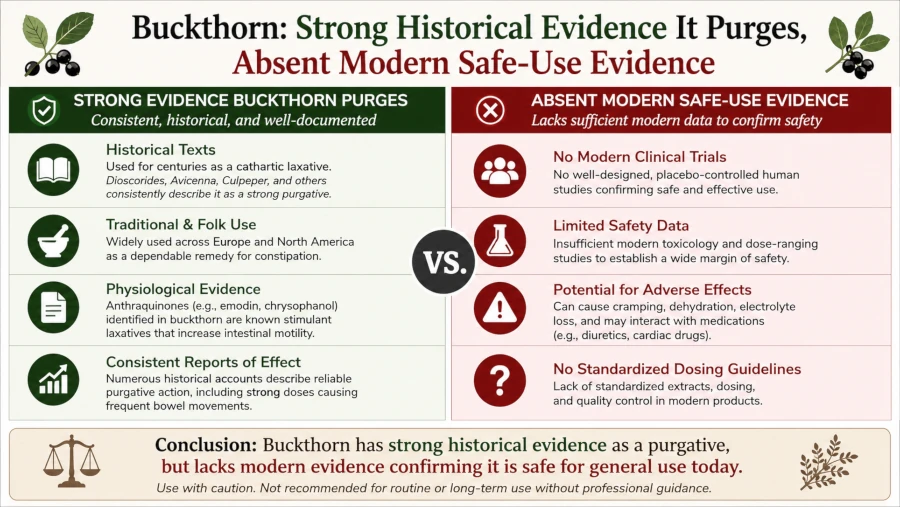
Two things deserve to be kept apart. There is no real doubt that buckthorn berries cause a bowel movement; that effect is well established and is the reason the plant has been used for a thousand years. What is missing is modern clinical evidence that common buckthorn is a safe or sensible way to treat constipation. There are essentially no good human trials of the berries for this purpose — the support is historical and pharmacological, not the controlled research used to approve a medicine today.
The wider picture for this drug class is not reassuring. In 2002 the U.S. Food and Drug Administration ruled that two related anthraquinone laxatives — aloe and cascara sagrada — could no longer be sold over the counter as laxatives, because the data were not enough to establish that they were safe and effective [FDA, 2002] [MSKCC]. Common buckthorn was never standardized or approved as a modern drug at all.
The honest summary: strong evidence that it purges, little to no modern evidence that it should be used to.
Safety: “natural” is not the same as gentle
This is the part that matters most. Every part of the common buckthorn plant — and especially raw or unripe berries — is considered toxic to people [NC State Extension] [Woodland Trust]. Eating them usually brings on nausea, stomach cramps, vomiting, and diarrhea. Larger amounts can cause violent, watery diarrhea and serious dehydration. Historical accounts describe exactly this, and it is the reason the berries fell out of human use.
Beyond the immediate reaction, the anthraquinone class carries known risks when used repeatedly:
- Fluid and electrolyte loss, including low potassium, which can strain the heart.
- Melanosis coli — a usually harmless but telling dark staining of the colon lining seen with chronic stimulant-laxative use.
- A sluggish bowel and worsening constipation when stimulant laxatives are relied on long term [MedlinePlus].
Children are at particular risk. The glossy berries are tempting, and an amount an adult might shrug off can seriously harm a small child. Keep the plant, and any berries, away from children and pets.
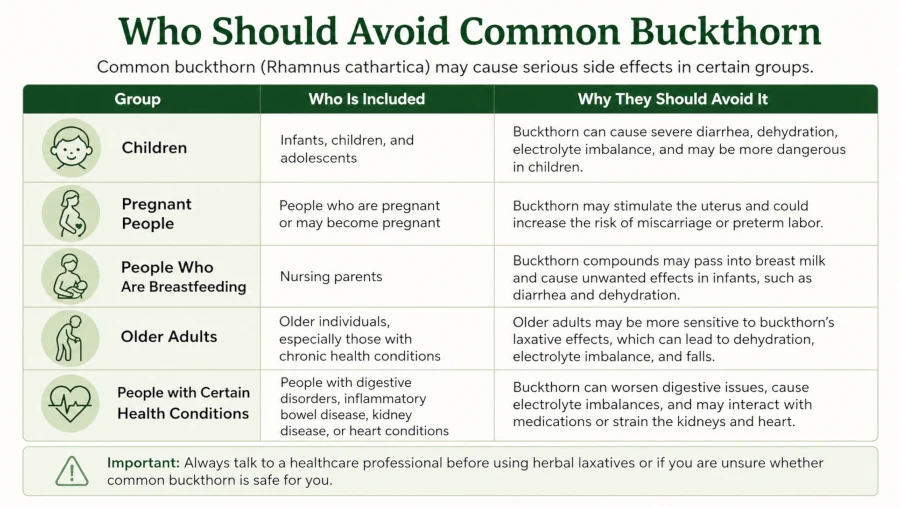
Who should not use common buckthorn
Avoid it altogether if you are:
- pregnant or breastfeeding — stimulant laxatives are generally discouraged, and safety here is not established;
- a child, or buying it for a child;
- living with a gut condition such as inflammatory bowel disease, a known or suspected bowel obstruction, appendicitis, or undiagnosed abdominal pain;
- prone to dehydration or electrolyte problems, or living with kidney disease.
Medication interactions
Because anthraquinone laxatives can lower potassium, they can be risky alongside drugs whose safety depends on potassium levels. Take particular care — and check with a pharmacist or doctor first — if you use digoxin or other heart-rhythm medicines, diuretics (“water pills”), corticosteroids, or other laxatives. Stacking stimulant laxatives can compound both diarrhea and potassium loss [MedlinePlus].
Realistic expectations
Common buckthorn is not a tonic, a “detox,” or a weight-loss aid. What it does is force the bowel to empty, sometimes painfully. Any weight that drops afterward is water, and it returns. Leaning on a strong purgative to feel “cleansed” tends to backfire, leaving the bowel less responsive over time rather than healthier.
Safer ways to deal with constipation
Constipation is common — about 16 in 100 U.S. adults have symptoms — and it usually responds to gentler measures [NIDDK]. The standard first steps are more dietary fiber, more fluids, and regular movement [NIDDK]. A bulk-forming fiber such as psyllium is one of the most reliable and best-tolerated options. If that is not enough, osmotic laxatives (such as polyethylene glycol) and short-term, standardized stimulant laxatives are sold over the counter and behave far more predictably than wild berries.
For gentler plant-based approaches, see our guides to the best herbs for constipation, foods that ease constipation, and essential oils for constipation. The cassia fistula tree is one example of a milder traditional laxative, and our overview of herbs for the digestive system puts these options in context. None of these replaces a doctor’s advice for stubborn or worrying symptoms.

When to talk to a healthcare professional
See a doctor rather than self-treating if constipation lasts more than a week or two despite diet changes, or if you notice blood in the stool, unexplained weight loss, ongoing abdominal pain, or a sudden change in bowel habits — especially if you are over 50 [NIDDK].
If someone swallows buckthorn berries, seek medical care for severe cramping, repeated vomiting, bloody or black stool, or signs of dehydration such as dizziness, very dark urine, or confusion. In the United States, Poison Control (1-800-222-1222) gives fast guidance day or night.
| Health Disclaimer This article is for general education and information only and is not medical advice. Common buckthorn berries are toxic in more than small amounts, and nothing here should be read as encouragement to eat them or prepare them at home. Do not use the information on this page in place of diagnosis or treatment from a qualified health professional. If you are pregnant or breastfeeding, give care to a child, take prescription medicine, or have any existing health condition, talk with your doctor or pharmacist before using any herbal or natural remedy. If you suspect poisoning, contact Poison Control (1-800-222-1222 in the U.S.) or your local emergency number right away. |
Frequently Asked Questions
Is common buckthorn the same as sea buckthorn?
Are common buckthorn berries poisonous?
In more than tiny amounts, yes. They commonly cause nausea, cramps, vomiting, and diarrhea, and larger amounts can cause heavy fluid loss and dehydration [NC State Extension]. Keep them away from children and pets.
Can I use the berries to relieve constipation?
It is not advised. The dose from wild berries is unpredictable and the effect can be harsh, and there is no modern clinical evidence supporting safe use. Standardized over-the-counter options, fiber, and fluids are safer and better studied [NIDDK].
My child ate buckthorn berries — what should I do?
Do not wait for symptoms. In the U.S., call Poison Control at 1-800-222-1222 (or your local emergency number) for guidance, and watch for vomiting, diarrhea, and signs of dehydration. Seek care promptly if those appear.
Is common buckthorn the same as cascara or senna?
Not the same plant, but the same chemical family — anthraquinone (anthranoid) laxatives. Two relatives in that class, aloe and cascara sagrada, lost their U.S. over-the-counter laxative approval in 2002 for lack of safety and effectiveness data [FDA, 2002].
References
- North Carolina Extension Gardener Plant Toolbox. “Rhamnus cathartica (European/Common Buckthorn).” NC State University. → View source
- Woodland Trust. “Purging buckthorn (Rhamnus cathartica).” → View source
- University of Toronto Scarborough, Department of Biological Sciences. “Common buckthorn (Rhamnus cathartica).” → View source
- Marzouk M.S. et al. “Evaluation of Antimicrobial Activity of Some Compounds Isolated from Rhamnus cathartica L.” Oriental Journal of Chemistry, 2015 (isolation of emodin and glucofrangulin A). → View source
- U.S. Food and Drug Administration. “Status of Certain Additional OTC Drug Category II and III Active Ingredients” (aloe and cascara sagrada not GRASE), Federal Register, 67 FR 31125, May 9, 2002 (effective Nov 5, 2002). → View source
- Memorial Sloan Kettering Cancer Center. “FDA Rules that Aloe & Cascara Are Not Safe as Stimulant Laxatives.” → View source
- MedlinePlus (U.S. National Library of Medicine). “Cascara Sagrada.” → View source
- NIDDK (National Institute of Diabetes and Digestive and Kidney Diseases). “Definition & Facts for Constipation.” → View source
- NIDDK. “Eating, Diet, & Nutrition for Constipation.” → View source
