
Milk thistle is one of the first supplements people reach for when they start worrying about their liver. It has a long folk reputation, a plausible-sounding active ingredient, and shelves of bottles promising “detox” and “liver support.” So it helps to know where that reputation holds up and where it runs ahead of the evidence.
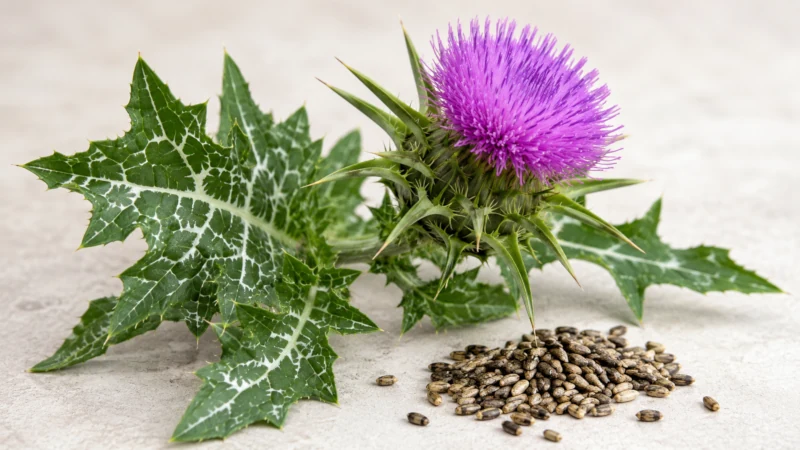
Here is the honest summary. Milk thistle (Silybum marianum) contains silymarin, a group of plant compounds concentrated in the seeds that show antioxidant activity in laboratory studies [NCCIH, 2025]. It is generally well tolerated. But when you look at the actual health benefits of milk thistle in careful human trials, the picture is far more modest than the marketing: there is not enough high-quality evidence to say it treats or reverses liver disease [NCCIH, 2025]. That does not make it useless — it makes it a supplement to approach with realistic expectations rather than a cure to bank on.
What milk thistle actually is
The plant is a tall, spiny weed with purple flower heads, native to the Mediterranean and now growing across North America [NCCIH, 2025]. The seeds are the medicinal part. Silymarin — the extract most supplements are standardized to — is a mixture of flavonolignans, mainly silibinin (also called silybin) [LactMed, 2026]. Silymarin is what researchers study when they test milk thistle, and it is what “liver support” claims ultimately rest on.
The health benefits of milk thistle, graded by evidence
The single most useful thing to understand about milk thistle is that its lab behavior and its real-world results do not match. In test tubes and animal studies, silymarin scavenges free radicals, stabilizes liver-cell membranes, and calms inflammatory signaling [NCCIH, 2025]. Those mechanisms are real. But they have not translated into proven benefit for people with liver disease.
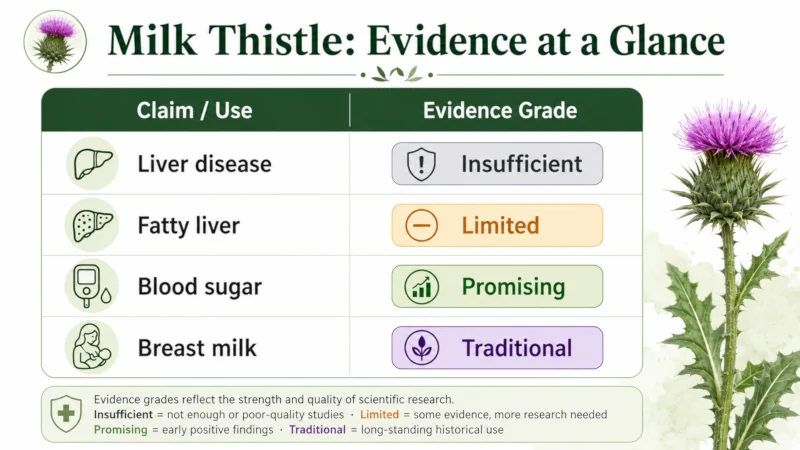
Liver disease — cirrhosis, alcohol-related liver disease, hepatitis B and C: mixed to insufficient.
This is milk thistle’s headline use, and it is where the evidence is most disappointing. A Cochrane systematic review pooled 13 randomized trials covering 915 patients with alcohol-related or viral liver disease and found no significant effect on death, complications of liver disease, or liver structure; the apparent benefit for liver-related death disappeared once low-quality trials were set aside [Cochrane review, 2007].
The most rigorous hepatitis C trial to date, a 2012 study in JAMA, gave patients silymarin at doses several times higher than usual and found it worked no better than placebo on liver enzymes or virus levels [NCCIH, 2025]. Two trials funded by the National Center for Complementary and Integrative Health — one in hepatitis C, one in fatty liver disease — likewise showed no benefit [NCCIH, 2025].
Fatty liver and liver enzymes: limited and conflicting.
Some smaller studies have reported modest drops in liver enzymes, but results across trials have been inconsistent, and higher-quality research has not confirmed a meaningful benefit [NCCIH, 2025]. If you have fatty liver, the steps with real evidence behind them are weight loss, cutting alcohol, and managing blood sugar and cholesterol. A liver-friendly diet does more for fatty liver than any supplement.
Blood sugar and type 2 diabetes: limited but promising.
This is arguably where the signal is most encouraging. A small number of studies suggest milk thistle extracts may help control blood sugar in people with type 2 diabetes, though most of that research was done in Middle Eastern countries and it is unclear whether the results generalize [NCCIH, 2025]. Mayo Clinic reaches the same cautious conclusion: it might lower blood sugar, but more studies are needed [Mayo Clinic, 2025]. Promising is not the same as proven.
Increasing breast milk: traditional, not supported by good trials.
Milk thistle has been used since the Middle Ages to boost milk supply — the plant’s name comes from a legend tied to nursing. But no scientifically valid clinical trials support this use, and the studies that exist are small and poorly controlled [LactMed, 2026]. Reassuringly, silymarin’s components are barely detectable in breast milk and are poorly absorbed, so it is unlikely to harm a breastfed infant [LactMed, 2026] — but “unlikely to harm” is different from “proven to help.”
Detox, hangover cures, and everything else: not established.
Your liver already detoxifies your body around the clock, and there is no good evidence a supplement improves on that in a healthy person. Beyond the liver and blood-sugar research above, it simply is not known whether milk thistle helps other conditions [NCCIH, 2025]. Claims that it cures hangovers, prevents liver damage from drinking, or treats unrelated conditions run well ahead of the data. If you are drawn to milk thistle as part of a broader “liver cleanse,” it is worth reading past the marketing on any liver-support herb and focusing on habits that are actually shown to help.
Realistic expectations and how people take it
Milk thistle comes as capsules, tablets, and liquid extracts, usually standardized to silymarin [Mayo Clinic, 2025]. Trials have used a wide range of doses, and one detail is instructive: the JAMA hepatitis C trial pushed doses up to 700 mg of silymarin three times a day — far above typical labels — and still saw no benefit [NCCIH, 2025]. The lesson is not “take more.” It is that dose was not the reason milk thistle underperformed.
If you decide to try it, treat it as a low-stakes experiment rather than a treatment: give it a defined window, keep up the things that actually protect your liver, and stop if you notice side effects.
Safety, side effects, and who should be cautious
Taken by mouth at appropriate doses, milk thistle is generally well tolerated [Mayo Clinic, 2025]. The most common side effects are digestive — bloating, gas, nausea, and diarrhea — along with occasional headache or itchiness [NCCIH, 2025].
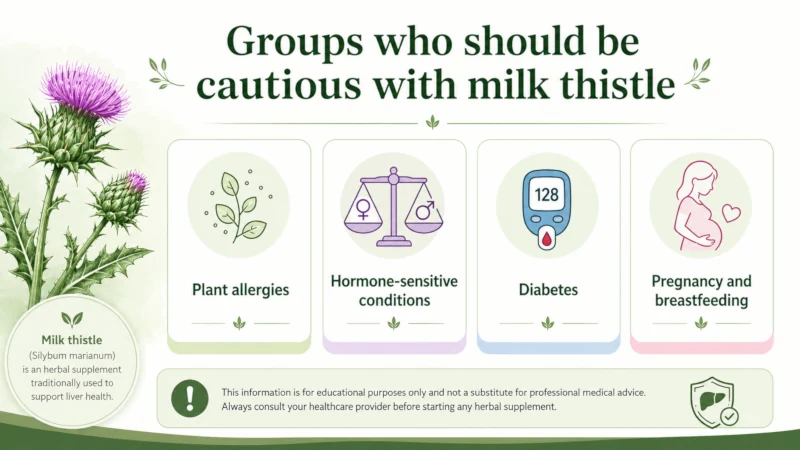
A few groups should be more careful:
- People allergic to related plants. Milk thistle belongs to the same family as ragweed, daisies, marigolds, and chrysanthemums, and can trigger allergic reactions in people sensitive to those plants — rarely including severe, life-threatening anaphylaxis [Mayo Clinic, 2025].
- People with hormone-sensitive conditions. There is concern milk thistle might affect estrogen levels, so Mayo Clinic advises considering avoiding it if you have breast, uterine, or ovarian cancer, endometriosis, or uterine fibroids [Mayo Clinic, 2025].
- People with diabetes. Because it may lower blood sugar, milk thistle can add to the effect of diabetes medication; monitor closely and talk to your doctor first [Mayo Clinic, 2025].
- Pregnancy and breastfeeding. Little is known about whether milk thistle is safe during pregnancy or breastfeeding, so caution is warranted [NCCIH, 2025].
One quieter issue is product quality. Testing has found that some milk thistle supplements contain amounts of silymarin substantially different from the label, or are contaminated with pesticides, microbes, or mold toxins [NCCIH, 2025]. Because supplements are not approved by the FDA before sale, look for products verified by an independent testing organization.
Drug interactions worth knowing
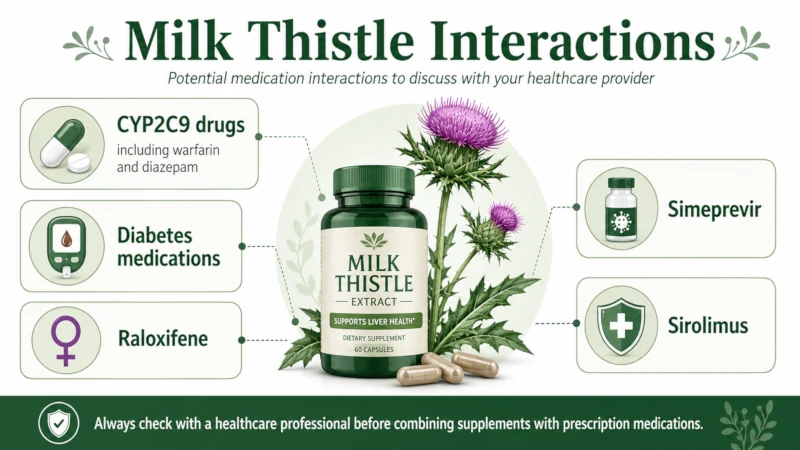
Milk thistle can interfere with how the liver processes certain medications [Mayo Clinic, 2025]. Reported interactions include:
- Drugs processed by the CYP2C9 enzyme, such as the blood thinner warfarin and the sedative diazepam — milk thistle may change their levels [Mayo Clinic, 2025].
- Diabetes medications, because of the additive blood-sugar-lowering effect [Mayo Clinic, 2025].
- Raloxifene (an osteoporosis drug), simeprevir (a hepatitis C drug — avoid the combination), and sirolimus (an immunosuppressant) [Mayo Clinic, 2025].
If you take any prescription medication, clear milk thistle with your pharmacist or doctor before starting [NCCIH, 2025].
When to skip the supplement and see a professional
Milk thistle is not a substitute for medical care, and some situations call for a doctor rather than a bottle:
- Signs your liver may be in trouble — yellowing of the skin or eyes (jaundice), dark urine, pale stools, severe or persistent abdominal pain, or unusual fatigue and confusion — need prompt medical evaluation, not self-treatment.
- Suspected poisoning from toxic mushrooms, chemicals, or a medication overdose is a medical emergency. Call your local emergency number or poison control immediately; do not rely on a supplement.
- A diagnosed liver condition should be managed with a specialist. If you would like to add milk thistle, raise it with them first, and never stop prescribed treatment in favor of it.
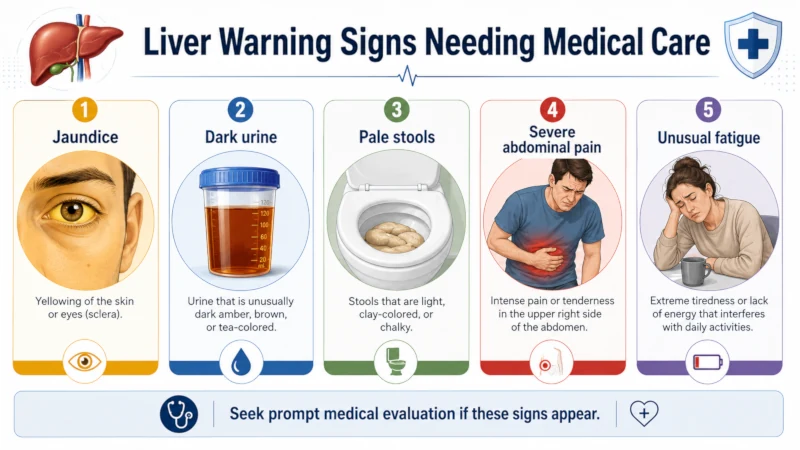
| Medical Disclaimer: This article is for general education and information only. It is not medical advice and is not a substitute for diagnosis or treatment from a qualified health professional. Milk thistle is a dietary supplement, not a treatment for liver disease. If you have a liver condition, diabetes, a hormone-sensitive condition, take any prescription medication, or are pregnant or breastfeeding, talk with your doctor or pharmacist before using milk thistle. If you have warning signs such as jaundice, dark urine, or severe abdominal pain — or suspect any kind of poisoning — seek medical care right away. |
Frequently Asked Questions
Does milk thistle repair or “detox” the liver?
There is no strong evidence that milk thistle repairs the liver or improves detoxification in a healthy person; the liver already does that job continuously [NCCIH, 2025]. At best it is a supportive supplement, not a cleanse.
Is milk thistle safe to take every day?
For most people it is generally well tolerated, with mild digestive side effects being the most common [Mayo Clinic, 2025]. If you take medication or have a health condition, check with your doctor before daily use [NCCIH, 2025].
Can milk thistle help fatty liver disease?
The evidence is limited and conflicting, and the best-designed trials have not shown a meaningful benefit [NCCIH, 2025]. Weight loss, less alcohol, and better blood-sugar and cholesterol control do far more.
Who should avoid milk thistle?
Be cautious if you are allergic to ragweed, daisies, marigolds, or chrysanthemums; have a hormone-sensitive condition such as breast, uterine, or ovarian cancer; take diabetes or interacting medications; or are pregnant or breastfeeding [Mayo Clinic, 2025]; [NCCIH, 2025].
Does milk thistle increase breast milk?
It has a long traditional reputation as a galactagogue, but no scientifically valid clinical trials support that use [LactMed, 2026]. Its components barely enter breast milk, so occasional use is unlikely to harm an infant, but it is not proven to help.
References
- National Center for Complementary and Integrative Health. “Milk Thistle: Usefulness and Safety.” NIH. Last updated February 2025. View source
- Mayo Clinic Staff. “Milk thistle.” Mayo Foundation for Medical Education and Research. Updated May 21, 2025. View source
- Rambaldi A, Jacobs BP, Gluud C. “Milk thistle for alcoholic and/or hepatitis B or C virus liver diseases.” Cochrane Database of Systematic Reviews, 2007. DOI: 10.1002/14651858.CD003620.pub3. View source
- Drugs and Lactation Database (LactMed). “Milk Thistle.” National Institute of Child Health and Human Development. Updated March 15, 2026. View source
