
Meadowsweet (Filipendula ulmaria) is a tall, cream-flowered wildflower of wet European meadows with a four-hundred-year reputation for easing aches and fevers — and a much shorter list of things it has actually been shown to do. Europe’s medicines regulator registers meadowsweet for exactly two uses, and classes both as traditional: supportive treatment of the common cold, and relief of minor joint pain. That word matters. It means the herb qualifies on long-standing use alone, not on clinical trials, and the regulator says so in plain language [EMA herbal monograph on meadowsweet, 2011].
So here is the honest shape of the meadowsweet plant health benefits you’ll see advertised. As a mild, aromatic tea for a cold or a nagging ache, it is a reasonable, low-risk thing to try. As a treatment for gout, fluid retention, kidney stones, or a heart or liver problem — all claims you will find attached to it — the evidence isn’t there, and in the case of gout the underlying pharmacology may point the wrong way entirely.
One more thing worth knowing before you brew a cup: meadowsweet is a salicylate plant. That is the source of both its appeal and its cautions.
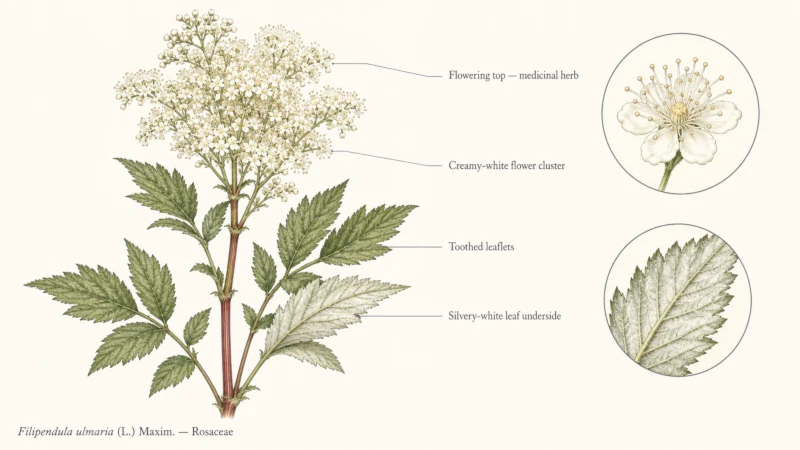
What meadowsweet is, and how it got aspirin’s name
Meadowsweet is a member of the rose family that grows up to about five feet tall in damp meadows and ditches across Europe and parts of North America. Older books call it queen of the meadow, bridewort, or goat’s beard; in French it’s reine des prés, in German Mädesüß. The medicinal parts are the dried flowering tops (Filipendulae ulmariae herba) and, separately, the dried flowers alone (flos) [EMA assessment report on Filipendula ulmaria, 2011].
The plant used to be classified in the genus Spiraea, and that old name is why you have a bottle of aspirin in your cupboard. When Bayer registered acetylsalicylic acid in March 1899, the accepted account of the name is that it combined a– for acetyl, spir– for Spiraea (in German, salicylic acid was Spirsäure), and the -in ending that drug names took at the time [Science History Institute]. Aspirin was never made from meadowsweet — it is synthesised from salicylic acid in a factory — but the herb did lend the drug its name, and it shares a chemical family with white willow bark, the other famous salicylate plant.
That family resemblance is where most of the confusion about meadowsweet starts, so it’s worth being precise about the chemistry.
What’s actually in the flowers
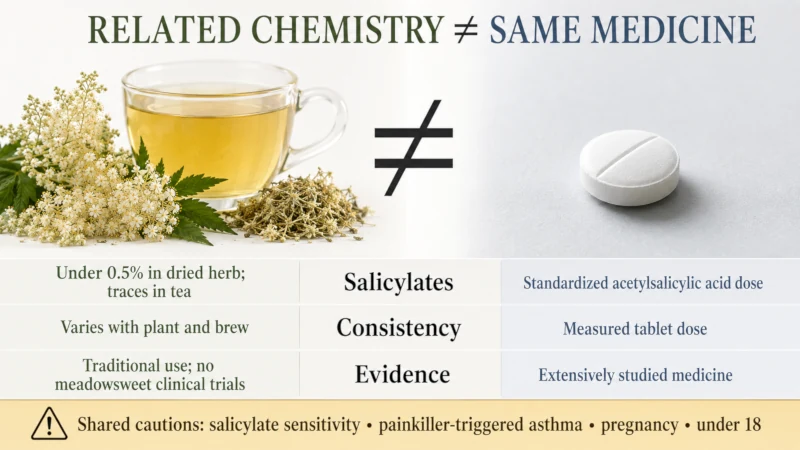
Meadowsweet contains phenolic glycosides that break down as the plant dries, releasing an aromatic oil in which salicylaldehyde makes up as much as 70% of the volatile fraction. But the total salicylate content of the herb is small — assumed to be under 0.5%, and mostly still bound up as glycosides [EMA assessment report, 2011].
The regulator’s assessors go further, quoting a standard German phytotherapy text: an infusion contains only trace amounts of salicylates, so meadowsweet tea is better understood as an aromatic remedy than as a salicylate medication [EMA assessment report, 2011]. Set your expectations by that sentence. A cup of meadowsweet tea is not a cup of aspirin, and nobody should treat it as an interchangeable substitute.
The rest of the plant’s chemistry is arguably more interesting than the salicylates. Flowering tops carry 3–4% flavonoids, rising to about 6% in fresh flowers, dominated by spiraeoside. There are hydrolysable tannins too, from around 1% in an alcoholic extract up to 12% in a water extract, mostly a compound called rugosin D — which is where the herb’s astringent, stomach-settling reputation likely comes from [EMA assessment report, 2011].
Meadowsweet plant health benefits: what the evidence supports
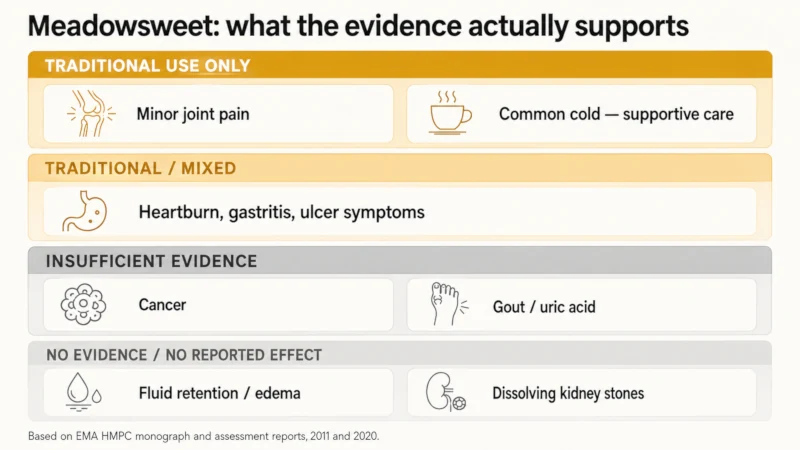
Here is where each commonly repeated use actually lands.
| Use | Strength of evidence | What that means for you |
| Minor joint and muscle aches | Traditional only | Registered on long use, not trials. Mild, slow, and not for an acutely inflamed joint. |
| Supportive care during a common cold | Traditional only | A warming, aromatic tea alongside rest and fluids — supportive, not curative. |
| Heartburn, gastritis, ulcer symptoms | Traditional, and genuinely mixed in animals | Old British herbals favour it; rodent studies point in both directions. |
| Fluid retention, edema, ascites | Insufficient / none | Regulators found no reported effect on kidney elimination. These conditions need medical care. |
| Gout and lowering uric acid | Insufficient — and possibly backwards | Only a laboratory signal supports it, while low-dose salicylates can raise uric acid. |
| Dissolving kidney stones | None | No evidence meadowsweet dissolves or clears stones. |
| Cancer | Insufficient | Cell and rodent findings only. Nothing that applies to a person. |
Minor joint and muscle aches
This is meadowsweet’s best-known use and its strongest registered one — which still means traditional. European regulators list “relief of minor articular pain” for the dried herb as tea, the powdered herb, and a 1:5 tincture, on the basis of more than thirty years of documented medicinal use rather than trial results [EMA herbal monograph on meadowsweet, 2011]. Laboratory and animal work gives that use some plausibility: extracts have inhibited prostaglandin production and elastase release in vitro, and flower preparations lowered body temperature in rodents [EMA assessment report, 2011].
What’s missing is people. When regulators reviewed the field again in 2020, covering everything published between 2011 and 2018, they found a single clinical study touching meadowsweet — a combination beverage that also contained chamomile and willow bark, with the plant part unspecified, and whose own authors called the results inconclusive. The conclusion was that nothing had emerged to justify changing the monograph [EMA monograph review, 2020].
The practical read: meadowsweet belongs in the same tier as a warm compress or a comforting tea, not in the same tier as an anti-inflammatory tablet. If joint pain is the reason you’re here, our guide to herbs for musculoskeletal pain covers the options with more clinical support behind them. And meadowsweet is explicitly not intended for acute arthritis — a suddenly hot, swollen, painful joint needs a doctor, not a tea [EMA herbal monograph on meadowsweet, 2011].
Colds, chills, and fever
The second registered indication is supportive treatment of the common cold. In German practice the flowers appear in traditional cold and flu teas blended with linden and elderflower, and the herb has been used as a diaphoretic — something to help you sweat out a chill — for centuries [EMA assessment report, 2011].
Again, “supportive” is doing real work in that phrase. Meadowsweet is not an antiviral and won’t shorten a cold. It is a pleasant hot drink with a mild febrifuge tradition behind it. The regulator attaches firm limits: start at the first signs, and if symptoms last longer than seven days, stop self-treating and see a doctor [EMA herbal monograph on meadowsweet, 2011].
Heartburn, gastritis, and the ulcer question
British herbal texts have long listed meadowsweet for acid indigestion, gastritis, and peptic ulcer — an unusual reputation for a salicylate plant, since salicylates usually irritate the stomach. The tannin content is the likely explanation [EMA assessment report, 2011].
The animal evidence is where honesty is required, because it genuinely conflicts. Flower preparations prevented the development of stomach ulcers in rats and mice, and flavonoids and flower extracts protected rat stomachs against drug-induced lesions. In the other direction, a flower decoction potentiated the ulcer-causing effects of histamine in guinea pigs. The assessors’ own summary is that the effects on gastric ulcers “seem contradictory” [EMA assessment report, 2011].
Meadowsweet is not registered for stomach complaints at all, which tells you how the regulator weighed that mixed picture. If reflux or an irritated stomach is the actual problem, our guide to herbs for stomach issues sorts the few with real evidence from the many with only tradition. Persistent indigestion also deserves a proper look — an H. pylori infection or regular painkiller use won’t be fixed by any herb.
What meadowsweet does not do: fluid retention, gout, and kidney stones
Three claims follow meadowsweet everywhere, and all three deserve to be retired.
It is not a reliable diuretic. Meadowsweet’s diuretic reputation is old and widespread, but when European assessors went through the pharmacology, their finding was blunt: no effects on renal and digestive elimination functions have been reported [EMA assessment report, 2011]. This one matters more than the others, because the conditions it gets recommended for are serious. Swollen ankles from heart failure, or fluid in the abdomen from liver disease, are signs of organ dysfunction that need prescribed treatment and monitoring. Treating either with a herbal tea instead of medical care is genuinely dangerous. If your ankles are swelling or your abdomen is distending, that is a same-week appointment, not a tea.
It is not a gout remedy. The traditional literature does describe meadowsweet as uricosuric — increasing uric acid excretion — but that comes from a single herbal text rather than from human data, and the only supporting laboratory finding is that a methanol flower extract inhibited xanthine oxidase in a test tube [EMA assessment report, 2011]. Meanwhile the salicylate pharmacology cuts against the claim. Salicylates act on uric acid in two directions depending on dose: high doses increase excretion, while low doses appear to block tubular secretion and push uric acid up.
A 2025 case report described a man whose gout flares only resolved when his daily low-dose aspirin was swapped for a different antiplatelet drug [Nguyen et al., case report, 2025]. That’s one patient and the authors say the literature is limited, so it isn’t proof — but combined with the absence of any human data for meadowsweet, it is more than enough reason not to call this herb ideal for gout. If gout is your concern, diet, alcohol, weight, and urate-lowering medication are the levers that work; our guide to foods that trigger gout flares covers the first three.
It does not dissolve kidney stones. No study supports meadowsweet dissolving stones or gravel of any composition. Stones are managed with fluids, dietary changes, and urological treatment.
How to use meadowsweet, and a realistic dose
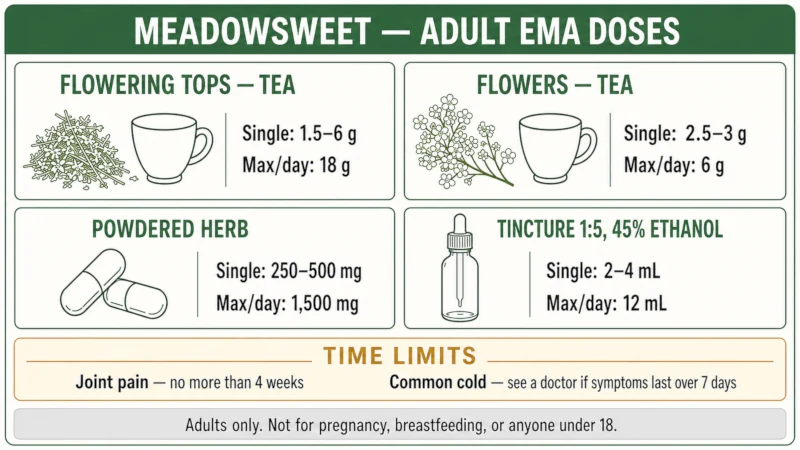
The registered preparations are all for adults, and the amounts are specific [EMA herbal monograph on meadowsweet, 2011]:
| Preparation | Single dose | Maximum daily |
| Dried flowering tops, as tea | 1.5–6 g infused | 2–18 g |
| Dried flowers alone, as tea | 2.5–3 g infused | 2.5–6 g |
| Powdered herb (capsules) | 250–500 mg | 250–1,500 mg |
| Tincture, 1:5 in 45% ethanol | 2–4 mL | 6–12 mL |
Older herbal manuals often give far larger amounts — 30 to 40 grams of flowers per litre, five cups a day — which lands well above every ceiling in that table. Stay inside the registered range.
Duration is capped too. For joint pain, don’t use it for more than four weeks. For a cold, see a doctor if symptoms persist beyond seven days, and sooner if a fever goes above 102°F (39°C), keeps climbing, or comes with a severe headache [EMA herbal monograph on meadowsweet, 2011].
You’ll also see meadowsweet compresses recommended for painful areas. Topical use appears in older British herbal texts, but it isn’t part of the European monograph, so there’s no established strength, duration, or safety data behind it. If you try one, treat it as a comfort measure, keep it to intact skin, and don’t let it replace looking into what’s causing the pain.
Expectations, plainly: mild and gradual, more like a warm drink that takes the edge off than a tablet that switches pain off. If a few weeks of it hasn’t helped, that’s useful information — a cue to reassess rather than to increase the dose.
Safety, side effects, and who should avoid meadowsweet
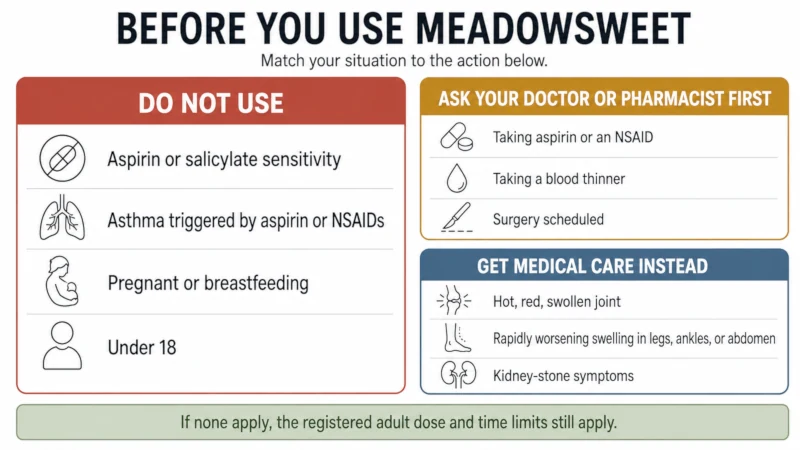
The European monograph lists no known undesirable effects and no reported interactions [EMA herbal monograph on meadowsweet, 2011]. Read that carefully. It reflects thin data and a long history without alarms, not a body of safety testing. No trials of meadowsweet in humans have measured side effects, and no genotoxicity, carcinogenicity, or reproductive toxicity studies have been done — which is precisely why regulators declined to give it a lighter regulatory listing [EMA assessment report, 2011].
A note on that last point, since you may encounter it: two studies published after the original assessment reported weak genotoxic signals from methanol extracts of Filipendula. Regulators reviewed them and judged the testing methodologically inadequate — the wrong solvent for the registered preparations, and assays that didn’t follow the relevant international guidelines — so the monograph was left unchanged [EMA monograph review, 2020]. Not a red alert, but not nothing either.
Do not take meadowsweet if:
- You are hypersensitive to salicylates. This is the one formal contraindication, and it includes people for whom aspirin or NSAIDs bring on hives, swelling, or asthma [EMA herbal monograph on meadowsweet, 2011].
- You have asthma that reacts to painkillers. Beyond the salicylate issue, meadowsweet flower preparations increased bronchial tone in cats and worsened histamine-induced bronchospasm in guinea pigs — animal findings, but a reason for extra care [EMA assessment report, 2011].
- You are pregnant or breastfeeding (see below).
- You are under 18 (see below).
- You have an acutely inflamed joint, or the fluid retention, ascites, or kidney-stone symptoms described earlier. Those need assessment first.
Drug interactions worth checking
No interactions have been documented clinically, which again reflects a lack of study rather than a clean bill of health. Two are worth raising with a pharmacist before you start:
- Aspirin, other salicylates, and NSAIDs. European guidance says concomitant use is not recommended without medical advice [EMA herbal monograph on meadowsweet, 2011]. The salicylate load from tea is small, but stacking is stacking.
- Blood thinners and upcoming surgery. A heparin-like fraction isolated from meadowsweet flowers showed anticoagulant and fibrinolytic activity in animals — after injection, not by mouth, so it does not translate directly to drinking tea [EMA assessment report, 2011]. Still, if you take warfarin, clopidogrel, apixaban, or similar, or have surgery scheduled, ask your doctor or pharmacist first.
One practical point that applies to every herb sold in the US: supplements aren’t reviewed for safety and effectiveness the way medicines are, so strength and quality vary between products. Buy from a reputable supplier and tell your doctor what you’re taking.
Pregnancy, breastfeeding, and children
Safety in pregnancy and breastfeeding has not been established, there are no fertility data, and the recommendation is straightforward: don’t use it [EMA herbal monograph on meadowsweet, 2011].
For children and teenagers under 18, use is not recommended because the data simply aren’t there [EMA herbal monograph on meadowsweet, 2011]. There is a second reason to be careful. Salicylates are the reason aspirin isn’t given to young people recovering from a viral illness: aspirin raises the risk of Reye syndrome, a rare but potentially fatal condition affecting the liver and brain, which is why other pain relievers are recommended for young patients [MedlinePlus, 2024]. Meadowsweet’s salicylate content is far lower than aspirin’s and no case has ever been tied to it, but it is not a risk worth taking with a child.
Red flags: when to stop self-treating
Call 911 or go to an emergency room for chest pain, trouble breathing, or sudden severe swelling of the face, lips, or throat after taking any salicylate-containing product.
Get same-day care for:
- A joint that is suddenly hot, red, and swollen, especially with fever — a joint infection can look exactly like gout and is an emergency.
- Vomiting blood or material like coffee grounds, or black tarry stools.
- New shortness of breath, or wheezing that starts after taking a salicylate.
- Rapidly worsening swelling in the legs, ankles, or abdomen.
Make an appointment if a fever lasts more than three days or goes above 102°F, cold symptoms run past a week, joint pain hasn’t eased after four weeks or keeps getting worse, or indigestion keeps returning. Depending on how you feel, primary care or urgent care is the right starting point.
| HEALTH DISCLAIMER: This article is for general education and information only. It is not medical advice, and it is not a substitute for diagnosis or treatment from a qualified healthcare professional. Meadowsweet is a salicylate-containing herb: it is registered on traditional use rather than clinical trial evidence, it has not been safety-tested the way medicines are, and it isn’t suitable for everyone. Do not use it if you are pregnant or breastfeeding, if you are under 18, or if you are sensitive to aspirin or other salicylates. If you take any medication — especially aspirin, an NSAID, or a blood thinner — or have an ongoing condition, talk to your doctor or pharmacist before starting it. Never use a herbal remedy in place of treatment for heart, liver, or kidney problems. Seek medical care for severe, persistent, or worsening symptoms, or any of the red-flag signs above. |
Frequently Asked Questions
Is meadowsweet the same as aspirin?
No. Meadowsweet contains salicylates that share a chemical family with aspirin, and it gave aspirin its name, but the amounts are small — under 0.5% in the herb, and only traces in a brewed infusion. Regulators’ own assessors describe meadowsweet tea as an aromatic remedy rather than a salicylate medication [EMA assessment report, 2011]. It carries aspirin’s cautions without delivering aspirin’s dose.
How much meadowsweet tea can I safely drink?
Adults: 1.5–6 g of dried flowering tops per infusion, up to 18 g a day, or 2.5–6 g a day if you’re using the flowers alone. Cap it at four weeks for joint pain, and stop and see a doctor if cold symptoms last more than seven days [EMA herbal monograph on meadowsweet, 2011].
Does meadowsweet help gout?
There’s no good evidence that it does, and reason to think it might not help at all. The uricosuric claim traces to a single herbal text, with only a test-tube xanthine oxidase finding behind it [EMA assessment report, 2011]. Salicylates at low doses can reduce uric acid excretion rather than increase it [Nguyen et al., case report, 2025]. Manage gout with proven approaches and talk to your doctor.
Can I take meadowsweet with aspirin or a blood thinner?
Not without checking first. Taking it alongside aspirin, other salicylates, or NSAIDs is not recommended without medical advice [EMA herbal monograph on meadowsweet, 2011], and an anticoagulant-like fraction has been found in the flowers in animal studies. Ask your doctor or pharmacist, and mention any upcoming surgery.
Is meadowsweet safe during pregnancy or for children?
No on both counts. Safety in pregnancy and breastfeeding has not been established, and use under 18 is not recommended for lack of data [EMA herbal monograph on meadowsweet, 2011]. Salicylates in young people recovering from a viral illness also carry a Reye syndrome concern [MedlinePlus, 2024].
Will meadowsweet reduce swelling in my ankles?
Don’t count on it, and don’t use it for that. Despite meadowsweet’s diuretic reputation, regulators found no reported effects on kidney elimination [EMA assessment report, 2011]. Swollen ankles can signal a heart, kidney, liver, or circulation problem, and that needs a doctor.
References
- European Medicines Agency, Committee on Herbal Medicinal Products. Community herbal monograph on Filipendula ulmaria (L.) Maxim., herba. EMA/HMPC/434881/2010. Adopted 12 July 2011. View source
- European Medicines Agency, Committee on Herbal Medicinal Products. Assessment report on Filipendula ulmaria (L.) Maxim., herba and Filipendula ulmaria (L.) Maxim., flos. EMA/HMPC/434892/2010. Adopted 12 July 2011. View source
- European Medicines Agency, Committee on Herbal Medicinal Products. Addendum to assessment report on Filipendula ulmaria (L.) Maxim. (= Spiraea ulmaria L.), herba. EMA/HMPC/595722/2019. Adopted 6 May 2020. View source
- European Medicines Agency. Filipendulae ulmariae herba — herbal medicinal product (product overview and document list). Accessed 11 August 2026. View source
- Goldberg DR. Aspirin: Turn-of-the-Century Miracle Drug. Distillations, Science History Institute, 3 June 2009. View source
- Nguyen J, Liang Y, Islam A, Kakarala V, Overturf MD. Identifying Aspirin as a Contributing Factor to Persistent Gout: A Case Report. Cureus. 2025;17(6):e85940. doi:10.7759/cureus.85940. PMID 40656343. Single case report; cited as limited evidence. View source
- MedlinePlus. Reye Syndrome. U.S. National Library of Medicine / National Institute of Neurological Disorders and Stroke. Updated 18 July 2024. View source
