
A daily handful of almonds can nudge your LDL cholesterol down, won’t make you gain weight, and delivers close to half a day’s vitamin E. Those are the almond health benefits with solid research behind them. Other popular claims — that almonds ease depression, control diabetes on their own, or boost breast milk — have little or no evidence, and a few of them deserve to be retired.
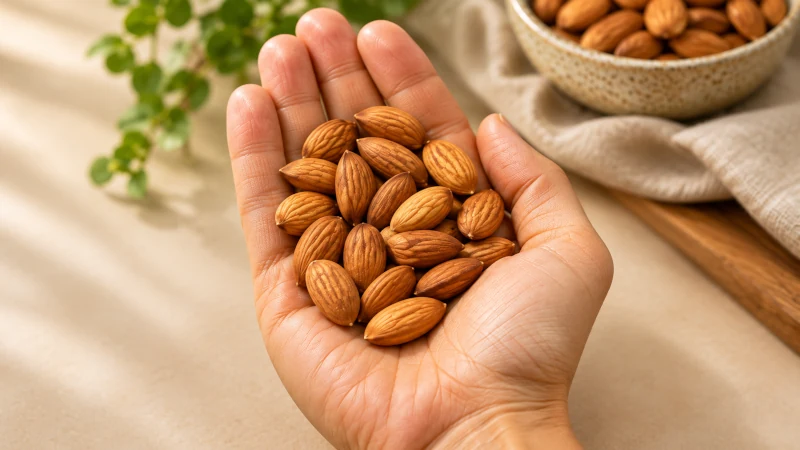
Botanically, the part you eat is the seed of a stone fruit in the rose family, a close cousin of peaches and apricots. That family resemblance matters for one safety reason, covered below: bitter almonds.
What’s in a handful of almonds
One ounce of raw almonds is about 23 nuts. Here is what it contains, calculated from USDA Standard Reference data as published by the Almond Board of California [Almond Board of California, 2021]. Daily Values for vitamin E (15 mg) and magnesium (420 mg) come from the NIH [NIH ODS Vitamin E, 2026] [NIH ODS Magnesium, 2026].
| Nutrient (per 1 oz / 28 g raw) | Amount | Note |
| Calories | ≈162 | Energy-dense; portion matters |
| Protein | 5.9 g | |
| Total fat | 14 g | Monounsaturated 8.8 g · polyunsaturated 3.5 g · saturated 1.1 g |
| Fiber | 3.5 g | |
| Vitamin E (alpha-tocopherol) | 7.2 mg | ≈48% of the Daily Value |
| Magnesium | 76 mg | ≈18% of the Daily Value |
| Calcium | 75 mg | A modest amount |
| Potassium | 205 mg | |
| Riboflavin (vitamin B2) | 0.32 mg | |
| Iron | 1.0 mg |
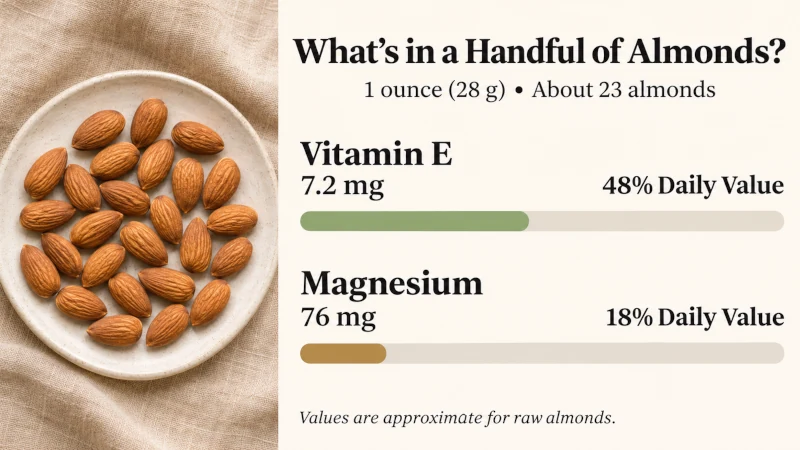
Vitamin E is the standout. On the NIH’s list of common food sources, dry-roasted almonds rank just behind sunflower seeds among nuts and seeds, with 6.8 mg per ounce [NIH ODS Vitamin E, 2026]. Our guide to vitamin E-rich foods shows how a handful fits into a day’s total.
Magnesium is the other useful one. An ounce of dry-roasted almonds gives about 80 mg, and national survey data suggest roughly half of Americans get less magnesium from food than they need [NIH ODS Magnesium, 2026]. For more ways to close that gap, see our list of magnesium-rich foods.
Mostly the heart-friendly kind of fat
Almonds are about half fat by weight, and close to two-thirds of that fat is monounsaturated, mainly oleic acid. Nearly all of the rest is polyunsaturated linoleic acid, an omega-6 fat. Almonds contain essentially no alpha-linolenic acid, the plant form of omega-3 [Almond Board of California, 2021]. If omega-3s are what you’re after, almonds aren’t the food for that job.
Almond health benefits backed by research
Cholesterol and heart health: the strongest evidence
This is where almonds have earned their reputation. A 2019 meta-analysis pooled 15 randomized trials in 534 adults, healthy or at risk of heart disease, that compared eating almonds with not eating them for at least three weeks. Almonds lowered LDL cholesterol by about 6 mg/dL, total cholesterol by about 11 mg/dL and apolipoprotein B (a marker of the particles that carry cholesterol into artery walls) by about 7 mg/dL [Lee-Bravatti et al., 2019].
Two caveats keep that in proportion. The changes are small — a helpful nudge, not a treatment for high cholesterol. And HDL (“good”) cholesterol also dipped slightly, by about 1 mg/dL, while the trials varied so much in dose and design that the authors declined to draw firmer conclusions. The review was supported by the Almond Board of California, which, according to the authors, had no role in the analysis.
The U.S. Food and Drug Administration took a similarly hedged position in 2003. It allows nut packages, almonds included, to say that evidence suggests but does not prove that eating 1.5 ounces of most nuts a day, as part of a diet low in saturated fat and cholesterol, may reduce the risk of heart disease [FDA, 2003].
Notice what’s missing: trials showing that almonds prevent heart attacks. The evidence is about risk factors. Almonds do the most good as a swap — a handful instead of chips or cookies — inside an overall pattern like the ones in our guide to foods for healthy arteries. Their vitamin E is often credited for the benefit, but vitamin E supplements have not prevented cardiovascular disease in large clinical trials [NIH ODS Vitamin E, 2026], so the advantage belongs to the whole food, not a pill.
Blood sugar and diabetes: mixed evidence
Whether almonds improve long-term blood sugar control is genuinely unsettled. A 2021 meta-analysis of eight trials in people with type 2 diabetes found that almond-based diets lowered HbA1c, the three-month blood sugar marker, but did not change fasting glucose, after-meal glucose or insulin resistance [Ojo et al., 2021]. A broader 2022 analysis of 26 trials with 1,750 participants found no significant effect on fasting glucose, insulin or HbA1c, even as it confirmed improvements in blood fats [Morvaridzadeh et al., 2022].
The fair reading: almonds are a sensible snack if you have diabetes, especially in place of refined, sugary snacks, but they are not a glucose-lowering treatment and shouldn’t change your medication plan. Our list of diabetic-friendly foods shows where nuts fit in a broader eating plan.
Weight: no gain, possibly a small loss
A 160-calorie handful sounds like a diet risk. The trials say otherwise. A 2020 meta-analysis of 28 randomized trials found that people eating almonds lost slightly more weight than control groups — about 0.4 kg, under a pound — and about 0.6 kg more fat mass, with no significant change in BMI or waist size [Eslampour et al., 2020]. The 2019 heart-risk analysis also recorded a small drop in body weight [Lee-Bravatti et al., 2019].
One likely reason is displacement: people tend to eat less of other foods when almonds are added [Dreher, 2021]. That only works if the almonds replace something. Poured on top of an unchanged diet, any calorie-dense food adds up. For a fuller picture of what helps, see our guide to foods to eat to lose weight.
Bones: helpful minerals, not a calcium substitute
Almonds supply magnesium, phosphorus and some calcium — about 75 mg per ounce [Almond Board of California, 2021]. Magnesium is a real bone nutrient: half or more of the body’s supply is stored in bone, and higher intakes are linked with better bone density, although research hasn’t shown that extra magnesium prevents osteoporosis [NIH ODS Magnesium, 2026].
What almonds can’t do is stand in for dairy, fortified foods or other high-calcium choices. Per 100 grams they look calcium-rich, but nobody snacks on 100 grams; a realistic handful covers only a small slice of a day’s needs. Our guide to the best foods for osteoporosis lays out the better-absorbed sources.
Claims that don’t hold up
Stress, depression and “strengthening the nerves.” No clinical trials show that almonds treat depression, anxiety or fatigue. Magnesium deficiency can cause fatigue and personality changes, but deficiency is uncommon in healthy people because the kidneys conserve magnesium when intake runs low [NIH ODS Magnesium, 2026]. Low mood or exhaustion that won’t lift deserves a conversation with your doctor, not a snack swap.
More breast milk. We found no clinical trials testing almonds or almond milk as a way to increase milk supply. A systematic review of galactagogues found a shortage of high-quality evidence even for the herbs and drugs most often used, and noted that the Academy of Breastfeeding Medicine cited insufficient evidence to recommend any specific one [Bazzano et al., 2016]. Almonds are a fine food while breastfeeding; just don’t count on them for supply. A lactation consultant is the right first call.
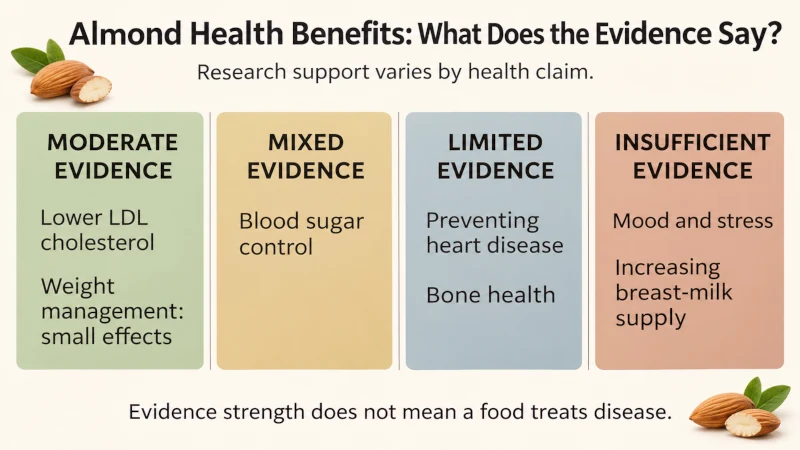
The evidence at a glance
| Claim | Strength of evidence | What it means for you |
| Lowers LDL cholesterol | Moderate: meta-analyses of randomized trials; small effect | A daily handful nudges LDL down by roughly 6 mg/dL |
| Prevents heart disease | Limited: risk-factor trials and an FDA qualified claim; no outcome trials | A reasonable part of a heart-healthy pattern |
| Weight control | Moderate: no weight gain; slight loss in pooled trials | Works best as a swap for other snacks |
| Blood sugar / diabetes | Mixed: one analysis shows lower HbA1c, a larger one does not | Good snack choice, not a treatment |
| Bone health | Limited, indirect (magnesium) | Helpful minerals; not a calcium source to rely on |
| Mood, stress, fatigue | Insufficient: no trials found | No reason to expect an effect |
| Breast-milk supply | Insufficient: no trials found | No reason to expect an effect |
How many almonds a day?
For most people, one ounce — about 23 almonds, roughly 160 calories — is a practical daily amount. The FDA’s qualified heart claim is built around 1.5 ounces of nuts a day [FDA, 2003], and the 2019 meta-analysis favored doses near that level, with some effects larger above it [Lee-Bravatti et al., 2019].
Two habits make the difference. Eat them instead of another snack, not in addition to one. And choose unsalted: raw almonds have essentially no sodium, while salted dry-roasted almonds carry about 65 mg per ounce [Almond Board of California, 2021].
Almond milk: what it is and isn’t
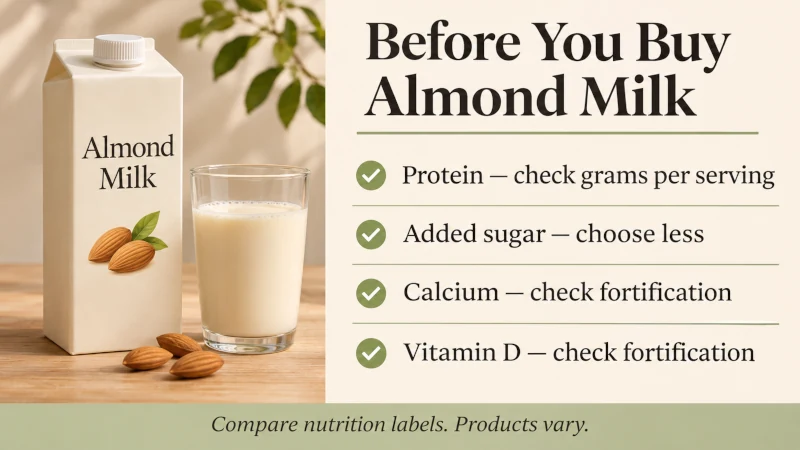
Almond milk is a convenient dairy-free drink, but it isn’t a liquid version of a handful of almonds. Most plant-based milks are not nutritionally equivalent to cow’s milk and can be low in protein, calcium and vitamin D [AAP, 2023]. Read the label for protein, added sugar, and whether calcium and vitamin D have been added.
For young children, the American Academy of Pediatrics is specific. Babies under 12 months should drink breast milk or infant formula, not other milks. From ages 1 to 5, plant-based milks other than soy milk are not recommended in place of dairy milk [AAP, 2023]. If your child can’t have dairy, ask their pediatrician or a registered dietitian which alternative to use.
Raw, roasted, blanched or soaked?
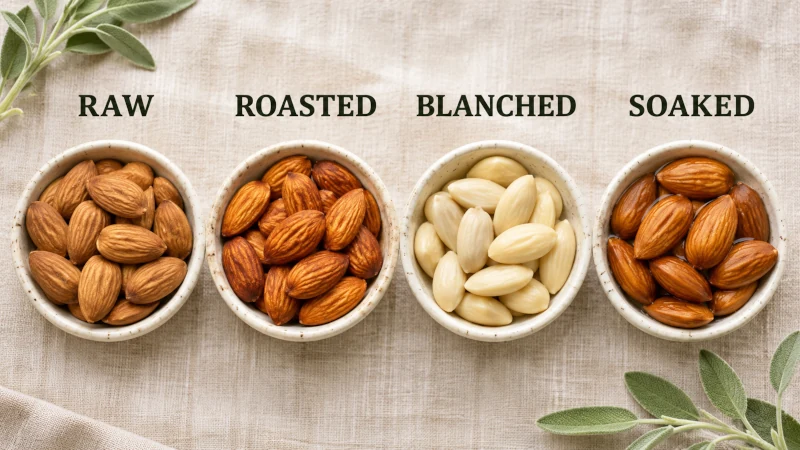
Nutritionally, the differences are small. Per 100 grams, dry-roasted almonds have slightly less vitamin E than raw (about 24 mg vs. 26 mg), and blanching, which removes the skin, trims fiber from about 12.5 g to about 10 g [Almond Board of California, 2021]. Pick the form you enjoy and will actually eat.
Soaking, sometimes sold as “activating,” softens the texture, which is a perfectly good reason to do it. It doesn’t do much else. When researchers soaked almonds, hazelnuts, peanuts and walnuts under several regimes, phytate levels barely changed, mineral content generally fell — especially in chopped nuts — and the phytate-to-mineral ratios that govern absorption didn’t improve [Kumari et al., 2020].
Who should be careful with almonds
Tree nut allergy
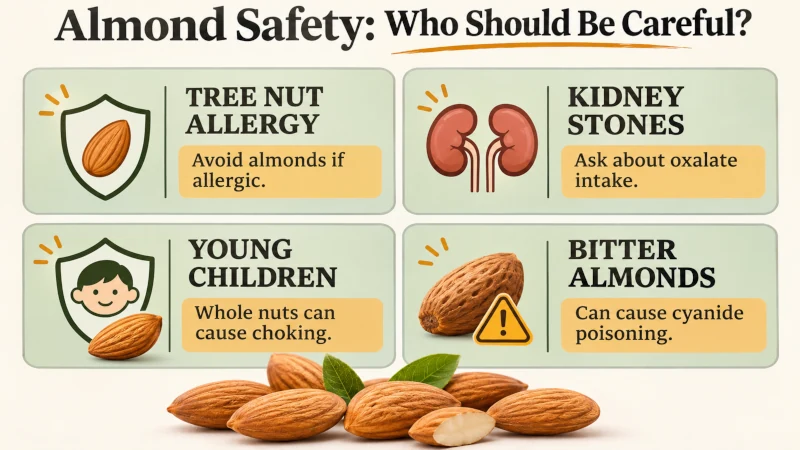
Tree nuts, almonds among them, are one of the food allergens most often linked to anaphylaxis, and the allergy usually lasts for life — fewer than 10% of people outgrow it [ACAAI, 2023]. Symptoms can include itching of the mouth or throat, stomach pain, vomiting, diarrhea, trouble swallowing and shortness of breath. Allergists usually advise people allergic to one tree nut to avoid all of them, and 25% to 40% of people with a peanut allergy also react to at least one tree nut. Nut oils can turn up in lotions, soaps and hair products as well.
Kidney stones and oxalate
Almonds are high in oxalate, which can bind with calcium to form calcium oxalate stones, the most common type. If you’re prone to them, your doctor may suggest moderating high-oxalate foods such as almonds, spinach and beets — moderation, not elimination [Cleveland Clinic, 2026]. Cleveland Clinic urologists also stress drinking plenty of fluids and keeping calcium-rich foods in your diet, because dietary calcium helps neutralize oxalate in the gut.
Babies and young children
Whole or chopped nuts are on the CDC’s list of choking hazards for young children, along with chunks or spoonfuls of nut butter [CDC, 2026]. Ask your child’s doctor when and how to introduce almonds, particularly if food allergies run in the family.
Pregnancy and breastfeeding
Unless you’re allergic, sweet almonds are an ordinary food during pregnancy and breastfeeding. Vitamin E needs hold at 15 mg a day in pregnancy and rise to 19 mg while breastfeeding [NIH ODS Vitamin E, 2026], and an ounce of almonds covers a meaningful share. Don’t rely on them to raise milk supply, and avoid bitter almonds and amygdalin products entirely.
Medications and supplements
We found no well-documented interactions between almonds eaten as food and medications. The interactions you may read about involve supplement doses: high-dose vitamin E can raise bleeding risk with blood thinners such as warfarin, and magnesium supplements can block absorption of certain antibiotics and osteoporosis drugs [NIH ODS Vitamin E, 2026] [NIH ODS Magnesium, 2026]. If you take any of those medicines and also use supplements, check with your pharmacist.
Bitter almonds are a different, toxic food
Bitter almonds contain amygdalin, a compound that releases hydrogen cyanide when it breaks down [Arabizadeh et al., 2024]. Poisonings after eating bitter almonds have been reported in the medical literature for decades [Shragg et al., 1982]; in one 2024 case report, a woman who ate about 40 bitter almonds developed severe cyanide poisoning that required intensive hospital treatment [Arabizadeh et al., 2024].
Amygdalin is also sold online as “laetrile” or “vitamin B17.” It has not been shown to treat or prevent cancer, it has caused cyanide toxicity, and the FDA has banned its sale in the United States [MSKCC, n.d.]. If an almond tastes sharply bitter, spit it out.
When to get medical help
- Call emergency services right away if, after eating almonds or any nut, someone has trouble breathing, difficulty swallowing or other signs of anaphylaxis. Use an epinephrine auto-injector if one has been prescribed [ACAAI, 2023].
- Call emergency services if someone has eaten bitter almonds, apricot kernels or an amygdalin product and develops vomiting, faintness, drowsiness or confusion. Cyanide poisoning can worsen over hours [Arabizadeh et al., 2024].
- See an allergist if nuts ever cause mouth itching, stomach symptoms or a runny nose, even mildly [ACAAI, 2023].
- Talk to your doctor or a dietitian before eating large amounts of almonds if you’ve had kidney stones, and before using diet changes in place of treatment for high cholesterol or diabetes.
| HEALTH DISCLAIMER: This article is for general education and is not medical advice. It doesn’t replace diagnosis or treatment from a qualified healthcare professional, and it shouldn’t be used to start, stop or change any treatment. Almonds are a food, not a medicine, and they don’t cure or reverse any disease. If you have a nut allergy, a history of kidney stones, diabetes, high cholesterol or another health condition, take prescription medication, or are pregnant or breastfeeding, talk to your doctor, pharmacist or a registered dietitian before making significant changes to your diet. In an emergency, call your local emergency number. |
Frequently Asked Questions
How many almonds should I eat a day?
About an ounce, or roughly 23 almonds, is a sensible daily amount for most people. Trials of heart-risk factors often used amounts near 1.5 ounces [Lee-Bravatti et al., 2019]. Whatever the amount, eat them in place of another snack.
Don’t almonds raise cholesterol because they’re so fatty?
No. Their fat is mostly monounsaturated, and in randomized trials almonds lowered LDL cholesterol slightly, by about 6 mg/dL on average [Lee-Bravatti et al., 2019].
Are soaked almonds healthier than raw almonds?
Not meaningfully. Soaking makes almonds softer, but it barely changes phytate and doesn’t improve how well you absorb their minerals [Kumari et al., 2020].
Is almond milk as healthy as eating almonds?
No. Most almond milks are much lower in protein than cow’s milk and rely on fortification for calcium and vitamin D. Pediatricians don’t recommend it in place of dairy milk for children under 5 [AAP, 2023].
Can almonds cause kidney stones?
Almonds are high in oxalate, so people prone to calcium oxalate stones may be advised to eat them in moderation, drink plenty of fluids and keep calcium-rich foods in their diet [Cleveland Clinic, 2026].
Are almonds good for people with diabetes?
They’re a reasonable snack, but the evidence on blood sugar is mixed. One meta-analysis found lower HbA1c in type 2 diabetes [Ojo et al., 2021]; a larger one found no significant effect [Morvaridzadeh et al., 2022].
References
- Almond Board of California. Almond Nutrient Comparison. View source
- National Institutes of Health, Office of Dietary Supplements. Vitamin E: Fact Sheet for Health Professionals. View source
- National Institutes of Health, Office of Dietary Supplements. Magnesium: Fact Sheet for Health Professionals. View source
- Lee-Bravatti MA, Wang J, Avendano EE, King L, Johnson EJ, Raman G. Almond consumption and risk factors for cardiovascular disease: a systematic review and meta-analysis of randomized controlled trials. View source
- U.S. Food and Drug Administration. Qualified Health Claims: Letters of Enforcement Discretion — “Nuts and Coronary Heart Disease,” View source
- Ojo O, Wang X-H, Ojo OO, Adegboye ARA. The effects of almonds on gut microbiota, glycometabolism, and inflammatory markers in patients with type 2 diabetes: a systematic review and meta-analysis of randomised controlled trials. View source
- Morvaridzadeh M, Qorbani M, Shokati Eshkiki Z, et al. The effect of almond intake on cardiometabolic risk factors, inflammatory markers, and liver enzymes: a systematic review and meta-analysis. View source
- Eslampour E, Moodi V, Asbaghi O, et al. The effect of almond intake on anthropometric indices: a systematic review and meta-analysis. View source
- Dreher ML. A comprehensive review of almond clinical trials on weight measures, metabolic health biomarkers and outcomes, and the gut microbiota. View source
- Kumari S, et al. Does “activating” nuts affect nutrient bioavailability? Food Chem. 2020;319:126529. View source
- American College of Allergy, Asthma & Immunology. Tree Nut. View source
- Cleveland Clinic. Kidney Stones Diet: What To Eat and Avoid. View source
- Centers for Disease Control and Prevention. Choking Hazards (Infant and Toddler Nutrition). View source
- Muth ND; American Academy of Pediatrics. Recommended Drinks for Children Age 5 & Younger. HealthyChildren.org. View source
- Bazzano AN, Hofer R, Thibeau S, Gillispie V, Jacobs M, Theall KP. A review of herbal and pharmaceutical galactagogues for breast-feeding. View source
- Shragg TA, Albertson TE, Fisher CJ Jr. Cyanide poisoning after bitter almond ingestion. View source
- Arabizadeh N, Mahmoudi M, Mokhtar Gandomani L, Eizadi-Mood N. Cyanide poisoning after bitter almond ingestion: “a rare case report.” View source
- Memorial Sloan Kettering Cancer Center. Amygdalin (About Herbs). View source


