
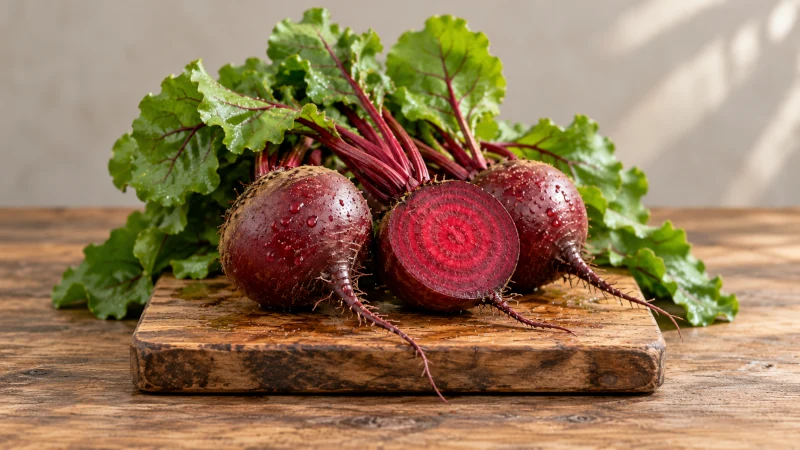
Red beets owe most of their reputation to one compound: nitrate. Your body turns it into nitric oxide, a signal that helps blood vessels relax, and that’s where the best-supported red beet health benefits come from: a modest drop in systolic blood pressure and a small boost to endurance. The older claims you may have seen, that beet juice cures anemia or shrinks tumors, don’t hold up in human research. Here’s what beets can realistically do for you, what they can’t, and how to eat them safely.
| The short answer Good evidence: beet juice lowers systolic blood pressure by about 4–5 mm Hg on average in short trials.Moderate evidence, small effect: nitrate helps you keep going longer during exercise, but doesn’t make you stronger.Early or lab-only: inflammation, brain blood flow, cancer.Not supported: beets as a treatment for anemia.Know before you start: red urine is usually harmless; beets are high in oxalate; concentrated juice can add to blood pressure medication. |
What’s in a red beet
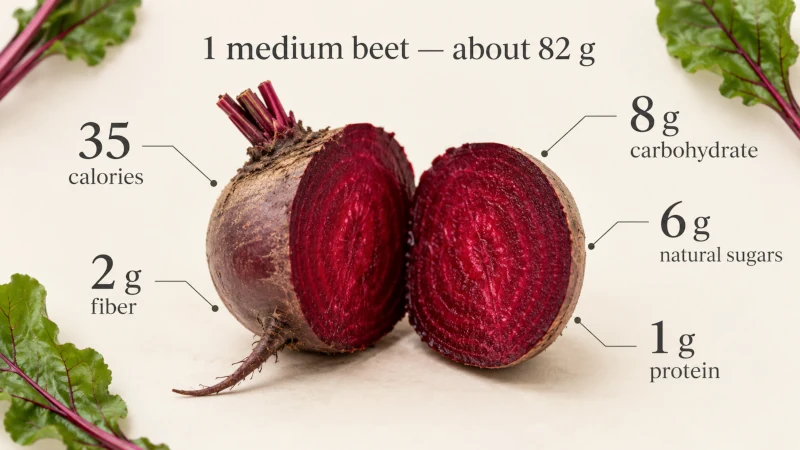
One medium beet (about 82 grams) has roughly 35 calories, 8 grams of carbohydrate, 6 grams of natural sugar, 2 grams of fiber and 1 gram of protein [USDA SNAP-Ed]. It’s a good source of folate and manganese [Virginia Cooperative Extension, 2025]. The deep red-violet color comes from betacyanins, water-soluble pigments in the betalain family. Red beet is the main commercial source, and its pigment betanin is used as a food coloring (E162) [ScienceDirect Topics].
What sets beets apart from most vegetables is their high inorganic nitrate content [Clifford et al., 2015]. Leafy greens like arugula and spinach can carry even more; our ranked list of nitrate-rich vegetables shows where beets fall.
| Per medium beet (82 g) | Amount |
| Calories | 35 |
| Carbohydrate | 8 g |
| Total sugars | 6 g |
| Fiber | 2 g |
| Protein | 1 g |
| Vitamin C | 4 mg |
| Sodium | 64 mg |
Source: USDA SNAP-Ed Seasonal Produce Guide.
Older articles, including earlier versions of this one, call beets rich in magnesium, calcium and potassium. None of the sources we checked singles out beets for those minerals. If magnesium is your goal, seeds, nuts, beans and leafy greens will do far more.
Red beet health benefits, ranked by evidence
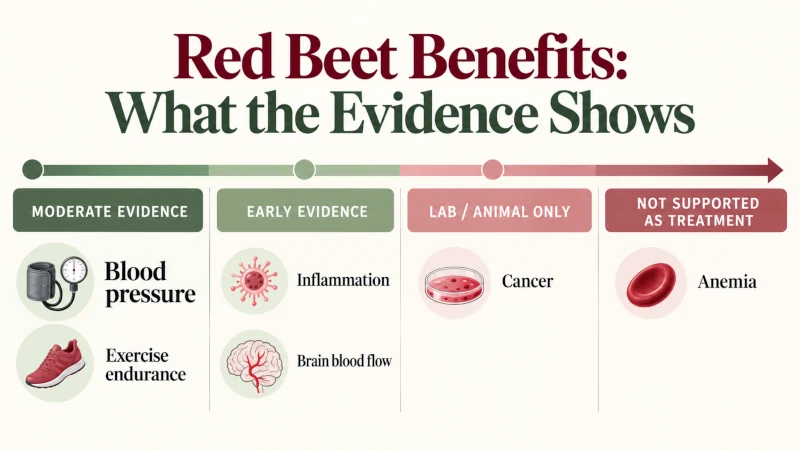
| Claimed benefit | Evidence | What it means for you |
| Lower blood pressure | Moderate: many short randomized trials | About 4–5 mm Hg off systolic pressure, short term |
| Exercise endurance | Moderate: small effects, low-quality reviews | Can help you last longer. No effect on strength or VO2 max |
| Less inflammation | Early: mostly lab, a few small human studies | Too soon to count on |
| Brain blood flow | Early: short imaging studies | Blood flow changes, not proven memory benefit |
| Cancer protection | Lab and animal only | No human evidence |
| Treating anemia | Insufficient: no trials found | Not a treatment. Get iron deficiency diagnosed |
| Lower cholesterol | Insufficient: no reliable source found | Don’t rely on beets for this |
Blood pressure: the best-supported benefit
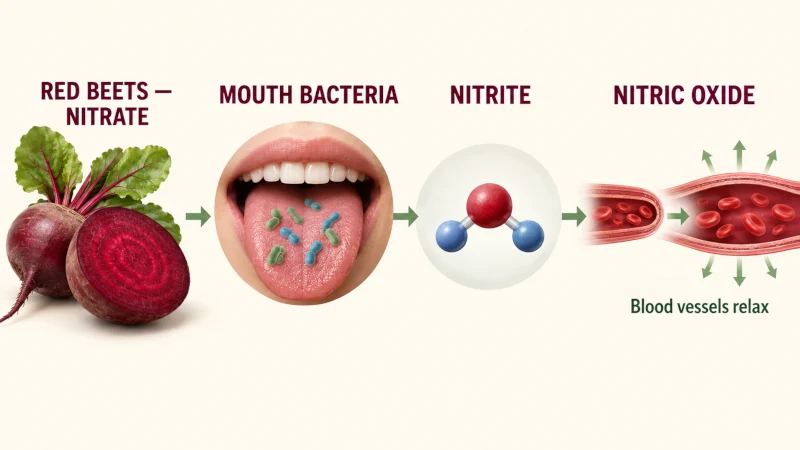
After you eat beets, the nitrate is absorbed and about a quarter of it cycles back into your saliva. Bacteria at the back of your tongue convert it to nitrite, which your body can turn into nitric oxide [Clifford et al., 2015]. Nitric oxide tells artery walls to relax, so blood moves with less resistance.
In a 2013 meta-analysis of 16 randomized trials (254 participants), nitrate or beet juice lowered systolic blood pressure by an average of 4.4 mm Hg. The 1.1 mm Hg drop in diastolic pressure fell short of statistical significance [Siervo et al., 2013]. A 2022 review limited to people with diagnosed high blood pressure pooled seven trials (218 participants) that used 70–250 mL of beet juice a day for 3 to 60 days. Systolic pressure fell by about 5 mm Hg, diastolic didn’t change, and the drop was bigger at clinic visits than on 24-hour monitoring [Benjamim et al., 2022].
Both review teams flagged the same gap: the trials ran for weeks, not years. Nobody yet knows whether the effect lasts, or whether it lowers the risk of heart attack and stroke [Siervo et al., 2013; Benjamim et al., 2022]. Treat beets as one helpful habit alongside diet, movement and any medication you’ve been prescribed, not a replacement for them. Our food-first guide to nitric oxide and blood pressure puts beets in that bigger picture, and our comparison of beetroot, citrulline and arginine supplements covers concentrated products.
Exercise endurance: a small, real edge
A 2025 umbrella review pooled 20 published meta-analyses on nitrate and exercise. Nitrate modestly improved time to exhaustion, total distance covered, muscular endurance and peak power. It did not improve time-trial results, maximal oxygen uptake or strength. Effects were larger with at least 6 mmol (about 372 mg) of nitrate a day taken for more than three days. The authors rated most of the included reviews as low or critically low quality [Poon et al., 2025], so expect a small benefit, not a guaranteed one.

Nitrate content varies a lot between beets, juices and powders. If you’re buying a product for training, choose one that states its nitrate content on the label.
Inflammation and antioxidants: promising in the lab
In lab studies, beet pigments block inflammatory pathways such as COX-2 and NF-κB. Human data are thin. One small study in people with osteoarthritis found lower inflammatory markers after 10 days of a beetroot supplement [Clifford et al., 2015]. The reviewers conclude that a lack of well-conducted human trials “precludes any definitive recommendations” for clinical use [Clifford et al., 2015].
Brain blood flow: early human data
In older adults (average age around 75), a high-nitrate diet that included beet juice increased blood flow to the brain’s frontal lobes on MRI. In young adults, beet juice lowered resistance in brain arteries [Clifford et al., 2015]. Both were short studies that measured blood flow, not memory or dementia risk.
Cancer: lab and animal studies only
Beet extracts slowed tumor growth in rats and in human cancer cells grown in the lab. The review we relied on cites no human trials [Clifford et al., 2015]. An earlier version of this page repeated reports of tumors shrinking on daily beet juice. We found no clinical evidence behind those reports, and beets should never stand in for cancer treatment.
Do red beets help with anemia?
This used to be the headline claim for beet juice, and it has the least support. Beets contain some iron, but they aren’t on the NIH’s list of notable food sources of iron [NIH ODS, 2025]. Iron from plants (nonheme iron) is also absorbed less easily than iron from meat, poultry and seafood, although vitamin C helps [NIH ODS, 2025]. We found no controlled human trials showing that beet juice treats iron-deficiency anemia.
If you have anemia, the cause needs a diagnosis, and iron supplements are best taken with a clinician guiding the dose and follow-up [NIH ODS, 2025]. For everyday eating, pair iron-containing foods with vitamin C. A leafy green like mâche, which supplies both iron and vitamin C, is an easy way to do it.
Why beets can turn your urine red
If your urine or stool turns pink or red a day after eating beets, the likely culprit is beeturia, not blood. It affects about 10% to 14% of people [Sauder & Rout, StatPearls; Cleveland Clinic, 2025]. The pigments are absorbed more readily in people who are iron deficient or absorbing iron at high rates, and beeturia shows up in about 45% of people with pernicious anemia [Sauder & Rout, StatPearls]. Beeturia itself is harmless [Sauder & Rout, StatPearls]. But if it happens to you regularly, mention it to your doctor. It isn’t a diagnosis, but it can be a reason to check your iron.
How to get the most from red beets
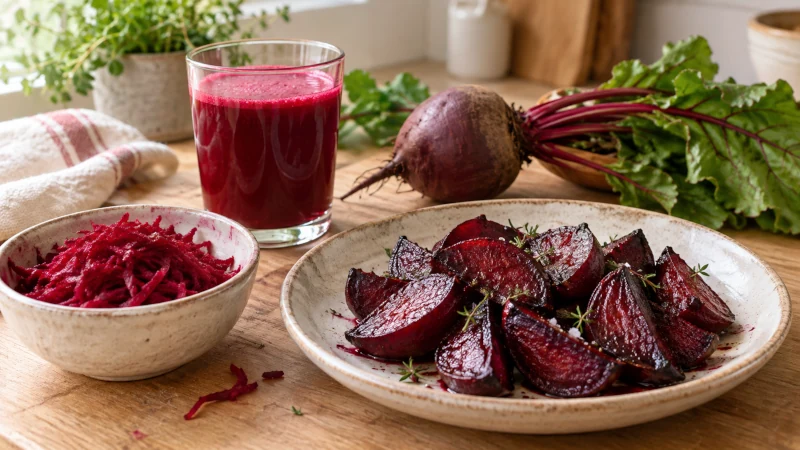
Whole beets and beet juice do different jobs. Beet juice is what the trials in people with high blood pressure used [Benjamim et al., 2022], and it delivers more nitrate per serving. Whole beets keep their fiber (about 2 grams per beet) [USDA SNAP-Ed].
- Raw: grate into salads and dress with lemon and oil.
- Cooked: boil or roast whole, unpeeled beets until a knife slides in easily. Plunge them into cold water and the skins slip off.
- Juice: the taste is earthy. Mixing it with apple, carrot or citrus juice makes it easier to drink.
- Greens: the leaves are edible. Sauté them like chard [USDA SNAP-Ed].
- Storage: cut the leaves off, leaving about an inch of stem, and keep the roots in a perforated bag in the fridge for up to three weeks [Virginia Cooperative Extension, 2025].
- Stains: salt can help lift beet stains from boards and hands [USDA SNAP-Ed].
One habit can undercut the whole process: antibacterial mouthwash reduces how much nitrate your mouth bacteria convert to nitrite [Clifford et al., 2015]. Read more in our guide to mouthwash, oral bacteria and nitric oxide.
Side effects, interactions, and who should be careful
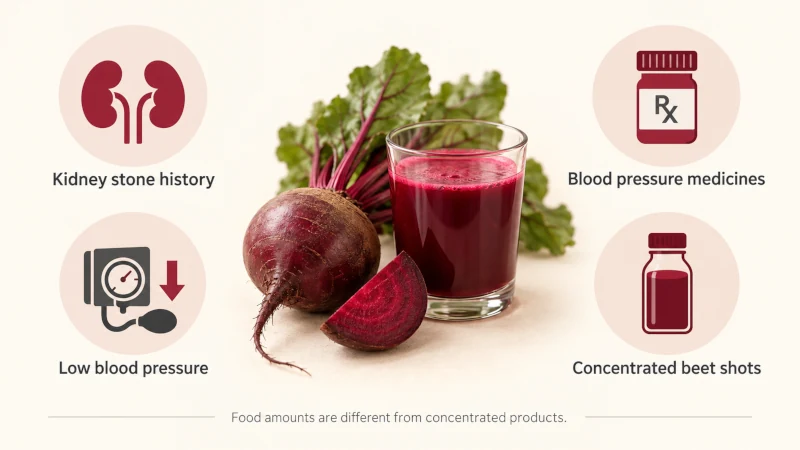
Beets are an ordinary food, and eating them a few times a week is safe for most people. Concentrated juices, shots and powders call for more care.
- Kidney stones. Beets are high in oxalate [National Kidney Foundation]. If you’ve had calcium oxalate stones, ask your doctor or dietitian how much is right for you. The National Kidney Foundation suggests eating oxalate-rich foods together with calcium-rich foods like milk or yogurt [National Kidney Foundation].
- Blood pressure medication. Beet nitrate lowers blood pressure, so daily juice or shots could add to the effect of your prescription. We didn’t find trials that tested this combination. If you start a daily habit, check your readings and tell your prescriber.
- Nitrate heart drugs and erectile dysfunction drugs. Nitroglycerin and similar drugs, as well as sildenafil-type drugs, act on the nitric oxide pathway. We found no trials of concentrated beet products taken with these medicines, so ask your pharmacist before combining them.
- Infants. The American Academy of Pediatrics advises against feeding home-prepared foods from high-nitrate vegetables, including beets, before 3 months of age [AAP via AAFP, 2005].
- Total nitrate. Europe’s food-safety agency set an acceptable daily intake for nitrate of 3.7 mg per kilogram of body weight. It noted that people with medium to high intake from all sources, vegetables included, may go over it [EFSA, 2017]. Whole beets as part of a normal diet are fine. Stacking several concentrated shots a day is a different matter.
- Pregnancy and breastfeeding. Beets as food are part of a normal varied diet. Concentrated beet shots and powders haven’t been studied in pregnancy or breastfeeding, so check with your clinician first.
- Blood sugar. A medium beet has about 6 grams of natural sugar [USDA SNAP-Ed]. Juice removes most of the fiber, so if you have diabetes, whole beets are the better pick. Count juice as carbohydrate.
- Low blood pressure. If you already run low or often feel dizzy when you stand up, skip daily beet shots unless your doctor says otherwise.
When to talk to a doctor
Red urine or stool after beets usually clears within a day or two. Call your doctor if [Cleveland Clinic, 2025]:
- the red color lasts more than 48 hours after you ate beets, or appears when you haven’t eaten beets or other red foods in the past 48 hours
- it hurts to urinate
- you have iron-deficiency anemia, or a higher risk of kidney stones or bladder cancer
Also talk to your clinician before using beet juice to manage high blood pressure, especially if you take medication. It can support treatment, but it can’t replace it.
| Health disclaimer: This article is for general education and does not replace advice, diagnosis or treatment from a qualified health professional. Don’t stop or change any prescribed medication based on what you read here. If you are pregnant, breastfeeding, managing a health condition or taking medication, talk with your doctor or pharmacist before adding concentrated beet juice, shots or powders to your routine. |
Frequently Asked Questions
Is it better to eat beets raw, cooked or as juice?
It depends on your goal. The blood pressure and exercise research mostly used beet juice, which packs more nitrate per serving. Whole beets, raw or cooked, give you fiber and fewer free sugars per serving. For general health, eat whole beets and treat juice as optional.
How much beet juice lowers blood pressure?
Trials in people with high blood pressure used 70 to 250 mL a day for up to two months and saw systolic pressure fall by about 5 mm Hg on average [Benjamim et al., 2022]. Longer-term effects aren’t known. Beet juice isn’t a substitute for prescribed medication.
When is the best time to drink beet juice before exercise?
The review we checked found bigger benefits when people took at least 6 mmol of nitrate a day for more than three days [Poon et al., 2025], so regular use may matter more than exact timing on the day. Check the label for nitrate content.
Does beet juice help with anemia?
There’s no good evidence that it does. Beets aren’t a major iron source [NIH ODS, 2025], and anemia needs a diagnosis to find the cause.
Is red urine after eating beets dangerous?
Usually not. Beeturia affects about 10–14% of people and is harmless [Sauder & Rout, StatPearls]. See a doctor if the color lasts more than 48 hours, appears without beets, or comes with pain [Cleveland Clinic, 2025].
Can beets cause kidney stones?
Beets are high in oxalate, which matters if you form calcium oxalate stones [National Kidney Foundation]. Most people don’t need to avoid them, but if you’ve had stones, ask your care team about portions and pair beets with a calcium-rich food.
References
- Siervo M, Lara J, Ogbonmwan I, Mathers JC. Inorganic nitrate and beetroot juice supplementation reduces blood pressure in adults: a systematic review and meta-analysis. J Nutr. 2013. PMID 23596162. View source
- Benjamim CJR, Porto AA, Valenti VE, et al. Nitrate derived from beetroot juice lowers blood pressure in patients with arterial hypertension: a systematic review and meta-analysis. Front Nutr. 2022;9. doi:10.3389/fnut.2022.823039. View source
- Poon ET, Iu JCK, Sum WMK, et al. Dietary nitrate supplementation and exercise performance: an umbrella review of 20 published systematic reviews with meta-analyses. Sports Med. 2025. doi:10.1007/s40279-025-02194-6. View source
- Clifford T, Howatson G, West DJ, Stevenson EJ. The potential benefits of red beetroot supplementation in health and disease. Nutrients. 2015;7(4):2801–2822. doi:10.3390/nu7042801. View source
- Sauder HM, Rout P. Beeturia. In: StatPearls [Internet]. StatPearls Publishing; 2023. NBK537012. View source
- Cleveland Clinic. Why beets turn poop and pee red. Health Essentials. Medically reviewed by Andrew Altman, MD. October 15, 2025. View source
- NIH Office of Dietary Supplements. Iron: Fact Sheet for Health Professionals. Updated September 4, 2025. View source
- National Kidney Foundation. Kidney Stone Diet Plan and Prevention. View source
- European Food Safety Authority. Nitrites and nitrates added to food: EFSA explains risk assessment. June 2017. View source
- Preboth M. AAP clinical report on infant methemoglobinemia. Am Fam Physician. December 15, 2005. (Summarizes Greer FR, Shannon M. Pediatrics. 2005;116(3):784.) View source
- USDA SNAP-Ed Connection. Seasonal Produce Guide: Beets. View source
- Virginia Cooperative Extension. Eat Smart, Move More at Farmers Markets: Beets. HNFE-314-7NP. Reviewed December 2025. View source
- ScienceDirect Topics. Betacyanin. Elsevier. View source


