
Passion fruit is one of the more nutrient-dense fruits you can buy: 100 grams of pulp carries about 10 grams of fiber, 30 mg of vitamin C, and 1.6 mg of iron for 97 calories [USDA FoodData Central, 2026]. That makes passion fruit a genuinely good thing to eat. It doesn’t make it a treatment. The headline results you may have seen for blood pressure, asthma, and joint pain come from concentrated peel extracts tested in small trials, and the calming reputation belongs to a different plant altogether.
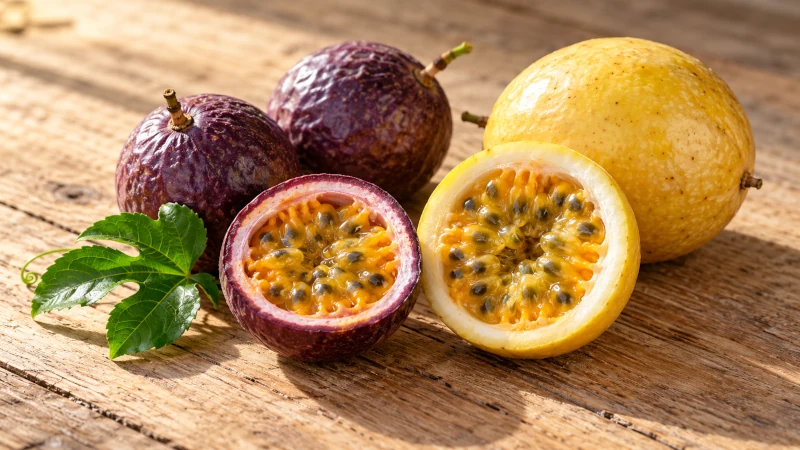
The practical version is short: eat the ripe pulp and seeds, leave the rind alone, and treat strained juice as a drink rather than a fiber source.
Purple, yellow, and the name confusion
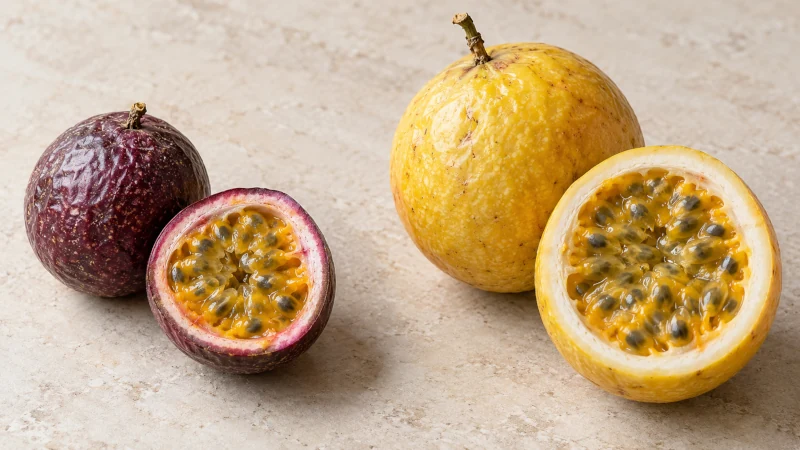
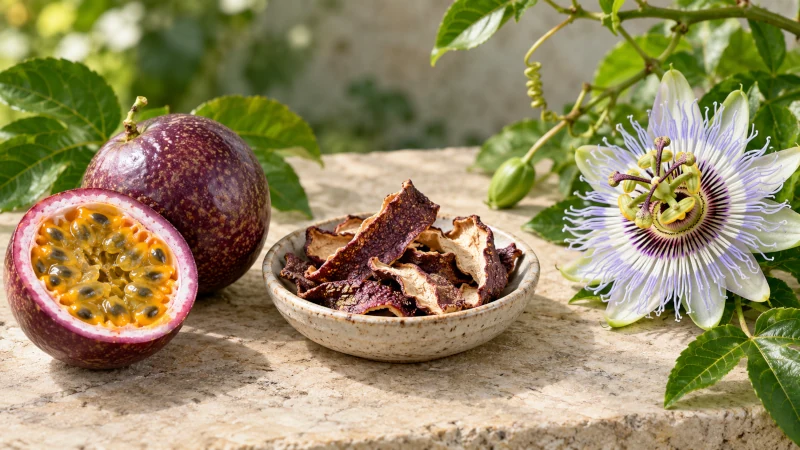
Most passion fruit in stores is Passiflora edulis, which comes in two main forms that differ mostly in color and taste:
- Purple passion fruit (P. edulis f. edulis): smaller, with a refreshing bittersweet pulp. Ripe fruit has deep purple, somewhat wrinkled skin.
- Yellow passion fruit (P. edulis f. flavicarpa): larger, more acidic and less sweet. It’s ripe when the skin turns deep yellow and starts to wrinkle.
Names vary from country to country. You’ll see granadilla, maracuyá or fruta de la pasión in Spanish, grenadille in French, and Passionsfrucht in German, so color is the most reliable way to tell the two apart. The nutrition numbers below are from USDA’s entry for raw purple passion fruit; yellow fruit is similar but not identical.
One more name to keep straight: passionflower usually means Passiflora incarnata, a related vine whose leaves and flowers are sold as an herbal remedy [NCCIH, 2025]. It’s a different plant from the fruit on your counter.
Passion fruit nutrition facts
| Nutrient | Per 100 g pulp | Per 1 cup (236 g) | For context |
| Calories | 97 kcal | 229 kcal | |
| Fiber | 10.4 g | 24.5 g | Adults need 22–34 g a day [NIDDK] |
| Total sugars | 11.2 g | 26.4 g | Naturally occurring |
| Protein | 2.2 g | 5.2 g | |
| Vitamin C | 30 mg | 70.8 mg | RDA: 75 mg women, 90 mg men [NIH ODS, 2021] |
| Iron | 1.6 mg | 3.8 mg | RDA: 18 mg women 19–50, 8 mg men [NIH ODS, 2025] |
| Potassium | 348 mg | 821 mg | |
| Magnesium | 29 mg | 68 mg | |
| Vitamin A (RAE) | 64 µg | 151 µg | From about 743 µg beta-carotene per 100 g |
| Calcium | 12 mg | 28 mg | Low |
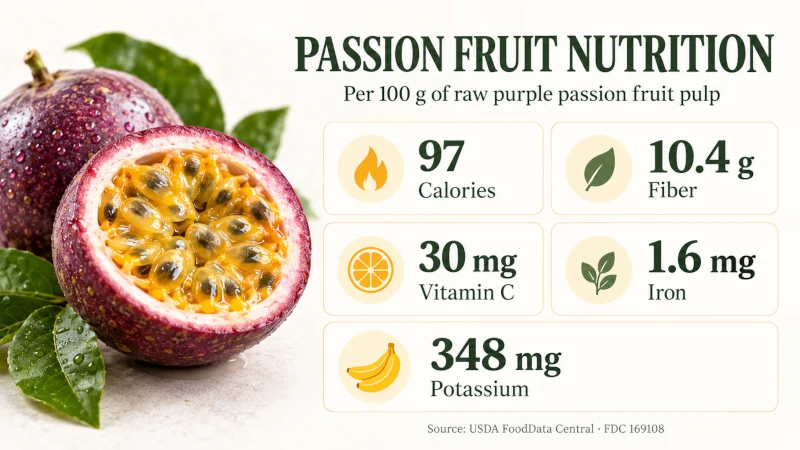
Source: [USDA FoodData Central, 2026], FDC 169108 (raw purple passion fruit). A single fruit yields far less than a cup of pulp, so treat the cup column as a guide to what the fruit is good at, not a typical serving.
The fiber stays with the pulp, not the juice
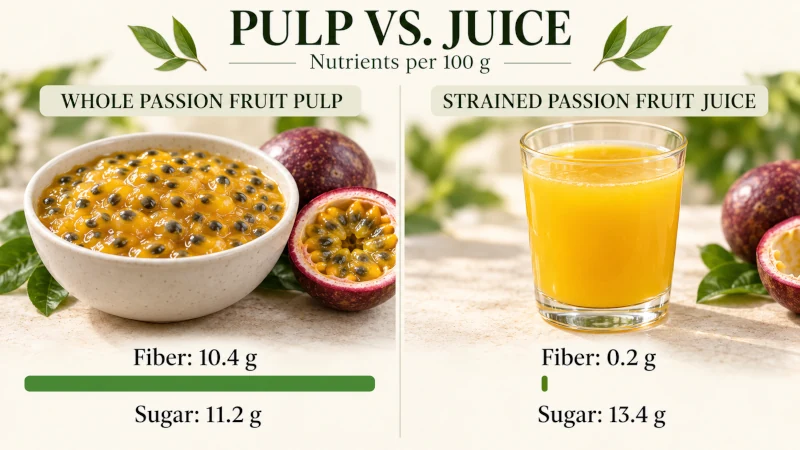
Fiber is passion fruit’s real standout. Strain the seeds out to make juice and most of it disappears: USDA lists 0.2 g of fiber per 100 g of raw purple passion fruit juice, against 10.4 g in the pulp, while the juice still carries about 13 g of sugar [USDA FoodData Central, 2026]. If fiber is part of why you’re eating passion fruit, eat the seeds along with the pulp. They’re edible and give the fruit its crunch.
Iron: a useful contribution, not a treatment
At 1.6 mg per 100 g, passion fruit has more iron than most fruit [USDA FoodData Central, 2026]. Two facts keep that number in proportion. Plant foods contain only nonheme iron, which the body absorbs less readily than the heme iron in meat and seafood; NIH puts iron bioavailability at roughly 5% to 12% from vegetarian diets versus 14% to 18% from mixed diets that include meat, seafood, and vitamin C [NIH ODS, 2025]. And women 19 to 50 need 18 mg a day, so 100 g of pulp covers just under a tenth of that.
The vitamin C helps. It improves the absorption of iron from plant foods [NIH ODS, 2021], and passion fruit delivers both in the same bite. That’s a nice bonus for anyone building an iron-conscious diet, and you’ll find bigger plant and animal sources in our list of foods rich in iron. It isn’t a fix for iron-deficiency anemia, which needs a diagnosis and usually a cause, since iron deficiency is linked to blood loss and malabsorption as well as diet [NIH ODS, 2025].
Vitamin C, vitamin A, and potassium
A 100 g serving gives 30 mg of vitamin C, about a third to two-fifths of the adult RDA [NIH ODS, 2021]. Your body uses vitamin C to make collagen for wound healing and to help the immune system work properly; our guide to what vitamin C does and how much you need covers the rest.
The orange-yellow pulp gets part of its color from beta-carotene, about 743 µg per 100 g, which USDA counts as 64 µg of vitamin A activity [USDA FoodData Central, 2026]. Potassium (348 mg) and magnesium (29 mg) are there in modest amounts. They add up across a day of produce, but if those minerals are your goal, potassium-rich foods and magnesium-rich foods such as beans, seeds, and leafy greens do far more.
Passion fruit health benefits, graded by evidence
| Claim | What was actually studied | Evidence | What it means for you |
| Regularity / constipation | Dietary fiber in general; no trials of passion fruit pulp found | Indirect but sound | The fiber helps if you eat the pulp and seeds |
| Iron absorption | Nutrient content plus the vitamin C mechanism | Established mechanism; small contribution | A helpful extra, not an anemia treatment |
| Lower blood pressure | Purple peel extract capsules: one 4-week trial in hypertension, one 16-week trial in type 2 diabetes; rat studies | Limited; one research network | Not shown for eating the fruit |
| Asthma symptoms | Peel extract, 42 adults, 4 weeks | Limited | Never a substitute for asthma medication |
| Knee osteoarthritis | Peel extract, 33 adults, 60 days | Limited | Preliminary |
| Blood sugar | Yellow peel flour, two small human studies | Mixed | Results conflict |
| Calm and sleep | Passionflower herb (P. incarnata), not the fruit | Limited for the herb; none for the fruit | The fruit isn’t a sedative |
Digestion: the fiber does the work
We didn’t find clinical trials testing passion fruit itself for constipation. What’s well established is that getting enough fiber helps prevent and relieve constipation; NIDDK suggests 22 to 34 grams a day for adults, depending on age and sex, along with enough fluid to help the fiber work [NIDDK]. A 100 g serving of pulp supplies about 10 g. If you don’t usually eat much fiber, add it a little at a time so your body can adjust [NIDDK].
Blood pressure, asthma, and joint pain: the peel extract studies
Search for passion fruit benefits and you’ll run into big numbers. They come from capsules of purple passion fruit peel extract, a concentrated mix of flavonoids and other plant compounds, not from the pulp you scoop with a spoon.
- Blood pressure. In a 4-week placebo-controlled trial in people with high blood pressure, 400 mg a day of the extract lowered systolic pressure by about 31 mm Hg and diastolic by about 25 mm Hg compared with placebo [Zibadi, 2007]. A 16-week trial in 41 adults with type 2 diabetes reported smaller but significant drops in systolic pressure and fasting blood sugar on 220 mg a day [Raju, 2013].
- Asthma. In 42 adults with asthma, 150 mg a day for 4 weeks reduced wheeze, cough, and shortness of breath and improved forced vital capacity, though FEV1, a key measure of airflow, did not improve [Watson, 2008].
- Knee osteoarthritis. In 33 adults with knee osteoarthritis, the extract cut self-reported pain, stiffness, and physical-function scores by roughly 18% to 20% after 60 days, while placebo scores worsened [Farid, 2010].
These results deserve interest and caution in equal measure. The trials were small and short, and all four came out of the same research network, with a patent pending on the extract at the time [NutraIngredients, 2008]. A blood pressure drop as large as 31 mm Hg from a dietary extract needs independent replication before anyone should rely on it. In rats, the extract also lowered blood pressure, and the authors of one carefully instrumented study concluded that more mechanistic work is needed before claiming value in humans [Lewis, 2013].
So don’t swap blood pressure or asthma medicine for passion fruit products. If an extract interests you, bring it to your doctor first, especially if you already take medication for either condition.
Blood sugar: mixed results
Flour made from yellow passion fruit peel, which is rich in soluble fiber (mainly pectin), has been tested in type 2 diabetes. In one study, 43 volunteers who took 30 g a day for two months showed lower insulin resistance, but participants were compared against their own pre-study readings rather than a separate control group [Queiroz, 2012]. A randomized trial published in 2017 found no significant change in fasting glucose, capillary glucose, or HbA1c after eight weeks [J Diabetes Metab Disord, 2017]. That’s genuinely mixed evidence.
For the fruit you’d actually eat: 100 g of pulp has about 11 g of natural sugar alongside its 10 g of fiber. If you manage diabetes, the whole pulp is a better pick than juice, which keeps the sugar and loses the fiber [USDA FoodData Central, 2026].
Calm and sleep: that’s passionflower, a different plant
The calming reputation comes from Passiflora incarnata, whose leaves and flowers go into teas and supplements. Even for that herb, NCCIH says a small amount of research suggests it might ease anxiety, but conclusions are not definite [NCCIH, 2025], and a Cochrane review found too few trials to draw conclusions [Miyasaka, 2007]. We found no trials showing that passion fruit pulp has a sedating effect. If the herb is what you’re after, our guide to passion flower (Passiflora incarnata) covers the evidence and its separate safety cautions.
How to choose and eat passion fruit
Pick fruit that feels heavy for its size. A little wrinkling is a good sign; it usually means the pulp inside is ripe and sweet.
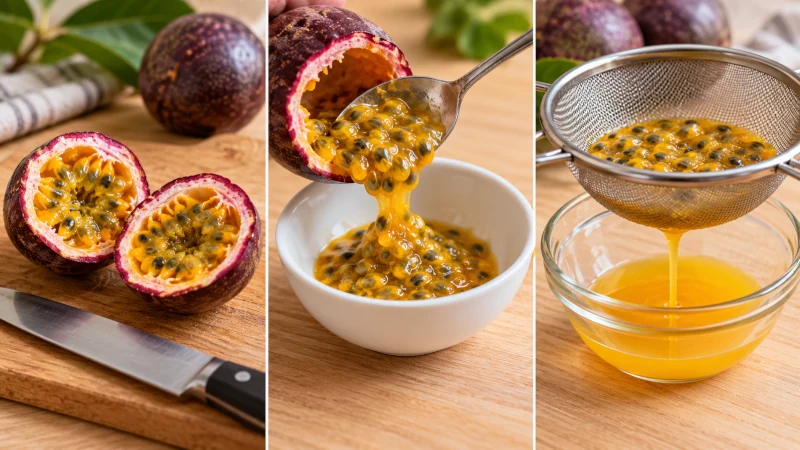
- Fresh: Cut the fruit in half and scoop out the pulp and seeds with a spoon. Discard the rind.
- Juice: Press the pulp through a strainer to remove the seeds, then blend. Expect a tart, aromatic drink with little fiber.
- In food: Spoon it over yogurt or oatmeal, stir it into fruit salad, or use it to give an exotic note to fresh or frozen desserts.
Side effects, allergies, and who should be careful
Ripe passion fruit pulp is an ordinary food for most people. A few groups need more care.
People with latex allergy. Some people allergic to natural rubber latex also react to certain fruits, a cross-reaction called latex-fruit syndrome that affects 30% to 50% of people with latex allergy [Allergy & Asthma Network]. Sources disagree on how strongly passion fruit is involved. A clinical allergen reference states that clinically relevant cross-reactivity between latex and passion fruit has been documented and that reactions are more frequent in latex-allergic people [Thermo Fisher], while Allergy & Asthma Network places passion fruit in its low-or-undetermined group [Allergy & Asthma Network]. If you have a latex allergy, ask your allergist before trying it.
Anyone tempted to eat the rind or unripe fruit. Passion fruit peel contains cyanogenic glycosides, mainly prunasin, compounds that can release cyanide. Researchers who measured them in processed yellow passion fruit peel flours found levels within the safe intake range [Bizzo, Embrapa], but that’s processed flour, not raw rind. Unripe fruit of at least one related wild species, Passiflora adenopoda, has poisoned people, while its fully ripe fruit tested free of cyanide [Sáenz & Nassar, 1972]. Stick to ripe pulp and seeds.
People watching blood sugar. The natural sugar adds up quickly in juice, which has almost no fiber to slow it down [USDA FoodData Central, 2026]. Check labels on bottled passion fruit drinks for added sugar too.
People on a potassium-restricted diet. If your clinician has you limiting potassium, count passion fruit: about 348 mg per 100 g of pulp [USDA FoodData Central, 2026].
People taking blood pressure or diabetes medicine. We found no interaction studies for the fruit or the peel extracts. Because the extracts were reported to lower blood pressure and fasting glucose in trials [Raju, 2013], combining them with medication could, in theory, add to those effects. This is an untested concern, not a documented interaction; tell your prescriber before starting any passion fruit supplement and keep checking your readings.
Pregnancy and breastfeeding. We found no safety concerns specific to eating ripe passion fruit pulp as part of a normal diet. The peel extracts and flours haven’t been studied in pregnant or breastfeeding women, so skip them unless your clinician approves. Passionflower, the herb, should not be used during pregnancy [NCCIH, 2025].
When to see a doctor
- Call 911 if you develop hives, swelling of the lips, tongue, or throat, wheezing, trouble breathing, or faintness after eating passion fruit or any food.
- Get checked for anemia if you have ongoing tiredness, weakness, or trouble concentrating. These can be signs of iron-deficiency anemia [NIH ODS, 2025], and the cause needs to be found, not just treated with food.
- See a doctor about constipation if it doesn’t improve with self-care, lasts a long time, or comes with bleeding from the rectum, blood in your stool, or continual abdominal pain [NIDDK].
- Keep taking prescribed medicine for asthma, blood pressure, or diabetes. Talk to your doctor before adding passion fruit extracts, flours, or passionflower products.
| HEALTH DISCLAIMER: This article is for general education and isn’t a substitute for medical advice, diagnosis, or treatment from a qualified healthcare professional. Passion fruit is a nutritious food, but it does not treat anemia, high blood pressure, asthma, diabetes, arthritis, anxiety, or any other condition. Passion fruit peel extracts and flours are not well studied and have not been evaluated for safety in pregnancy or breastfeeding. Don’t start, stop, or change any medication based on what you read here. If you have a latex allergy, take medication for blood pressure or diabetes, have been told to limit potassium, or are pregnant or breastfeeding, talk with your doctor, a registered dietitian, or your pharmacist before adding supplements. If you have signs of a severe allergic reaction, call 911. |
Frequently Asked Questions
Is passion fruit good for you?
Yes, as a food. It’s high in fiber (about 10 g per 100 g of pulp) and gives you vitamin C, some iron, potassium, and beta-carotene for under 100 calories [USDA FoodData Central, 2026]. What it can’t do is treat disease; the striking trial results come from peel extracts, not the fruit.
Can you eat passion fruit seeds?
Yes. The seeds are edible and most people eat them with the pulp. Eating them also keeps the fiber: strained juice has about 0.2 g of fiber per 100 g, compared with 10.4 g in the pulp [USDA FoodData Central, 2026]. Don’t eat the rind.
Does passion fruit help with anemia?
It contributes a little iron (1.6 mg per 100 g) plus vitamin C, which improves absorption of iron from plant foods [NIH ODS, 2021]. That supports an iron-aware diet but doesn’t treat iron-deficiency anemia, which needs testing and, usually, a doctor-guided plan [NIH ODS, 2025].
Does passion fruit lower blood pressure?
Not that anyone has shown for the fruit. Small trials of purple passion fruit peel extract capsules reported lower blood pressure [Zibadi, 2007] [Raju, 2013], but they were short, came from one research group, and haven’t been independently replicated. Keep taking any prescribed blood pressure medicine.
Will passion fruit help me relax or sleep?
There’s no good evidence it will. The calming reputation belongs to passionflower (Passiflora incarnata), a related plant whose leaves and flowers are used as an herb, and even that evidence is limited [NCCIH, 2025].
Is passion fruit juice as healthy as the fruit?
Not quite. Juice keeps much of the sugar (about 13 g per 100 g) but loses nearly all the fiber [USDA FoodData Central, 2026]. Enjoy it as a drink, and eat the whole pulp when you want the fiber.
References
- U.S. Department of Agriculture, Agricultural Research Service. View source
- U.S. Department of Agriculture. View source
- National Institutes of Health, Office of Dietary Supplements. Iron: Fact Sheet for Health Professionals. View source
- National Institutes of Health, Office of Dietary Supplements. Vitamin C: Fact Sheet for Consumers. View source
- National Institute of Diabetes and Digestive and Kidney Diseases. Eating, Diet, & Nutrition for Constipation. View source
- National Institute of Diabetes and Digestive and Kidney Diseases. Constipation. View source
- National Center for Complementary and Integrative Health. Passionflower: Usefulness and Safety. View source
- Miyasaka LS, Atallah AN, Soares BG. Passiflora for anxiety disorder. View source
- Zibadi S, Farid R, Moriguchi S, et al. Oral administration of purple passion fruit peel extract attenuates blood pressure in female spontaneously hypertensive rats and humans. View source
- Watson RR, Zibadi S, Rafatpanah H, et al. Oral administration of the purple passion fruit peel extract reduces wheeze and cough and improves shortness of breath in adults with asthma. View source
- Farid R, Rezaieyazdi Z, et al. Oral intake of purple passion fruit peel extract reduces pain and stiffness and improves physical function in adult patients with knee osteoarthritis. View source
- Raju NN, Reddy KK, Kumari KK, et al. Efficacy of purple passion fruit peel extract in lowering cardiovascular risk factors in type 2 diabetic subjects. View source
- de Queiroz MSR, Janebro DI, da Cunha MAL, et al. Effect of the yellow passion fruit peel flour (Passiflora edulis f. flavicarpa deg.) in insulin sensitivity in type 2 diabetes mellitus patients. View source
- The effect of flour from the rind of the yellow passion fruit on glycemic control of people with diabetes mellitus type 2: a randomized clinical trial. View source
- Lewis BJ, Herrlinger KA, Craig TA, et al. Antihypertensive effect of passion fruit peel extract and its major bioactive components following acute supplementation in spontaneously hypertensive rats. View source
- Thermo Fisher Scientific. Allergen Encyclopedia: f294 Passion fruit. View source
- Allergy & Asthma Network. Latex Allergy and Foods. View source
- Bizzo HR, Antoniassi R, Faria-Machado AF, et al. Cyanogenic compounds from mesocarp and epicarp flours of passion fruit (Passiflora edulis flavicarpa). View source
- Sáenz JA, Nassar M. Toxic effect of the fruit of Passiflora adenopoda D.C. on humans: phytochemical determination. View source
- NutraIngredients. Passion fruit peel may ease breathing for asthmatics: study. View source


