
One cup of cubed avocado — 150 grams of flesh, about what Harvard’s Nutrition Source describes as a whole medium avocado — has roughly 240 calories, 22 grams of fat, 13 grams of carbohydrate, 10 grams of fiber, and less than a gram of sugar [USDA FDC 171705; Harvard T.H. Chan, 2022]. Those are the core avocado nutrition facts. What makes the fruit unusual is the mix: around four-fifths of its calories come from fat, most of it monounsaturated, yet the same cup covers more than a third of a day’s fiber and useful amounts of potassium, folate, vitamin K and several B vitamins.
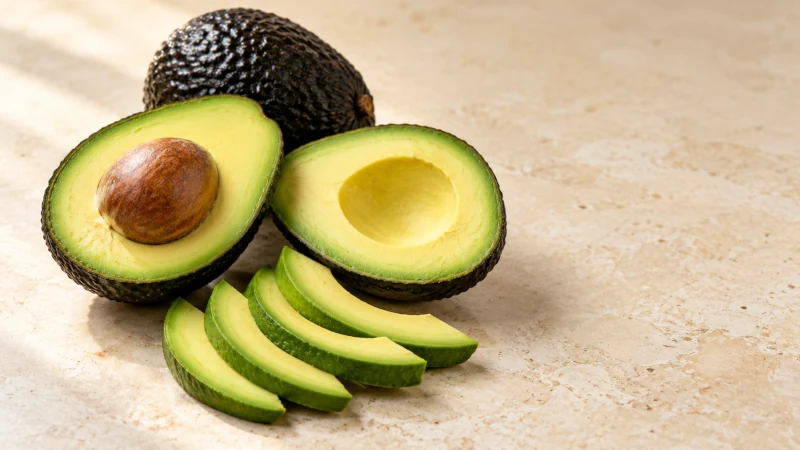
[Image block retained: avocado-nutrition-facts-halved-hass.webp] Alt text: Fresh Hass avocado cut in half with its seed, creamy green flesh, and sliced avocado on a neutral background.
Every number in this guide is for raw flesh only — no skin, no pit. Because avocados range from small Hass fruit to Florida avocados with more than half a pound of flesh, the figures below also show how serving size and variety change the totals.
Avocado Nutrition Facts at a Glance
| Nutrient | Half portion (75 g) | 1 cup cubed (150 g) |
| Calories | 120 | 240 |
| Total fat | 11 g | 22 g |
| Carbohydrate | 6.4 g | 12.8 g |
| Fiber | 5.0 g | 10.1 g |
| Net carbs | 1.4 g | 2.8 g |
| Sugars | 0.5 g | 1.0 g |
| Protein | 1.5 g | 3.0 g |
| Potassium | 364 mg | 728 mg |
| Sodium | 5 mg | 11 mg |
| Cholesterol | 0 mg | 0 mg |
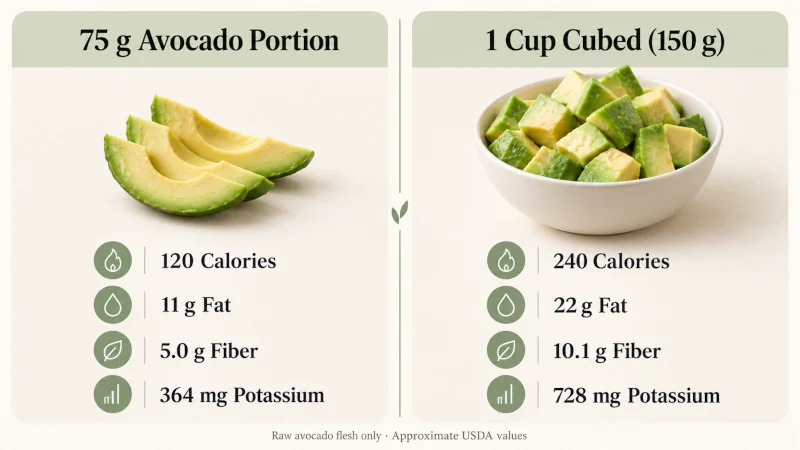
Source: USDA FoodData Central record 171705 (Avocados, raw, all commercial varieties), per-cup values via the University Hospitals nutrition database. Half column calculated by halving. Net carbs = carbohydrate minus fiber.
[Image block retained: avocado-nutrition-facts-half-vs-whole.webp] Alt text: Avocado nutrition comparison showing 120 calories, 11 grams of fat, 5 grams of fiber, and 364 milligrams of potassium in a 75-gram portion versus double those amounts in a 150-gram cup of cubed avocado. [Alt text updated; see Image Recommendations — the graphic’s own “whole avocado” label should be revised to “1 cup (150 g)”.]
Avocado Nutrition Table Per 100 Grams
USDA’s standard record for raw avocado blends 86% California and 14% Florida fruit [USDA FDC 171705]. The per-100 g column is calculated from USDA’s 150 g values, so it scales easily to whatever you weigh out.
| Nutrient | Per 100 g | Per 1 cup cubed (150 g) | % Daily Value per cup |
| Calories | 160 | 240 | — |
| Total fat | 14.7 g | 22.0 g | 28% |
| Saturated | 2.1 g | 3.2 g | 16% |
| Monounsaturated | 9.8 g | 14.7 g | — |
| Polyunsaturated | 1.8 g | 2.7 g | — |
| Cholesterol | 0 mg | 0 mg | 0% |
| Carbohydrate | 8.5 g | 12.8 g | 5% |
| Fiber | 6.7 g | 10.1 g | 36% |
| Sugars | 0.7 g | 1.0 g | — |
| Protein | 2.0 g | 3.0 g | 6% |
| Pantothenic acid (B5) | 1.4 mg | 2.1 mg | 42% |
| Folate | 81 mcg DFE | 122 mcg DFE | 30% |
| Vitamin K | 21 mcg | 32 mcg | 26% |
| Vitamin B6 | 0.26 mg | 0.39 mg | 23% |
| Vitamin E | 2.1 mg | 3.1 mg | 21% |
| Vitamin C | 10 mg | 15 mg | 17% |
| Niacin (B3) | 1.7 mg | 2.6 mg | 16% |
| Copper | 0.19 mg | 0.28 mg | 31% |
| Potassium | 485 mg | 728 mg | 15% |
| Magnesium | 29 mg | 44 mg | 10% |
| Manganese | 0.14 mg | 0.21 mg | 9% |
| Zinc | 0.64 mg | 0.96 mg | 9% |
| Phosphorus | 52 mg | 78 mg | 6% |
| Iron | 0.55 mg | 0.82 mg | 5% |
| Calcium | 12 mg | 18 mg | 1% |
| Sodium | 7 mg | 11 mg | <1% |
| Lutein + zeaxanthin | 271 mcg | 407 mcg | — |
Sources: USDA FDC 171705 via University Hospitals; % Daily Value uses FDA’s current Daily Values (for example, fiber 28 g, potassium 4,700 mg, folate 400 mcg DFE, vitamin K 120 mcg). A dash means FDA sets no Daily Value for that nutrient.
One cup reaches 20% of the Daily Value or more — the level FDA treats as high [FDA, 2024] — for fiber, pantothenic acid, copper, folate, vitamin K, vitamin B6 and vitamin E.
Calories in Half and Whole Avocados
Ask how many calories are in “an avocado” and the honest answer is: it depends which avocado. USDA’s own records put the flesh of a single fruit anywhere from 136 to 304 grams.
| Serving (flesh only) | Weight | Calories | Source |
| Label serving, 1/3 medium | 50 g | 80 | Industry label [Avocados From Mexico, 2016] |
| Half of a 1-cup portion | 75 g | 120 | USDA 171705, calculated |
| 1 cup cubed | 150 g | 240 | USDA 171705 |
| 1 California avocado (SR28 weight) | 136 g | 227 | USDA SR28 09038 |
| 1 California avocado (current portion) | ≈173 g* | 289 | USDA California record via UH |
| 1 avocado, variety not specified | 201 g | 322 | USDA 171705 via UH |
| 1 Florida avocado | 304 g | 365 | USDA SR28 09039 |
*Weight calculated from the record’s calories (289 ÷ 1.67 kcal/g); the source page lists no gram weight.
So a whole avocado can land anywhere from about 230 to 365 calories. If you track closely, weigh the flesh and multiply grams by 1.6 (all varieties) or 1.67 (California fruit). Packaged-avocado labels use a smaller serving still: one-third of a medium avocado, 50 g, at 80 calories, adopted with FDA’s 2016 label update according to an avocado industry brochure [Avocados From Mexico, 2016].
Either way, avocado is calorie-dense, so it does the most good when it replaces something on the plate — butter, mayonnaise, cheese — rather than piling on top.
Carbohydrates, Fiber, Sugar, and Net Carbs
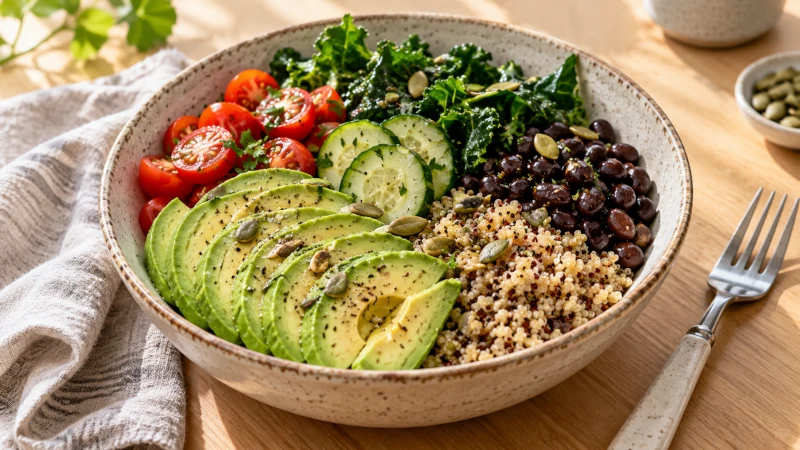
A cup of cubed avocado has 12.8 grams of carbohydrate, and 10.05 grams of that is fiber. Subtract the two and you get about 2.8 grams of net carbs per cup, or roughly 1.8 grams per 100 g [USDA FDC 171705]. “Net carbs” is dieting shorthand rather than a Nutrition Facts label term, but it explains why avocado fits so easily into low-carb eating plans. Sugar is close to negligible: about 1 gram per cup.
The fiber is mostly insoluble, the type that adds bulk to stool, with a smaller share of soluble fiber [Harvard T.H. Chan, 2022]. Ten grams is 36% of the Daily Value. Harvard also puts avocado’s glycemic index at about 40, well inside the low range. If you’re watching your numbers, our guide to normal blood sugar levels and what moves them explains the targets.
[Image block retained: avocado-fiber-gut-health-bowl.webp] Alt text: Bowl of sliced avocado, beans, quinoa, and leafy vegetables illustrating fiber-rich whole foods.
Avocado can help close a fiber gap, but if constipation is your main concern, prunes and kiwifruit have stronger trial evidence. Our list of foods that help with constipation, ranked by evidence covers the best-tested options.
Fat Content and Types of Fat
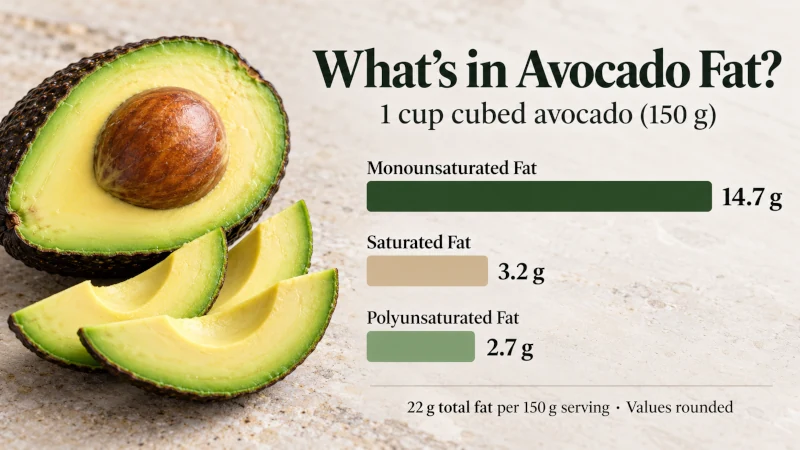
Avocado is one of the highest-fat plant foods you can eat [Harvard T.H. Chan, 2022]. A cup has 22 grams of fat, 28% of the Daily Value, split roughly like this:
- Monounsaturated: 14.7 g — about two-thirds of the total, mainly oleic acid, the same fatty acid that dominates olive oil [Harvard T.H. Chan, 2022].
- Saturated: 3.2 g — 16% of the Daily Value.
- Polyunsaturated: 2.7 g.
Avocados contain no cholesterol. They do contain plant sterols, compounds with a structure similar to cholesterol that are poorly absorbed and may interfere with cholesterol absorption in the gut [Harvard T.H. Chan, 2022].
[Image block retained: avocado-fat-breakdown-monounsaturated.webp] Alt text: Avocado fat composition showing approximately 14.7 grams of monounsaturated fat, 3.2 grams of saturated fat, and 2.7 grams of polyunsaturated fat in a 1-cup (150-gram) serving.
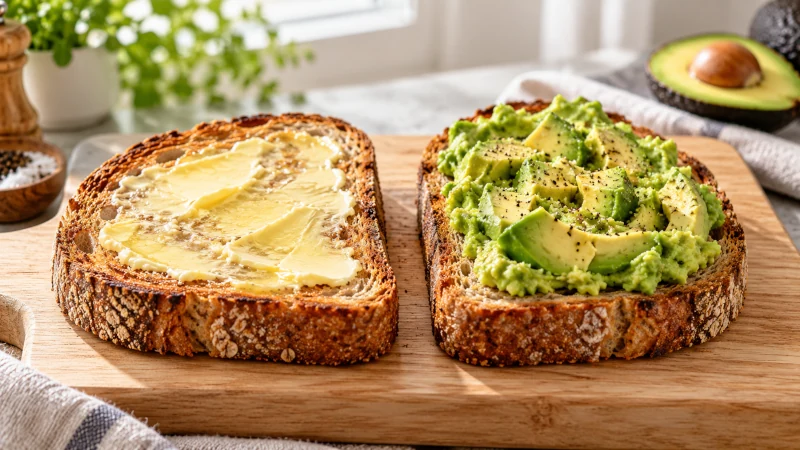
That fat profile is why avocado so often stands in for butter. Harvard notes that pureed avocado can replace butter or oil one-for-one in many baking recipes [Harvard T.H. Chan, 2022].
[Image block retained: avocado-heart-healthy-butter-swap.webp] Alt text: Side-by-side food comparison showing avocado spread on whole-grain toast as an alternative to butter.
Protein Content
Avocado is not a protein food. A cup of cubed flesh has about 3 grams of protein, 6% of the Daily Value, and 100 g has about 2 grams [USDA FDC 171705]. If you want a filling meal, pair it with eggs, beans, fish, tofu or Greek yogurt.
Vitamins in Avocados
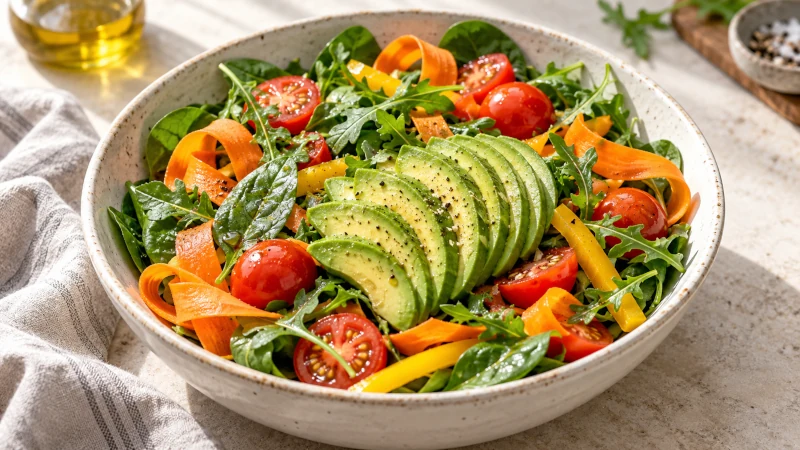
Avocado’s vitamins lean toward the B group and the fat-soluble vitamins K and E. The standout is pantothenic acid (B5): 2.1 mg per cup, 42% of the Daily Value. After that come folate (122 mcg DFE, 30%), vitamin K (32 mcg, 26%), vitamin B6 (0.39 mg, 23%), vitamin E (3.1 mg, 21%), vitamin C (15 mg, 17%) and niacin (2.6 mg, 16%) [USDA FDC 171705; FDA, 2024]. All of the folate is natural food folate; avocado contains no folic acid.
Avocado also supplies about 407 mcg of lutein plus zeaxanthin per cup — carotenoids rather than vitamins, but often grouped with them. And its fat helps you absorb carotenoids from other foods. In two small crossover studies of 11 healthy adults each, adding 150 g of avocado to salsa raised absorption of lycopene 4.4-fold and beta-carotene 2.6-fold compared with avocado-free salsa [Unlu, 2005]. The easy move: add a few slices to salads, tomato dishes and vegetable bowls.
[Image block retained: avocado-carotenoid-absorption-vegetable-salad-1024×576.webp] Alt text: Fresh avocado slices served with tomatoes, carrots, and leafy greens, foods containing fat-soluble carotenoids.
Minerals in Avocados
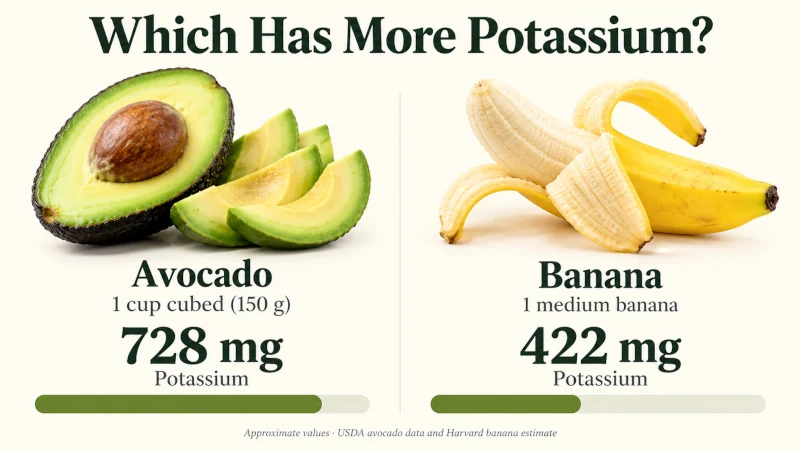
Potassium is the headline mineral. A cup of avocado has about 728 mg, 15% of the Daily Value [USDA FDC 171705]. Harvard lists a medium banana at 422 mg [Harvard T.H. Chan, 2022], so a cup of avocado carries considerably more. (Our article on the benefits of eating bananas covers that fruit in detail.)
[Image block retained: avocado-vs-banana-potassium-comparison.webp] Alt text: Potassium comparison chart showing approximately 728 milligrams in a 1-cup (150-gram) serving of avocado and 422 milligrams in a medium banana.
Copper is the quiet standout at 0.28 mg per cup, 31% of the Daily Value. Magnesium contributes 10%, and manganese and zinc 9% each. Sodium is almost nil at 11 mg, and iron and calcium are minor [USDA FDC 171705].
Most people in the U.S. get less potassium than recommended [NIH ODS, 2021], so that is useful — unless you need to limit potassium (see below).
How Avocado Nutrition Compares With Other Foods
Avocado sits somewhere between a fruit and a fat:
- Against other fruit: almost no sugar (about 1 g per cup) and far more fat. Harvard calls avocado one of the highest-fat plant foods [Harvard T.H. Chan, 2022].
- Against olive oil: the same dominant fatty acid, oleic acid [Harvard T.H. Chan, 2022], but avocado also brings 10 g of fiber per cup and a range of vitamins that oil does not.
Avocado earns a place on our evidence-graded list of heart-healthy foods, where it is rated moderate — useful within an overall eating pattern rather than as a stand-alone fix.
Does Avocado Size Affect Nutrition?
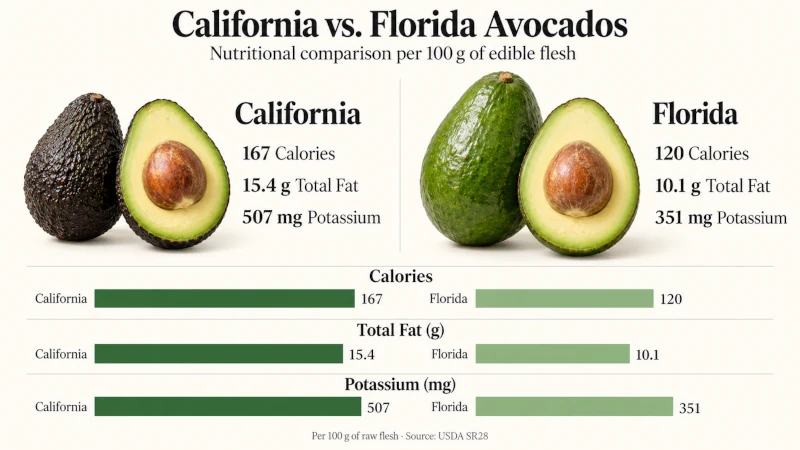
Size changes the totals, not the concentration: a big avocado simply has more of everything. Variety is what changes the concentration. Florida avocados, which come largely from West Indian types and their hybrids, are lower in oil than California fruit, as our guide to the avocado tree and its three varieties explains. California’s crop is dominated by Hass. USDA data show how wide the gap is:
| Per 100 g of flesh | California | Florida | All varieties |
| Calories | 167 | 120 | 160 |
| Total fat | 15.4 g | 10.1 g | 14.7 g |
| Carbohydrate | 8.6 g | 7.8 g | 8.5 g |
| Fiber | 6.8 g | 5.6 g | 6.7 g |
| Sugars | 0.3 g | 2.4 g | 0.7 g |
| Potassium | 507 mg | 351 mg | 485 mg |
| Vitamin C | 8.8 mg | 17.4 mg | 10 mg |
| Folate | 89 mcg DFE | 35 mcg DFE | 81 mcg DFE |
| Flesh per fruit | 136 g | 304 g | 201 g |
Sources: USDA SR28 report 09038 (California); USDA SR28 report 09039 (Florida); USDA FDC 171705 and its single-fruit portion.
Gram for gram, a Florida avocado has about 30% fewer calories and about a third less fat, plus more vitamin C and sugar. But a typical Florida fruit holds more than twice the flesh of a California one, so a whole Florida avocado still comes out higher in calories — 365 versus 227 in USDA’s figures.
What This Nutrient Profile Means for Health
Several of the nutrients avocado is rich in — monounsaturated fat, fiber, potassium and carotenoids — have been associated with lower chronic disease risk as part of an overall balanced diet, and avocado fits well into Mediterranean and DASH-style eating patterns [Harvard T.H. Chan, 2022]. Some studies show LDL cholesterol falls when avocado replaces other fats, and diets rich in lutein and zeaxanthin are associated with lower rates of macular degeneration — associations, not proof that avocado itself prevents disease. Harvard also notes that much of the published avocado research is funded by industry groups [Harvard T.H. Chan, 2022].
For the trials on cholesterol, heart disease, blood sugar, gut bacteria and weight, and how strong each finding is, see our guide to the health benefits of avocado.
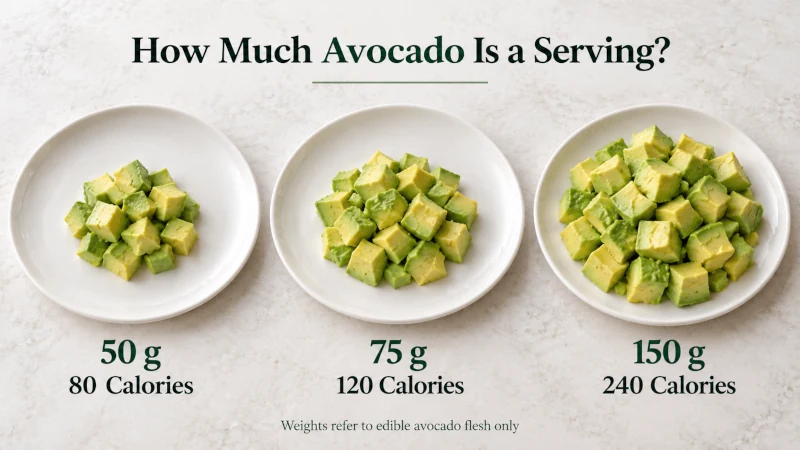
Practical Serving Sizes
No U.S. agency sets an avocado limit for healthy adults; the real questions are calories and what the avocado replaces. These benchmarks help:
- 1/3 medium (50 g): the label serving — about 80 calories and 3 g of fiber [Avocados From Mexico, 2016].
- Half portion (75 g): about 120 calories, 11 g of fat and 5 g of fiber.
- 1 cup cubed (150 g): about 240 calories, 22 g of fat and 10 g of fiber — a generous salad or bowl topping.
A few kitchen tips from Harvard’s Nutrition Source [Harvard T.H. Chan, 2022]: hard, unripe avocados ripen in two to three days at room temperature, faster in a paper bag with a banana. Browned flesh is safe to eat; lemon or lime juice and an airtight container slow it down. Skip stabbing the pit with a knife — press it out with your thumb from the skin side instead.
Who Should Watch Their Avocado Portions
For most people, avocado is simply a nutritious food. These are the exceptions, and each follows directly from the numbers above.
Kidney disease and potassium-raising medicines
This is the most important caution. If you have chronic kidney disease, or take an ACE inhibitor (such as benazepril), an angiotensin receptor blocker (such as losartan) or a potassium-sparing diuretic (such as spironolactone), your blood potassium can climb too high — even from typical amounts of food [NIH ODS, 2021]. At about 728 mg per cup, avocado is a high-potassium food. Ask your doctor or a renal dietitian how much fits your plan, see our list of lower-potassium, kidney-friendly foods, and avoid potassium-based salt substitutes unless your clinician approves them.
Warfarin (Coumadin)
A cup of avocado has about 32 mcg of vitamin K. If you take warfarin, the goal isn’t to avoid vitamin K but to keep your intake about the same from day to day, because sudden changes can raise the risk of bleeding or clots [NIH ODS, 2021]. Eat avocado consistently rather than in bursts, and tell your anticoagulation clinic if your habits change.
Latex allergy and latex-fruit syndrome
Some people allergic to natural rubber latex also react to certain foods because the proteins are similar. A 2024 review of 14 studies found banana, avocado, kiwifruit and papaya were the fruits most often involved [Gromek, 2024]. If latex gloves or balloons give you hives or swelling, ask an allergist before eating avocado regularly.
IBS and FODMAPs
Avocado contains sorbitol, a sugar alcohol that can trigger bloating and pain in people with irritable bowel syndrome. In Monash University’s FODMAP app, as described in a 2018 explainer, avocado rated high at 80 g (about half a fruit), moderate at 45 g and low at 30 g [Monash University, 2018]. Those figures date from 2018, so check the app for current thresholds and start with a few slices.
Pregnancy and breastfeeding
Avocado is an ordinary food and fine in pregnancy and while breastfeeding unless you’re allergic, and it is a good folate source. Food folate doesn’t replace a supplement, though: the NIH advises that anyone who could become pregnant get 400 mcg of folic acid daily from supplements, fortified foods or both, on top of the folate in a healthy diet [NIH ODS, 2022].
When to get medical help
- Call 911 or go to the emergency room if you develop swelling of the lips, tongue or throat, trouble breathing, or widespread hives after eating avocado.
- Contact your care team promptly if you have kidney disease and notice new muscle weakness or an unusual heartbeat, which can signal a potassium problem.
- Call your anticoagulation clinic if you take warfarin and your INR changes after a shift in how much avocado or other vitamin K foods you eat.
- See a clinician if bloating or bowel changes persist despite smaller portions.
HEALTH DISCLAIMER: This article is for general education and is not medical advice, diagnosis or treatment. Avocados are a food, not a medicine, and they don’t cure or prevent any disease. Talk with your doctor, pharmacist or a registered dietitian before making major diet changes if you have kidney disease, take warfarin or medicines that affect potassium (such as ACE inhibitors, ARBs or potassium-sparing diuretics), have a latex or food allergy, or are pregnant or breastfeeding. Seek emergency care right away for signs of a severe allergic reaction.
Frequently Asked Questions
How many calories are in an avocado?
A cup of cubed avocado (150 g of flesh) has about 240 calories, and a 75 g half-portion about 120 [USDA FDC 171705]. A single whole fruit ranges from about 227 calories for a 136 g California avocado to 365 for a 304 g Florida avocado [USDA SR28]. Weigh the flesh if you track closely.
How many carbs and net carbs are in an avocado?
A cup of cubed avocado has 12.8 g of carbohydrate and 10.05 g of fiber, which leaves about 2.8 g of net carbs. Per 100 g, it is about 8.5 g of carbohydrate and 1.8 g net [USDA FDC 171705].
What is avocado nutrition per 100g?
Per 100 g of raw flesh: about 160 calories, 14.7 g fat, 8.5 g carbohydrate, 6.7 g fiber, 0.7 g sugar, 2 g protein and 485 mg potassium, based on USDA’s all-varieties record [USDA FDC 171705]. California fruit runs slightly higher in fat; Florida fruit noticeably lower.
Do avocados have more potassium than bananas?
Yes. A cup of cubed avocado has about 728 mg, versus roughly 422 mg in a medium banana [Harvard T.H. Chan, 2022].
Is avocado a good source of protein?
Not really. A cup of cubed avocado has only about 3 g of protein. Pair it with eggs, beans, fish or yogurt for a protein-rich meal.
Is it OK to eat an avocado every day?
For most healthy adults, yes, as long as the calories fit your day — ideally in place of butter, mayonnaise or cheese. People who need to limit potassium should ask their care team first, and people on warfarin should keep their intake consistent [NIH ODS, 2021].
References
- U.S. Department of Agriculture, FoodData Central. Avocados, raw, all commercial varieties View source
- U.S. Department of Agriculture, FoodData Central. View source
- U.S. Department of Agriculture. Avocados, raw, California, 1 fruit without skin and seeds — via University Hospitals. View source
- USDA National Nutrient Database for Standard Reference, View source
- USDA National Nutrient Database for Standard Reference, View source
- U.S. Food and Drug Administration. Daily Value on the Nutrition and Supplement Facts Labels. View source
- Harvard T.H. Chan School of Public Health, The Nutrition Source. Avocados. View source
- National Institutes of Health, Office of Dietary Supplements. Potassium: Fact Sheet for Consumers. View source
- National Institutes of Health, Office of Dietary Supplements. Vitamin K: Fact Sheet for Consumers. View source
- National Institutes of Health, Office of Dietary Supplements. Folate: Fact Sheet for Consumers. View source
- Unlu NZ, Bohn T, Clinton SK, Schwartz SJ. Carotenoid absorption from salad and salsa by humans is enhanced by the addition of avocado or avocado oil. View source
- Gromek W, Kołdej N, Świtała S, Majsiak E, Kurowski M. Revisiting latex-fruit syndrome after 30 years of research: View source
- Collins L. Understanding the traffic lights in the Monash FODMAP Diet App. Monash University FODMAP blog. View source
- Avocados From Mexico. Get the Nutrition Facts: View source


