
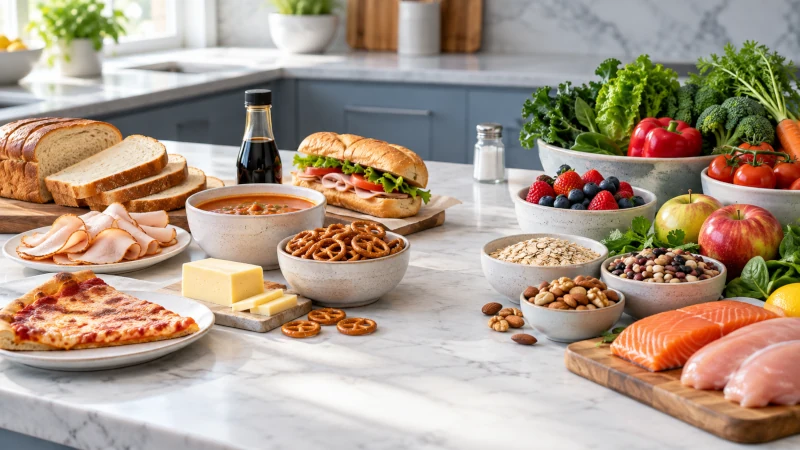
If you’re hunting for the main food sources of sodium, here’s the short version first: most of it isn’t in your salt shaker. More than 70% of the sodium the average American eats is already built into packaged, prepared, and restaurant foods before it ever reaches the table [FDA, 2024]. Some of it tastes salty. A lot of it doesn’t. This guide maps the food sources of sodium from highest to lowest, puts real numbers on the worst offenders, and shows you the everyday foods that are naturally low — so you can steer by pattern instead of chasing the salt shaker.
Sodium and salt aren’t the same thing
People use the words interchangeably, but they’re not identical, and the difference matters when you read a label. Table salt is sodium chloride — about 40% sodium and 60% chloride by weight [AHA, 2025]. Nutrition Facts labels list sodium, not salt, which is why the numbers can look confusing. A rough conversion helps:
- 1/4 teaspoon salt ≈ 600 mg sodium
- 1/2 teaspoon salt ≈ 1,200 mg sodium
- 1 teaspoon salt ≈ 2,400 mg sodium [AHA, 2025]
So a single teaspoon of salt is already more sodium than a full day’s recommended maximum. Keep that in mind as the food numbers below add up.
How much sodium do you actually need — and how much is too much?
Your body needs only a small amount of sodium — less than 500 mg a day — to balance fluids and keep your nerves and muscles working [AHA, 2025]. That’s less than a quarter teaspoon of salt. Almost nobody is at risk of getting too little. The problem is the ceiling, not the floor:
| Source | Recommended daily limit for adults |
| FDA Daily Value (the label reference) | Less than 2,300 mg [FDA, 2024] |
| American Heart Association | No more than 2,300 mg; ideal is no more than 1,500 mg for most adults [AHA, 2025] |
| World Health Organization | Less than 2,000 mg [WHO, 2025] |
The average American actually eats about 3,400 mg a day — well over every one of those limits [FDA, 2024]. Roughly 9 in 10 adults take in more sodium than recommended [CDC, Vital Signs]. You don’t have to be reaching for the shaker to be over the line — the sodium finds you.
Where your sodium really comes from
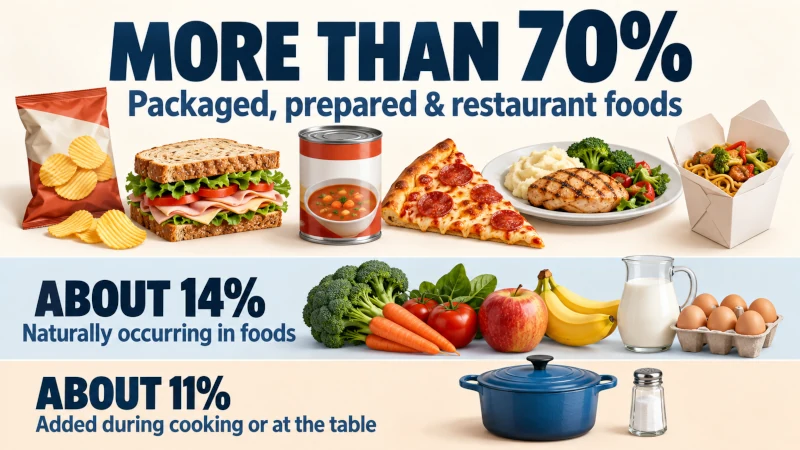
Here’s the breakdown that surprises most people. Of all the sodium in the U.S. diet, only about 14% occurs naturally in foods, and only about 11% comes from salt added while cooking or at the table. The remaining majority — more than 70% — is added during commercial processing and restaurant prep [AHA, 2025].
Broken down by where you buy it, roughly 65% of dietary sodium comes from retail-store foods and about 25% from restaurants [CDC, Vital Signs]. The practical takeaway: you cut sodium mostly by choosing and comparing packaged foods and by cooking at home — not by being stingy with the shaker.
The highest food sources of sodium
The CDC found that more than 40% of Americans’ sodium comes from just a handful of everyday food types — including sandwiches, pizza, tacos and burritos, soups, savory snacks, poultry, pasta dishes, burgers, and egg dishes [FDA, 2024]. Notice how few of those are “obviously salty.”
One caveat before the numbers: sodium varies enormously between brands and recipes of the same food. The CDC found chicken noodle soup can differ by as much as 840 mg of sodium per serving depending on the brand [CDC, Vital Signs]. Treat the figures below as representative — the label on the actual package is always the real answer.
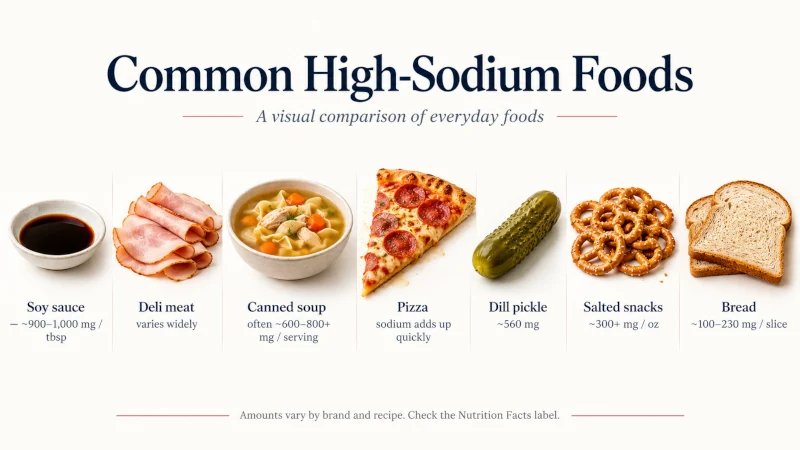
| High-sodium food | Roughly how much (per typical serving) |
| Soy sauce | ~900–1,000 mg per tablespoon [Healthline] |
| Cured/deli meats (ham, salami, turkey, bologna) | A few slices can add several hundred mg to a sandwich [FDA, 2024] |
| Canned soup | Often ~600–800+ mg per serving; brands vary by up to 840 mg [CDC] |
| Pizza, burgers, tacos/burritos | Multi-ingredient dishes that stack sodium fast — one restaurant serving can approach a day’s limit [FDA, 2024] |
| Dill pickle (medium) | ~560 mg [Healthline] |
| Pretzels, chips, salted snacks | ~300+ mg per ounce [Healthline] |
| Bread and rolls | ~100–230 mg per slice — modest alone, but eaten all day [MSU Extension] |
Foods that taste as salty as they are
Soy sauce, pickles, olives, salted chips, and cured meats announce themselves. If you’re watching sodium, these are the easy targets — reduced-sodium soy sauce, rinsing before eating, and smaller portions all help.
The sneaky ones that don’t taste salty
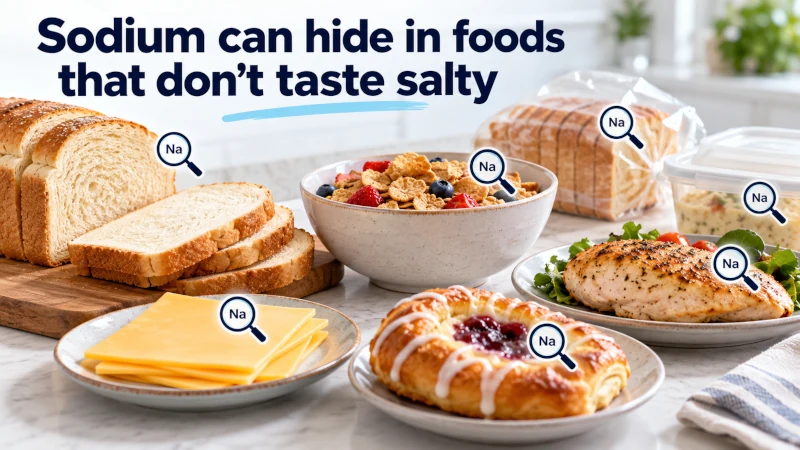
This is where most people get caught. Bread is the single biggest sodium contributor in the average American diet — not because any one slice is high, but because it’s eaten several times a day [CDC, Vital Signs]. Breakfast cereals, pastries, and cheese carry sodium your tongue never flags [FDA, 2024]. And fresh chicken or turkey can be quietly high if it’s been injected with a salt-water solution — look for “enhanced,” “self-basting,” or “contains up to X% solution” on the label [FDA, 2024]. Taste alone won’t warn you, which is why cooking at home and reading labels pay off. Many of these are ultra-processed items worth minimizing anyway.
“Sodium” by other names on the label
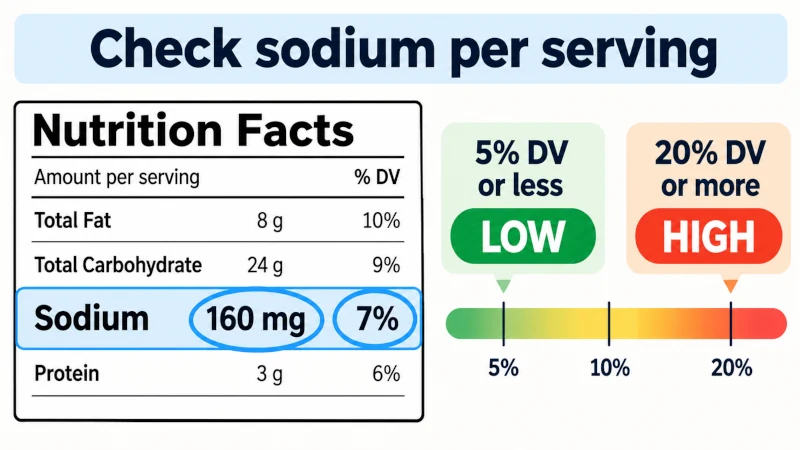
Salt isn’t the only source on an ingredient list. Any of these adds sodium: monosodium glutamate (MSG), sodium bicarbonate (baking soda), sodium nitrate and sodium nitrite, sodium benzoate, sodium citrate, disodium guanylate, and disodium inosinate, among others [AHA, 2025]. The total on the Nutrition Facts label already bundles them all together — a quick way to judge is the % Daily Value: 5% or less per serving is low, and 20% or more is high [FDA, 2024].
The lowest food sources of sodium
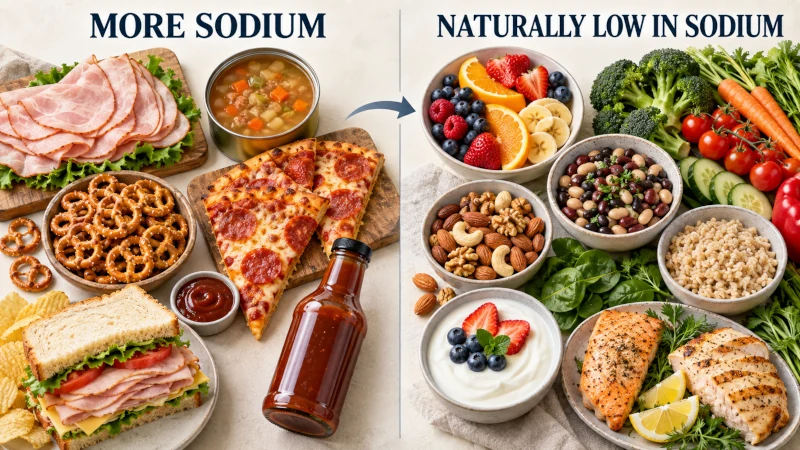
The good news is that whole, minimally processed foods are naturally low in sodium. Build meals around these and the math takes care of itself:
- Fresh and frozen vegetables (without added sauces or seasoning)
- Fresh fruit — one of the lowest-sodium food groups there is
- Dried beans, peas, and lentils (dried, or canned “no salt added” — and rinse canned ones)
- Unsalted nuts and seeds
- Plain yogurt and fresh, unprocessed meat, poultry, and fish
- Grains cooked without salt (rice, oats, plain pasta)
A few whole foods carry more naturally occurring sodium than others — celery, beets, and some leafy greens among vegetables, and animal foods like milk and eggs. Even so, the amounts are small: milk and cream contain roughly 50 mg of sodium per 100 g and eggs about 80 mg per 100 g [WHO, 2013] — a fraction of what a few slices of deli meat deliver. When shopping, “low sodium” means 140 mg or less per serving, “very low sodium” means 35 mg or less, and “sodium-free” means under 5 mg [FDA, 2024].
You still need some: sodium’s job in the body
Sodium isn’t a villain — it’s an essential nutrient. It helps regulate the fluid balance in and around your cells and keeps your nerves firing and muscles contracting [FDA, 2024]. You lose some in sweat, which is why the usual “aim lower” advice comes with an exception: people who sweat heavily for long stretches — endurance athletes, and workers exposed to serious heat like firefighters and foundry workers — may not fit the standard 1,500 mg target and should follow guidance tailored to them [AHA, 2025]. For nearly everyone else, getting enough sodium is not the problem.
Why too much sodium matters
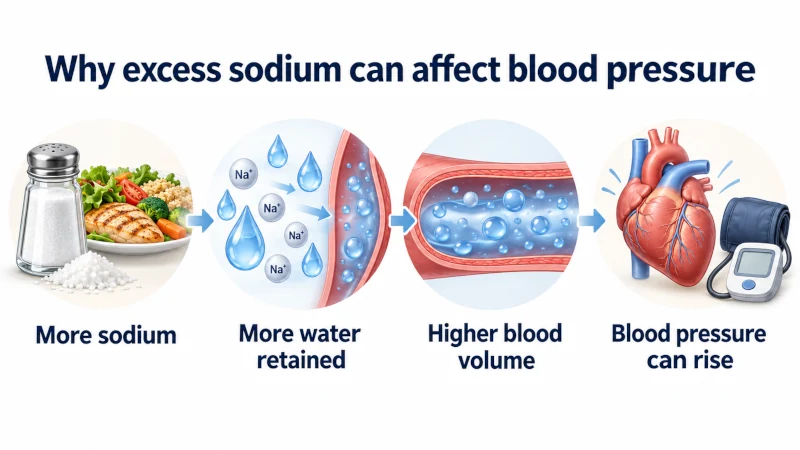
Sodium attracts water. A high-sodium diet pulls more water into your bloodstream, raising blood volume and, in turn, blood pressure [FDA, 2024]. Over time, high blood pressure makes the heart work harder and damages arteries and organs, raising the risk of heart attack, stroke, heart failure, and kidney disease [FDA, 2024].
How strong is that link? Strong enough that every major authority treats sodium reduction as a priority. The WHO associates excess sodium with about 1.7 million deaths a year, mainly through raised blood pressure [WHO, 2025]. And the fix is meaningful but not dramatic per person: for many people, cutting about 1,000 mg of sodium a day is enough to improve blood pressure [AHA, 2025].
One honest nuance: not everyone’s blood pressure responds to sodium the same way, and sodium works against potassium, which pulls blood pressure in the opposite direction — so the balance between the two matters, not sodium alone. For the full picture, see our guide to electrolytes for blood pressure. For a broader, evidence-graded look at lowering your numbers, our overview of natural home remedies for high blood pressure puts approximate mmHg figures on each change.
Can you have too little sodium?
On a typical Western diet, going dangerously low from food alone is uncommon [AHA, 2025]. But low blood sodium — hyponatremia — is real, and usually not about how much salt you ate. It most often results from too much water diluting the blood rather than too little dietary sodium [Cleveland Clinic]. Common triggers include heart, liver, and kidney disease; certain medications, especially diuretics; severe vomiting or diarrhea; and overhydration during endurance events without replacing electrolytes [Merck Manual]. Symptoms range from sluggishness, nausea, headache, and confusion to — when it drops fast or far — muscle twitching, seizures, and, in severe cases, unconsciousness, which is a medical emergency [Merck Manual]. For most healthy people, aiming lower on sodium is safe.
How to bring your sodium down (the short version)
You don’t need a spreadsheet. The highest-yield moves target the foods that contribute most, not the ones that taste saltiest:
- Cook at home more often, where you control what goes in.
- Compare Nutrition Facts labels and pick the lower-sodium version — near-identical products can differ several-fold.
- Buy “no salt added” canned beans and vegetables, or drain and rinse regular ones.
- Choose plain fresh meat and poultry over “enhanced” or brined versions.
- Flavor with citrus, vinegar, garlic, and herbs instead of reaching for the shaker [FDA, 2024].
Your palate adjusts, too — after a few weeks of eating less sodium, many people find their old favorites too salty [FDA, 2024]. For a full walkthrough with specific swaps, see our guide to lowering salt (and sugar) without making your food bland.
Who should be extra careful — and when to see a professional
Some people benefit from a stricter target — often 1,500 mg a day or lower. That includes people with high blood pressure, heart failure, chronic kidney disease, or diabetes, plus older adults, who tend to be more salt-sensitive [CDC, Vital Signs]. If you’re in one of those groups, your clinician can give you a specific number.
A note on potassium-based salt substitutes: they can cut sodium effectively, but they are not safe for everyone — people with kidney disease and those on certain blood-pressure medications (ACE inhibitors, ARBs, or potassium-sparing diuretics) can develop dangerously high potassium. Check with a clinician first.
Talk to a healthcare professional if you have high blood pressure or heart, kidney, or liver disease and aren’t sure of your target; if you’re pregnant or breastfeeding and considering major dietary changes; or if you take diuretics or other medications that affect fluid and electrolyte balance.
Seek urgent care for signs of a possible hypertensive or stroke emergency — a severe headache with vision changes, chest pain, sudden weakness or trouble speaking, or severe shortness of breath — or for signs of severe low sodium such as marked confusion, seizures, or loss of consciousness. Self-care is not enough on its own once blood pressure is high or a chronic condition is involved.
| Health Disclaimer: This article is for general educational purposes and is not medical advice, diagnosis, or treatment. Sodium needs depend on your health, your medications, and your kidney and heart function. If you have high blood pressure, heart failure, kidney or liver disease, diabetes, are pregnant or breastfeeding, or take prescription medication (especially diuretics), talk with a qualified clinician — or a registered dietitian — before making large changes to your sodium intake or using a salt substitute. Do not stop or change a prescribed medication on your own. If you think you are having a medical emergency, call 911. |
Frequently Asked Questions
Which foods have the most sodium?
By category, the biggest contributors are sandwiches, pizza, tacos and burritos, soups, savory snacks, poultry, pasta dishes, burgers, and egg dishes — together more than 40% of total intake [FDA, 2024]. By concentration, soy sauce, cured and deli meats, canned soups, and salty snacks top most lists. The exact amount varies a lot by brand, so the label is the final word.
Is sea salt or Himalayan salt lower in sodium than table salt?
Not meaningfully. Table salt, kosher salt, and most sea salts are all roughly 40% sodium; specialty salts may have trace minerals but similar sodium content [AHA, 2025]. For your heart, it’s total sodium that counts, not the type of salt.
Do foods have to taste salty to be high in sodium?
No — that’s the trap. Bread, cheese, breakfast cereals, and pastries can carry significant sodium without tasting salty, which is why taste is unreliable and the Nutrition Facts label is essential [FDA, 2024].
What are the best low-sodium foods?
Fresh fruit, fresh or plain frozen vegetables, dried or “no salt added” beans, unsalted nuts and seeds, plain yogurt, and fresh unprocessed meat, poultry, and fish. On labels, “low sodium” means 140 mg or less per serving [FDA, 2024].
How much sodium do I need each day?
Very little — your body needs less than 500 mg a day to function [AHA, 2025]. The practical concern is the ceiling: under 2,300 mg for most adults, with an ideal of 1,500 mg per the American Heart Association [AHA, 2025].
Can eating too little salt be dangerous?
It’s uncommon from diet alone in most people. Low blood sodium (hyponatremia) is usually caused by excess fluid, illness, or medications like diuretics rather than by using less salt [Cleveland Clinic]. Endurance athletes and people on certain medications are exceptions worth discussing with a clinician.
References
- U.S. Food and Drug Administration. Sodium in Your Diet. Current as of March 5, 2024. → View source
- American Heart Association. How Much Sodium Should I Eat Per Day? → View source
- American Heart Association. Sodium Sources: Where Does All That Sodium Come From? → View source
- World Health Organization. Sodium reduction (fact sheet). → View source
- World Health Organization. WHO issues new guidance on dietary salt and potassium. Jan 31, 2013. → View source
- Centers for Disease Control and Prevention. Vital Signs: Where’s the Sodium? → View source
- Michigan State University Extension. Sodium in bread products. → View source
- Healthline. 30 Foods High in Sodium and What to Eat Instead. → View source
- Cleveland Clinic. Hyponatremia. → View source
- Merck Manual, Consumer Version. Hyponatremia (Low Level of Sodium in the Blood). → View source


