
The ipecac plant (Carapichea ipecacuanha) was once the source of a syrup that millions of parents kept on a high shelf in case a child swallowed something dangerous. That advice has changed. Major poison-control authorities now tell people not to use ipecac at all, and the syrup is no longer sold in U.S. drugstores [Poison Control, 2024]. This page covers what the plant is, what its root was actually used for, why the medical consensus turned against it, and what to do today if you think someone has been poisoned.
What the ipecac plant is
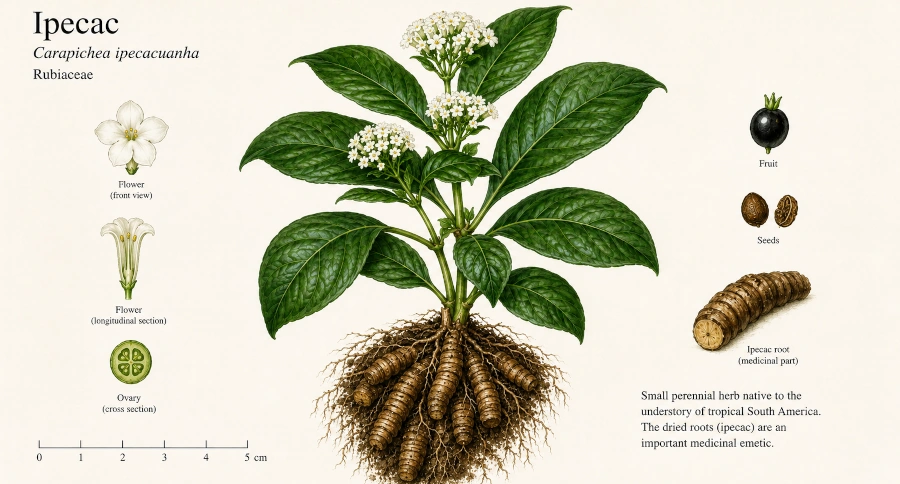
Ipecac comes from the dried root of a low, shade-loving shrub in the coffee family (Rubiaceae). It grows wild in the rainforests of Brazil, Central America, and parts of northern South America, reaching only about 30 to 50 cm tall, with small white flowers and a knotted, ringed root. The root is the part that was harvested and ground into powder [USDA, Dr. Duke’s].
Two alkaloids in the root do most of the work: emetine and cephaeline. Both irritate the stomach lining and trigger the brain’s vomiting reflex, usually within 20 to 30 minutes [USDA, Dr. Duke’s]. Cephaeline is the stronger emetic of the pair. Emetine is the one tied to the most serious toxic effects — a detail that matters later in this article.
You may see the plant written as Cephaelis ipecacuanha or Psychotria ipecacuanha in older books. Those are former names; Carapichea ipecacuanha is the one accepted today.
A short, slightly strange history
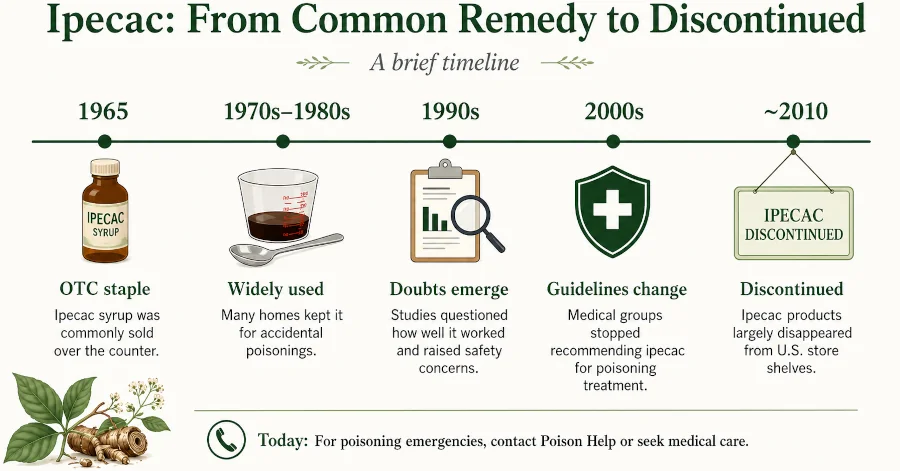
Ipecac reached European medicine in the 1600s. A Dutch physician, Jan Adrian Helvetius, used a secret root-based remedy to treat dysentery at the court of Louis XIV; the formula was later bought and made public. By the early 1900s chemists had isolated emetine and cephaeline, and the root made its way into cough syrups and dysentery treatments. In the mid-1960s U.S. regulators cleared small bottles of ipecac syrup for sale without a prescription, and for the next forty years it was treated as the standard home response to accidental poisoning [Poison Control, 2024].
What ipecac was used for — and where each use stands now
The root had three traditional jobs. Modern medicine views all three differently than it did fifty years ago.
Inducing vomiting after poisoning
This was ipecac’s main role: make a poisoned person vomit to bring the toxin back up. The American Academy of Pediatrics reversed its long-standing advice in 2003, telling families to stop keeping ipecac at home and to safely discard any bottles they still had [AAP, 2003]. Poison-control centers did the same, and they now state plainly that ipecac should not be used [Poison Control, 2024]. The reasons are in the next section. If you want background on other plants traditionally used for stomach and digestive complaints, that is a separate topic from emergency poisoning care.
As an expectorant in cough syrup
In tiny doses — far below the amount that causes vomiting — ipecac was once a common ingredient in expectorant cough syrups, on the idea that mild stomach irritation helps loosen chest mucus. That use has faded as safer cough products replaced it, and pharmacy guidance no longer recommends ipecac for routine use [Aronson, Meyler’s].
Against amebic infections
Emetine kills Entamoeba histolytica, the parasite behind amebic dysentery and amebic liver abscess, and for much of the 20th century injectable emetine was a genuine treatment. It has been largely replaced by metronidazole and related drugs, which are safer and at least as effective [Aronson, Meyler’s]. If you are reading about the liver because of an infection, the treatments that matter come from a doctor, not from this plant — though a generally supportive diet, including foods that support liver health, is reasonable alongside proper care.
Why doctors turned against ipecac
Two findings drove the change. First, when researchers measured how much poison ipecac actually removed, the amount was small and dropped quickly as time passed — and across studies, giving ipecac did not lead to better outcomes for poisoned patients [AACT/EAPCCT, 1997]. Second, the vomiting it caused could get in the way of treatments that do work. A child who keeps vomiting may not be able to keep down activated charcoal or an oral antidote, and the drowsiness ipecac sometimes causes can mask the early signs of a dangerous ingestion [AAP, 2003].
Put simply: it didn’t help much, and it could make real treatment harder to give. The last U.S. manufacturers stopped producing the syrup around 2010, and it has effectively disappeared from store shelves since [Poison Control, 2024].
Side effects and the real danger of repeated use
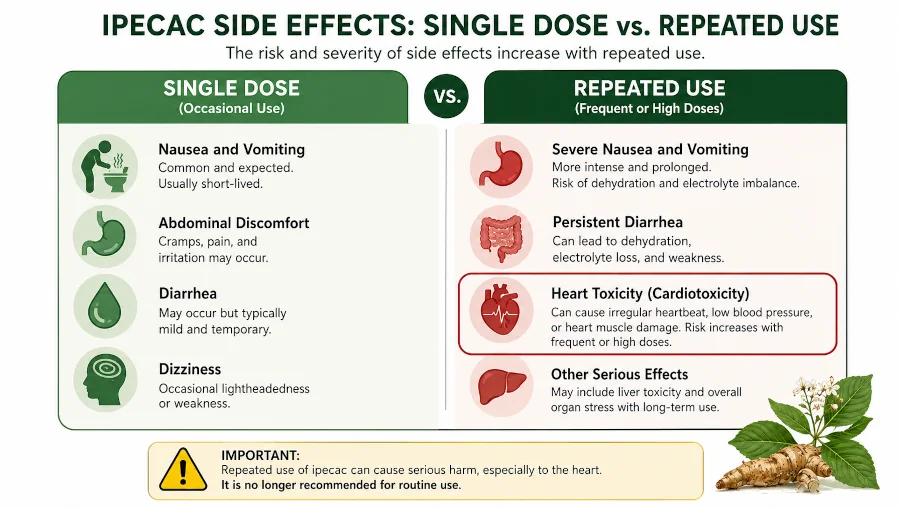
Even a single intended dose is unpleasant. Prolonged vomiting, stomach cramps, diarrhea, and lethargy are common [Drugs.com, 2025]. The serious problem appears with repeated use. Emetine builds up in the body and is toxic to muscle — including heart muscle. Chronic use has caused muscle weakness (myopathy), heart-rhythm changes, weakened heart pumping (cardiomyopathy), and, in some cases, death [Drugs.com, 2025].
This is not theoretical. The clearest pattern in the medical literature comes from people with eating disorders who used ipecac repeatedly to make themselves vomit. Clinicians documented muscle and heart damage that often improved after the person stopped — but not always [Palmer & Guay, 1985]. The toxicity is the reason ipecac is treated as a drug to keep away from, not a casual home remedy.
| Pattern of use | What can happen |
| A single dose | Repeated vomiting, stomach cramps, diarrhea, drowsiness |
| Repeated or chronic use | Muscle weakness, abnormal heart rhythm, cardiomyopathy, electrolyte disturbance, rarely death |
| Handling the raw powder | Skin, eye, and airway irritation on contact |
The powdered root is irritating on contact, so people who handle it can develop skin or eye irritation; for context on plants and skin, see our related guide.
Who should avoid ipecac
Ipecac is no longer recommended for anyone as a home remedy. A few situations are especially dangerous and worth naming:
- Anyone who has swallowed a corrosive (drain cleaner, strong acid or alkali) or a petroleum product — vomiting can cause far worse injury on the way back up.
- Anyone who is drowsy, unconscious, seizing, or has a weak gag reflex — vomit can enter the lungs.
- Infants and very young children.
- People with heart disease, who are most vulnerable to emetine’s effect on the heart.
- Anyone considering it for weight control. This is dangerous, can damage the heart, and has been fatal.
What to do instead if you suspect poisoning
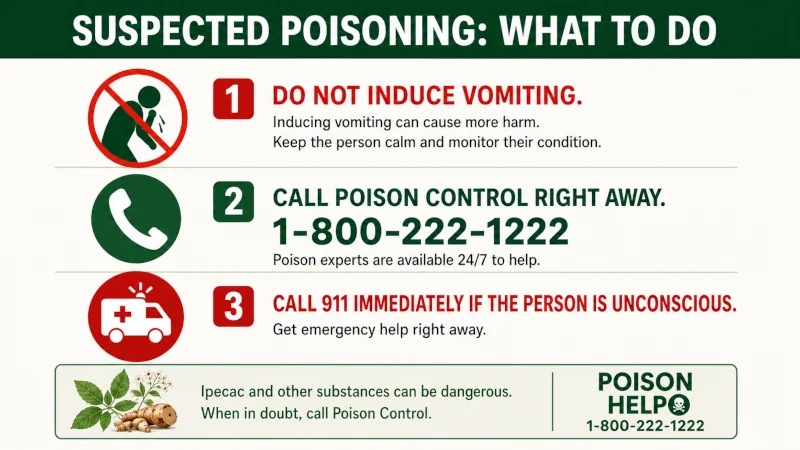
If you think someone has swallowed something harmful, do not try to make them vomit. In the United States, call Poison Control at 1-800-222-1222 — it is free, confidential, and staffed 24 hours a day — or use the online tool. Call 911 if the person is unconscious, struggling to breathe, having a seizure, or collapsing [Poison Control, 2024]. Keep the container nearby if you can. Poison-control staff will tell you whether to watch at home or go to an emergency department.
The bottom line
The ipecac plant has real pharmacology and a long medical history, and emetine is still studied in the lab for other purposes. As a home remedy, though, it has been retired for good reasons. It is not a liver cleanse, not a detox, and not a safe way to empty the stomach. If you have an old bottle of ipecac syrup at home, the current advice is simple: dispose of it safely and rely on Poison Control if an emergency comes up [AAP, 2003].o the real publication or review date. Recommended review cycle: every 12–18 months or when major guidance changes.
| Health Disclaimer This article is for general education only and is not medical advice, diagnosis, or treatment. It does not describe how to use ipecac, and it does not recommend its use. Do not try to induce vomiting in a poisoning emergency. Always talk to a qualified healthcare professional before using any herb or supplement, and tell them about your medications and any pregnancy or breastfeeding. Poisoning emergency (U.S.): call Poison Control at 1-800-222-1222, or 911 if the person is unconscious or struggling to breathe. Eating-disorder support: the topic of self-induced vomiting is sensitive; if it affects you or someone you know, the National Alliance for Eating Disorders helpline (1-866-662-1235) offers free, confidential help. |
Frequently asked questions
Can you still buy ipecac syrup?
Not in ordinary U.S. drugstores. Manufacturers stopped producing it around 2010, and poison-control authorities advise against keeping it at home [Poison Control, 2024].
Is it safe to use ipecac at home for poisoning?
No. Major medical groups recommend against it because it does not reliably remove poison and can interfere with effective treatment. Call Poison Control instead [AAP, 2003].
Why is repeated use so risky?
The alkaloid emetine accumulates in the body and is toxic to muscle, including the heart, which can lead to muscle weakness and cardiomyopathy [Drugs.com, 2025].
Is the plant the same as homeopathic “Ipecac 30C”?
They share a name but are different products. Homeopathic ipecac is extremely diluted; this article is about the herbal root preparation. Evidence does not support using either to treat poisoning.
What should I keep at home instead?
Save the Poison Control number (1-800-222-1222) in your phone and post it where you can find it. Keep nothing on hand to induce vomiting [Poison Control, 2024].
References
- U.S. Department of Agriculture. “Cephaelis ipecacuanha (Rubiaceae).” Dr. Duke’s Phytochemical and Ethnobotanical Databases. → View source
- American Academy of Pediatrics, Committee on Injury, Violence, and Poison Prevention. “Poison Treatment in the Home.” Pediatrics. 2003;112(5):1182–1185. doi:10.1542/peds.112.5.1182. → View source
- National Capital Poison Center. “Ipecac: Don’t use it.” Poison Control (poison.org). → View source
- American Academy of Clinical Toxicology; European Association of Poisons Centres and Clinical Toxicologists. “Position Statement: Ipecac Syrup.” J Toxicol Clin Toxicol. 1997;35(7):699–709. doi:10.3109/15563659709162567. → View source
- Palmer EP, Guay AT. “Reversible Myopathy Secondary to Abuse of Ipecac in Patients with Major Eating Disorders.” N Engl J Med. 1985;313(23):1457–1459. doi:10.1056/NEJM198512053132306. → View source
- Drugs.com. “Ipecac Side Effects.” (Professional and consumer monograph.) → View source
- Aronson JK. “Ipecacuanha and emetine.” In: Meyler’s Side Effects of Drugs (via ScienceDirect Topics). → View source
