Maidenhair fern (Adiantum capillus-veneris) has been used for centuries as a gentle cough remedy and a folk hair tonic, and it still turns up in herbal cough syrups and “grow your hair back” recipes. Here’s the honest version before you read further: the plant has a long traditional record and some early lab and animal research behind it, but almost no human clinical trials for any of its popular uses. It’s also one of the herbs you should not take while pregnant. This guide covers what maidenhair fern is, what people use it for, how much of that holds up, how it’s traditionally prepared, and who should leave it alone.
What is maidenhair fern?
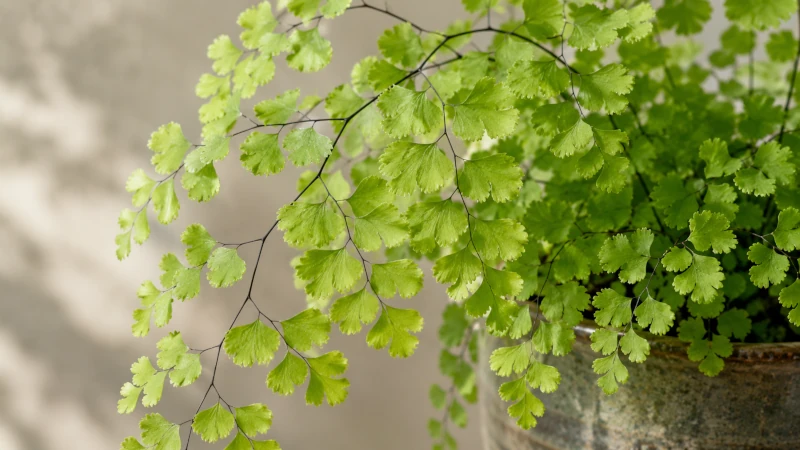
Maidenhair fern is a small, delicate fern with fan-shaped green leaflets on fine, glossy black stems. Its common name “Venus’ hair” comes from an old story that the goddess Venus rose from the water with her hair still dry, and the Latin name Adiantum means “unwetted” because the fronds shed water. That same legend is roughly where its reputation as a hair remedy began.
The parts used in herbal preparations are the fronds, stems, and rhizomes. They contain mucilage (a soothing, gel-like fiber), tannins, flavonoids, phenolic acids, and small amounts of essential oils — the mucilage and tannins are the usual explanation for why it was used on irritated throats [PMC review, 2025].
Quick plant profile
| Botanical name | Adiantum capillus-veneris |
| Common names | Maidenhair fern, Venus’ hair fern, Venus maidenhair |
| Family | Pteridaceae |
| Parts used | Fronds, stems, rhizomes |
| Native range | Southern Europe; also warm, humid regions of the Americas, Asia, and beyond |
| Traditional uses | Cough, sore throat, chest congestion, menstrual complaints, hair tonic |
What maidenhair fern is used for — and what the evidence actually says
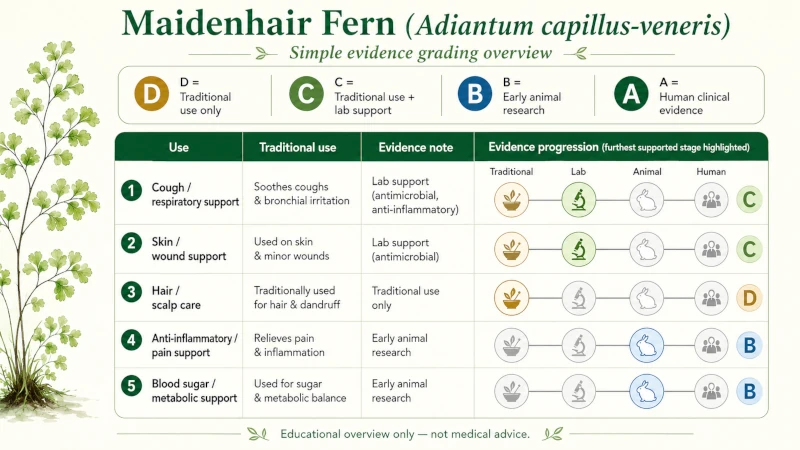
Most of what you’ll read about maidenhair fern comes from traditional medicine, not modern trials. That doesn’t make it worthless, but it does mean expectations should stay modest. Here’s where each use stands.
Coughs and sore throats
This is the plant’s oldest and most plausible use. The Greek physician Dioscorides recommended it for chest complaints, and it was a key ingredient in an old French cough syrup called Sirop de Capillaire. The reasoning is sound on paper: mucilage coats and soothes an irritated throat, and tannins have a mild astringent effect. For a dry, scratchy, irritation-driven cough, a warm sweetened infusion is the kind of thing that can feel soothing — much like honey in tea.
What’s missing is the proof. There are no quality human trials showing maidenhair fern shortens a cough or outperforms a plain warm drink. Treat it as a comfort measure, not a treatment.
Chest congestion and bronchitis
Maidenhair fern has a long reputation as an expectorant, used as supportive care during chest infections like bronchitis. Again, this rests on tradition and the herb’s soothing mucilage rather than clinical data. Bronchitis is also not something to self-manage with herbs alone — see the red-flag list further down.
Menstrual cramps and flow
Traditionally, maidenhair fern was used to ease painful periods and to bring on or increase menstrual flow (herbalists call this an emmenagogue effect). This is worth understanding for one reason in particular: an herb believed to stimulate menstruation is exactly the kind of herb you avoid in pregnancy. There’s no human evidence that it reliably helps period pain, and the same property that’s promoted as a benefit is the basis for the pregnancy warning below.
Antioxidant and anti-inflammatory research
Laboratory and animal studies have found that maidenhair fern extracts have antioxidant, anti-inflammatory, antimicrobial, and blood-sugar-lowering activity, which is why researchers keep studying it [PMC review, 2025; PubMed review, 2020]. These are test-tube and rodent findings. They explain scientific interest in the plant; they do not tell you that drinking the tea will lower your blood sugar or calm inflammation in your body. Review authors are blunt that standardized preparations and human clinical data are still largely missing.
Does maidenhair fern help hair growth?
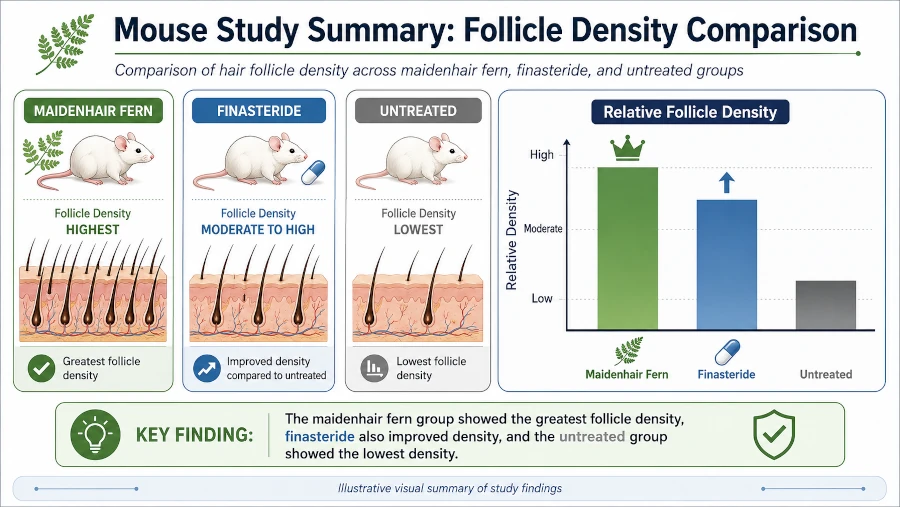
This is the claim that brings most people to the plant, so it deserves a straight answer: the human evidence is essentially nonexistent, and the strongest support is a single small animal study.
In that 2014 study, published in the Iranian Journal of Pharmaceutical Research, researchers induced hair loss in albino mice using testosterone, then applied a 1% maidenhair fern solution to the skin of one group for 21 days [Iran J Pharm Res, 2014]. The treated animals lost less hair than the testosterone-only group. Their follicular density measured about 1.92 follicles per area versus 1.05 in the untreated group, and the ratio of actively growing to resting follicles improved markedly — results that approached, but didn’t match, the prescription drug finasteride used as the comparison.
That’s a genuinely interesting finding, and it’s consistent with the plant’s folk use as a hair tonic. But keep its limits in view: it’s one study, in rodents, with six animals per group, using a topical extract — not a person rubbing fern tea on their scalp, and not anyone taking it by mouth for hair. No human trial has tested whether maidenhair fern regrows hair or slows balding. If you’re losing hair, the treatments with actual human evidence are minoxidil and finasteride, and a dermatologist can tell you what fits your situation. There are also other herbs traditionally used for thinning hair, but most sit on the same thin evidence footing.
How maidenhair fern is traditionally prepared
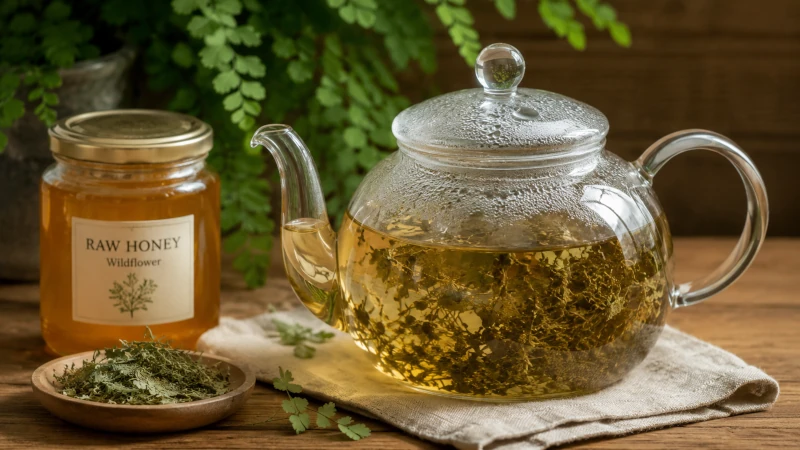
If you’ve talked to a healthcare professional and want to try it as a soothing drink, these are the traditional preparations. Note that there’s no established, tested dose for maidenhair fern, so “traditional” amounts are starting points, not medical recommendations.
- Infusion (tea): About 30 g of the dried aerial parts per liter of water, steeped and sweetened with honey. Traditionally taken as a few cups across the day for a scratchy, irritation-driven cough or sore throat.
- Syrup: The plant is simmered (around 100 g per liter), reduced, strained, and sweetened heavily with honey, then taken by the spoonful. Because honey is not safe for infants under 12 months, don’t give honey-based syrups to babies.
- Scalp poultice: The mashed plant has traditionally been applied to the scalp and covered for short periods. This is folk practice with no clinical support, and anything left on irritated or broken skin can cause a reaction.
Safety, side effects, and who should avoid it
In the small amounts used to flavor some drinks, maidenhair fern is generally considered safe. In the larger amounts used as “medicine,” there isn’t enough reliable information to confirm it’s safe, and large quantities have been reported to cause vomiting [WebMD; RxList]. There’s also no established therapeutic dose, which is its own reason for caution.
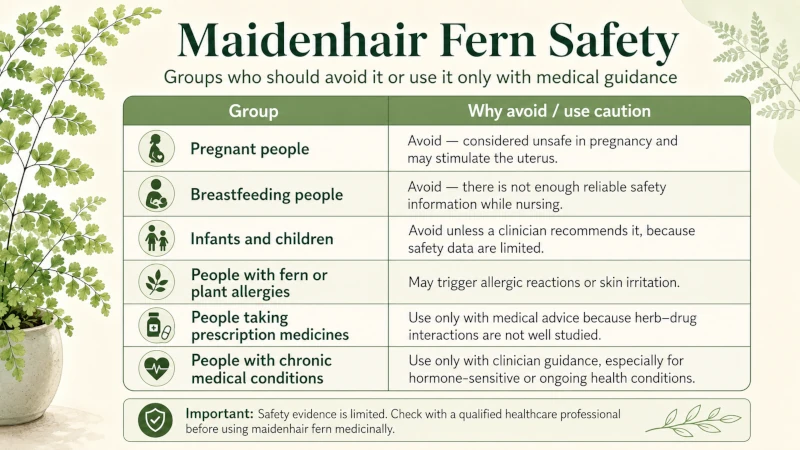
Who should not use it
- Anyone pregnant. Maidenhair fern is considered unsafe in pregnancy [RxList]. Its traditional use to stimulate menstruation is the reason to avoid it entirely while pregnant or trying to conceive.
- Anyone breastfeeding. There isn’t enough information to call it safe; the cautious choice is to avoid it.
- Infants and young children, except under guidance from a pediatric professional — and never with honey-sweetened syrups under age one.
- Anyone with a known fern or plant allergy.
Possible interactions
Because the human data are so limited, interaction information is mostly theoretical. Animal studies suggest blood-sugar-lowering and diuretic activity, so if you take diabetes medication or diuretics (“water pills”), there’s a plausible reason for added caution and a conversation with your prescriber. As a general rule, tell your doctor or pharmacist about any herb you’re taking, especially alongside prescription medicines.
When to see a healthcare professional
Maidenhair fern is, at most, a comfort measure. Don’t let it delay care. Seek medical attention if you have:
- a cough lasting more than about three weeks, or one that keeps returning
- coughing up blood, or thick discolored mucus with a high fever
- shortness of breath, chest pain, or wheezing
- menstrual bleeding heavy enough to soak through protection hourly, or severe pelvic pain
- any new symptom while pregnant
These point to conditions that need proper diagnosis, not a herbal tea.
| Health Disclaimer This article is for general education and information only. It is not medical advice and is not a substitute for diagnosis or treatment from a qualified healthcare professional. Herbal remedies can have real effects, side effects, and interactions. If you are pregnant, breastfeeding, taking any medication, or managing a health condition, talk to your doctor or pharmacist before using maidenhair fern or any herbal product. If you have severe or worsening symptoms, seek medical care. |
Frequently Asked Questions
Is maidenhair fern safe to drink as a tea?
For most adults, small amounts are generally considered safe, but there’s no tested standard dose, and large amounts have been reported to cause vomiting. Anyone pregnant or breastfeeding should avoid it, and it’s worth a quick check with your pharmacist if you take regular medication [WebMD; RxList].
Does maidenhair fern really regrow hair?
There’s no human evidence that it does. The main support is a single small study in mice, using a topical extract, that showed less hair loss in a testosterone-induced balding model [Iran J Pharm Res, 2014]. That’s promising for researchers, not proof for people. For hair loss with real human evidence, see a dermatologist about options like minoxidil or finasteride.
Why can’t I use it during pregnancy?
Maidenhair fern has traditionally been used to stimulate menstruation, and herbs with that reputation are avoided in pregnancy. It’s specifically listed as unsafe to use while pregnant [RxList].
What does maidenhair fern actually do for a cough?
Its mucilage can soothe an irritated, dry throat, which is why it’s been used in cough syrups for centuries. It’s a comfort measure rather than a proven treatment, and it won’t cure an infection.
Is maidenhair fern the same as the maidenhair tree (ginkgo)?
No. “Maidenhair tree” is a common name for Ginkgo biloba, a completely different plant with different uses. Don’t substitute one for the other [WebMD].
References
- Effect of Adiantum capillus-veneris Linn on an Animal Model of Testosterone-Induced Hair Loss. Iranian Journal of Pharmaceutical Research, 2014. PMID 24711836. View source
- WebMD. Maidenhair Fern: Uses, Side Effects, and Safety. View source
- RxList. Maidenhair Fern Supplement. View source
- Medicinal Properties of Adiantum capillus-veneris Linn. in Traditional Medicine and Modern Phytotherapy: A Review Article. PMC5810381. View source
- Adiantum capillus-veneris: A Comprehensive Review of Its Medicinal Properties, Bioactive Compounds, and Advanced Extraction Techniques. 2025. PMID 41132578. View source
- A Review of Pharmacological Properties and Toxicological Effects of Adiantum capillus-veneris L. 2020. PMID 32178614. View source
- Pamplona-Roger GD. Encyclopedia of Medicinal Plants. Editorial Safeliz, 2000 (traditional-use source).
