
Bugleweed is a mint-family herb with a long folk reputation for calming the fast heartbeat and restless, wired feeling that can come with a mildly overactive thyroid. Before you try it, one thing trips up a surprising number of health sites: two unrelated plants share the name bugleweed, and only one of them is the medicinal herb.
The herb used for thyroid symptoms is Lycopus — Lycopus virginicus in North America, Lycopus europaeus (gypsywort) in Europe. The plant most people picture, the low purple-flowered ground cover sold at garden centers, is Ajuga reptans, and it is not used for thyroid problems at all [Britannica, 2026]. If a supplement label, book, or article mentions bugleweed for the thyroid, it means Lycopus [Drugs.com, 2025]. Everything below is about that plant.
Two plants, one confusing name
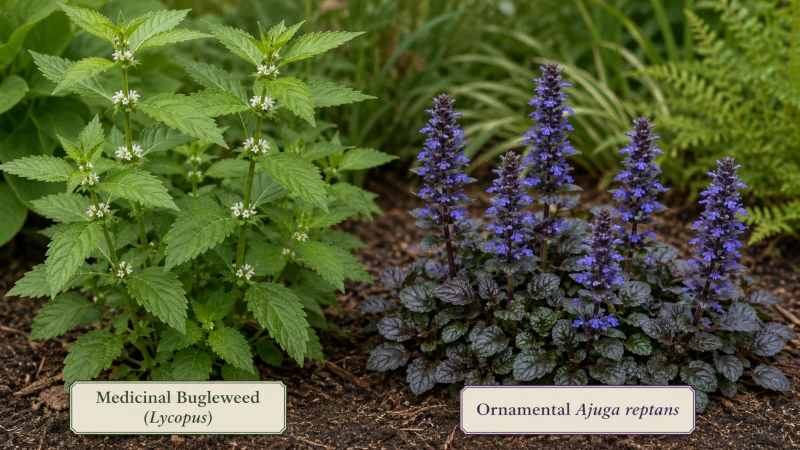
The mix-up is old, and it is built into the common names. Both plants sit in the mint family (Lamiaceae), alongside peppermint, sage, and lavender, so loose writing lumps them together. They are not interchangeable.
| Medicinal bugleweed (Lycopus) | Ornamental bugleweed (Ajuga reptans) | |
| Also called | Virginia or American bugleweed, gypsywort, water horehound | Carpet bugle, common bugle, burgundy glow |
| Looks like | Taller, lanky, square stem; small white flowers; grows in wet ground | Low spreading mat; leaf rosettes; blue-purple flower spikes |
| Used for | Mild hyperthyroid symptoms (traditional, limited evidence) | Ground cover; older folk use was mostly external (wounds, bruises) |
| Where it grows | Wet meadows, stream edges, ditches | Garden beds and shady borders |
The rest of this guide covers the medicinal plant. The garden ground cover is grown for its looks, and its traditional uses were mainly applied to the skin [Britannica, 2026].
What bugleweed is used for
Traditional and product use centers on two things: easing the symptoms of a mildly overactive thyroid, and calming premenstrual breast pain. The evidence behind both is limited, and it helps to understand how limited before you decide anything.
A mildly overactive thyroid
Hyperthyroidism means the thyroid makes too much hormone, which speeds the body up: a pounding or fast heartbeat, shaky hands, trouble sleeping, heat intolerance, and weight loss [Mayo Clinic, 2022]. Bugleweed’s traditional niche is the milder end of that picture, especially when the loudest complaint is a racing heart and a keyed-up nervous system. Germany’s Commission E, an expert panel that reviewed herbal medicines, issued a positive monograph for Lycopus in mild hyperthyroidism with these nervous, autonomic symptoms [Drugs.com, 2025].
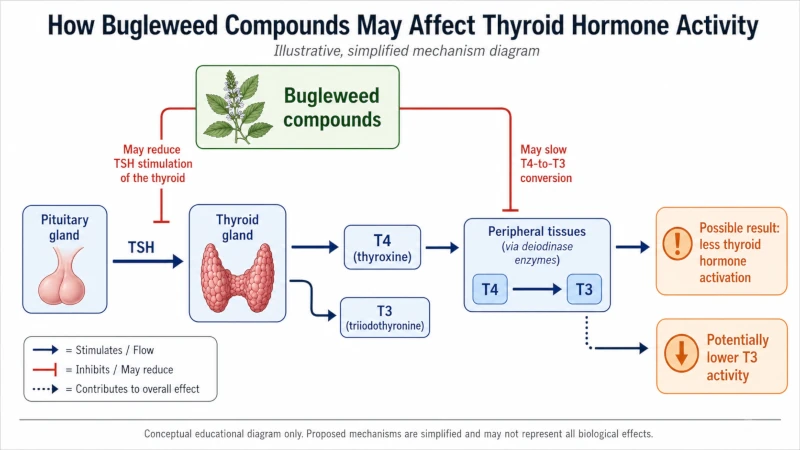
In the lab, the active ingredients look to be caffeic-acid derivatives — chiefly rosmarinic acid and lithospermic acid. Their oxidation products appear to keep thyroid-stimulating hormone (TSH) from binding to and switching on thyroid cells, and they slow the conversion of the storage hormone T4 into the more active T3 out in the body’s tissues [Restorative Medicine, n.d.]. In Graves’ disease, an autoimmune cause of an overactive thyroid, lab studies suggest the same compounds can block the antibodies that drive the gland [Medscape, 2024].
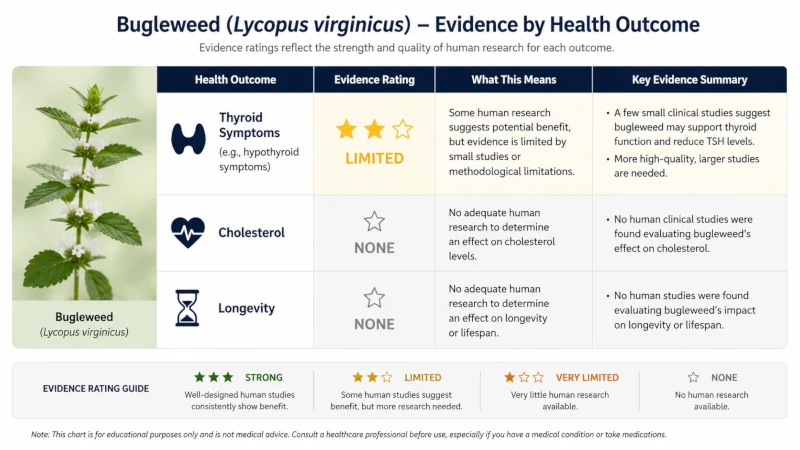
Here is the catch. Almost all of that is test-tube and animal work. Human data is thin. The most-cited human study, an open trial published in 2008, followed patients who had a low TSH and hyperthyroid symptoms for three months; those taking a Lycopus europaeus extract passed more T4 in their urine and saw some symptoms settle, such as a high morning heart rate, and tolerated it well [Beer et al., 2008]. It was small, it was not blinded, and no large randomized trial stands behind it. WebMD’s plain-English verdict is that there is no good scientific evidence for any of bugleweed’s uses [WebMD, 2024]. Treat it as a traditional remedy with a plausible mechanism — not a proven treatment, and never a stand-in for diagnosis and care.
Premenstrual breast pain
Bugleweed has a second traditional use: easing the breast tenderness and pain (mastalgia) that can build before a period. The proposed reason is that it gently lowers prolactin and related reproductive hormones [Drugs.com, 2025]. As with the thyroid, the evidence is mostly historical, and any effect is likely modest. It will not reliably “regulate your cycle,” despite what some sites claim. If menstrual discomfort is your main concern, herbs such as black haw have a longer traditional track record for that specific problem.
Restlessness and sleep
Because a fast, anxious, can’t-settle feeling overlaps so much with a mild overactive thyroid, bugleweed was also used as a gentle calming herb and sleep aid [Restorative Medicine, n.d.]. People sometimes pair it with milder calming plants. This use is traditional rather than clinically proven.
Claims that do not hold up
Be clear about the promises you will see online that the evidence does not back. There is no reliable proof that bugleweed lowers cholesterol, lowers blood pressure in healthy people, “detoxifies” the body, treats arthritis, or extends lifespan. Its real, narrow story is about thyroid hormone signaling — not a cure-all [WebMD, 2024].
How strong is the evidence, really?
A quick, honest map of where things stand:
| Use | Evidence level | What it rests on |
| Mild hyperthyroid symptoms | Limited / early | Traditional use, lab and animal studies, one small open human trial |
| Blocking Graves’ antibodies | Early, lab only | Test-tube studies; no human trials |
| Premenstrual breast pain | Limited | Traditional use and a proposed hormone effect |
| Calming, sleep, cough | Traditional only | Historical herbal use |
| Cholesterol, blood pressure, “detox,” longevity | No reliable evidence | — |
Forms and dosing

Bugleweed is sold as a dried herb for tea, a tincture, a liquid extract, and capsules. There is no official standardized dose, and products vary a lot in strength, so the ranges below are general traditional figures, not a prescription [Restorative Medicine, n.d.].
- Tea: roughly 1–2 g of dried herb steeped in hot water, taken up to a few times a day, in line with Commission E’s traditional daily amount.
- Tincture or liquid extract: follow the strength and dosing on the product label, since concentrations differ widely.
- Capsules / standardized extract: some sources cite about 100–400 mg, two to three times daily.
Two rules matter more than the exact number. First, because bugleweed acts on the thyroid, use it under the eye of a clinician or experienced herbalist who can check your thyroid levels; guessing is a poor idea with a gland this central. Second, do not stop abruptly after taking it for a while — sudden changes and very high doses have been linked, at least in theory, to thyroid enlargement [Drugs.com, 2025].
Realistic expectations. If bugleweed helps, it helps with the symptoms of a mild case, gradually, over weeks — not overnight, and not by replacing thyroid testing or any prescribed treatment.
Safety, side effects, and who should avoid it
At usual doses and over short periods, bugleweed is generally well tolerated [Restorative Medicine, n.d.]. Problems are uncommon but worth knowing.
Possible side effects
- Stomach upset or nausea, more likely at higher amounts.
- Thyroid enlargement — a theoretical risk with very high doses or sudden discontinuation.
- A possible drop in blood sugar.
- Allergic reactions, especially if you react to other mint-family plants.
Who should not take bugleweed
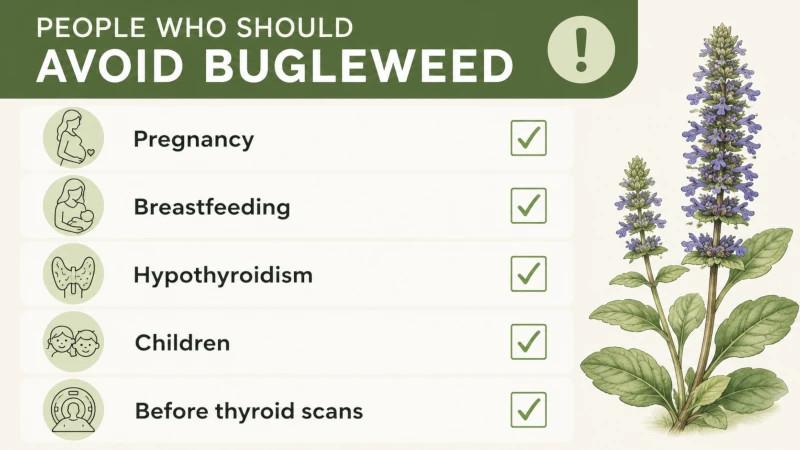
- People with an underactive thyroid (hypothyroidism) — it can push thyroid function lower still [WebMD, 2024].
- Anyone with an enlarged thyroid that is not overactive.
- During pregnancy — likely unsafe, because it affects hormones [WebMD, 2024].
- While breastfeeding — it may reduce milk supply, much like sage [Drugs.com, 2025].
- Children. Its thyroid-altering action makes it inappropriate for kids.
- Anyone about to have a thyroid scan or radioactive iodine treatment — it can interfere [Medscape, 2024].
- Anyone who cannot be monitored by a healthcare professional.
Medication interactions
- Thyroid hormone (levothyroxine, desiccated thyroid): bugleweed works against them — do not combine [Medscape, 2024].
- Antithyroid drugs (such as methimazole): the effects add up and can overshoot — only with supervision [Medscape, 2024].
- Radioactive iodine therapy: can interfere — avoid around treatment [Medscape, 2024].
- Sedatives: may add to drowsiness [Drugs.com, 2025].
- Diabetes medicines or insulin: may lower blood sugar further [Medscape, 2024].
When to talk to a doctor

Bugleweed is not a do-it-yourself fix for a thyroid problem. An overactive thyroid needs a real diagnosis — usually a simple blood test — because the causes and treatments differ, and an untreated overactive thyroid can strain the heart and weaken bones over time [Mayo Clinic, 2022].
Get emergency care for a very fast or irregular heartbeat together with fever, chest pain, severe agitation or confusion, or trouble breathing. That combination can signal thyroid storm, a rare but life-threatening surge in thyroid activity.
See a clinician soon for unexplained weight loss, a persistently pounding or rapid heart, hands that will not stop trembling, new heat intolerance, neck swelling, or changes in your eyes.
| Health Disclaimer This article is for general education only and is not medical advice or a substitute for it. Bugleweed affects the thyroid and can interact with medications, so talk with a qualified healthcare professional before using it — especially if you are pregnant or breastfeeding, take any prescription medicine, or have a thyroid or other health condition. Nothing here is meant to diagnose, treat, cure, or prevent any disease. Any use of this information is at your own risk. |
Frequently Asked Questions
Is bugleweed the same as the bugleweed in my garden?
No. The garden plant is Ajuga reptans (carpet bugle), grown as ground cover. The medicinal herb is Lycopus, a different plant that grows in wet places. Only Lycopus is used for thyroid symptoms [Britannica, 2026].
Can bugleweed cure hyperthyroidism or Graves’ disease?
No. The evidence points to mild, gradual symptom relief at most, and it comes mainly from tradition, lab work, and one small human study [Beer et al., 2008]. It is not a cure and not a replacement for diagnosis and proper treatment [WebMD, 2024].
Can I take bugleweed with my thyroid medication?
Not on your own. Bugleweed can work against thyroid hormone replacement and can add to antithyroid drugs, so combining them needs a clinician’s oversight and monitoring [Medscape, 2024].
Is it safe during pregnancy or breastfeeding?
No. It is considered likely unsafe in pregnancy because it affects hormones, and it may reduce milk supply while breastfeeding [WebMD, 2024].
How fast does bugleweed work?
There is no quick answer. Traditionally it is used over weeks, and any benefit is gradual and limited to mild cases. Track your symptoms and thyroid labs with a professional rather than expecting a fast change.
References
- Britannica. (2026). Bugleweed (genus Ajuga). Encyclopaedia Britannica. → View source
- Drugs.com. (2025). Bugleweed. Professional natural products monograph. → View source
- WebMD. (2024). Bugleweed. Vitamins & Supplements. → View source
- Medscape Reference. (2024). Bugleweed (gypsywort, Lycopus). Drugs & interactions. → View source
- Restorative Medicine. (n.d.). Bugleweed (Lycopus virginicus) monograph. → View source
- Beer, A. M., Wiebelitz, K. R., & Schmidt-Gayk, H. (2008). Lycopus europaeus (gypsywort): effects on the thyroidal parameters and symptoms associated with thyroid function. Phytomedicine, 15(1–2), 16–22. → View source
- Mayo Clinic. (2022). Hyperthyroidism — symptoms and causes. → View source
