
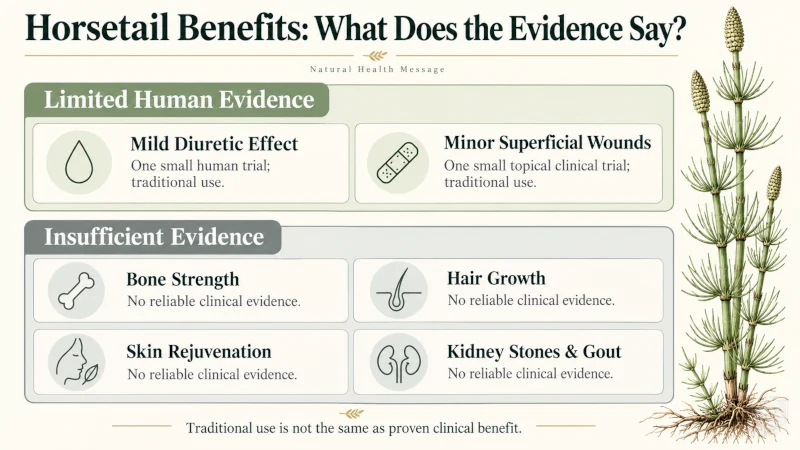
Horsetail (Equisetum arvense) has a small, specific track record. European regulators accept it as a traditional remedy for increasing urine flow in minor urinary complaints and for helping superficial wounds heal, and one small trial found a mild diuretic effect [EMA, 2016]. Most of the bigger claims made for the horsetail plant — stronger bones, thicker hair, firmer skin, dissolved kidney stones — rest on its silica content and a long folk history rather than human studies.
There are also real safety issues. Raw horsetail contains an enzyme that destroys vitamin B1, a toxic look-alike species can end up in poorly sourced material, and people with heart or kidney disease shouldn’t use it. Here is what holds up, what doesn’t, and how to use it sensibly if you decide to.
What is the horsetail plant?
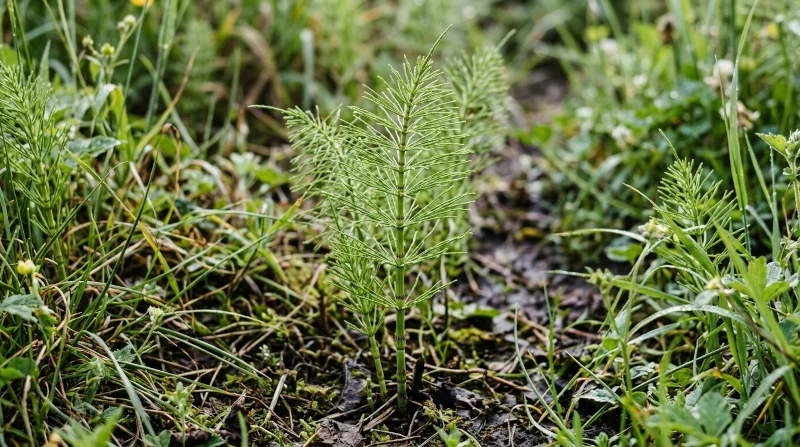
Horsetail is an ancient, flowerless plant more closely related to ferns than to garden plants. It spreads by spores and grows two kinds of stems: a short, cone-tipped fertile stem in early spring, then green, sterile stems ringed with whorls of thin, jointed branches [Utah State University Extension]. Those green aerial parts are what medicinal products use [EMA, 2016].
It grows in damp woods, meadows, stream banks and disturbed ground across much of the Northern Hemisphere. The stems are stiff with silica, which is why people once used them to scour pots and polish wood — hence the old names scouring rush and shavegrass [Utah State University Extension].
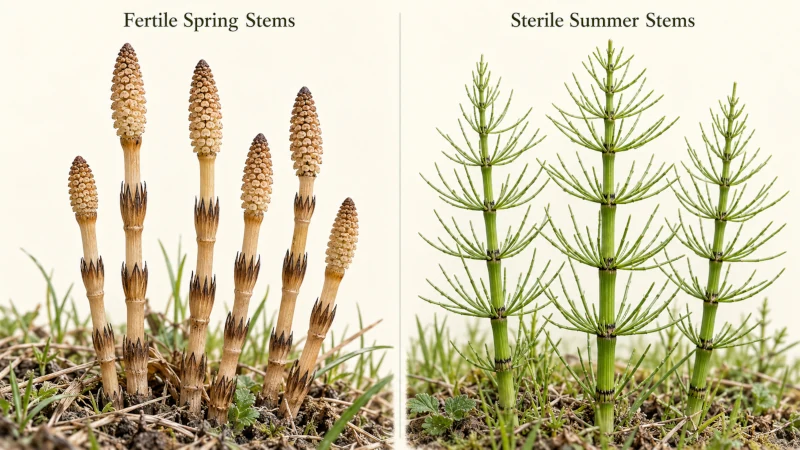
One caution before you ever pick it: not every horsetail is field horsetail. Marsh horsetail (E. palustre) can contain a potentially toxic alkaloid called palustrine and may be mixed into material gathered by people who can’t tell the species apart. The European Pharmacopoeia includes a specific test to exclude it, and regulators advise using only quality-controlled horsetail [EMA assessment report, 2016]. Buy a tested product rather than harvesting your own.
Horsetail plant benefits: what the evidence actually shows
| Use | What the evidence shows | Evidence grade |
| Mild diuretic for minor urinary complaints | One randomized trial in 36 healthy men; accepted in the EU on the basis of traditional use | Limited human evidence + traditional use |
| Superficial wounds (on the skin) | One randomized trial of a 3% ointment after episiotomy (108 women); EU traditional use | Limited |
| Brittle nails (on the nail) | Two small trials of a nail product combining horsetail with a sulfur compound | Limited — not horsetail alone |
| Bone density, osteoporosis | Silicon is linked to bone in lab, animal and observational studies; no solid horsetail trials | Insufficient |
| Hair, skin, wrinkles, stretch marks | EU food-safety reviewers found horsetail not characterised well enough to support these claims | Insufficient |
| Kidney stones, gout | A rat study found no change in stone risk factors | Insufficient |
| Stopping bleeding (nose, hemorrhoids, heavy periods, ulcers) | Traditional use only | Traditional — these need medical care |
| Blood sugar | One small study used a different species (E. myriochaetum) | Insufficient for field horsetail |
Sources for the table: [EMA, 2016]; [EMA assessment report, 2016]; [Carneiro et al., 2014]; [Asgharikhatooni et al., 2015].
A mild diuretic — the best-supported use
In a double-blind, randomized crossover trial, 36 healthy men took a standardized dry horsetail extract (900 mg a day), the prescription diuretic hydrochlorothiazide (25 mg), or a placebo, each for four days. Horsetail produced a net fluid loss similar to the drug and better than placebo. Urinary sodium and potassium didn’t change significantly, blood tests stayed normal, and side effects were rare and mild [Carneiro et al., 2014].
That’s encouraging, and narrow: healthy men, four days, one extract. European regulators reviewed the trial and judged it too small, with too little detail about the preparation, to count as proof. They approved horsetail products on the strength of long traditional use instead — to increase urine and flush the urinary tract in minor complaints [EMA, 2016].
In practice, horsetail tea may make you urinate more. It doesn’t treat a urinary tract infection. And an effect comparable to a prescription diuretic is a reason for caution, not enthusiasm, if you already take one. If you’re comparing options for bladder symptoms, our guide to herbal remedies for the urinary system sets horsetail beside cranberry, uva ursi and others.
Minor wounds: one promising trial
Putting horsetail on poorly healing superficial wounds is the other use EU regulators accept on traditional grounds [EMA, 2016]. Human evidence is thin but real. In a placebo-controlled trial in Iran, 108 first-time mothers applied a 3% horsetail ointment or a placebo to their episiotomy wounds twice a day for 10 days. The horsetail group healed better and had less pain at day 5 and day 10, and used fewer painkillers [Asgharikhatooni et al., 2015]. The researchers described it as the first study of its kind. One trial is a signal, not a settled answer.
The traditional preparation is a compress or rinse made from about 10 g of dried herb boiled in 1 liter of water [EMA monograph, 2016]. Keep it to small, clean, shallow wounds, and see a clinician if a wound looks infected or gets worse. For other plants with evidence on burns and wounds, see our overview of herbs for skin issues.
Bones, hair, skin and nails: the silica story
This is where most horsetail marketing lives, and where the evidence is weakest. The argument goes: horsetail is rich in silica, silicon concentrates in bone and connective tissue, so horsetail must build bones, hair, skin and nails.
The first two steps hold up. Dried horsetail contains roughly 5–7.7% silicic acid, mostly in insoluble forms [EMA assessment report, 2016]. Researchers have linked higher dietary silicon to better bone density, and lab and animal work suggests a role in forming collagen — though silicon’s exact job in bone is still unclear [Jugdaohsingh, 2007].
The last step is where it falls apart. Very little of horsetail’s silicon gets into a cup of tea: one experiment found about 5% silicon in the whole plant but only about 0.3% that dissolved in water. In 2009, the European Food Safety Authority reviewed horsetail claims for bone, skin and hair and found the herb hadn’t been characterised well enough to back them [EMA assessment report, 2016]. No good trial shows horsetail prevents osteoporosis, firms skin or grows hair.
Nails are a partial exception. Two small trials found that a topical product combining horsetail with a sulfur-containing compound reduced splitting and ridges [EMA assessment report, 2016]. Because it was a combination, you can’t give horsetail the credit on its own. If bone strength is your real goal, calcium, vitamin D, protein and weight-bearing exercise have far better support — start with our guide to the best foods for osteoporosis.
Kidney stones, gout and “detox”
Older herbals recommend horsetail for kidney and bladder stones, gout and “excess uric acid.” The research doesn’t follow. In a rat study, horsetail tea didn’t change urine volume, calcium, citrate, or the urine’s ability to stop crystals forming [EMA assessment report, 2016]. No herb has been shown to dissolve kidney stones. Drinking enough fluid remains the best-supported prevention, and what you eat matters too — see our breakdown of foods that raise kidney stone risk. For gout, diet and medication do the heavy lifting; our list of gout-friendly foods explains why.
Bleeding: a traditional use that now needs a doctor
Horsetail has a long history as a remedy to stop bleeding — nosebleeds, bleeding hemorrhoids, heavy periods, bleeding ulcers, even coughing up blood in tuberculosis [EMA assessment report, 2016]. None of this has been tested in modern trials. These symptoms can point to ulcers, clotting problems, bowel disease or lung disease that need a diagnosis. Don’t pack your nose with horsetail gauze or treat rectal or stomach bleeding with tea. Get checked.
How horsetail is used, and sensible amounts
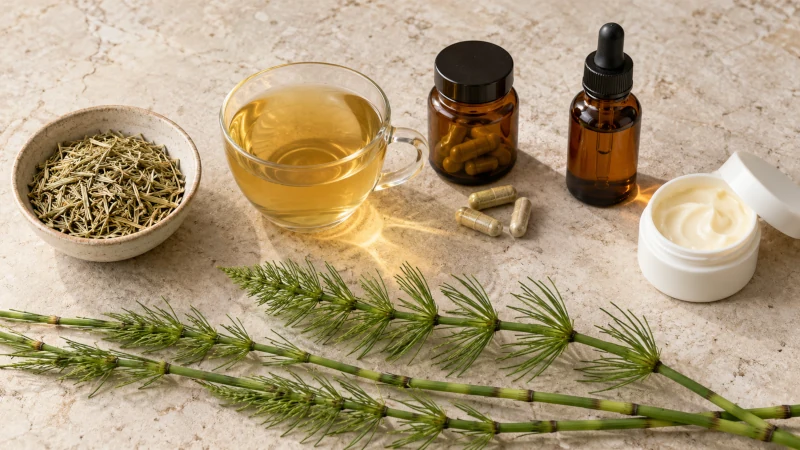
Horsetail is sold as dried herb for tea, capsules, liquid extracts and creams. Doses in old herbal books vary widely and often run several times higher than regulators accept. The EU monograph — written for licensed products used for minor urinary complaints in adults and teens over 12 — lists these traditional amounts [EMA monograph, 2016]:
| Form | Traditional amount (adults and teens 12+) |
| Herbal tea | 1–4 g dried herb in 150 ml boiling water, as an infusion or a 5–15 minute decoction, 3–4 times a day (3–12 g a day in total) |
| Powdered herb (capsules or tablets) | 500–570 mg three times a day |
| Water-based dry extract (4–7:1) | 370 mg three times a day, or 540 mg twice a day |
| Pressed fresh juice | 10–20 ml three times a day |
| Compress or rinse for minor wounds | Decoction of 10 g dried herb in 1 liter of water, one to several times a day |
Traditional use runs two to four weeks. See a doctor if symptoms last more than a week. With capsules or extracts, drink plenty of fluid [EMA monograph, 2016]. Extracts aren’t interchangeable, so follow the label of the specific product you buy.
Heat matters more than most labels admit. The thiamine-destroying enzyme in horsetail is fully inactivated at 80 °C, and testers found none in water-based dry extracts or a 30% alcohol extract [EMA assessment report, 2016]. Raw powdered herb hasn’t been through that step, which is one more reason to prefer a properly made tea or a standardized extract.
Horsetail side effects and safety
Used briefly at normal amounts, horsetail is usually well tolerated. Reported side effects include mild stomach and gut upset, needing to urinate more, and allergic reactions such as a rash or facial swelling [EMA monograph, 2016]; [WebMD, 2026]. The less common issues deserve a closer look.
Thiamine (vitamin B1)
Crude horsetail contains thiaminase, an enzyme that breaks down vitamin B1. Horses that eat a lot of horsetail in hay can become thiamine-deficient, and Canada requires horsetail supplements to be certified thiaminase-free [EMA assessment report, 2016]; [Drugs.com, 2025]. Regulators note no confirmed human cases with traditional, heat-processed preparations. The risk is highest if you drink heavily, eat poorly, or already run low on B1 — our guide to B vitamins covers who’s most at risk of thiamine deficiency.
Trace nicotine and the toxic look-alike
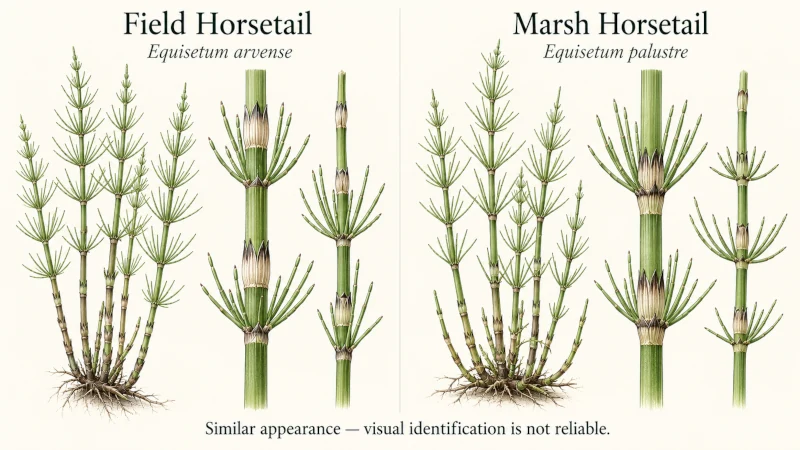
Horsetail contains tiny amounts of nicotine — under 1 part per million by one estimate [Drugs.com, 2025]. That’s irrelevant for most people, but it has been linked to dermatitis in a person allergic to nicotine [EMA assessment report, 2016]. Children have been poisoned after using the stems as whistles or blowguns [Drugs.com, 2025]. Keep the plant and products away from kids, and remember the marsh horsetail problem above.
Rare reports: liver, pancreas and sodium
A man with underlying hepatitis B developed acute hepatitis after drinking 500 ml a day of boiled horsetail juice for two weeks — about eight times the traditional daily amount — and recovered after he stopped [EMA assessment report, 2016]. NIH’s LiverTox database is reported to describe horsetail liver injury as rare and self-limiting and to advise against high doses with existing liver disease [LiverTox]. Single case reports also link habitual horsetail tea to recurrent pancreatitis, and horsetail’s diuretic effect to worsening low blood sodium in one patient [Drugs.com, 2025]. Isolated cases don’t prove horsetail caused these problems. They do argue for short courses at normal amounts.
Drug interactions: where sources disagree
The evidence here is genuinely mixed. The EU monograph lists no reported interactions [EMA monograph, 2016]. In the lab, though, horsetail extract blocked two liver enzymes (CYP2C8 and CYP1A2) that clear certain drugs; regulators decided the findings were too thin to act on without real-world cases [EMA assessment report, 2016]. US drug references are more cautious. WebMD’s pharmacist-reviewed monograph advises discussing horsetail first if you take a water pill, an HIV medicine or lithium [WebMD, 2026], and Drugs.com flags a case in which horsetail may have weakened the HIV drug efavirenz [Drugs.com, 2025].
Potassium is a similar split. The four-day trial found no change in potassium loss [Carneiro et al., 2014], yet the plant itself is high in potassium — which is why the National Kidney Foundation lists horsetail as high-risk for people with kidney disease [NKF, 2025]. If you take prescription medicine, especially diuretics, blood pressure drugs, lithium or HIV treatment, ask a pharmacist before starting horsetail.
Who should avoid horsetail
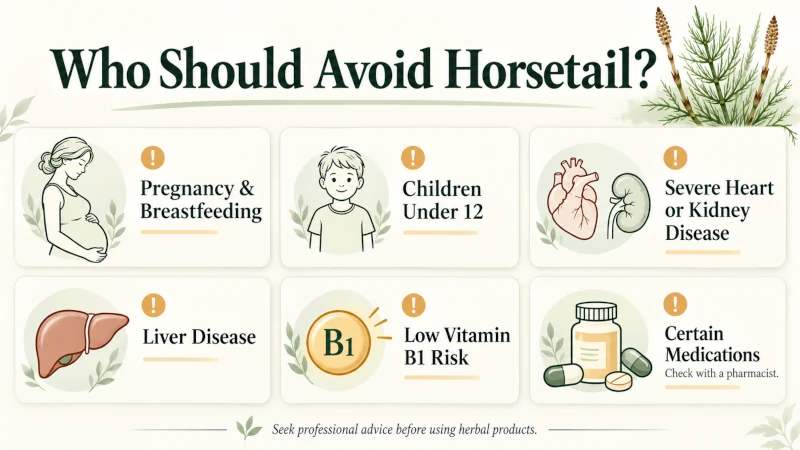
- People with severe heart or kidney disease, or anyone told to limit fluids. EU regulators list this as a contraindication [EMA monograph, 2016], and the National Kidney Foundation rates horsetail high-risk for people with kidney disease, on dialysis, or with a transplant [NKF, 2025].
- Pregnant or breastfeeding women. Safety hasn’t been established, so oral use isn’t recommended, and horsetail products shouldn’t be applied to the breast while nursing [EMA monograph, 2016].
- Children under 12 [EMA monograph, 2016].
- People with liver disease, particularly at higher doses [EMA assessment report, 2016].
- Anyone with low thiamine, heavy alcohol use or a poor diet.
- People allergic to horsetail or nicotine. A cross-reaction between horsetail and carrot allergy has also been reported [EMA assessment report, 2016].
- Anyone taking diuretics, lithium or HIV medicines without checking with a pharmacist or prescriber first.
When to see a doctor
EU guidance says to see a doctor if urinary symptoms last longer than a week, or if you develop fever, painful urination, cramping or blood in your urine while using horsetail. For wounds, get help if there are signs of infection or things get worse [EMA monograph, 2016]. Also seek prompt care for:
- Any unexplained bleeding: blood in urine, stool or vomit, coughing up blood, unusually heavy periods, or a nosebleed that won’t stop.
- Swelling in your legs or ankles. Don’t treat it yourself with a diuretic herb — the cause may be your heart, kidneys or liver.
- Yellowing skin or eyes, dark urine, severe belly pain, confusion or unsteady walking while taking horsetail.
- Call 911 for swelling of the face, lips or throat, or trouble breathing.
| HEALTH DISCLAIMER: This article is for general education and is not medical advice. It doesn’t replace diagnosis or treatment from a qualified healthcare professional. Herbal products can cause side effects and interact with medicines, and product quality varies. Talk to your doctor or pharmacist before using horsetail, especially if you are pregnant or breastfeeding, giving it to a child or teen, taking prescription medication, or living with heart, kidney or liver disease. If you have bleeding, fever with urinary symptoms, or signs of a serious allergic reaction, seek medical care promptly. |
Frequently Asked Questions
Is horsetail tea safe to drink every day?
For short periods, usually yes for healthy adults. Traditional use runs two to four weeks, and long-term daily use hasn’t been studied [EMA monograph, 2016]. Thiamine loss, fluid shifts and rare liver reports are reasons not to make it an open-ended habit.
Does horsetail help hair grow?
There’s no good evidence that it does. European food-safety reviewers found horsetail hadn’t been characterised well enough to support hair or skin claims, and very little of its silica dissolves into tea [EMA assessment report, 2016].
Can horsetail help with osteoporosis?
Not on current evidence. Silicon may matter for bone, but no solid human trial shows horsetail improves bone density [Jugdaohsingh, 2007]. Osteoporosis needs proven treatment, and diet still helps.
Is horsetail a diuretic?
Yes, mildly. In one small trial its effect was similar to a low dose of hydrochlorothiazide in healthy men [Carneiro et al., 2014]. That’s why it shouldn’t be stacked with prescription water pills without advice.
How can I tell field horsetail from the toxic marsh horsetail?
Not reliably by eye, especially once dried and cut. Buy products made to pharmacopoeia standards, which include a test to exclude marsh horsetail [EMA assessment report, 2016], rather than gathering it wild.
References
- European Medicines Agency. Equiseti herba — herbal medicinal product (horsetail herb). View source
- European Medicines Agency, HMPC. European Union herbal monograph on Equisetum arvense L., herba. View source
- European Medicines Agency, HMPC. Assessment report on Equisetum arvense L., herba. View source
- Carneiro DM, Freire RC, Honório TC, et al. Randomized, double-blind clinical trial to assess the acute diuretic effect of Equisetum arvense (field horsetail) in healthy volunteers. Evid Based Complement Alternat Med. View source
- Asgharikhatooni A, Bani S, Hasanpoor S, Mohammad Alizade S, Javadzadeh Y. The effect of Equisetum arvense (horse tail) ointment on wound healing and pain intensity after episiotomy: a randomized placebo-controlled trial. View source
- Jugdaohsingh R. Silicon and bone health. J Nutr Health Aging. View source
- National Institute of Diabetes and Digestive and Kidney Diseases. Horsetail. View source
- WebMD. Horsetail — Uses, Side Effects, and More. View source
- Drugs.com. Horsetail (professional natural products monograph). View source
- National Kidney Foundation. Herbal Supplements and Kidney Disease. View source
- Utah State University Extension. Range Plants of Utah: Horsetail (Equisetum arvense). View source


