
Olive oil is one of the better-supported foods in nutrition science, but the benefits of olive oil are narrower and more practical than most lists make them sound. The strongest evidence is for your heart. Used in place of butter, margarine, and other saturated fats, olive oil is consistently linked with lower rates of heart disease, and in a large Spanish trial, a Mediterranean diet supplemented with extra virgin olive oil cut major cardiovascular events by roughly 30% [Estruch et al., 2018]. Most of the bigger claims — preventing cancer, healing the liver, flushing out gallstones — rest on much thinner evidence, or none at all.
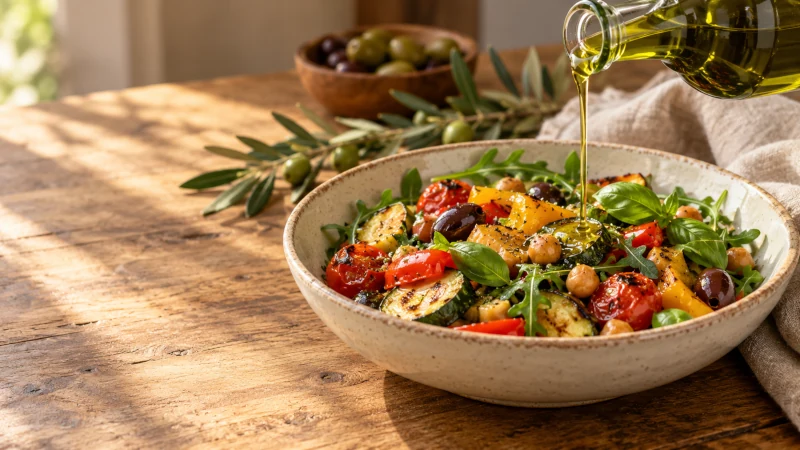
The practical version is short: make olive oil your everyday cooking and salad fat, use it instead of solid fats rather than on top of them, and keep the portions sensible.
What Makes Olive Oil Healthy
Two things: the kind of fat it contains, and, in extra virgin oil, a set of plant compounds called polyphenols.
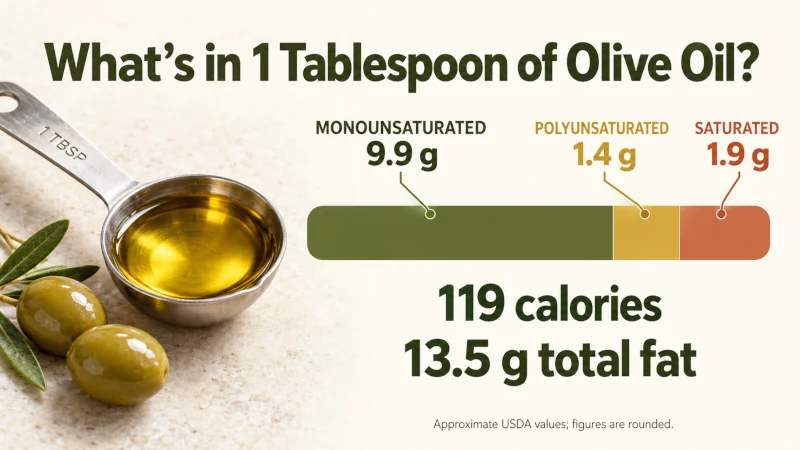
One tablespoon of olive oil has about 119 calories and 13.5 grams of fat. Roughly 9.9 grams of that is monounsaturated fat, mostly oleic acid; about 1.4 grams is polyunsaturated, and about 1.9 grams is saturated. The same tablespoon supplies about 1.9 mg of vitamin E [USDA data via University Hospitals]. Nutritionally, it’s a fat — a good one — and not much else.
Polyphenols such as hydroxytyrosol set extra virgin olive oil apart; refining strips most of them out. Amounts vary enormously: in one European trial, the test oils ranged from about 3 to 366 mg of phenolic compounds per kilogram depending on type and processing [Covas et al., 2006].
European regulators allow one specific polyphenol claim: olive oil polyphenols contribute to the protection of blood lipids from oxidative stress — but only for oils containing at least 5 mg of hydroxytyrosol and its derivatives per 20 grams of oil [EU Regulation 432/2012, reviewed in Foods, 2023]. That wording describes a biological marker, not protection from a disease.
Evidence-Based Health Benefits of Olive Oil
Heart health: the strongest evidence
In the PREDIMED trial, researchers randomly assigned 7,447 Spanish adults aged 55 to 80, all at high cardiovascular risk, to one of three diets: a Mediterranean diet with free extra virgin olive oil, a Mediterranean diet with free mixed nuts, or a control diet with advice to cut fat. Over a median of 4.8 years, major cardiovascular events (heart attack, stroke, or cardiovascular death) occurred in 3.8% of the olive oil group, 3.4% of the nut group, and 4.4% of the control group. After adjustment, that was about a 31% lower risk for the olive oil diet and 28% lower for the nut diet [Estruch et al., 2018].
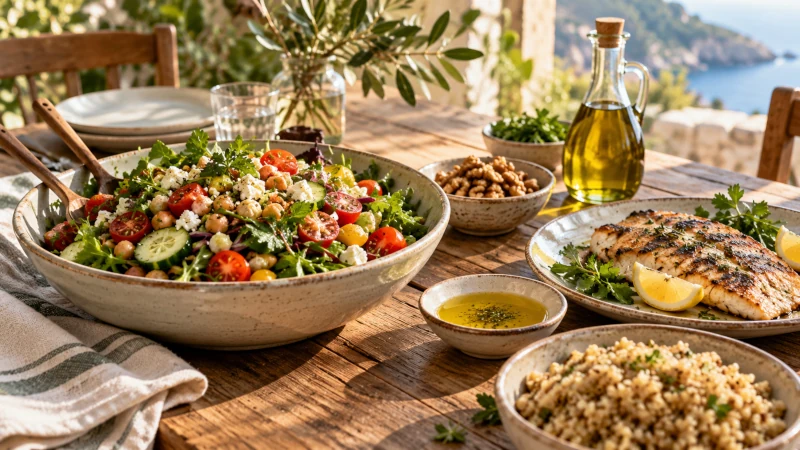
Two details matter. PREDIMED tested a whole eating pattern supplemented with olive oil, not olive oil alone. And the nut group did about as well. The fairest reading is that a Mediterranean diet rich in unsaturated fat protects the heart, and extra virgin olive oil is an excellent way to build one. (The 2018 paper is a corrected reanalysis of results first published in 2013; the main conclusions held.)
Large observational studies point the same way, with a twist. In about 93,000 U.S. nurses and health professionals followed for decades, people who used more than half a tablespoon of olive oil a day had a 14% lower risk of cardiovascular disease and an 18% lower risk of coronary heart disease than people who never used it. Swapping just 5 grams a day of margarine, butter, mayonnaise, or dairy fat for olive oil was linked with a 5% to 7% lower risk. But when olive oil was compared with other plant oils, there was no significant difference [Guasch-Ferré et al., 2020].
The same cohorts later linked the highest olive oil intake with a 19% lower risk of death from any cause [Guasch-Ferré et al., 2022]. Here too, olive oil beat butter and margarine, not other vegetable oils. And the heaviest olive oil users were also more active, less likely to smoke, and ate more fruit and vegetables — differences statistics can adjust for, but never perfectly.
| Randomized trial or observational study — why it matters: A randomized trial like PREDIMED assigns people to a diet, so it can show cause and effect for that diet. Observational studies follow what people already eat. They’re good at spotting patterns across huge groups, but they can’t fully separate olive oil from the healthier habits that tend to travel with it. When both kinds of evidence point the same way, as they do for heart health, confidence goes up. |
Regulators are cautious. Since 2004, the FDA has allowed olive oil labels to say that limited and not conclusive evidence suggests about 2 tablespoons (23 grams) a day may reduce coronary heart disease risk — but only if it replaces a similar amount of saturated fat without raising total calories [FDA, 2004, via Federal Register, 2005]. In 2018, the FDA extended a similar qualified claim to any edible oil that is at least 70% oleic acid, including high-oleic versions of sunflower, safflower, and canola oil [FDA, 2018].
The thread running through all of it: the benefit comes from the swap.
Olive oil and cholesterol
Replacing saturated fat with olive oil lowers LDL (“bad”) cholesterol. A network meta-analysis of 54 randomized trials compared 13 oils and solid fats head to head. Olive oil, along with safflower, sunflower, canola (rapeseed), flaxseed, corn, and soybean oils, lowered LDL more than butter did — by roughly 0.23 to 0.42 mmol/L across the oils, or about 9 to 16 mg/dL [Schwingshackl et al., 2018]. Safflower and canola ranked highest for LDL lowering. So olive oil helps your cholesterol, but it isn’t the strongest LDL-lowering oil on the shelf.
Polyphenols seem to add something separate. In the EUROLIVE trial, 200 healthy European men took three olive oils that were identical except for their polyphenol content. HDL (“good”) cholesterol rose and oxidized LDL fell in step with polyphenol content, and the higher-polyphenol oils performed best [Covas et al., 2006]. The changes were small, and they’re changes in lab markers. A better number on a lipid panel is encouraging, but it isn’t the same as proof of fewer heart attacks.
If your cholesterol is high, olive oil is a sensible part of a broader heart-healthy diet, not a substitute for treatment your doctor recommends.
Inflammation and blood vessel function
A meta-analysis of 30 randomized trials with about 3,100 participants found that olive oil interventions modestly lowered C-reactive protein (by about 0.64 mg/L) and interleukin-6, two blood markers of inflammation, and slightly improved how well blood vessels widen [Schwingshackl et al., 2015]. The authors themselves urged caution: the trials were very different from one another, and some gave olive oil inside a whole Mediterranean diet.
So olive oil appears to nudge inflammation markers in a good direction, and lab studies of oleic acid and olive polyphenols suggest plausible mechanisms. Neither is evidence that it treats an inflammatory disease.
Olive oil’s link with blood pressure is similar: it’s part of eating patterns that help, but the changes with the biggest, best-measured effects lie elsewhere — sodium, potassium, weight, activity, and alcohol. Our guide to natural home remedies for high blood pressure puts numbers on each.
Cancer: promising signals, not proof
The most interesting cancer finding again comes from PREDIMED. Among 4,152 women, those assigned to the Mediterranean diet with extra virgin olive oil had a 68% lower relative risk of invasive breast cancer than the control group [Toledo et al., 2015]. But breast cancer was a secondary outcome, only 35 cases occurred across all three groups, and the women were older and at high cardiovascular risk. A result built on 35 cases is a reason for more research, not a prevention strategy.
The broader evidence is mixed. A 2022 meta-analysis of 45 studies found that people with the highest olive oil intake had 31% lower odds of cancer overall [Markellos et al., 2022], but most of those studies asked people with cancer to recall their past diets, an approach prone to bias. A 2024 dose-response meta-analysis limited to prospective cohort studies, which track people forward in time, found no association between olive oil intake and cancer incidence or cancer death [Food & Function, 2024].
Olive oil fits comfortably in a cancer-conscious diet, but there’s no good evidence that it prevents or treats cancer on its own.
What Olive Oil Can’t Reliably Treat
Liver disease. Claims that olive oil heals hepatitis or cirrhosis come from animal experiments. No human trials show it treats liver disease, and nobody with liver disease should use it in place of medical care.
Gallstones. Gallbladder “flushes” — large doses of olive oil with juice and herbs — have no reliable evidence behind them. The “stones” people see afterward are actually globs of oil, juice, and other material, and flushes can cause nausea, vomiting, diarrhea, and abdominal pain [Mayo Clinic, 2024]. Ordinary amounts of healthy fat are a different story. They help the gallbladder empty normally, which is why a sensible gallbladder diet keeps olive oil in moderation rather than cutting all fat.
Constipation. Olive oil can act as a mild lubricant laxative. The best trial is small and specific: in 50 people on hemodialysis, about a teaspoon a day (starting at 4 mL, adjusted as needed) worked as well as mineral oil over four weeks [Ramos et al., 2015]. That isn’t evidence that large spoonfuls on an empty stomach are a reliable treatment. Fiber, fluids, and a few specific foods have far better support — see our list of foods that help with constipation.
Extra Virgin vs. Regular Olive Oil
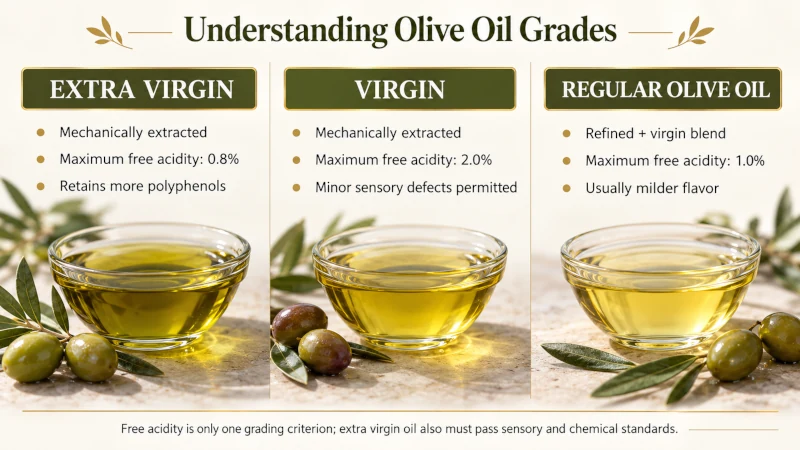
The International Olive Council (IOC) sets the grading system most countries follow. Virgin olive oils are produced only by mechanical means, with no refining or chemical solvents. Refined oils are processed to remove defects, which also removes most flavor and polyphenols [IOC Trade Standard, current revision].
| Grade | How it’s made | Maximum free acidity | What to know |
| Extra virgin | Mechanical extraction only | 0.8 g per 100 g | Must also pass a trained tasting panel: no defects, some fruitiness. Highest in polyphenols. |
| Virgin | Mechanical extraction only | 2.0 g per 100 g | Small sensory defects allowed. |
| Lampante virgin | Mechanical extraction | Above 3.3 g per 100 g | Not fit to eat; must be refined. |
| Refined olive oil | Refined from virgin oils | 0.3 g per 100 g | Neutral taste; few polyphenols. |
| “Olive oil” (often labeled “pure” or “light”) | Blend of refined and virgin oils | 1.0 g per 100 g | The most common supermarket bottle. |
| Olive-pomace oil | Solvent-extracted from the leftover olive paste, refined, blended with virgin oil | 1.0 g per 100 g (blend) | Cannot be sold simply as “olive oil.” |
Sources: IOC Trade Standard; EU olive oil category definitions [OCL, 2016].
Free acidity measures how much of the oil’s fat has broken down into free fatty acids, a sign of fruit quality and handling. It has nothing to do with sour taste, and it’s only one test: extra virgin oil must also meet a long list of chemical limits and pass a tasting panel. A low acidity number alone doesn’t make an oil extra virgin.
“Light” is the label people misread most often. It refers to a lighter flavor and color, not fewer calories; light olive oil has the same calories as any other olive oil [America’s Test Kitchen].
For health, extra virgin is the better buy because it keeps the polyphenols. Regular and light olive oils still give you the same monounsaturated fat.
Olive Oil vs. Seed Oils and Other Cooking Fats
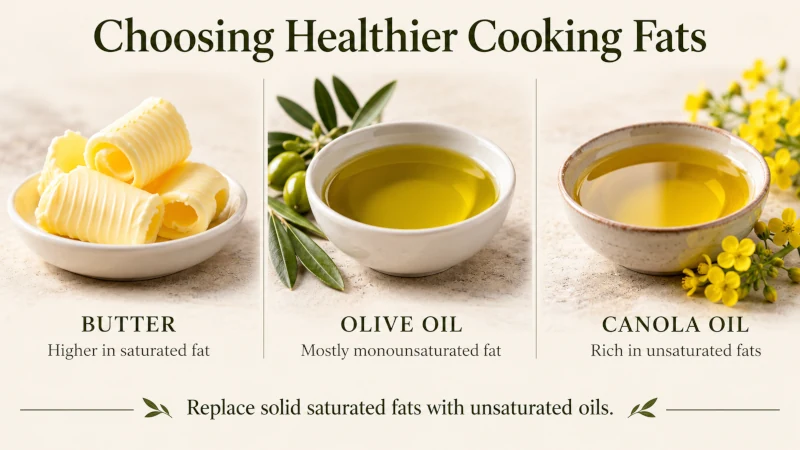
Olive oil is a very good choice, but not the only one — and seed oils aren’t the villains social media makes them out to be.
The American Heart Association lists canola, olive, and sunflower oils together as healthy, nontropical cooking oils, and recommends choosing oils with less than 4 grams of saturated fat per tablespoon over butter, lard, shortening, and tropical oils such as coconut and palm [AHA, Healthy Cooking Oils]. AHA News has also addressed the seed-oil backlash directly, noting that the omega-6 fats in these oils help lower LDL cholesterol and that the AHA supports including them in a healthy diet [AHA News, 2024].
The research lines up with that. In the large U.S. cohorts, olive oil beat butter, margarine, and mayonnaise but didn’t significantly beat other plant oils [Guasch-Ferré et al., 2020]. And in head-to-head lipid trials, several seed oils lowered LDL a little more than olive oil [Schwingshackl et al., 2018].
| Fat | Main type of fat | Where it stands out | Good uses |
| Extra virgin olive oil | Monounsaturated | Polyphenols, flavor, minimal processing | Dressings, drizzling, sautéing, roasting |
| Refined or “light” olive oil | Monounsaturated | Neutral taste | Baking, higher-heat cooking |
| Canola (rapeseed) oil | Monounsaturated, with some omega-3 | Among the strongest for lowering LDL in trials | Everyday cooking, baking |
| Sunflower, safflower, soybean, corn oil | Mostly polyunsaturated (omega-6); high-oleic versions are mostly monounsaturated | Lower LDL vs. butter | General cooking |
| Butter, lard, coconut and palm oil | Mostly saturated | — | Best kept occasional |
Extra virgin olive oil earns its reputation through its polyphenols and its central place in the best-tested eating pattern. The bigger win for your heart, though, is moving away from solid fats, whichever liquid oil you choose.
How Much Olive Oil Per Day?
No official body sets a daily olive oil target. A few numbers give useful guardrails:
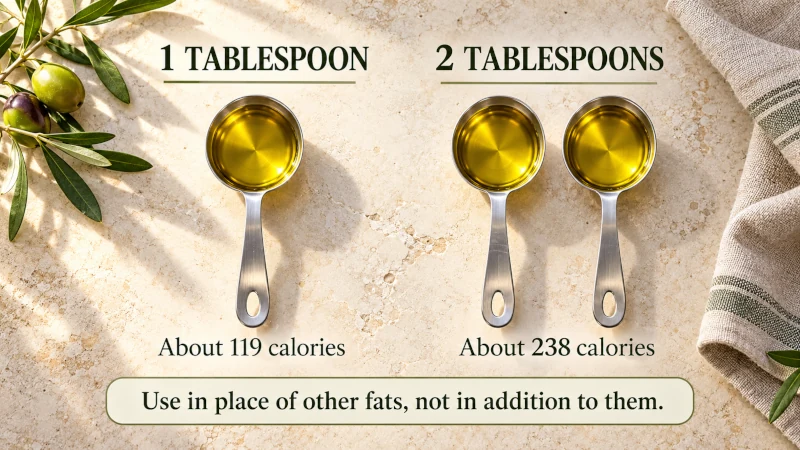
- The FDA’s qualified health claim is built around about 2 tablespoons (23 grams) a day, replacing saturated fat [FDA, 2004].
- In the Harvard cohorts, lower risk showed up at more than half a tablespoon a day [Guasch-Ferré et al., 2020].
- A meta-analysis of 13 cohort studies found little additional benefit beyond about 20 grams a day, roughly 1½ tablespoons [Xia et al., 2022].
For most people, then, 1 to 2 tablespoons a day, used in place of other fats, is a reasonable range. PREDIMED participants used considerably more, but inside a carefully structured diet.
Calories keep this honest. Two tablespoons add roughly 240 calories. Added on top of what you already eat, that can mean weight gain rather than heart benefit. Use it to replace butter on bread, cream-based dressings, or the stick margarine in a recipe.
Is Olive Oil Good for Cooking?
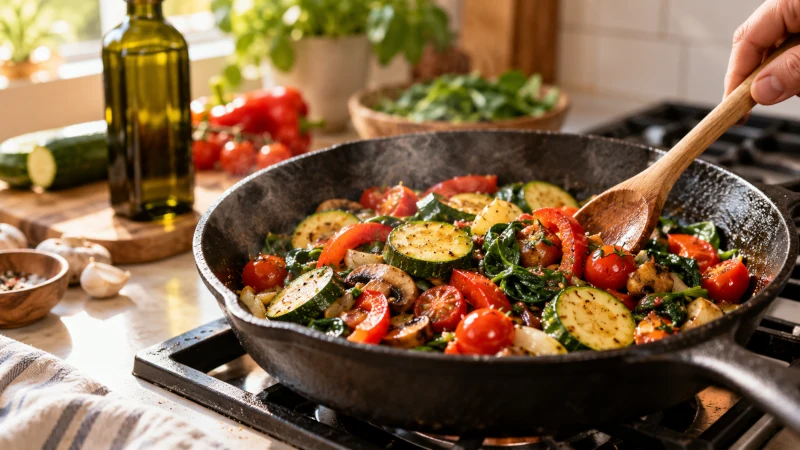
Yes, for ordinary home cooking. The smoke-point warning misses the more important question: how well an oil resists breaking down under heat.
The AHA lists olive oil among the oils that are generally safe for all cooking, including at higher temperatures, with two caveats: it doesn’t recommend deep-frying as a healthy cooking method, and it advises against reusing or reheating cooking oil [AHA, Healthy Cooking Oils].
One lab study heated extra virgin olive oil and other common oils to 240°C (464°F), and held them at 180°C (356°F) for six hours. Extra virgin olive oil produced the lowest level of polar compounds, a standard measure of breakdown products, and smoke point turned out to be a poor predictor of how an oil behaved [De Alzaa et al., 2018]. Treat this with care: it was a single study, run by a laboratory owned by an olive oil producer.
In practice:
- Extra virgin is fine for sautéing, roasting, and pan-frying. Its flavor shines brightest raw or lightly heated.
- Refined or light olive oil suits baking or dishes where you don’t want an olive flavor.
- Don’t let any oil smoke. If it does, the pan’s too hot; wipe it out and start again.
How to Choose and Store Olive Oil
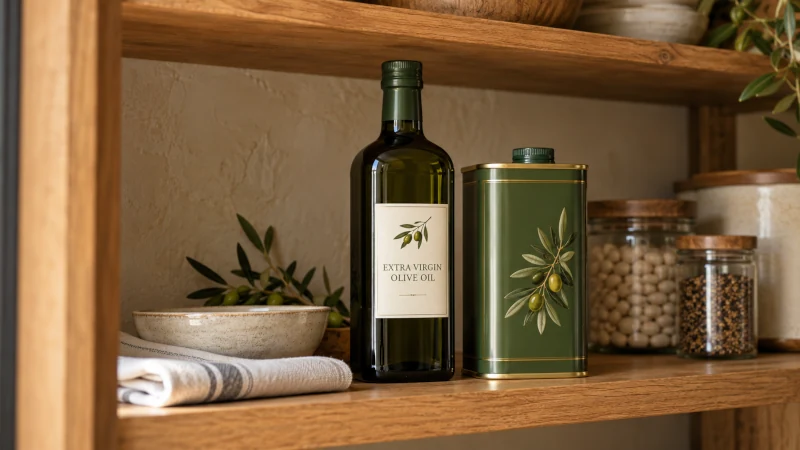
- Read the grade. For the polyphenols, buy oil labeled “extra virgin.” “Pure,” “light,” and plain “olive oil” are blends that contain refined oil.
- Look for freshness information. A harvest date or best-by date helps.
- Choose dark glass or a tin. Light degrades oil, so clear bottles under bright store lights are a poor bet.
- Consider a certification seal. Seals from the California Olive Oil Council (COOC) or the North American Olive Oil Association (NAOOA) add a quality check [AARP, 2022].
- Store it cool, dark, and closed. Keep it away from the stove, cap it tightly, and buy a size you’ll use up while it’s fresh. If it smells like crayons or stale nuts, it has gone rancid.
Possible Downsides and Precautions
Used as food, olive oil is safe for most people. The risks come from treating it as medicine or using a lot of it.
- Calories add up. At about 119 calories a tablespoon, olive oil is easy to overdo. The heart benefit depends on replacing other fats, not adding to them.
- Large doses can upset your stomach. Big spoonfuls, “olive oil shots,” and flushes can cause diarrhea, nausea, and cramping [Mayo Clinic, 2024].
- Gallstones. If fatty meals trigger gallbladder pain for you, large amounts of any oil can too. Moderate portions with meals are a different matter.
- It’s not a treatment. Don’t use olive oil in place of prescribed treatment for high cholesterol, heart disease, liver disease, gallstones, or chronic constipation.
- Pregnancy and breastfeeding. Olive oil in normal food amounts is part of many healthy diets. There’s no evidence-based reason to take concentrated “doses” of it.
- Olive supplements are a separate product. Olive leaf extracts and other concentrated preparations carry different evidence and cautions, which we cover in our guide to olive tree medicinal uses. And if you’re curious about eating whole olives, their salt content and nutrition differ from the oil’s.
Talk to a healthcare professional if you have high LDL cholesterol, heart disease, gallstones, or ongoing digestive symptoms, or before making big diet changes while on medication. Get urgent care for chest pain or pressure, sudden shortness of breath, or pain spreading to your arm, jaw, or back (call 911); for severe upper-right abdominal pain lasting several hours, especially with fever or yellowing of the skin or eyes; and for blood in your stool or a sudden, unexplained change in bowel habits.
| HEALTH DISCLAIMER: This article is for general education and is not medical advice, diagnosis, or treatment. Olive oil is a healthy food, not a medicine, and it shouldn’t replace care from a qualified professional. If you have heart disease, high cholesterol, gallbladder or liver disease, or digestive symptoms, or if you take prescription medication, are pregnant, or are breastfeeding, talk with your doctor or a registered dietitian before making significant changes to your diet. If you have symptoms of a heart attack or stroke, call 911. |
Frequently Asked Questions
Is extra virgin olive oil better than regular olive oil?
For health, yes, modestly. All olive oils provide the same monounsaturated fat, but extra virgin keeps far more polyphenols, and higher-polyphenol oils produced bigger improvements in HDL cholesterol and LDL oxidation in a controlled trial [Covas et al., 2006]. Regular olive oil is still a much better choice than butter.
Can you fry with olive oil?
You can sauté, roast, and pan-fry with it. The AHA considers olive oil generally safe at higher cooking temperatures, but it doesn’t recommend deep-frying as a healthy method and advises against reusing oil [AHA]. Frying doesn’t turn fried food into health food, whatever oil you use.
Is drinking olive oil in the morning good for you?
There’s no evidence that a morning shot of olive oil adds anything beyond using the same amount in your food. It does add about 119 calories per tablespoon. For constipation, the only good trial used about a teaspoon a day in people on dialysis [Ramos et al., 2015].
Is olive oil healthier than canola or other seed oils?
Not clearly. Both are healthy replacements for saturated fat. Large U.S. cohort studies found no significant difference between olive oil and other plant oils for heart disease or death [Guasch-Ferré et al., 2022], and canola lowered LDL slightly more in trials. Extra virgin olive oil’s edge is its polyphenols and flavor.
Can olive oil help with weight loss?
Not on its own. It’s calorie-dense, and adding it to your current diet can push weight up. It can be part of a satisfying eating pattern when it replaces other fats, and its flavor can make vegetables and whole grains easier to enjoy.
References
- Estruch R, Ros E, Salas-Salvadó J, et al.; PREDIMED Investigators. Primary prevention of cardiovascular disease with a Mediterranean diet supplemented with extra-virgin olive oil or nuts. View source
- Guasch-Ferré M, Liu G, Li Y, et al. Olive oil consumption and cardiovascular risk in U.S. adults. View source
- Guasch-Ferré M, Li Y, Willett WC, et al. Consumption of olive oil and risk of total and cause-specific mortality among U.S. adults. View source
- Xia M, Zhong Y, Peng Y, Qian C. Olive oil consumption and risk of cardiovascular disease and all-cause mortality: a meta-analysis of prospective cohort studies. View source
- U.S. Food and Drug Administration. View source
- U.S. Food and Drug Administration. FDA completes review of qualified health claim petition for oleic acid and the risk of coronary heart disease. View source
- Schwingshackl L, Bogensberger B, Benčič A, et al. Effects of oils and solid fats on blood lipids: a systematic review and network meta-analysis. View source
- Covas MI, Nyyssönen K, Poulsen HE, et al.; EUROLIVE Study Group. The effect of polyphenols in olive oil on heart disease risk factors: a randomized trial. View source
- Schwingshackl L, Christoph M, Hoffmann G. Effects of olive oil on markers of inflammation and endothelial function — a systematic review and meta-analysis. View source
- Toledo E, Salas-Salvadó J, Donat-Vargas C, et al. View source
- Markellos C, Ourailidou ME, Gavriatopoulou M, et al. Olive oil intake and cancer risk: a systematic review and meta-analysis. View source
- Olive oil intake and cardiovascular disease, cancer, and all-cause mortality: a systematic review and dose-response meta-analysis of prospective cohort studies. View source
- Regulation (EU) No 432/2012 olive polyphenol health claim, as reproduced in: EFSA health claims-based virgin olive oil shelf-life. View source
- International Olive Council. Trade Standard Applying to Olive Oils and Olive Pomace Oils, View source
- Definition and designation of olive oil categories (from Council Regulation (EC) 1513/2001). View source
- U.S. Department of Agriculture nutrient data, “Oil, olive, salad or cooking, 1 tablespoon,” via University Hospitals Health Library. View source
- American Heart Association. Healthy Cooking Oils. View source
- Williamson L. There’s no reason to avoid seed oils and plenty of reasons to eat them. American Heart Association News. View source
- Mayo Clinic. Gallbladder cleanse: a “natural” remedy for gallstones? View source
- Ramos CI, Andrade de Lima AF, Grilli DG, Cuppari L. The short-term effects of olive oil and flaxseed oil for the treatment of constipation in hemodialysis patients. View source
- De Alzaa F, Guillaume C, Ravetti L. Evaluation of chemical and physical changes in different commercial oils during heating. View source
- America’s Test Kitchen. “Light” olive oil. View source
- AARP. Healthy cooking oils: which is the right choice for you? View source


