
Lobelia inflata has been part of North American herbal practice for centuries — first among Indigenous peoples of the eastern United States, then among 18th- and 19th-century herbalists who prized it for respiratory complaints, spasms, and as a powerful emetic. Today it still appears in tinctures, capsules, and topical preparations, often described as a relaxant, expectorant, and antispasmodic.
The honest summary on the benefits of lobelia is this: the plant has genuine pharmacological activity, but most human evidence is preliminary or absent. Its main active compound, lobeline, behaves somewhat like nicotine in the body — which explains both its traditional uses and its real toxicity risks. Small doses may have antispasmodic and expectorant effects; large doses can cause serious harm. This article explains what is known, what is uncertain, and what you need to know to use it safely — or to decide against using it.
| SAFETY FIRST: Lobelia is considered likely unsafe when taken by mouth, according to WebMD and Drugs.com. Doses of 0.6–1 gram of the dried leaf are classified as toxic; 4 grams may be fatal. Do not self-treat with lobelia, and do not increase doses beyond the lowest traditional guidance without consulting a healthcare provider. |
What Is Lobelia?
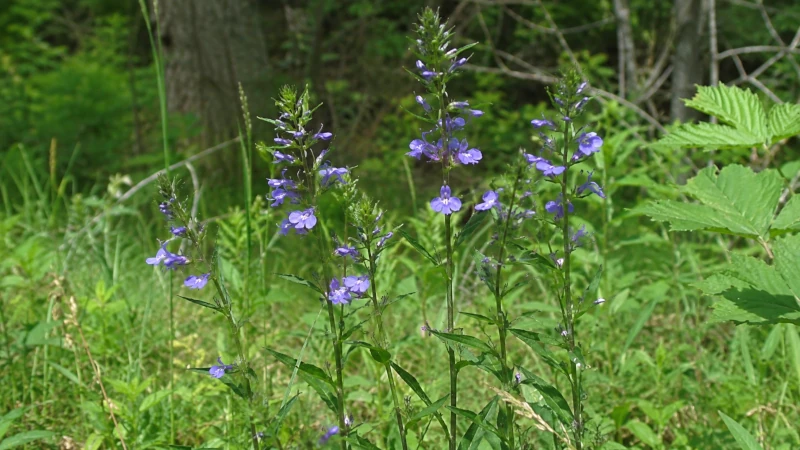
Lobelia inflata is a branching annual herb native to the eastern half of North America. It grows 30–90 cm tall and produces small violet-to-pinkish flowers; the base of each flower swells into a seed capsule — the origin of the species name “inflata.” The plant and seeds are the parts traditionally used medicinally.
Lobelia belongs to the Campanulaceae (bellflower) family and shares its genus with more than 400 recognized species, some of which contain similar alkaloids. The genus was named in honor of Matthias de Lobel, a 16th-century Flemish physician and botanist. American Indians smoked the leaves and used them for respiratory ailments; the plant entered broader medical practice in New England during the 18th century.
Its chemistry centers on a group of piperidine alkaloids — chiefly lobeline, along with lobelanine, norlobelanine, lobelanidine, and others — as well as flavonoids including apigenin, luteolin, and quercetin. Lobeline concentration is highest in the seeds. [Drugs.com, 2026]
Medicinal Properties and Traditional Uses
Herbalists have historically described lobelia in four overlapping roles:
- Antispasmodic — relaxing smooth and skeletal muscle spasms
- Expectorant — loosening and helping clear mucus from the airways
- Nervine — calming the nervous system in small doses
- Emetic — inducing vomiting in large doses
The dose-dependent nature of these effects is central to understanding the herb. Very small amounts (traditionally 5–10 drops of tincture) may relax spasms. Slightly larger doses produce sedation. In large amounts — 40 drops of tincture or two gelatin capsules or more — the herb acts as a potent emetic. Historically, herbalists used it to clear the stomach in cases of food poisoning or accidental ingestion, though this use carries serious risks and has been superseded by modern emergency care.
Respiratory use has been the most documented application. Lobelia was used for asthma, whooping cough, bronchitis, and pleurisy, where its putative ability to relax bronchial muscle and promote mucus clearance made it attractive. For an overview of other botanical options in this category, see our article on herbs for the lungs.
Beyond the lungs, traditional use included headache, heart palpitation, indigestion, rheumatism, fevers, and topical application for skin complaints, muscle spasms, bruises, sprains, and insect bites. Small amounts placed in the ear were used for earache. These uses are not supported by clinical trials.
Herbalists often combined lobelia with complementary nervines. The herb has been paired with skullcap for nervous conditions, and with lady’s slipper for convulsive states — both herbs having their own histories in nervine formulas.
What the Research Actually Shows
Respiratory Effects
Lobeline shares some receptor-level activity with nicotine — it binds to nicotinic acetylcholine receptors, stimulates breathing in low doses, and can thin bronchial secretions. Drugs.com notes that these properties explain its traditional use for respiratory complaints, but also notes that with the development of more effective medications, “lobelia use in respiratory conditions has become obsolete.”
Animal research has shown some anti-inflammatory effects in lung tissue, but no adequately controlled human clinical trials exist for asthma or other respiratory conditions. The evidence does not support using lobelia as a replacement for prescribed inhalers or other respiratory treatments. [Drugs.com, 2026; WebMD, 2026]
Smoking Cessation
Because lobeline resembles nicotine pharmacologically, it was used in commercial smoking-cessation lozenges, patches, and gums for many decades. The FDA banned all over-the-counter lobeline products for this purpose in 1993, citing a lack of acceptable clinical efficacy data. A Cochrane systematic review (Stead and Hughes, 2012; PMID 22336780; CD000124) found no long-term randomized trials meeting inclusion criteria and noted that one large short-term trial detected no benefit. [Cochrane Library; Drugs.com, 2026]
Depression and CNS Effects
Preclinical animal studies suggest lobeline may have antidepressant and anxiolytic properties — reducing depressive behaviors and stress hormones in mice in some experiments. One small human trial (N=42, only 9 completers) in adults with ADHD found no significant difference from placebo. These are early-stage, insufficient-evidence findings. [Healthline, 2024; Drugs.com, 2026]
Drug Addiction
Animal studies suggest lobeline may reduce self-administration of amphetamine, methamphetamine, and heroin — possibly by affecting dopamine release in a different way than nicotine. Human studies are lacking. This remains experimental research only and cannot support any clinical recommendation.
Summary of Evidence Strength
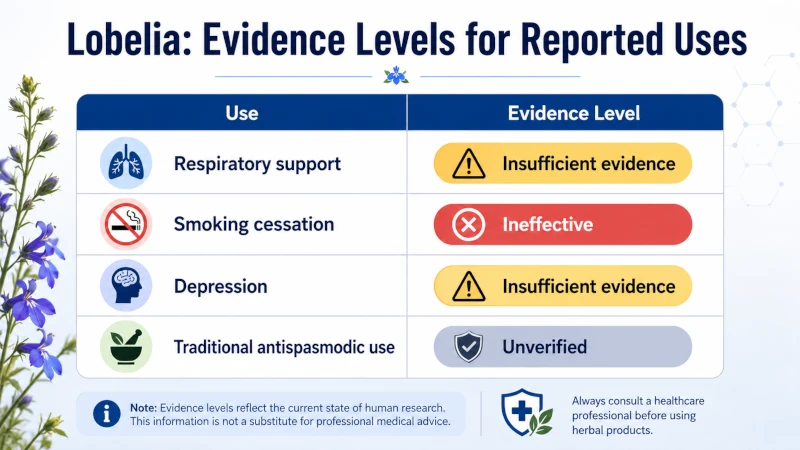
| Claimed Use | Evidence Level | Practical Takeaway |
| Respiratory (asthma, cough) | Insufficient — animal data only | Cannot replace prescribed treatment |
| Smoking cessation | Possibly ineffective — FDA-banned OTC; Cochrane: no benefit | Not recommended |
| Depression / ADHD | Insufficient — animal data; one small failed human trial | Not an alternative to treatment |
| Drug addiction (preclinical) | Very early — animal studies only | Research stage only |
| Antispasmodic / expectorant (traditional) | Traditional use; no controlled human trials | Unverified in clinical settings |
Safety, Side Effects, and Toxicity
Lobelia’s safety profile is one of the most important things to understand before considering it. The dose range between a potential therapeutic effect and a toxic one is narrow.
Adverse Effects at Low-to-Moderate Doses
Even at modest doses, lobelia and lobeline can cause nausea, diarrhea, coughing, dizziness, tremors, mouth numbness, and increased blood pressure. Respiratory effects — including sensations of choking or breathlessness — have also been described.
Serious Effects at High Doses
At higher doses, lobelia’s alkaloids are cardioactive. Documented cardiotoxicities include hypotension (low blood pressure), tachycardia (rapid heart rate), and convulsions. In severe overdose, symptoms include diaphoresis (heavy sweating), hypothermia, hypotension, coma, and potentially death. Toxic doses of the dried leaf are described as 0.6–1 gram; 4 grams is considered potentially fatal. [WebMD, 2026; Drugs.com, 2026]
Interactions
Lithium: Lobelia may have a diuretic-like effect that reduces the body’s clearance of lithium, potentially leading to lithium toxicity. If you take lithium, do not use lobelia without medical supervision. [WebMD, 2026]
Nicotine-containing products: Because lobeline acts at nicotinic receptors, combining it with nicotine-based medications or patches could produce additive or unpredictable effects. Discuss with a healthcare provider.
No other drug interactions are well-documented, but the absence of documented interactions in a poorly-studied herb should not be taken as reassurance that none exist.
Pregnancy and Breastfeeding
Avoid lobelia during pregnancy. Adverse effects including loss of uterine tone have been documented. Evidence of safety during breastfeeding is completely lacking. Both WebMD and Drugs.com classify oral lobelia use as likely unsafe during pregnancy and breastfeeding. [WebMD, 2026; Drugs.com, 2026]
Who Should Avoid Lobelia
- Pregnant or breastfeeding individuals
- Children (safety data are absent)
- People with heart disease or arrhythmias
- People with peptic ulcers, Crohn’s disease, or other GI conditions (lobelia irritates the GI tract)
- Anyone taking lithium
- Anyone using nicotine replacement therapy
When to Seek Urgent Care
If you or someone else takes lobelia and experiences any of the following, seek emergency medical care immediately:
- Rapid or irregular heartbeat
- Severe vomiting or inability to stop vomiting
- Convulsions or seizures
- Loss of consciousness or extreme drowsiness
- Breathing difficulty or choking sensation
- Heavy sweating with cold skin (signs of shock)
Traditional Dosage and Available Forms
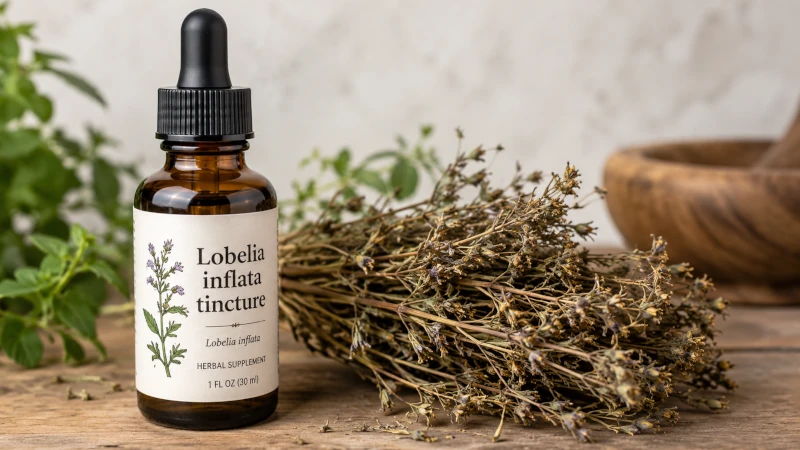
No standardized dosing exists because clinical trials are lacking. Traditional herbalist guidance, which does not carry the weight of evidence-based dosing, is included here for informational context only. These ranges were derived from historical use, not from controlled safety studies.
| Form | Traditional Range | Notes |
| Infusion (tea) | 1 tbsp as needed | Steep 5–15 min. Not a therapeutic standard. |
| Tincture | 10–30 drops as needed | Traditionally, 5–10 drops for relaxant effect; 40+ drops emetic range. Lower end only. |
| Fluid extract | 5–30 drops as needed | More concentrated than tincture; exercise extra caution. |
| Dried herb / capsule | Up to 100 mg 3x/day (traditional) | Drugs.com notes 0.6–1 g is toxic and 4 g may be fatal. Keep well below toxic threshold. |
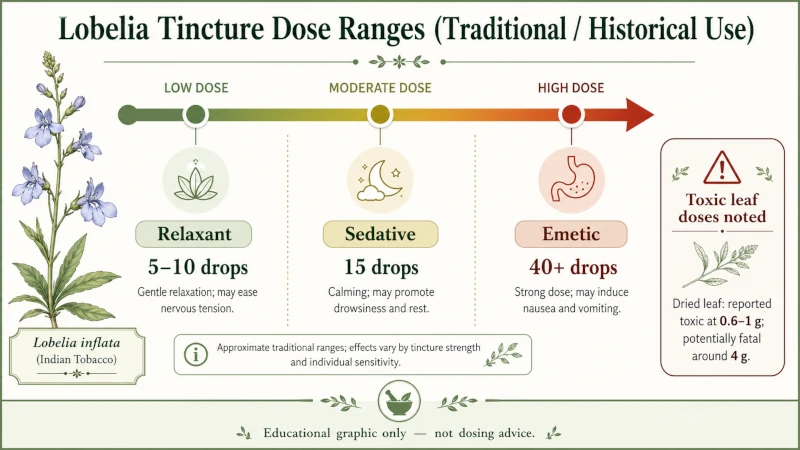
These ranges are historical. No clinical trial has established a safe and effective therapeutic dose for any condition. Consult a qualified herbalist or healthcare provider before using lobelia, and never increase doses on your own.
For context on how lobelia fits within a broader respiratory herbal approach, see our guides on natural asthma relief and herbs for the lungs.
Topical and External Uses
Traditionally, lobelia has also been used externally — added to baths, fomentations, poultices, and salves for muscle spasms, and to liniments for sore muscles, pain, and rheumatism. A small amount of the tincture was placed in the ear for earache, and the herb was applied to bruises, sprains, poison ivy reactions, and insect bites.
There is no clinical trial evidence for any of these topical applications. Skin safety data are insufficient; WebMD notes there is not enough reliable information to determine topical safety or side effects. Contact dermatitis has been reported from occupational contact with related Lobelia richardii.
The Lobeline–Nicotine Connection: A Cautionary Tale
Lobeline is structurally and pharmacologically related to nicotine — both bind to nicotinic acetylcholine receptors — but lobeline is not as potent and behaves differently at various receptor subtypes. For decades this similarity fueled hope that lobeline could serve as a non-addictive substitute to help people quit smoking.
That hope did not survive clinical testing. The FDA removed lobeline-containing OTC smoking cessation products from the U.S. market in 1993, citing a lack of acceptable clinical efficacy data. A Cochrane systematic review (Stead and Hughes, 2012) found no adequate long-term randomized controlled trials and concluded there is no evidence that lobeline aids smoking cessation; one large short-term trial found no benefit. [Cochrane Library, CD000124]
The story matters for two reasons. First, it illustrates that mechanistic plausibility — the fact that lobeline touches the same receptors as nicotine — did not translate into real-world efficacy. Second, it is a reminder that the regulatory history of this herb is specifically one of removal from the market for a lack of safety and effectiveness evidence, not approval.
| HEALTH DISCLAIMER: The information in this article is for educational purposes only. It is not a substitute for professional medical advice, diagnosis, or treatment. Lobelia inflata carries genuine toxicity risk; doses that cause harm are not far above any doses that might have therapeutic effect. Do not use lobelia to self-treat asthma, respiratory disease, or any other medical condition. Do not use it as a substitute for smoking cessation support; FDA-approved options with proven efficacy exist. Do not take lobelia if you are pregnant, breastfeeding, taking lithium, or have heart disease. Always consult a qualified healthcare provider before using any herbal supplement. If you experience an adverse reaction, contact emergency services or call Poison Control (US: 1-800-222-1222). |
Frequently Asked Questions
Is lobelia safe to take?
In the doses commonly found in herbal preparations, lobelia may cause nausea, dizziness, and vomiting in some people. At higher doses it can cause serious cardiovascular effects, seizures, and potentially death. WebMD classifies it as “likely unsafe” when taken by mouth. It is not recommended for self-treatment without professional supervision.
Can lobelia help with asthma?
There are no controlled human clinical trials supporting lobelia as a treatment for asthma. Animal studies suggest it may have some anti-inflammatory and bronchial-relaxing effects, but these findings have not been replicated in humans. Do not substitute lobelia for prescribed asthma medications.
Did lobelia really cure whooping cough?
Lobelia was used historically for whooping cough — its antispasmodic and expectorant effects may have provided symptom relief. But “used historically” is not the same as “proven effective.” No modern clinical evidence supports lobelia as a treatment for whooping cough, which is now preventable by vaccination and treatable with antibiotics.
Why did the FDA ban lobelia for smoking cessation?
In 1993, the FDA required the removal of OTC lobeline products for smoking cessation because clinical studies failed to demonstrate efficacy. A Cochrane review confirmed there is no evidence from long-term trials that lobeline aids smoking cessation. The ban is still in effect.
Can I use lobelia with other herbs?
Traditional formulas often combined lobelia with other nervines and antispasmodics such as skullcap and lady’s slipper. If you are considering a herbal formula containing lobelia, have it reviewed by a qualified herbalist or naturopathic doctor who can assess the full combination in the context of your health history and medications.
What are the signs of lobelia overdose?
Signs of a potentially serious reaction include profuse sweating, very rapid heartbeat, seizures, low blood pressure, extreme pallor or cold clammy skin, vomiting that will not stop, and loss of consciousness. If any of these occur, call emergency services immediately. In the US you can also contact Poison Control at 1-800-222-1222.
References
- Drugs.com Herbal Database — Lobelia. Last updated February 19, 2026. https://www.drugs.com/npp/lobelia.html
- WebMD Vitamins & Supplements — Lobelia. https://www.webmd.com/vitamins/ai/ingredientmono-231/lobelia
- Healthline — What Is Lobelia, and How Is It Used? Updated September 26, 2024. By Lizzie Streit MS RDN; medically reviewed by Megan Soliman MD. https://www.healthline.com/nutrition/lobelia
- Stead LF, Hughes JR. Lobeline for smoking cessation. Cochrane Database Syst Rev. 2012;2:CD000124. doi:10.1002/14651858.CD000124.pub2. PMID: 22336780. https://www.cochranelibrary.com/cdsr/doi/10.1002/14651858.CD000124.pub2/abstract
