
If you’ve ever crushed a lemon verbena leaf between your fingers and caught that clean, sherbet-lemon scent, you already understand why people have been drinking it after dinner for two centuries. The honest short version of the lemon verbena health benefits story is this: it’s a genuinely pleasant, low-risk herbal tea with a long traditional record for helping people wind down and settle a restless stomach — and a small but growing set of human studies that back up the calming and recovery effects, without proving it treats any disease.
That gap between “traditionally used for” and “proven to cure” matters, so this guide keeps them separate the whole way through.
What lemon verbena is
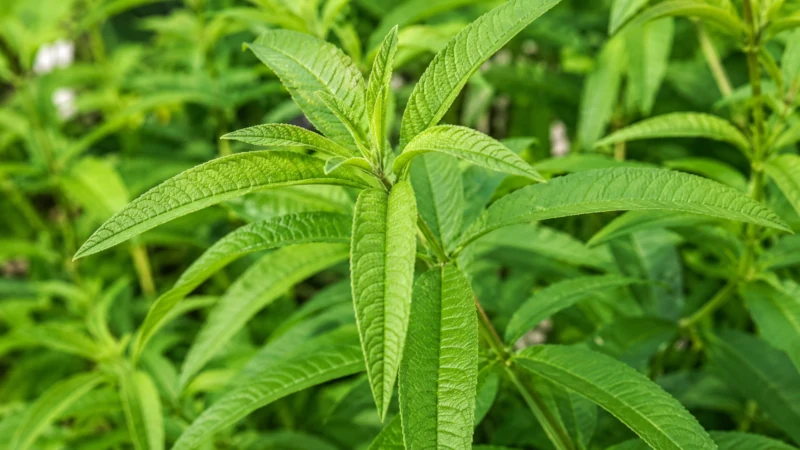
Lemon verbena (Aloysia citrodora, also written Aloysia triphylla or Lippia citriodora) is a lemon-scented shrub in the Verbenaceae family, native to South America and widely grown around the Mediterranean as an aromatic garden plant. The leaves are the part used — dried for tea, distilled for essential oil, or concentrated into standardized extracts for supplements.
What’s inside those leaves explains most of the interest. The essential oil is dominated by citral (a blend of geranial and neral), alongside limonene, and lesser amounts of compounds like geraniol and caryophyllene — though the exact profile shifts a lot with where and when the plant is grown (Bahramsoltani et al. review, Journal of Ethnopharmacology, 2018). The water-soluble side of the leaf is rich in polyphenols, especially verbascoside, which is the compound most often credited for the plant’s antioxidant activity (Drugs.com professional monograph, 2025).
What lemon verbena health benefits the evidence actually supports
Calm and sleep — the best-supported use
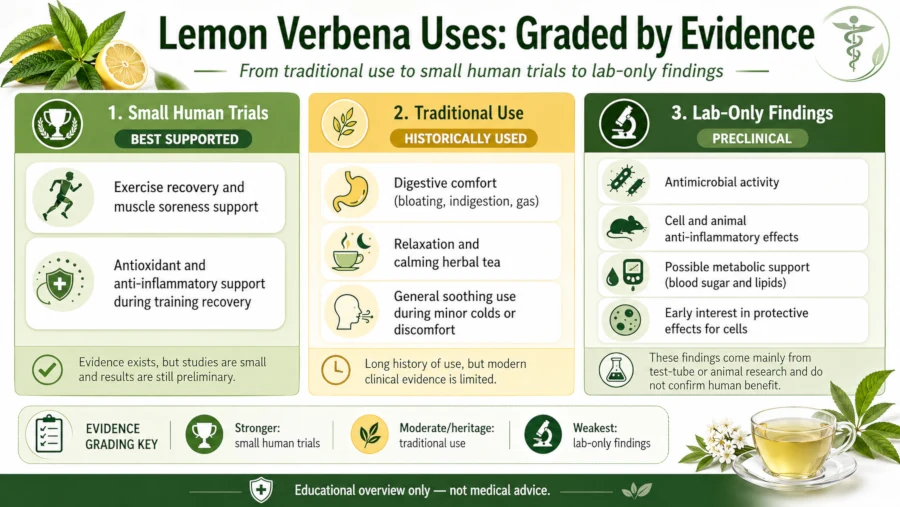
This is where lemon verbena has both the strongest tradition and the most encouraging human data. Europe’s medicines regulator has finalized a herbal monograph recognizing lemon verbena leaf as a traditional herbal medicinal product “for relief of mild symptoms of mental stress and to aid sleep” (EMA traditional-use herbal monograph, 2021). That status is important to read correctly: it reflects long-standing, plausible use rather than proof from large clinical trials.
Small trials do exist, and they lean positive. In a randomized, double-blind, placebo-controlled study of 100 people with insomnia, a lemon verbena syrup taken before bed for four weeks improved sleep-quality and insomnia-severity scores significantly more than placebo (Afrasiabian et al., Phytotherapy Research, 2019). A separate 2024 trial in 71 healthy adults with sleep problems found that three months of a lemon verbena extract improved several Pittsburgh Sleep Quality Index measures compared with placebo (Pérez-Piñero et al., Nutrients, 2024).
The realistic takeaway: these are small, mostly short studies, several using concentrated proprietary extracts rather than a mug of tea. They’re enough to make lemon verbena a reasonable part of a calming evening routine — the way you might reach for a gentle nervine tea blend — but not enough to treat a diagnosed anxiety disorder or chronic insomnia.
Digestion, bloating, and gas
Lemon verbena’s second traditional role is digestive. The same European monograph recognizes it for “symptomatic treatment of mild gastrointestinal complaints including bloating and flatulence” (EMA traditional-use herbal monograph, 2021). This fits its classic reputation as a carminative and antispasmodic — a warm after-dinner tea that helps relax the gut and ease the trapped-gas feeling.
Here the evidence is mostly traditional use supported by laboratory and animal work rather than human trials, so it’s fair to treat it as a comfort measure for everyday, minor upset — one of many mild herbs people turn to for stomach issues — not a remedy for a real digestive condition.
Exercise recovery and oxidative stress
This is the most active area of modern research on the plant. Because lemon verbena polyphenols are antioxidants, several small randomized trials have tested whether a concentrated extract can blunt the muscle damage and oxidative stress that hard exercise produces. A placebo-controlled trial of 44 active adults found that a proprietary lemon verbena extract (400 mg/day) improved some markers of muscle recovery after an exhausting workout (Buchwald-Werner et al., J. Int. Soc. Sports Nutr., 2018), and a later trial of 60 participants reported reduced muscle soreness and damage markers with a similar extract and dose (Lee et al., 2021).
It’s promising, and consistent across studies — but the trials are small and use standardized commercial extracts, not tea. If muscle recovery is your goal, that distinction is the whole ballgame.
Antioxidant and anti-inflammatory activity
Lemon verbena extract reliably shows antioxidant and anti-inflammatory activity in the lab, driven largely by verbascoside and citral (Bahramsoltani et al. review, 2018). This is real and repeatable — but “reduces oxidative stress in a test tube” is a mechanism, not a health outcome. It helps explain why the recovery trials turned out the way they did; it doesn’t by itself mean drinking the tea prevents disease.
Where the evidence is still thin
A few claims float around the internet that the current science doesn’t carry. Lemon verbena essential oil has antimicrobial activity against certain bacteria and fungi in lab studies, and some cell-line work has looked at anticancer effects — but neither has been shown to translate into treating infections or cancer in people.
Early studies on weight, appetite, and inflammatory markers in multiple sclerosis are preliminary and often use combination products. As two major drug-information references put it plainly, good clinical evidence for most of lemon verbena’s popular uses is still lacking (WebMD, 2026; Drugs.com, 2025). Treat those uses as interesting leads, not reasons to take it.
How to use lemon verbena (and how much)
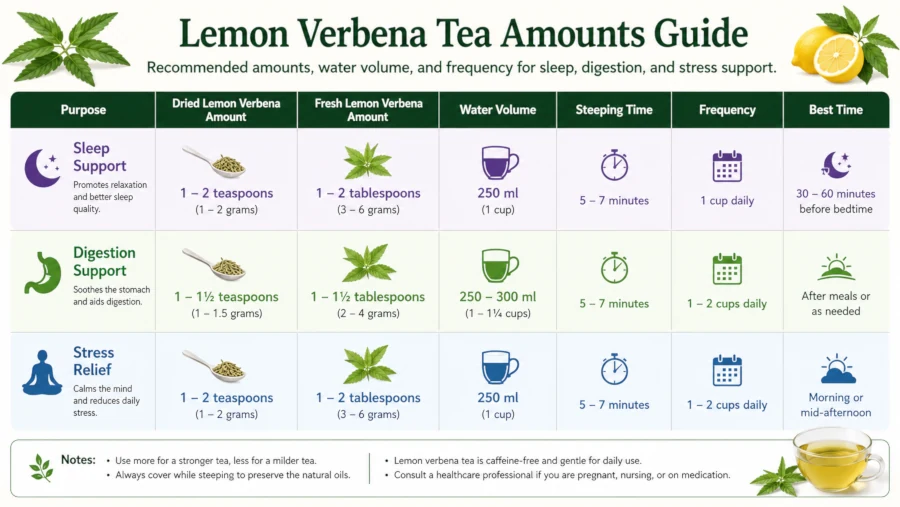
For most people, lemon verbena means tea, and the European monograph gives sensible, specific amounts for the traditional uses (EMA, 2021):
| Purpose | Amount of dried leaf | Water | How often |
| To aid sleep | 1–2 g | 200 mL boiling water (infusion) | About 30 minutes before bed |
| Mild digestive discomfort | 2–3 g (or 1 g for a weaker cup) | 200 mL boiling water (infusion) | 1–3 times daily (or up to 5 times for the 1 g cup) |
| Mild mental stress | 5 g | 100 mL boiling water (decoction) | 3 times daily |
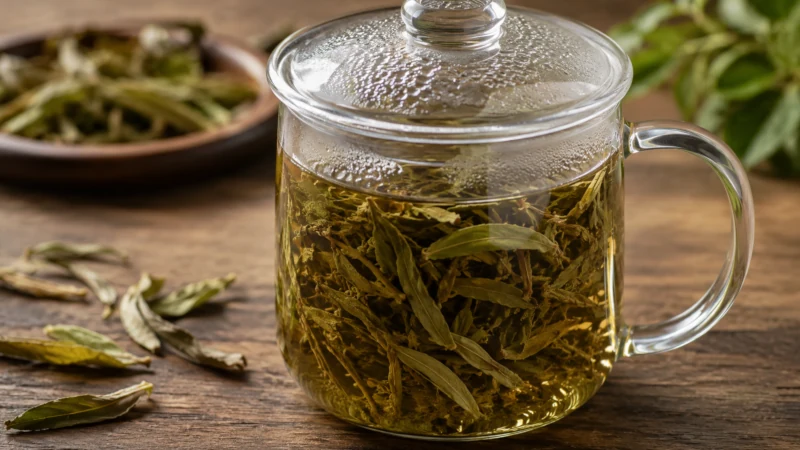
Cover the cup while it steeps to keep the aromatic oils from drifting off in the steam, and let it cool from scalding before you sip. A practical rule from the same guidance: if your symptoms last longer than about two weeks despite the tea, stop self-treating and check in with a clinician.
Two clarifications worth making. First, the concentrated extracts used in the sleep and exercise studies aren’t the same as tea, so you can’t assume a cup delivers the same dose. Second, lemon verbena essential oil is a concentrated product for aromatherapy and flavoring — it isn’t meant to be swallowed by the spoonful the way the leaf infusion is.
Safety, side effects, and who should avoid it
Lemon verbena leaf tea has a reassuring safety record. The European regulator lists no known side effects at traditional tea doses and no reported drug interactions — but that reflects an absence of formal studies, not a guarantee, so it shouldn’t be read as “proven completely safe” (EMA, 2021).
A few cautions are worth taking seriously:
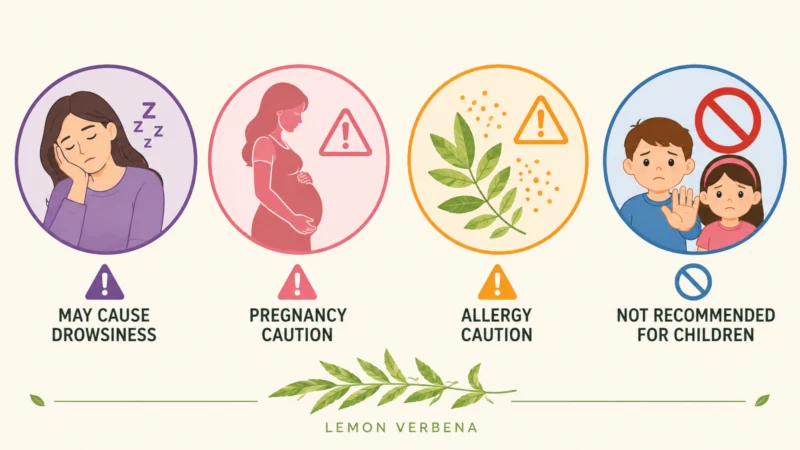
- Allergy. Avoid it if you’re hypersensitive to lemon verbena or other plants in the Verbenaceae family.
- Drowsiness and driving. The monograph specifically warns that the product may impair your ability to drive or operate machinery, and that affected people shouldn’t do either. If it relaxes you as intended, treat it like anything mildly sedating — and be cautious about combining it with other sedatives or sleep aids.
- Concentrated extracts. Formal tests for reproductive toxicity, genotoxicity, and carcinogenicity haven’t been done, which is another reason to be more conservative with high-dose supplements than with an occasional cup of tea.
Pregnancy, breastfeeding, and children
Because there isn’t enough safety data, the European guidance recommends not using lemon verbena during pregnancy or breastfeeding, and does not recommend it for children (EMA, 2021). If you’re in any of those groups, talk to your doctor or midwife before using it in any medicinal amount.
When to see a healthcare professional
Herbal tea is for minor, everyday complaints. Seek proper medical care — don’t rely on lemon verbena — if you have any of these:
- Digestive symptoms that are severe or persistent, or that come with blood in the stool, black stools, unexplained weight loss, repeated vomiting, or fever
- Insomnia or anxiety that’s worsening, disrupting your daily life, or lasting more than a couple of weeks
- Any thoughts of self-harm — contact a crisis line or your doctor right away
- A new symptom that simply doesn’t fit “mild and occasional”
For ongoing low mood or anxiety in particular, a tea is at most a small comfort alongside real care; here’s a broader look at recognizing anxiety and depression and when to get help, and at foods that support the nervous system as part of a bigger picture.
| Health Disclaimer: This article is for general educational purposes only and is not a substitute for professional medical advice, diagnosis, or treatment. Lemon verbena is a traditional herbal tea; it is not a proven treatment, cure, or preventive for any disease. Always speak with a qualified healthcare professional before using it in medicinal amounts — especially if you are pregnant or breastfeeding, are giving it to a child, take prescription medication (including sedatives), have a medical condition, or have new or worsening symptoms. |
Frequently Asked Questions
Is lemon verbena good for sleep?
It may gently help. A traditional-use herbal monograph recognizes it as an aid to sleep, and small placebo-controlled trials have shown modest improvements in sleep quality (Afrasiabian et al., 2019; Pérez-Piñero et al., 2024). It’s a reasonable part of a wind-down routine, but not a treatment for chronic insomnia.
Does lemon verbena tea help digestion?
Is lemon verbena the same as lemon balm?
No. They share a lemony scent and a calming reputation but are different plants (lemon verbena is Aloysia citrodora; lemon balm is Melissa officinalis) with different chemistry and separate research.
Can I drink lemon verbena tea while pregnant?
Current guidance advises against it during pregnancy and breastfeeding because there isn’t enough safety data (EMA, 2021). Check with your doctor or midwife first.
Are there side effects?
At normal tea amounts, reported side effects are minimal, but it may cause drowsiness — enough that official guidance warns against driving if you’re affected. Avoid it if you’re allergic to plants in the Verbenaceae family, and be more cautious with concentrated extracts than with tea.
Does lemon verbena help muscle recovery after exercise?
A few small trials of concentrated lemon verbena extract (around 400 mg/day) suggest reduced muscle soreness and damage markers after intense exercise (Buchwald-Werner et al., 2018). Those results used supplements, not tea, so a cup won’t deliver the same dose.
References
- European Medicines Agency (HMPC). European Union herbal monograph on Aloysia citrodora Paláu … folium (EMA/HMPC/376770/2019), adopted 13 Jan 2021. → View source | Monograph PDF
- Bahramsoltani R, Rostamiasrabadi P, Shahpiri Z, Marques AM, Rahimi R, Farzaei MH. Aloysia citrodora Paláu (Lemon verbena): A review of phytochemistry and pharmacology. J Ethnopharmacol. 2018;222:34–51. → View source (DOI)
- Afrasiabian F, Mirabzadeh Ardakani M, Rahmani K, et al. Aloysia citriodora Palau (lemon verbena) for insomnia patients: a randomized, double-blind, placebo-controlled clinical trial. Phytother Res. 2019;33(2):350–359. → View source (DOI)
- Pérez-Piñero S, et al. Dietary supplementation with an extract of Aloysia citrodora (lemon verbena) improves sleep quality in healthy subjects. Nutrients. 2024. → View source (PMC11123999)
- Buchwald-Werner S, et al. Effects of lemon verbena extract (Recoverben) supplementation on muscle strength and recovery after exhaustive exercise. J Int Soc Sports Nutr. 2018;15:5. → View source (DOI)
- Lee MC, et al. Efficacy of supplementation with Planox lemon verbena extract in improving oxidative stress and muscle damage. 2021 (NCT04742244). → View source (PMC8176190)
- WebMD. Lemon Verbena — Uses, Side Effects, and More. → View source
- Drugs.com. Lemon Verbena — professional monograph (updated Dec 2025). → View source
