
If you’ve been rubbing peppermint oil on your stomach or diffusing lavender at night hoping it’ll get things moving, here’s the honest picture: essential oils for constipation have some real, if modest, research behind them for the discomfort around constipation — cramping, bloating, the general misery of feeling backed up. What they don’t have is strong evidence that they act as a laxative on their own. A few small trials, mostly in older adults, mostly using massage rather than a diffuser, are the actual foundation under a much bigger pile of marketing claims.
That’s not a reason to write off essential oils entirely. It’s a reason to know which claims are backed by something real, which ones are traditional use dressed up as science, and which ones carry safety concerns nobody mentioned. This guide sorts through all three.
Do Essential Oils Actually Relieve Constipation?
Constipation happens when stool moves too slowly through the colon, giving your body more time to pull water out of it — the result is stool that’s harder, drier, and more difficult to pass [Mayo Clinic, 2025]. Fewer than three bowel movements a week, straining, or a sense of incomplete emptying are the usual signs.
The therapies with the strongest track record for fixing that are unglamorous: more fiber, more fluid, regular movement, and a consistent bathroom routine [Mayo Clinic, 2025]. Essential oils sit in a different category. Most of what’s been studied involves massaging diluted oil into the abdomen, not simply smelling the oil or dabbing it on skin — and most of the trials are small, short, and conducted in nursing-home populations, which limits how confidently the results apply to a healthy 35-year-old with occasional constipation.
The National Center for Complementary and Integrative Health, the U.S. government’s own research center on this topic, is blunt about it: aromatherapy is used for a range of conditions, but “little rigorous research has been done” overall [NCCIH, 2020].
None of that means essential oils are useless. It means the honest answer to “do they work” is: maybe, modestly, mostly through massage, and not instead of the basics.
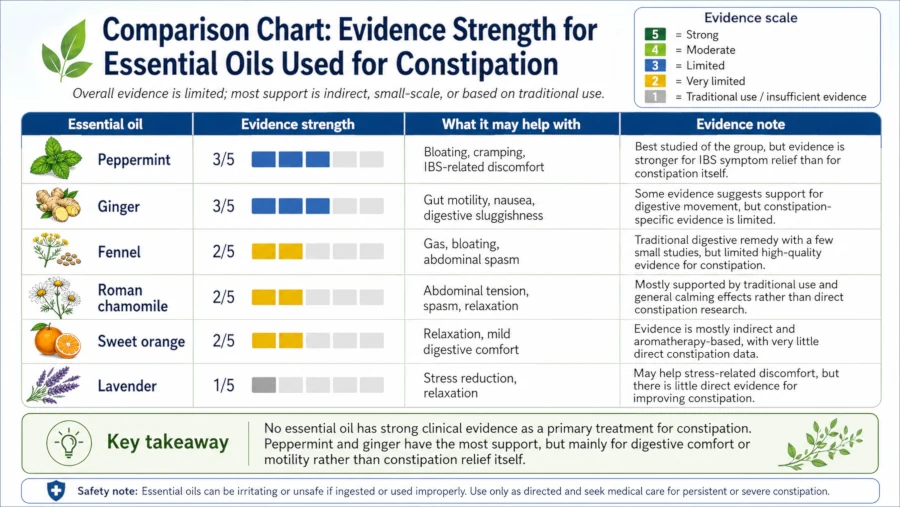
Evidence at a Glance
| Oil | What’s actually been studied | Strength | Key caution |
| Peppermint | One small massage trial (with rosemary and lemon); stronger evidence is for oral, enteric-coated capsules and IBS symptoms — not plain constipation | Limited / indirect | Can worsen heartburn or reflux |
| Ginger | One massage trial (with lavender); oral ginger evidence is about speeding stomach emptying, not colon transit | Limited | May increase bleeding risk with blood thinners |
| Fennel | Mostly studied as part of multi-herb combination products (often with senna), not as the isolated oil | Traditional / indirect | Contains estragole, flagged by EU food-safety regulators for pregnancy and child safety |
| Rosemary | Same single small massage trial as peppermint and lemon | Limited | Pregnancy guidance is mixed — reasonable to avoid |
| Lemon | Same single small massage trial | Limited | Photosensitizing — avoid sun exposure on treated skin |
| Lavender | One massage trial (with ginger); best-studied use overall is an oral capsule for anxiety, not constipation | Limited for constipation; stronger for stress | Generally low risk when properly diluted |
The Oils People Reach For, and What’s Actually Known
Peppermint Oil
Peppermint’s menthol relaxes smooth muscle, which is the basis for its best-documented use: enteric-coated peppermint oil capsules, taken orally, for irritable bowel syndrome. A 2019 meta-analysis of 12 randomized trials (835 patients) found peppermint oil improved global IBS symptoms and abdominal pain compared with placebo, though a later, more cautious review rated the overall evidence quality as very low and noted peppermint oil also came with more side effects than placebo [Alammar et al., 2019]. That’s a specific product (a coated capsule swallowed whole) tested for a specific condition — IBS, which involves both constipation- and diarrhea-predominant subtypes, not garden-variety occasional constipation.
Peppermint’s connection to constipation specifically comes from one small 2005 study, discussed below with rosemary and lemon. There’s no separate trial isolating peppermint oil alone for this purpose.
One caution the enthusiastic write-ups tend to skip: menthol relaxes the lower esophageal sphincter, the muscle that keeps stomach acid where it belongs — so peppermint oil and peppermint tea can worsen heartburn or reflux in people prone to it.
Ginger Oil
Ginger’s reputation for digestion is real, but most of the research is about the stomach, not the colon. In small trials, oral ginger sped up gastric emptying and increased antral contractions in both healthy adults and people with functional dyspepsia [Wu et al., 2008]; [Hu et al., 2011]. Faster stomach emptying can ease the heavy, backed-up feeling that often rides along with constipation, but it isn’t the same as speeding up colonic transit — the part of the process that actually determines whether you’re constipated.
The more directly relevant study is a 2022–2023 randomized controlled trial of 40 nursing-home residents with constipation. The intervention group received 15 minutes of abdominal massage, five days a week for four weeks, using ginger and lavender oil diluted to about 2% in sweet almond oil; the control group received no massage at all.
By the second and fourth week, the massage group showed softer stool consistency and lower constipation-severity scores than the no-treatment group [Aydinli & Karadağ, 2023]. That’s a genuinely useful finding — but because the control group got no massage of any kind, the trial can’t tell you how much of the benefit came from the oils specifically versus the massage itself, the physical touch, or the extra attention from staff.
Ginger has a mild antiplatelet effect, so people on blood thinners like warfarin should check with a pharmacist before using it regularly.
Fennel Oil
Fennel has a long tradition as a digestive aid, and there’s real trial evidence behind fennel as an ingredient — but almost all of it involves fennel combined with other laxative herbs in a capsule or tablet, not the isolated essential oil used topically or aromatically. A randomized trial in postmenopausal women tested a multi-herb capsule containing fennel alongside senna, raisins, and cloves for chronic constipation, with encouraging results for the combination [PMC6823525]. A separate large study of a commercial product combining activated charcoal, senna, peppermint oil, fennel oil, rhubarb, and sulfur also reported improvement, but without a placebo comparison [PMC8555919]. Neither tells you what fennel essential oil, on its own, does for constipation.
There’s also a safety issue that most consumer articles on this topic leave out entirely. Fennel oil contains estragole, a compound the European Food Safety Authority has classified as genotoxic and carcinogenic in rodent studies. EFSA specifically flagged fennel seed preparations as a potential risk for infants, young children, and pregnant or breastfeeding women, and said it could not establish a safe exposure level [EFSA, via Food Safety Magazine]. That’s a strong reason to avoid ingesting fennel oil and to be cautious with concentrated topical or aromatic use during pregnancy, even though direct human data specific to essential-oil-strength exposure is limited.
Rosemary Oil
Rosemary’s inclusion on most “essential oils for digestion” lists traces back to the idea that it stimulates bile flow and eases bloating — a claim repeated widely but rarely tied to a specific human trial. The one piece of direct evidence connecting rosemary oil to constipation is the same small 2005 study covered next, which combined it with lemon and peppermint.
Pregnancy guidance on rosemary is genuinely mixed. Some consumer-health references list rosemary in medicinal (non-culinary) amounts as possibly unsafe in pregnancy, citing concern about uterine stimulation, while the aromatherapy-safety guidelines published by NAHA don’t include rosemary on their specific avoid-list [NAHA]. Given the disagreement, the more conservative choice — skipping rosemary oil during pregnancy — is reasonable rather than alarmist.
Lemon Oil
Lemon oil’s presence on constipation lists rests almost entirely on one source: a 10-day randomized, controlled, pretest-posttest study of abdominal massage using rosemary, lemon, and peppermint oil in elderly nursing-home residents in Korea. The massage group showed a lower constipation score and more weekly bowel movements than the placebo-massage group, with the effect lasting about two weeks after treatment stopped [Kim, 2005]. It’s a real, published, peer-reviewed trial — but it’s small, short, specific to an elderly population, and it tested three oils together, so it can’t isolate what lemon oil contributed on its own.
Claims that lemon oil “stimulates bile production” mostly trace back to research on lemon juice and citrus compounds generally, not lemon essential oil specifically, and even that research doesn’t establish a clear digestive benefit [Examine.com]. Treat that mechanism as plausible folklore rather than established fact.
One practical caution: expressed lemon oil is a photosensitizer. Sun exposure on skin where it’s been applied can cause burning or pigment changes, so it’s worth staying out of direct sun or tanning beds for a day after topical use [NAHA].
Lavender Oil
Lavender’s best-documented health benefit isn’t digestive — it’s anxiety. A standardized, orally administered lavender oil capsule called Silexan has repeated randomized-trial support for reducing anxiety symptoms, performing comparably to low-dose lorazepam and paroxetine in some trials [network meta-analysis, 2019]. That’s a specific pharmaceutical-grade oral product taken under medical guidance in countries where it’s approved — not a few drops in a bedroom diffuser.
For constipation specifically, lavender’s evidence is the same ginger-lavender massage trial discussed above. Given how clearly stress and gut function are connected, using lavender for general relaxation before bed is a reasonable, low-risk choice. Just don’t expect it to move your bowels on its own.
How to Use These Oils Safely
Topical (Abdominal Massage)
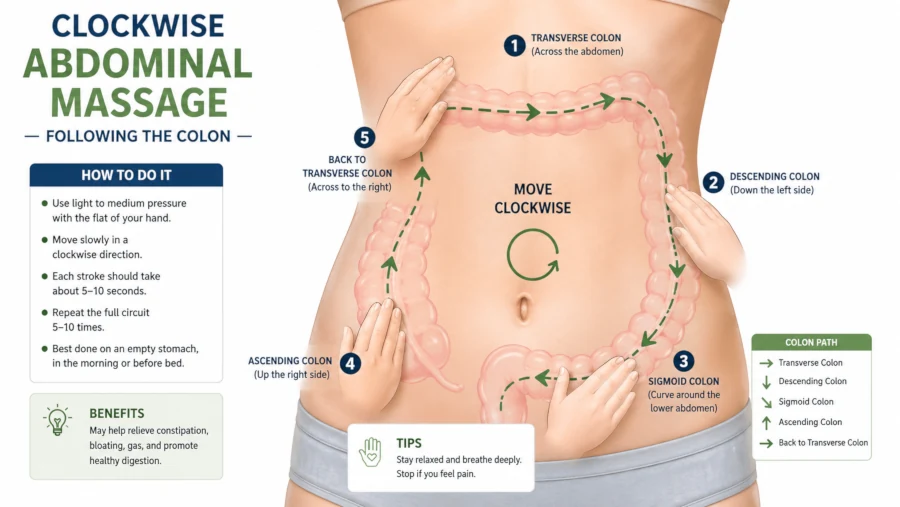
This is the method with the most direct research behind it. Dilute the essential oil in a carrier oil — almond, jojoba, or coconut are common choices — before it touches skin. The trials described above used roughly a 2% dilution (a fairly gentle strength). Massage gently in a clockwise direction over the lower abdomen, following the natural path of the colon. Patch-test on a small area of skin first and wait 24 hours to check for irritation before using it more broadly [NAHA].
Aromatic (Diffusing)
Inhaling essential oils carries a low risk profile for most people. NAHA notes that even in a small closed room, the concentration from diffusing is unlikely to reach a level that causes harm, aside from possible headache or lightheadedness with very prolonged exposure [NAHA]. There’s no direct evidence that diffusing alone relieves constipation, but it’s a reasonable, low-risk way to use these oils for general relaxation.
Internal Use — Why It’s Not Recommended for Home Use
This is where this article departs most from typical advice on the topic. Swallowing essential oils — even “just one drop in water” — is not something professional aromatherapy organizations endorse for casual home use. NAHA states directly that it “does not support the indiscriminate internal use of essential oils” [NAHA].
The Tisserand Institute goes further, warning that oral use carries the highest risk of internal toxicity because oils don’t mix with water, meaning a drop added to a glass is effectively ingested undiluted, risking irritation or burns to the digestive lining [Tisserand Institute]. A toxicologist at Nebraska Medicine’s regional poison center has described real cases of essential oil ingestion causing altered mental status and seizures with certain oils, and severe allergic reactions even from oils generally considered gentle, like lavender [Nebraska Medicine].
If a healthcare provider or a credentialed clinical aromatherapist has specifically recommended internal use of a particular oil, at a particular dose, for you, that’s a different situation. Deciding on your own to swallow essential oils for constipation isn’t supported by the safety guidance these organizations publish.
Safety: Dilution, Pregnancy, Interactions, and Who Should Be Extra Careful
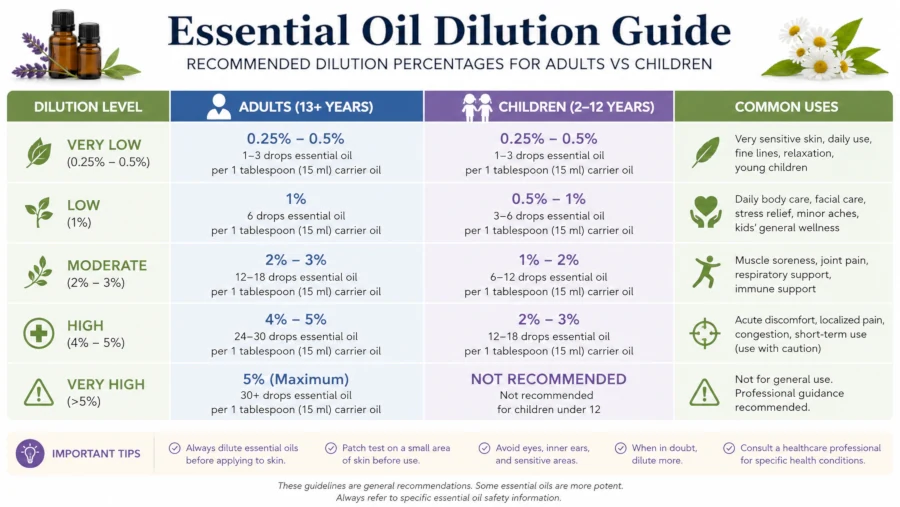
Dilution. For adult skin application, a 1–5% dilution in a carrier oil is the typical range NAHA describes as low-risk; go lower (0.5–2.5%) for children, and always patch-test first [NAHA].
Pregnancy and breastfeeding. This is genuinely oil-specific, not a blanket yes-or-no. NAHA’s own pregnancy guidance lists properly diluted ginger, lavender, and lemon among oils generally considered acceptable in pregnancy, while flagging pennyroyal, wintergreen, hyssop, sage, tansy, and several others as ones to avoid entirely [NAHA].
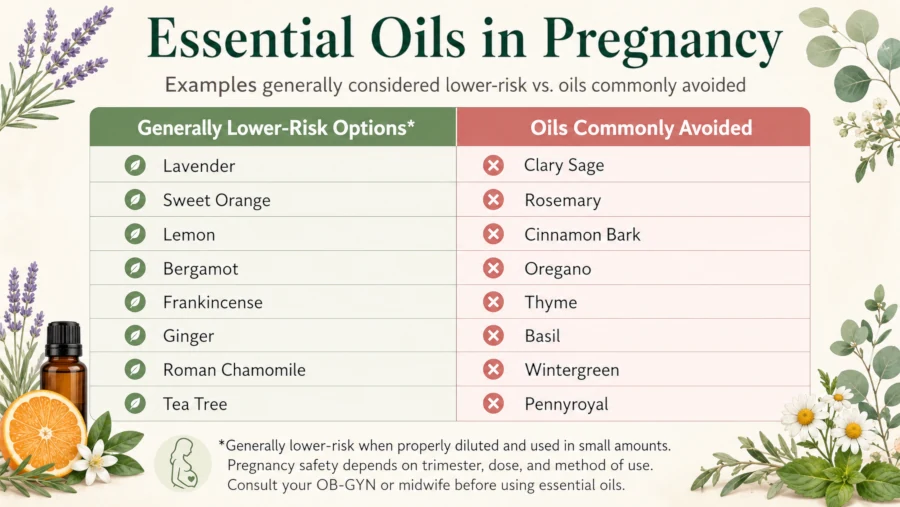
Fennel isn’t on their specific list, but given the EFSA findings above, it’s sensible to avoid it during pregnancy and breastfeeding regardless. Rosemary’s pregnancy status is disputed between sources, as noted above — when in doubt, skip it. In every case, talk with your obstetrician or midwife before using any essential oil regularly during pregnancy.
Medication interactions. Ginger’s mild antiplatelet effect matters if you’re on warfarin or another blood thinner. Peppermint can worsen GERD symptoms, which sometimes overlap with medications for reflux. If you take prescription medication regularly, it’s worth a quick check with your pharmacist before adding any essential oil to a daily routine.
Who should be especially careful. Infants and young children are more sensitive to essential oils relative to their body size, and some oils that are fine for adults aren’t appropriate for kids — talk to a pediatrician before using essential oils on or near infants. People with sensitive or damaged skin, known fragrance allergies, or a history of skin reactions should patch-test rigorously or skip topical use altogether.
What Actually Has the Strongest Evidence
If the goal is genuinely relieving constipation rather than just feeling like you’re doing something about it, the interventions with the most consistent research support are the least exciting ones: adequate fiber, adequate fluids, regular movement, and responding to the urge to go rather than delaying it [Mayo Clinic, 2025].
For a closer look at which specific foods have real trial data behind them — prunes and kiwifruit, notably, both outperformed comparable fiber supplements in randomized trials — see our guide to foods that help with constipation. If a warm drink appeals to you more than a diffuser, our breakdown of teas for constipation covers which ones have real evidence (senna) and which are mostly tradition (fennel, much like the essential oil version). And for the bigger picture on eating for a calmer gut generally, see foods for healthy digestion.
Essential oils, used topically through massage, are a reasonable complementary addition to that foundation — not a substitute for it.
When to See a Doctor Instead

Most constipation responds to time, diet, and the basics above. But certain symptoms mean it’s time to stop experimenting with home remedies and get evaluated. Contact a healthcare professional if you have constipation along with any of the following [Mayo Clinic, 2025]:
- Symptoms lasting longer than three weeks
- Bleeding from the rectum or blood on toilet paper
- Blood in your stool, or stools that are black
- Any unusual, unexplained change in the shape or color of your stool
- Abdominal pain that doesn’t let up
- Unintentional weight loss
| Health Disclaimer This article is for general educational purposes only and is not a substitute for professional medical advice, diagnosis, or treatment. Essential oils can interact with medications and aren’t appropriate for everyone — including some infants, young children, pregnant or breastfeeding women, and people with certain skin conditions or allergies. Always consult a licensed healthcare provider before starting any new remedy, especially if you are pregnant, nursing, managing a chronic condition, or taking prescription medication. Seek medical care promptly if you experience any of the red-flag symptoms listed above. |
Frequently Asked Questions
Is there a “best” essential oil for constipation?
No single oil stands out in the research. The oils with the most direct (if limited) supporting data — peppermint, lemon, rosemary, ginger, and lavender — were all studied as part of abdominal-massage blends rather than individually, so there’s no basis for ranking one above the others.
Can I put essential oils directly on my skin?
Not undiluted. Mix them into a carrier oil like almond, jojoba, or coconut first, and patch-test a small area 24 hours before broader use.
Is it safe to swallow essential oils for constipation?
Professional aromatherapy organizations don’t recommend casual home ingestion of essential oils. If a doctor or credentialed clinical aromatherapist has specifically prescribed internal use for you, follow their guidance — but doing it on your own carries real risk of irritation to your digestive lining.
How long should I try essential oils before deciding they’re not helping?
The clinical trials that showed benefit used consistent daily or near-daily massage for two to four weeks. If you’ve tried a diluted topical routine consistently for a few weeks without improvement — or if symptoms are getting worse — it’s a good time to talk with a doctor rather than continuing to self-treat.
Are essential oils safe during pregnancy?
It depends on the specific oil. Some, like properly diluted ginger, lavender, and lemon, are generally considered acceptable by professional aromatherapy safety guidelines. Others — including fennel and, per some sources, rosemary — are better avoided. Talk with your obstetrician before using any essential oil regularly during pregnancy.
References
- Mayo Clinic. “Constipation – Symptoms and causes.” Reviewed April 15, 2025. [source]
- National Center for Complementary and Integrative Health (NCCIH). “Aromatherapy.” Last updated January 2020. [source]
- National Association for Holistic Aromatherapy (NAHA). “Safety.” [source]
- Tisserand Institute. “To Ingest or Not to Ingest, That Is the Question.” [source]
- American College of Gastroenterology. “Constipation & Defecation Problems.” [source]
- International Foundation for Gastrointestinal Disorders (IFFGD). “Chronic Constipation.” [source]
- Kim MA. “Effect of aromatherapy massage for the relief of constipation in the elderly.” Journal of Korean Academy of Nursing. 2005;35(1):56–64. DOI: 10.4040/jkan.2005.35.1.56. PMID: 15778557. [source]
- Aydinli A, Karadağ S. “Effects of abdominal massage applied with ginger and lavender oil for elderly with constipation: A randomized controlled trial.” EXPLORE. 2023;19(1):115–120. DOI: 10.1016/j.explore.2022.08.010. [source]
- Alammar N, Wang L, Saberi B, et al. “The impact of peppermint oil on the irritable bowel syndrome: a meta-analysis of the pooled clinical data.” BMC Complementary and Alternative Medicine. 2019;19:21. [source]
- Nebraska Medicine. “Essential oils: Do they work? Are they safe?” [source]
- National Institute of Diabetes and Digestive and Kidney Diseases (NIDDK). “Constipation.” [source]
- Food Safety Magazine, reporting EFSA opinion. “EFSA Concludes Toxin in Fennel Seed Products May Pose Health Risk to Babies and Children.” [source]
