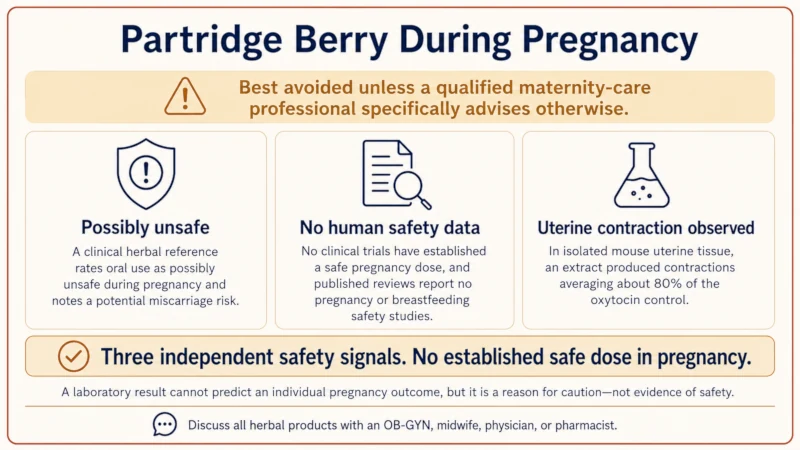
Partridge berry has one of the strongest reputations in North American herbal tradition and one of the thinnest evidence bases behind it. If you landed here because someone recommended partridge berry for pregnancy, labor, or fertility, the honest answer is short. No clinical trial has ever tested it in people. The one laboratory study that exists found that the extract makes uterine muscle contract, which is the opposite of what a miscarriage preventive should do. And the clinical database most US pharmacists rely on rates it possibly unsafe in pregnancy, with a note that it might cause a miscarriage Natural Medicines partridgeberry monograph, 2026.
None of that makes the plant worthless or the tradition foolish. It does mean the confident claims you will find elsewhere are running well ahead of anything anyone has measured.
What partridge berry actually is
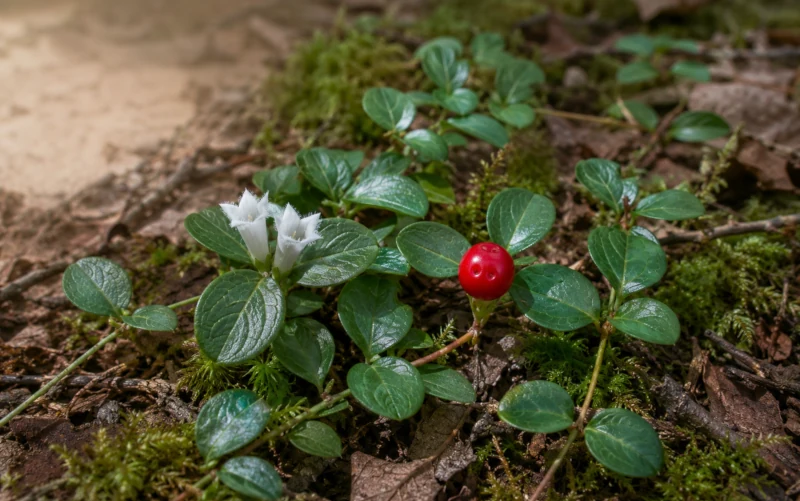
Mitchella repens is a creeping evergreen groundcover in the madder family, rarely more than two inches tall, native to woodlands from Nova Scotia down to Florida and west to Minnesota and east Texas Lady Bird Johnson Wildflower Center. Its small trumpet-shaped white flowers grow in pairs, and each pair fuses into a single scarlet berry carrying two dimples. That is where the names twinberry and two-eyed berry come from. The berries are edible and almost completely flavorless. Birds and small mammals eat them; people mostly do not.
Herbalists use the aerial parts, meaning the leaves and stems, brewed as a tea or extracted as a tincture. The fruit is not the medicinal part, despite the name.
A note on the older name
You will still see this plant sold as “squaw vine.” That word is a slur against Indigenous women. The U.S. Department of the Interior formally declared it derogatory in November 2021 and ordered its removal from federal usage, replacing it on more than 650 place names U.S. Department of the Interior, Secretary’s Order 3404, 2021. Partridge berry, twinberry, or the botanical name all work perfectly well.
At a glance
| Detail | |
| Botanical name | Mitchella repens L. |
| Family | Rubiaceae (madder family) |
| Other names | partridgeberry, twinberry, two-eyed berry, running box, winter clover, checkerberry |
| Parts used | Leaves and stems |
| Reported constituents | Saponins (including triterpenoid saponins), tannins, alkaloids, glycosides, mucilage, resin, wax, dextrin |
| Common preparations | Infusion (tea), tincture, capsules of dried powdered herb |
Constituent list from Jarco et al., 2021 and Horner & DeGolier, 2021.
Where the reputation comes from
The tradition is real and documented. Botanical records note that Indigenous women in eastern North America drank a tea made from the leaves as an aid in childbirth Lady Bird Johnson Wildflower Center. Nineteenth-century Eclectic physicians took the plant up enthusiastically and gave it a Latin title, partus preparator, the preparer for birth, prescribing it through the final weeks of pregnancy to make labor easier. It became a fixture in the blended “mother’s cordial” formulas sold well into the twentieth century, usually alongside blue cohosh, black cohosh, and raspberry leaf.
One detail in that record deserves attention. The same ethnobotanical tradition also lists partridge berry among preparations used to end pregnancies, and a modern clinical reference includes causing abortion on the same list of uses as easing childbirth Natural Medicines partridgeberry monograph, 2026. A plant credited with both holding a pregnancy and ending it is a plant whose effects nobody had actually measured.
What the research shows
The complete published record on this plant fits into three short sections. That is not an editorial choice. That is the literature.
It contracts uterine muscle in a dish
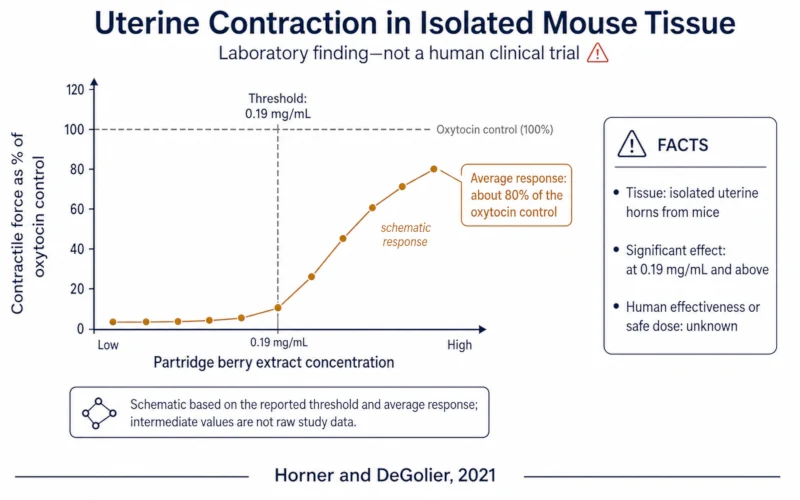
In 2021, researchers at Bethel University applied a water extract of Mitchella repens directly to isolated uterine horns from 18 mice, suspended in an organ bath. At concentrations of 0.19 mg/mL and above, the extract produced contractions significantly stronger than the tissue’s own spontaneous activity (p < 0.0001), averaging about 80% of the force generated by oxytocin, the hormone used as the positive control Horner & DeGolier, 2021. The authors proposed that saponins drive the effect and concluded that their data give some empirical support to the idea that the herb can augment or even induce labor.
Read that slowly, because it is the single most important finding on this plant and it cuts directly against the most common recommendation. An agent that contracts the uterus is not a miscarriage preventive. The researchers made the point themselves, warning that combining partridge berry with other contraction-promoting herbs can favor either a healthy timely labor or an unfortunate miscarriage.
Two limits keep this from being the last word. It is animal tissue in a bath, not a person drinking tea. And the authors were explicit that almost nothing is known about how much of the active material survives digestion, reaches the uterus, or is cleared afterward Horner & DeGolier, 2021. Treat it as a red flag, not as a measured human dose-response.
It has mild antioxidant activity in a test tube
A 2021 study from the Medical University of Silesia used electron paramagnetic resonance spectroscopy to compare how five herbal infusions used in obstetrics quench a model free radical. Partridge berry infusion did scavenge free radicals. It was also the second weakest of the five tested and the slowest to act Jarco et al., 2021. The authors were careful about what this means, noting the work was done in vitro and describing their own results as helpful rather than decisive.
Antioxidant activity in a cuvette is an unremarkable finding for almost any plant infusion, ordinary black tea included. It is not a health benefit until someone demonstrates that it changes something in a living person.
Almost everything else is untested
There are no randomized controlled trials of partridge berry for any condition, and no human safety studies. The Natural Medicines database, which sits behind most US pharmacist and clinician references, lists insufficient evidence for every use people put the herb to, and summarizes the picture in one line: there is no good scientific evidence to support any use Natural Medicines partridgeberry monograph, 2026.
That is not a hedge or a legal formula. It is an accurate description of the literature.
How the claims grade out
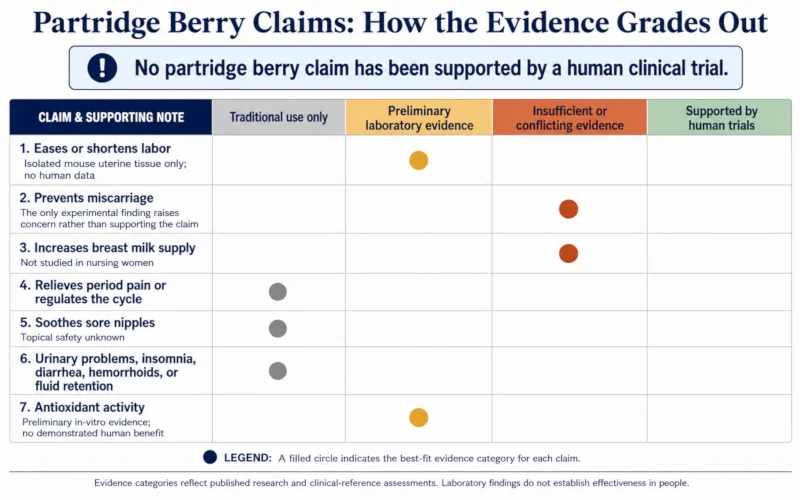
| Claim you will see | What the evidence actually supports |
| Eases or shortens labor | Traditional use only. One mouse-tissue study is consistent with a contraction effect. No human data. |
| Prevents miscarriage | No supporting evidence. The only experimental finding points the other way. |
| Increases breast milk supply | Insufficient evidence. Never studied in nursing women. |
| Relieves period pain or regulates the cycle | Traditional use only. Insufficient evidence. |
| Soothes sore nipples when applied to skin | Traditional use only. Not enough information to judge whether it is safe on skin. |
| Treats urinary problems, insomnia, diarrhea, hemorrhoids, fluid retention | Traditional use only. Insufficient evidence for each. |
| Antioxidant activity | Demonstrated in vitro, weakly. No human outcomes. |
Grades drawn from Natural Medicines partridgeberry monograph, 2026, Horner & DeGolier, 2021, and Jarco et al., 2021.
Pregnancy: the part that matters most
Most people searching for this plant are pregnant, trying to conceive, or supporting someone who is. So this section is blunt on purpose.
Partridge berry is rated possibly unsafe by mouth during pregnancy, with the specific note that some evidence suggests it might cause a miscarriage Natural Medicines partridgeberry monograph, 2026. A 2021 review of herbs used in obstetrics stated plainly that no literature reports exist on the safety of Mitchella repens in pregnant or breastfeeding women Jarco et al., 2021. And the only experimental work ever done on the plant found strong uterine contractions Horner & DeGolier, 2021.
Three independent lines of evidence, all pointing the same way. There is no dose known to be safe in pregnancy, because nobody has established one.
The traditional third-trimester blends compound the problem. Partridge berry rarely appears alone. It is usually stacked with blue cohosh, black cohosh, cramp bark, and raspberry leaf, several of which have their own demonstrated effects on uterine tissue Horner & DeGolier, 2021. Combining multiple contraction-promoting herbs at unknown doses is precisely the situation in which an unpredictable outcome becomes likely.
For comparison, our review of what the research actually shows about raspberry leaf in pregnancy covers the herb most often blended with this one. The human trials there are small and inconclusive, but they at least exist, which is more than can be said here.
If you are pregnant and want to prepare for labor, talk to your OB-GYN or midwife before taking any herbal product. That is not a formality. They can tell you what is known about a specific product, and they need to know what you are taking if labor does not go to plan.
Breastfeeding, milk supply, and sore nipples
Two separate traditional claims sit here, and neither one holds up.
On milk supply, the evidence is rated insufficient, and there is not enough reliable information to know whether partridge berry is safe at all while breastfeeding. The standard advice is to avoid it Natural Medicines partridgeberry monograph, 2026. Nothing is known about whether its compounds pass into breast milk.
On sore nipples, the traditional practice was to wash them with a preparation made from crushed berries. There is not enough information to know whether partridge berry is safe on skin in the first place Natural Medicines partridgeberry monograph, 2026, and anything applied to the nipple of a nursing parent ends up in a baby’s mouth. Sore or cracked nipples usually respond to a latch assessment from a lactation consultant, which fixes the cause rather than numbing the symptom. Pain that persists, along with cracking, bleeding, or fever, needs medical attention. Mastitis and thrush both present this way.
Safety, side effects, and who should avoid partridge berry
The honest summary of this herb’s safety profile is that it has never been characterized. That is a different statement from “it is safe.”
Side effects. No systematic collection of adverse effects exists. Reference sources describe partridge berry as possibly safe by mouth for most adults in appropriate amounts while also warning that taking it by mouth may be unsafe Natural Medicines partridgeberry monograph, 2026. Those two statements sit on the same page, and the tension between them is itself informative: there is not enough data underneath either one to settle the question.
Drug interactions. None are documented, which means none have been studied, not that none exist Natural Medicines partridgeberry monograph, 2026. NCCIH notes that herbal products carry the same potential for interactions and direct toxicity as any other pharmacologically active compound, despite a widespread public assumption to the contrary NCCIH on dietary and herbal supplements, 2020.
Dose. There is not enough scientific information to determine an appropriate dose range Natural Medicines partridgeberry monograph, 2026. The precise tincture-drop counts and capsule numbers that circulate online trace back to nineteenth- and twentieth-century herbal manuals, not to any study of how much works or how much is too much. A number written confidently in an old book is still not a tested dose.
Product quality. The FDA does not review dietary supplements for safety or effectiveness before they reach the shelf, manufacturing rules are looser than for medicines, and what is printed on the label may not match what is in the bottle NCCIH on dietary and herbal supplements, 2020. For a herb with no established dose, that uncertainty stacks on top of the uncertainty already there.
Who should avoid partridge berry
- Anyone who is pregnant, or trying to conceive
- Anyone breastfeeding
- Anyone with a history of preterm labor or recurrent pregnancy loss
- Anyone taking prescription medication, without asking a pharmacist or physician first
- Anyone with a chronic kidney, liver, or heart condition
- Children
- Anyone scheduled for surgery within the next two weeks
One specific thing not to do. Do not use partridge berry tea as an eyewash, whatever the old instructions say. Homemade plant preparations are not sterile, and anything placed in the eye needs to be. Our guide to what actually helps red and irritated eyes covers safer options and the warning signs that need same-day care.
When to see a healthcare professional
Herbal self-care is reasonable for minor, familiar complaints. It is not appropriate for the symptoms below, and reaching for a tea instead of a phone is where real harm tends to happen.
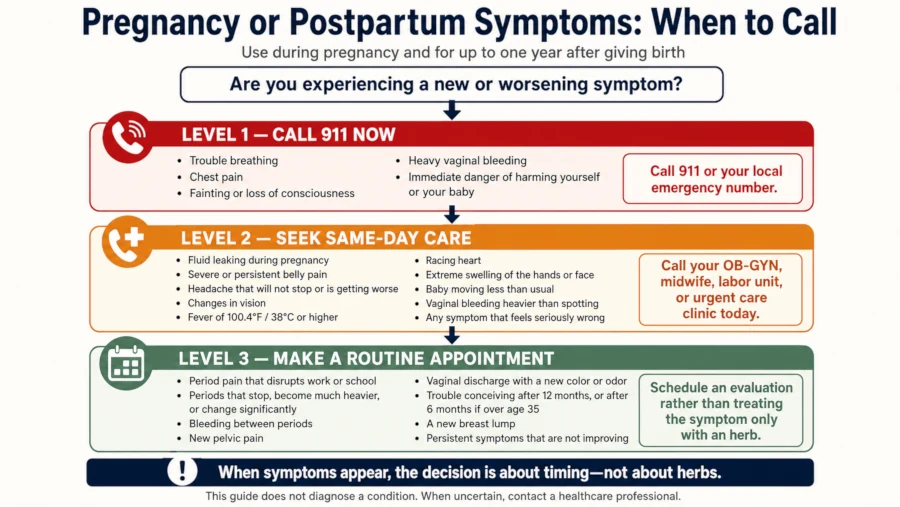
Get medical care right away during pregnancy or in the year after giving birth if you have any of these urgent maternal warning signs: vaginal bleeding heavier than spotting, or fluid leaking; severe belly pain that will not go away; a headache that will not stop or keeps worsening; changes in vision; a fever of 100.4°F or higher; trouble breathing; chest pain or a racing heart; extreme swelling of the hands or face; your baby moving less than before; or thoughts of harming yourself or your baby CDC Hear Her urgent maternal warning signs, 2024. Call 911 for trouble breathing, chest pain, fainting, or heavy bleeding. Otherwise call your OB-GYN, midwife, or an urgent care clinic the same day.
Make an appointment for period pain severe enough to keep you from work or school, periods that have stopped or turned much heavier, bleeding between periods, new pelvic pain, vaginal discharge that changes in color or smell, trouble conceiving after 12 months of trying (6 months if you are over 35), or any new breast lump. These deserve a diagnosis. Our roundup of herbs studied for menstrual cramps covers the milder options, but a persistent symptom needs a workup, not a tea.
| Health Disclaimer: This article is for education and is not a substitute for medical advice, diagnosis, or treatment. It describes general research findings and cannot account for your individual health situation. Partridge berry has not been tested in human clinical trials, has no established safe dose, and is rated possibly unsafe during pregnancy. Do not use it if you are pregnant, trying to conceive, or breastfeeding. If you are pregnant or breastfeeding, take prescription medication, have a chronic medical condition, or are considering any herbal product, talk with your physician, midwife, pharmacist, or a registered dietitian first. Stop any herb that causes an unusual reaction and contact a clinician if symptoms are serious or persistent. In an emergency, call 911. |
Frequently Asked Questions
Is partridge berry safe during pregnancy?
No reliable source says yes. It is rated possibly unsafe by mouth in pregnancy, with a note that it might cause a miscarriage Natural Medicines partridgeberry monograph, 2026, and a 2021 review confirmed that no safety literature on it exists for pregnant or breastfeeding women Jarco et al., 2021. If you are pregnant, do not take it, and tell your OB-GYN or midwife if you already have.
Does partridge berry prevent miscarriage?
There is no evidence that it does, and one reason to think it could do the opposite. In the only experimental study on the plant, an extract made isolated uterine tissue contract at about 80% of the strength of oxytocin Horner & DeGolier, 2021. The miscarriage-prevention claim comes from nineteenth-century case reports, not from research.
Is partridge berry the same thing as squaw vine?
Same plant, Mitchella repens. The second name uses a slur against Indigenous women that the U.S. Department of the Interior formally declared derogatory in 2021 U.S. Department of the Interior, Secretary’s Order 3404, 2021. Products are still sometimes labeled that way, particularly older stock.
Can you eat the berries?
Yes, the red berries are edible, though bland enough that almost nobody bothers Lady Bird Johnson Wildflower Center. Eating a few berries off a woodland plant is a different matter from drinking a concentrated leaf-and-stem infusion, which is what herbal preparations use. The safety concerns on this page apply to the preparations, not to a stray berry.
What dose of partridge berry tincture or tea should I take?
There is not enough scientific information to determine an appropriate dose Natural Medicines partridgeberry monograph, 2026. The specific drop counts and capsule numbers in circulation come from old herbal manuals rather than from any study of effectiveness or toxicity, so no responsible number can be given here.
Is partridge berry the same as pipsissewa?
No. Pipsissewa is Chimaphila umbellata, in the heath family, and partridge berry is Mitchella repens, in the madder family. They are unrelated plants that happen to share some overlapping folk indications. Traditional sources sometimes group them, but that grouping reflects historical usage rather than shared chemistry, and neither one has been shown to substitute for the other.
References
- Natural Medicines / Therapeutic Research Center. “Partridgeberry: Uses, Side Effects, Precautions, Interactions, Dosing.” Published on WebMD, 2026. → View source
- Horner S, DeGolier T. “Mitchella repens (Partridge Berry) contracts uterine smooth muscle in isolated mouse tissues.” Journal of Medicinal Plants Studies. 2021;9(3):123–128. → View source
- Jarco S, Pilawa B, Ramos P. “Free Radical Scavenging Activity of Infusions of Different Medicinal Plants for Use in Obstetrics.” Plants (Basel). 2021;10(10):2016. doi:10.3390/plants10102016. PMC8538768. → View source
- National Center for Complementary and Integrative Health (NIH). “Dietary and Herbal Supplements.” Last updated February 2020. → View source
- Centers for Disease Control and Prevention, Hear Her Campaign. “Urgent Maternal Warning Signs and Symptoms.” May 15, 2024. → View source
- Lady Bird Johnson Wildflower Center, University of Texas at Austin. “Mitchella repens (Partridgeberry).” Native Plant Database. → View source
- U.S. Department of the Interior. Secretary’s Order No. 3404, “Declaring ‘Squaw’ a Derogatory Term and Implementing Procedures to Remove the Term from Federal Usage.” November 19, 2021. → View source
- Native Plant Trust, Go Botany. “Mitchella repens L. — partridge-berry.” → View source
