
No single food makes you lose weight. What changes the outcome is the shape of your plate — building meals around foods that fill you up for fewer calories, so eating less stops feeling like a daily fight with yourself. That is the honest version of every list of foods to eat to lose weight, including this one.
The foods below earn their place for one of three reasons: they carry a lot of water and fiber for very few calories, they are high in protein, or they slow a meal down. None of them burn fat. Used week after week, they make an energy deficit easier to hold, and holding it is the part that actually moves the scale.
The three things that make a food filling
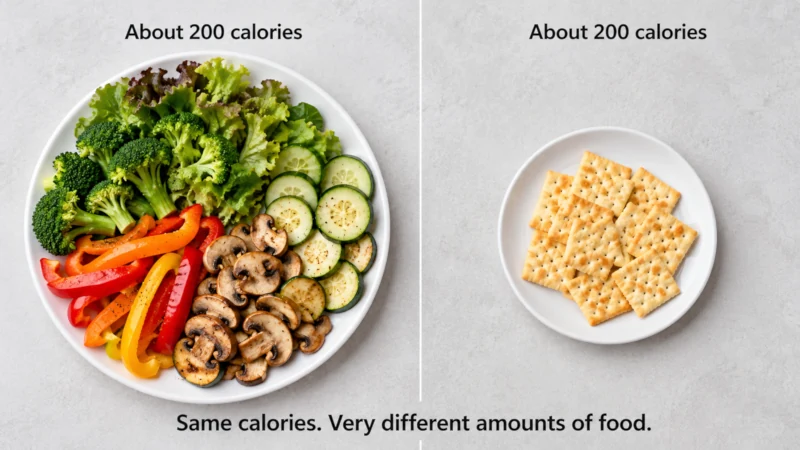
Volume. Water and fiber add bulk without adding calories. A large bowl of vegetable soup and a small handful of crackers can carry similar calories, but only one of them ends with you feeling like you ate.
Protein. This is the best-supported single lever. A meta-analysis of 24 controlled trials in 1,063 adults with overweight or obesity found that higher-protein, lower-fat diets produced about 0.8 kg more weight loss and 0.9 kg more fat loss than standard-protein diets at the same calorie level, while preserving more lean mass Wycherley et al., American Journal of Clinical Nutrition, 2012. That is a modest effect, not a transformation — but it points the same direction every time. Current federal guidance suggests 1.2–1.6 grams of protein per kilogram of body weight per day, adjusted to your calorie needs Dietary Guidelines for Americans, 2025–2030.
Fiber. In a 12-month randomized trial of 240 adults with metabolic syndrome, one group was told simply to eat at least 30 grams of fiber a day and nothing else. They lost 2.1 kg. A second group followed a 13-component American Heart Association diet and lost 2.7 kg. The gap between them was not statistically significant Ma et al., Annals of Internal Medicine, 2015. One clear instruction did most of the work of a complicated plan.
The best foods to eat to lose weight
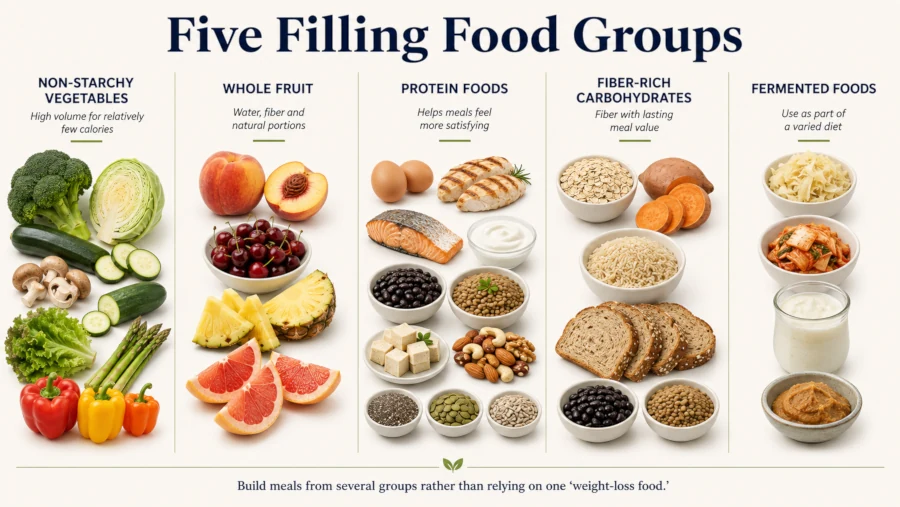
Non-starchy vegetables: the most food per calorie
Swiss chard, broccoli, cabbage, zucchini, asparagus, mushrooms, cucumber, lettuce, sweet peppers and turnips are the highest-volume, lowest-calorie things you can put on a plate. Federal guidance recommends three servings of vegetables a day for a 2,000-calorie pattern, eaten whole rather than juiced Dietary Guidelines for Americans, 2025–2030.
How you cook them decides a lot. Zucchini and mushrooms are sponges — deep-fried, they carry far more calories than the vegetable ever did. The guidelines specifically suggest swapping deep-frying for baking, broiling, roasting, stir-frying or grilling, and flavoring with salt, herbs and spices instead of heavy sauces.
You will read that you can eat unlimited amounts of these. That is not quite true — no food is unlimited. What is true is that these are the foods where portion size matters least, which is a useful thing to know when you are hungry at 9 p.m.
Whole fruit, not juice
Peaches, cherries, pineapple, grapefruit and cherimoya all fit a weight-loss pattern for the same reason: water, fiber and a portion size your hand naturally limits. Two servings of fruit a day is the current recommendation, with 100% juice kept to small portions or diluted, because juice loses the fiber and the chewing Dietary Guidelines for Americans, 2025–2030.
Eating cherries one at a time genuinely slows a snack down, and slower eating tends to mean less eaten. But no trial has shown that cherries, pineapple or grapefruit cause weight loss on their own. They are good choices, not interventions.
Protein at every meal
Eggs, poultry, seafood, lean red meat, beans, lentils, nuts, seeds, soy foods and dairy all count. Whey — the liquid left over from cheesemaking, and the base of most protein powders — is a high-quality protein and a convenient way to reach a daily target, though the evidence supports protein intake generally rather than whey doing anything unique.
Practically: aim for a protein source at breakfast, not just at dinner. Most people front-load carbohydrates and back-load protein, which is exactly backwards for appetite control.
Fiber-rich carbohydrates
Sweet potatoes, oats, brown rice, whole-wheat bread, beans and lentils belong on the plate, in a portion. Sweet potato is more calorie-dense than a non-starchy vegetable, so treat it as the starch in a meal rather than as the vegetable. Two to four servings of fiber-rich whole grains a day is the current target, with refined products such as white bread, crackers and packaged breakfast items significantly reduced Dietary Guidelines for Americans, 2025–2030.
Fermented foods
Sauerkraut, kimchi, kefir and miso are named in federal guidance as foods that, alongside vegetables, fruits and high-fiber foods, support a diverse gut microbiome — which the guidelines describe as something that may be beneficial, not something established Dietary Guidelines for Americans, 2025–2030. Sauerkraut is also salty. A spoonful as a topping is a better idea than a bowlful as a side, particularly if you have high blood pressure, heart failure or kidney disease.
Swaps that cut calories without cutting the meal
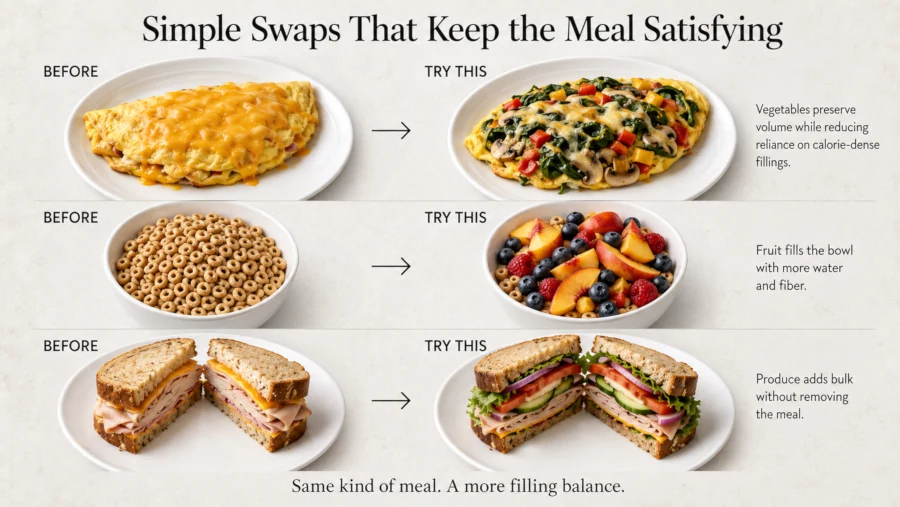
| Instead of | Try | Why it works |
| Half the cheese and one egg in an omelet | Mushrooms, spinach and peppers in their place | Same volume on the plate, noticeably fewer calories |
| A full bowl of cereal | Two-thirds cereal, topped with sliced peaches or berries | Fills the same bowl with more water and fiber |
| Fried zucchini or breaded vegetables | Roasted or grilled with olive oil and herbs | Deep-frying is where most of the calories enter |
| A glass of juice | The whole fruit and a glass of water | Keeps the fiber and the chewing; juice barely registers as food |
| Meat and cheese filling most of a sandwich | Lettuce, tomato, cucumber and onion taking half the space | Bulk from produce instead of from the densest ingredients |
What to eat less of
- Highly processed foods and refined carbohydrates — chips, cookies, candy, packaged breakfast items, flour tortillas, crackers. These are the single clearest target in current federal guidance Dietary Guidelines for Americans, 2025–2030.
- Sugar-sweetened drinks — soda, fruit drinks and energy drinks. Liquid calories arrive without much fullness attached.
- Deep-fried foods. The oil, not the food underneath, is doing the damage.
- Saturated fat above roughly 10% of daily calories, which mostly means limiting processed foods rather than policing individual ingredients.
- Sodium above 2,300 mg a day for anyone 14 and older. Worth being precise here: salt does not make you gain fat. A high-sodium day can cause short-term fluid retention that shows on the scale the next morning, and that is water, which comes and goes. The reason to limit sodium is blood pressure, not body fat.
Four claims that don’t hold up
“Diuretic foods” help you lose weight. They help you lose water. Fluid loss shows up fast on a scale and returns just as fast when you drink normally again. It has nothing to do with body fat, and chasing it is a good way to feel discouraged by Tuesday.
“Depurant” or blood-purifying foods clear out waste. Blood purification by food is not a recognized physiological process. Your liver and kidneys handle waste clearance continuously, and no vegetable meaningfully speeds that up.
Chili peppers burn fat. Capsaicin does something measurable to appetite — a meta-analysis of eight placebo-controlled trials in 191 people found it reduced energy intake by roughly 74 calories per meal, and a 2017 trial in 77 adults with overweight found people taking 4 mg a day ate about 252 fewer calories daily than the placebo group. Neither translated into weight change: body weight was unchanged at 6 and 12 weeks NIH Office of Dietary Supplements, 2026. Enjoy the heat; don’t count on it.
Seaweed speeds up your thyroid, and therefore your metabolism. Iodine is needed for thyroid hormones, so correcting a deficiency matters. Adding extra iodine to a thyroid that already has enough does not push it faster — and too much can cause dysfunction, which is covered in the safety section below. Fucoxanthin, the brown-seaweed compound sold for weight loss, has been tested in humans in a single trial, and only as part of a combination product NIH Office of Dietary Supplements, 2026.
It is also worth keeping one thing that is often said about grapefruit: it does not burn fat, whatever the commercial messaging suggests. It is a good low-calorie fruit, and that is the whole of it.
Supplements: weak evidence, real risks
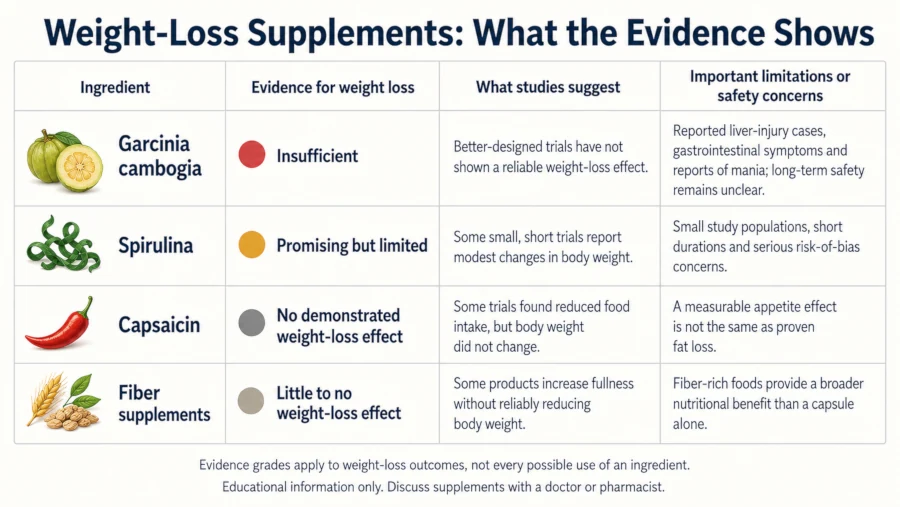
Fiber supplements are the clearest illustration of the gap between mechanism and result. Glucomannan, guar gum and beta-glucans all reliably increase feelings of fullness — and reviews of the trials find little to no effect on body weight NIH Office of Dietary Supplements, 2026. Fiber from food works better than fiber from a capsule.
Garcinia cambogia
Evidence: insufficient. A 2011 review pooling nine of 12 randomized trials in 706 people found an average reduction of 0.88 kg over 2 to 12 weeks — but when the reviewers looked only at the two rigorously designed trials, the effect disappeared. Federal reviewers summarize the human evidence as little to no effect on body weight NIH Office of Dietary Supplements, 2026.
Safety: not benign. Reported adverse effects include headache, nausea, upper respiratory and gastrointestinal symptoms. Three cases of mania have been linked to garcinia-containing supplements. Ten cases of liver toxicity have been reported in people taking products containing garcinia, including one death and two liver transplants. In most of those cases the products contained other botanicals and minerals too, so garcinia cannot be blamed with certainty — and every trial has been short, so long-term safety is simply unknown. Describing it as an appetite suppressant with no side effects is not accurate.
Spirulina
Evidence: promising but limited. A 2025 meta-analysis of 17 randomized trials found spirulina supplementation reduced body weight by about 1.07 kg, BMI by 0.40, and body fat by 0.84 percentage points, with no significant change in waist circumference. Effects were larger at 2 g a day or more and beyond 12 weeks Lak et al., Nutrition & Metabolism, 2025.
Read that with the authors’ own caveats attached. The trials were small — 20 to 80 people — ran 4 to 12 weeks, came overwhelmingly from one country, and the GRADE assessment flagged a serious risk of bias across every outcome. A kilogram over three months is also not what the marketing implies. Spirulina is a protein-dense algae rather than a calorie-free one; at the doses studied it contributes almost nothing to daily calories, but “virtually no calories” oversells it.
Seaweed, kelp and iodine
The tolerable upper intake for iodine is 1,100 mcg a day for adults. The American Thyroid Association advises against iodine or kelp supplements containing more than 500 mcg of iodine a day for children and adults, including during pregnancy and breastfeeding, and notes that many such products contain iodine at many times the upper limit. Infants, older adults, pregnant and breastfeeding women, and anyone with existing thyroid disease are the most susceptible to harm from excess iodine American Thyroid Association, updated 2024.
Seaweed as an occasional food is a different matter from kelp capsules taken daily. Iodine content varies enormously between species and batches, which is exactly why supplements are the riskier form.
Grapefruit and your medications
This is the interaction most likely to matter to a real reader of this page. Grapefruit and grapefruit juice block an intestinal enzyme called CYP3A4, letting more of certain drugs into the bloodstream. The FDA lists interactions with some statins including simvastatin and atorvastatin, some blood-pressure drugs such as nifedipine, the transplant drug cyclosporine, the anti-anxiety drug buspirone, budesonide for Crohn’s disease and ulcerative colitis, and the heart-rhythm drug amiodarone. With the antihistamine fexofenadine the effect runs the other way — less drug is absorbed and it works less well FDA, 2021.
Grapefruit does not affect every drug in those categories, and severity varies by person, drug and amount. Seville oranges, pomelos and tangelos may behave the same way. If you take a daily medication, ask your pharmacist before making grapefruit a habit — it is a two-minute question with a real answer.
Pregnancy and breastfeeding
Pregnancy is not the time to pursue weight loss, and the nutrient priorities shift to iron, folate and iodine. Weight-loss supplements have generally not been tested in pregnancy or breastfeeding, and the iodine cautions above apply with extra force. Talk to your doctor before changing your diet substantially during either Dietary Guidelines for Americans, 2025–2030.
When food changes aren’t the answer
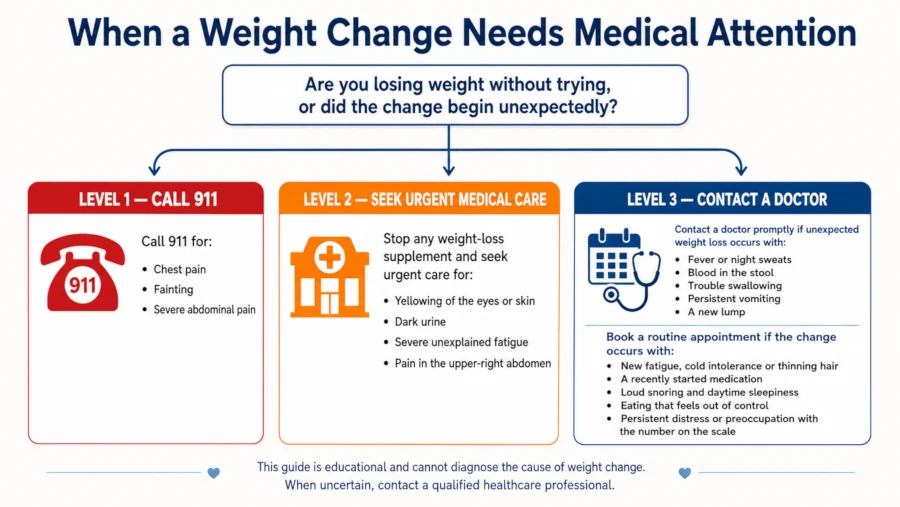
Losing weight you were not trying to lose is a symptom, not a success. See a doctor promptly if weight is falling without effort, or if weight change comes with fever, night sweats, blood in the stool, trouble swallowing, persistent vomiting or new lumps.
Book a regular appointment if weight change arrives alongside new fatigue, cold intolerance or thinning hair, which can point to thyroid problems; if it started after a new medication; or if loud snoring and daytime sleepiness suggest sleep apnea. And if eating has started to feel out of control, or the number on the scale has become the main thing you think about, that is worth raising with a doctor too — the National Alliance for Eating Disorders runs a clinician-staffed helpline if you would rather start there.
Stop any supplement and seek urgent care if you develop yellowing of the eyes or skin, dark urine, severe fatigue or pain in the upper right abdomen. Call 911 for chest pain, fainting or severe abdominal pain.
One last thing worth saying plainly: modest is normal. The best-supported dietary changes in this article moved weight by one to three kilograms across months, in supervised trials. Slow progress is not failure. It is what the evidence actually looks like.
| Health disclaimer: This article is for general education and is not medical advice, diagnosis or treatment. No food or supplement described here treats, cures, prevents or reverses any disease. Talk to a doctor or registered dietitian before making major dietary changes, particularly if you are pregnant or breastfeeding, have diabetes, thyroid disease, kidney disease, liver disease or a history of disordered eating. Talk to a doctor or pharmacist before starting any weight-loss supplement or before adding grapefruit to your routine if you take daily medication, because interactions depend on your specific prescription. |
Frequently Asked Questions
What food burns the most fat?
None of them. No food burns body fat. Chili peppers and green tea are the two most often named, and in trials neither produced a change in body weight even when they reduced how much people ate at a meal NIH Office of Dietary Supplements, 2026. Fat loss comes from a sustained energy deficit; food choices make that deficit easier to sustain.
What should I eat for breakfast to lose weight?
Something with protein in it. Eggs, Greek yogurt, cottage cheese, or beans and vegetables if you prefer savory. Most people eat almost all their protein at dinner, which is the least useful place for it if you are trying to control appetite during the day.
Are potatoes and sweet potatoes off-limits?
No. Treat them as the starch in the meal rather than the vegetable, and keep them out of the fryer — the same potato has several times the calories once it has been deep-fried.
Do fiber supplements work for weight loss?
They make you feel fuller without reliably making you lighter. Reviews of glucomannan, guar gum and beta-glucan trials find little to no effect on body weight NIH Office of Dietary Supplements, 2026. Fiber from vegetables, fruit, beans and whole grains is the version with trial support behind it Ma et al., 2015.
Is it safe to take garcinia cambogia?
The evidence that it works is weak, and the safety record is not clean: reported problems include liver toxicity in ten cases, with one death and two liver transplants, plus three cases of mania NIH Office of Dietary Supplements, 2026. Talk to a doctor or pharmacist before taking it, especially if you have liver disease or take any daily medication.
How much weight can I expect to lose by changing what I eat?
In controlled year-long trials, structured dietary change produced roughly 2 to 3 kg Ma et al., 2015. Adding physical activity and keeping the changes going matters more for the long run than the specific foods you pick NIDDK, 2023.
References
- U.S. Department of Health and Human Services and U.S. Department of Agriculture. “Dietary Guidelines for Americans, 2025–2030.” January 2026. View source
- National Institutes of Health, Office of Dietary Supplements. “Dietary Supplements for Weight Loss: Fact Sheet for Health Professionals.” Last modified June 7, 2026. View source
- U.S. Food and Drug Administration. “Grapefruit Juice and Some Drugs Don’t Mix.” Content current as of July 1, 2021. View source
- American Thyroid Association. “ATA Statement on the Potential Risks of Excess Iodine Ingestion and Exposure.” 2013, updated March 2024. View source
- Ma Y, Olendzki BC, Wang J, et al. “Single-Component Versus Multicomponent Dietary Goals for the Metabolic Syndrome: A Randomized Trial.” Annals of Internal Medicine. 2015;162(4):248–257. doi:10.7326/M14-0611. View source
- Wycherley TP, Moran LJ, Clifton PM, Noakes M, Brinkworth GD. “Effects of energy-restricted high-protein, low-fat compared with standard-protein, low-fat diets: a meta-analysis of randomized controlled trials.” American Journal of Clinical Nutrition. 2012;96(6):1281–1298. doi:10.3945/ajcn.112.044321. View source
- Lak M, Karimi M, Akhgarjand C, et al. “Effects of spirulina supplementation on body composition in adults: a GRADE-assessed and dose–response meta-analysis of RCTs.” Nutrition & Metabolism (London). 2025;22:61. doi:10.1186/s12986-025-00959-4. View source
- National Institute of Diabetes and Digestive and Kidney Diseases. “Eating & Physical Activity to Lose or Maintain Weight.” Last reviewed May 2023. View source
