The best foods for osteoporosis are the ones that supply the raw materials your skeleton actually rebuilds itself with: calcium, vitamin D, protein, and a supporting group of nutrients that includes vitamin K, magnesium and potassium. No single food prevents, treats or reverses osteoporosis. What matters is the overall pattern of what you eat across years, because that pattern shapes how much bone you bank before about age 30 and how quickly you lose it afterward [NIAMS, 2025].
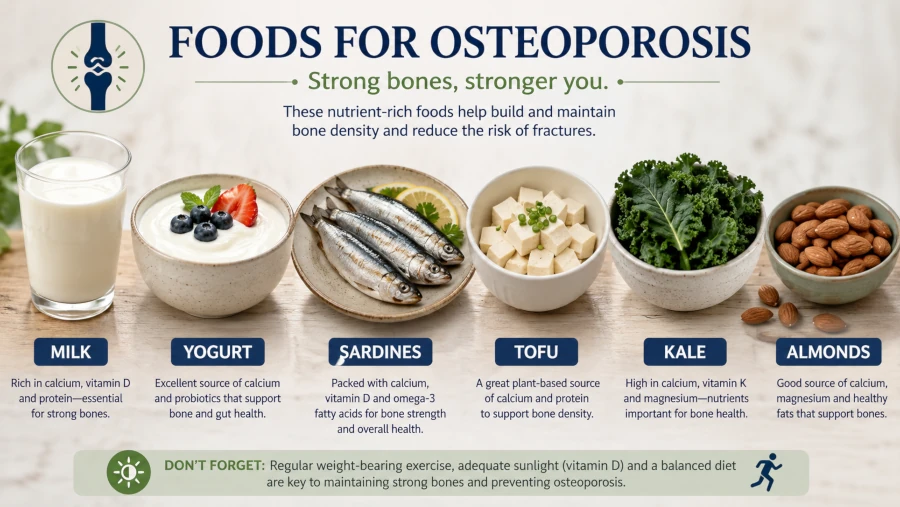
Bone is living tissue. Your body breaks down old bone and lays down new bone throughout life in a process called remodeling. Before roughly age 30 you build faster than you lose. After that the balance slowly tips the other way, and for women it tips sharply in the few years around menopause [Mayo Clinic, 2025]. Food cannot stop that biology, but the right foods slow it and give your bones what they need to stay dense and resilient.
What makes a food good for your bones
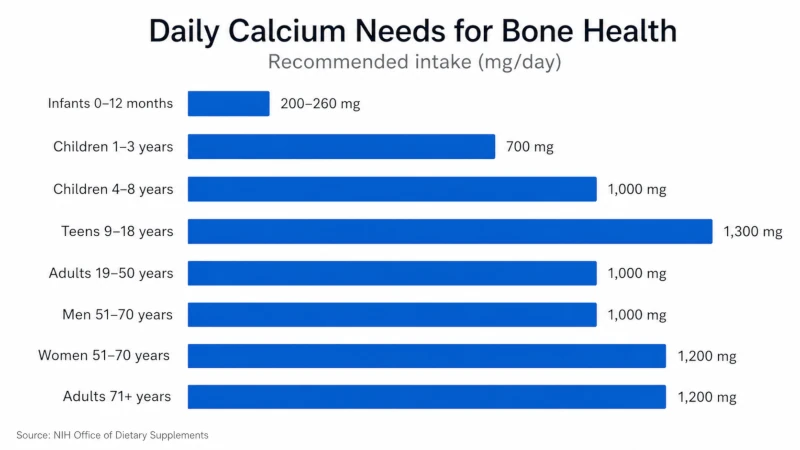
Four things do most of the work. Calcium is the main mineral in bone. Adults aged 19 to 50 need about 1,000 mg a day; women 51 and older and everyone over 70 need 1,200 mg, while men 51 to 70 stay at 1,000 mg [NIH ODS, 2026]. Vitamin D lets your gut absorb that calcium. The recommended intake is 600 IU a day up to age 70 and 800 IU after that [Mayo Clinic, 2025].
Protein makes up about half of bone by volume and supports the muscle that protects you from falls. Vitamin K and magnesium help your body use calcium and build the protein scaffold that mineral attaches to [IOF, 2025]. The foods below were chosen because they deliver one or more of these, and because the calcium in them is reasonably well absorbed.
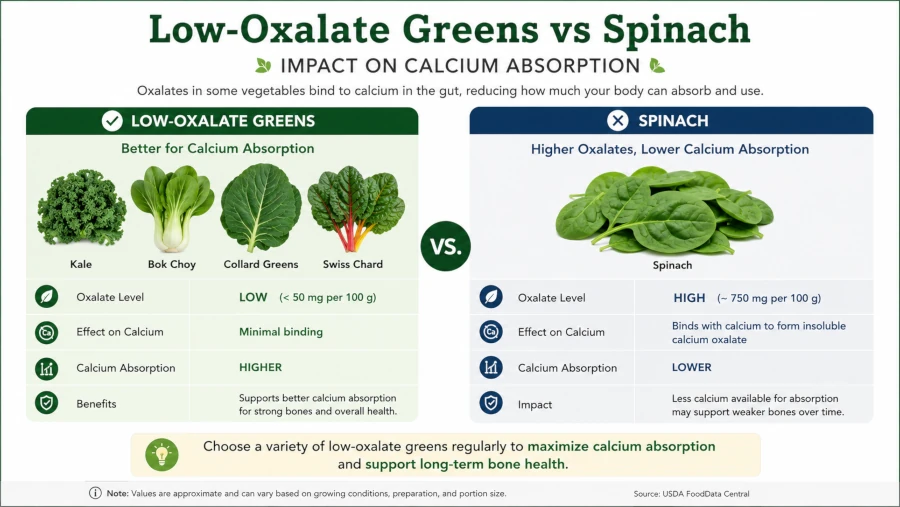
One practical point about absorption: not all calcium is equal. Your body takes up only about a quarter to a third of the calcium in most foods, and far less from high-oxalate greens like spinach. Low-oxalate greens such as kale, bok choy and broccoli give up roughly half their calcium, which is why they appear on this list and spinach does not. For a fuller breakdown of which foods carry the most usable calcium, see our guide to foods high in calcium.
The 16 best foods for osteoporosis
Think in groups rather than ranking, since variety is what fills the nutrient gaps. Dairy and fortified drinks cover calcium and vitamin D in one go; fish with edible bones and soy foods add protein; greens, nuts, beans and fruit round out the supporting nutrients.
Dairy: milk, yogurt and cheese
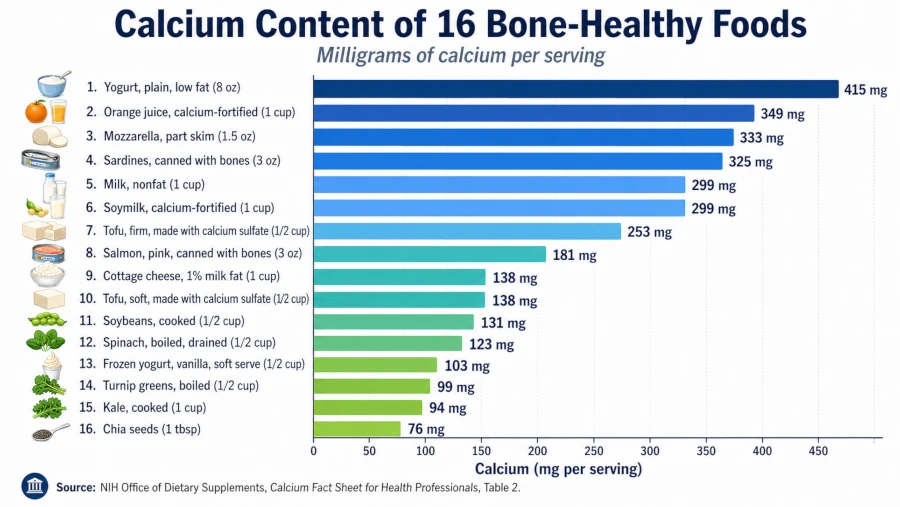
1–3. Dairy is the most reliable everyday source of calcium because the amount is high and well absorbed. A cup of milk carries about 300 mg, and milk is usually fortified with vitamin D, so it covers both key nutrients at once. Yogurt delivers a similar 300 to 450 mg per cup plus protein, and cheese concentrates calcium into small portions. If you are lactose intolerant, hard cheeses and yogurt are usually easier to tolerate than milk. Cheese is also higher in sodium, so it is a topping rather than a base [NIAMS, 2025].
Fortified drinks and cereals
4–5. If you skip dairy, fortified plant milks (soy, almond, oat) and fortified orange juice and breakfast cereals can match cow’s milk for calcium and vitamin D. The catch is that fortification settles, so shake the carton, and not every product is fortified — read the label and look for at least 20% of the Daily Value for calcium and vitamin D [BHOF, 2025].
Soy foods: calcium-set tofu and edamame
6–7. Calcium-set tofu is one of the strongest plant sources on this list, with anywhere from 250 to 430 mg per half cup depending on the firming agent (check for calcium sulfate on the label). Edamame (whole young soybeans) adds calcium, protein and magnesium. Soy also contains isoflavones, plant compounds that behave faintly like estrogen.
The evidence here is genuinely mixed: several meta-analyses of postmenopausal women found a modest improvement in spine bone density at isoflavone doses above about 75 mg a day for six months or longer [Sansai et al., 2022], while a meta-analysis in Western women found no significant effect [Ricci et al., 2010]. Treat soy as a good protein-and-calcium food, not as a proven osteoporosis treatment. Our overview of soybean health benefits goes deeper on the isoflavone question.
Fish with edible bones: sardines and canned salmon
8–9. This is the rare case where the bones are the point. Canned sardines provide roughly 325 mg of calcium per 3-ounce serving, and canned salmon with bones gives about 180 to 210 mg. Both also supply vitamin D and protein, plus omega-3 fats that are good for the heart. Mash the soft bones into the flesh; they are completely edible and are where most of the calcium lives [Mayo Clinic, 2025].
Leafy greens: kale, bok choy and broccoli
10–12. Low-oxalate greens punch above their calcium content because so much of it is absorbable. Bok choy leads at around 160 mg of well-absorbed calcium per cooked cup, followed by kale at about 90 to 100 mg and broccoli near 60 mg. Greens also bring vitamin K, which helps your body bind calcium into the bone matrix [IOF, 2025].
Nuts and beans: almonds and white beans
13–14. A one-ounce handful of almonds carries about 75 to 95 mg of calcium along with magnesium, and a cup of white beans adds roughly 160 mg plus protein and more magnesium. Neither replaces dairy on its own, but they make calcium easy to scatter across snacks and meals.
Fruit: dried figs and prunes
15–16. Dried figs are an unusual fruit source of calcium, at about 120 mg per half cup, with fibre to match. Prunes (dried plums) are here for a different reason. In a 12-month randomized controlled trial of 183 postmenopausal women, eating about 50 grams a day — five or six prunes — preserved hip bone density, while the no-prune group lost bone [De Souza et al., 2022]. It is one of the better pieces of food-specific evidence for bone, though the women in the trial also took calcium and vitamin D.
Calcium at a glance
Amounts are approximate and vary by brand, ripeness and preparation. Use this to mix sources across the day rather than chasing one big number [NIH ODS, 2026].
| Food | Serving | Calcium (approx.) | Why it earns a place |
| Plain yogurt | 1 cup | 300–450 mg | Calcium plus protein in one container |
| Cow’s milk | 1 cup | ~300 mg | Often fortified with vitamin D |
| Fortified soy or almond milk | 1 cup | ~300 mg | Dairy-free match; shake the carton |
| Hard cheese | 1.5 oz | ~300 mg | Concentrated, but watch the sodium |
| Canned sardines (with bones) | 3 oz | ~325 mg | Calcium, vitamin D and protein together |
| Calcium-set tofu | 1/2 cup | 250–430 mg | Depends on the calcium coagulant used |
| Fortified orange juice | 1 cup | ~300 mg | Check the label; not all juice is fortified |
| Canned salmon (with bones) | 3 oz | ~180–210 mg | Soft edible bones add the calcium |
| Cooked bok choy | 1 cup | ~160 mg | Low oxalate, so it absorbs well |
| White beans | 1 cup | ~160 mg | Adds protein and magnesium |
| Dried figs | 1/2 cup | ~120 mg | Portable, fibre-rich snack |
| Cooked kale | 1 cup | ~90–100 mg | Highly absorbable calcium |
| Almonds | 1 oz (~23) | ~75–95 mg | Magnesium as well as calcium |
| Cooked broccoli | 1 cup | ~60 mg | Well absorbed; adds vitamin K |
| Orange | 1 medium | ~50–60 mg | Vitamin C supports collagen in bone |
Foods and habits that work against your bones
What you limit matters too. Very high sodium increases the calcium you lose in urine, so heavily salted and processed foods can quietly undercut a good diet. Heavy alcohol use lowers bone density and raises fracture risk, and it can interfere with vitamin D. Caffeine has a smaller effect: a few cups of coffee a day is fine as long as your calcium intake is adequate, but it is worth not letting coffee or soda crowd out milk and other nutrient-dense drinks [Mayo Clinic, 2025]. Spinach, chard, beet greens and rhubarb are healthy foods, but their oxalate locks up most of their own calcium, so do not count them as calcium sources.
Calcium needs a partner: vitamin D and sunlight
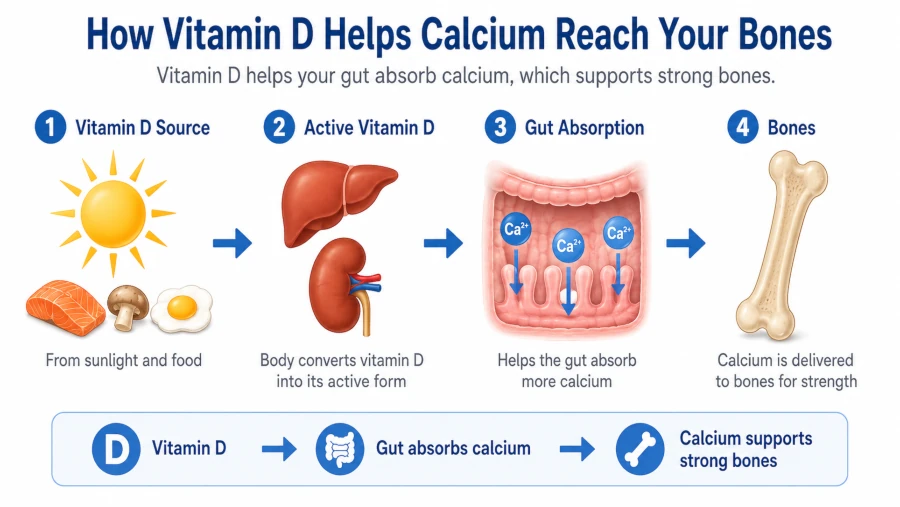
Calcium is close to useless for bone without enough vitamin D to absorb it. Few foods contain much — fatty fish like salmon and mackerel, egg yolks, and fortified milk, juice and cereal are the main dietary sources. Skin makes vitamin D from sunlight, but how much depends on season, latitude, skin tone and sunscreen, and many people fall short, especially in winter and at older ages [NIAMS, 2025]. If you are concerned about your level, ask your clinician for a blood test rather than guessing at a supplement dose. Around menopause, when bone loss speeds up, this partnership matters most; our notes on managing menopause symptoms naturally cover the wider picture.
Realistic expectations
Diet is prevention and maintenance, not a cure. Good nutrition during childhood and early adulthood builds a higher peak bone mass to draw down from later, and adequate calcium, vitamin D and protein in adulthood slow the rate of loss [BHOF, 2025]. But if you have already been diagnosed with osteoporosis, food supports your treatment rather than replacing it. Osteoporosis medications are designed to work alongside enough calcium and vitamin D, and they do not work well without them. Expect changes in bone density to be measured over years, not weeks.
Safety, side effects and who should be cautious
Getting these nutrients from food is the safest approach, and it is hard to get too much calcium from meals alone. Supplements are a different story and deserve more care.
- Don’t overshoot on calcium supplements. The tolerable upper limit is 2,500 mg a day for adults up to 50 and 2,000 mg for those 51 and older, counting food plus pills. Routinely exceeding it can cause kidney stones and, in some studies, has been linked to cardiovascular concerns. Aim to meet your needs through food and supplement only the shortfall [Mayo Clinic, 2026].
- Medication timing. Calcium binds several drugs and reduces their absorption, including thyroid medication (levothyroxine), some antibiotics (tetracyclines and fluoroquinolones) and oral bisphosphonates used for osteoporosis. Separate calcium-rich meals or supplements from these by a few hours and follow your pharmacist’s instructions [NIH ODS, 2026].
- Kidney stones and kidney disease. If you form calcium-oxalate stones or have kidney disease, your calcium and oxalate targets may differ from general advice; get individualized guidance before loading up on supplements or high-oxalate greens.
- Soy and isoflavones. Soy foods are considered safe for most people. Concentrated isoflavone supplements are not the same as eating tofu, and anyone with a history of a hormone-sensitive condition such as breast cancer should ask their oncologist before using them.
- Pregnancy and breastfeeding. Calcium and vitamin D needs stay high during pregnancy and nursing, and food sources are encouraged, but check supplement doses with your provider.
When to talk to a healthcare professional
Diet is something you can act on today, but some signs call for medical attention rather than a grocery list. See a clinician promptly if you experience any of the following:
- A broken bone from a minor fall or bump, which can be the first visible sign of osteoporosis.
- Sudden, severe back pain, which can signal a spinal compression fracture.
- Noticeable height loss or a developing stooped posture over time.
Bone density screening is generally recommended for women at age 65, for younger postmenopausal women with risk factors, and for anyone with a fragility fracture; your doctor can advise based on your history [MedlinePlus, 2026]. A registered dietitian can help you reach your calcium and protein targets if food alone feels hard to manage.
| Health Disclaimer This article is for general education and is not medical advice. It is not a substitute for diagnosis, treatment, or guidance from a qualified healthcare professional, and it should not be used to start, stop, or change any treatment. Osteoporosis is a medical condition that often needs prescribed therapy in addition to diet. If you are pregnant or breastfeeding, take prescription medication, or have a health condition such as kidney disease or a history of kidney stones, talk to your doctor or a registered dietitian before making large changes to your diet or adding supplements. |
Frequently Asked Questions
Can food alone reverse osteoporosis?
No. Diet can slow bone loss and supports treatment, but established osteoporosis usually needs prescribed medication. Calcium and vitamin D make those medications work as intended rather than replacing them.
Is milk really the best food for bones?
It is among the most convenient, because the calcium is plentiful, well absorbed, and often paired with added vitamin D. It is not the only option, though. Fortified plant milks, calcium-set tofu, canned fish with bones and low-oxalate greens can cover the same ground.
How much calcium should I get each day?
Most adults need 1,000 mg, rising to 1,200 mg for women over 50 and everyone over 70. Getting it from food across several meals is better absorbed than one large supplement dose [NIH ODS, 2026].
Do prunes actually help bones?
The evidence is more specific than for most foods. A year-long trial found that about 50 grams of prunes a day helped postmenopausal women preserve hip bone density [De Souza et al., 2022], though participants also took calcium and vitamin D. They are a reasonable addition, not a standalone fix.
Should I take a calcium supplement to be safe?
Only to fill a gap. If your diet already meets your target, extra supplemental calcium offers little benefit and may raise the risk of kidney stones. Estimate your dietary intake first, then supplement the difference with your clinician’s input.
References
- National Institutes of Health, Office of Dietary Supplements. “Calcium: Fact Sheet for Health Professionals.” 2026. → View source
- National Institute of Arthritis and Musculoskeletal and Skin Diseases (NIAMS). “Calcium and Vitamin D: Important for Bone Health.” 2025. → View source
- Mayo Clinic. “Bone health: Tips to keep your bones healthy.” 2025. → View source
- Bone Health & Osteoporosis Foundation. “Osteoporosis Diet & Nutrition: Foods for Bone Health.” 2025. → View source
- International Osteoporosis Foundation. “Nutrition.” 2025. → View source
- MedlinePlus (U.S. National Library of Medicine). “Osteoporosis.” 2026. → View source
- Sansai K, et al. “The Role of Soy Isoflavones in the Prevention of Bone Loss in Postmenopausal Women: A Systematic Review with Meta-Analysis of RCTs.” 2022. → View source
- Ricci E, et al. “Soy isoflavones and bone mineral density in peri- and postmenopausal Western women: a systematic review and meta-analysis of RCTs.” 2010. → View source
- De Souza MJ, et al. “Prunes preserve hip bone mineral density in a 12-month randomized controlled trial in postmenopausal women: the Prune Study.” Am J Clin Nutr. 2022. → View source
- Mayo Clinic. “Calcium and calcium supplements: Achieving the right balance.” 2026. → View source
