
When your stomach is unsettled, reaching for a herbal tea or a capsule is one of the oldest instincts there is — and for a couple of remedies, the science actually backs it up. Peppermint has genuine evidence behind it for irritable bowel syndrome. Ginger helps some kinds of nausea. Most other herbs for stomach issues sit in a gentler category: soothing, low-risk, worth a try, but not proven to fix much on their own. This guide sorts the few standouts from the many maybes — and flags the popular herb that can quietly push up your blood pressure, plus the symptoms that mean it’s time to stop self-treating and see a doctor.
One thing to hold onto before you brew anything: herbs ease symptoms, they rarely treat the cause. Indigestion is common — it affects roughly one in four people in the United States each year — and while it’s often harmless, it can also signal something that needs real treatment, such as an H. pylori infection, regular use of certain painkillers, an ulcer, or gastritis [NIDDK, 2025]. A calming tea can make a rough evening more bearable. It won’t clear a bacterial infection.
Match the herb to the actual problem
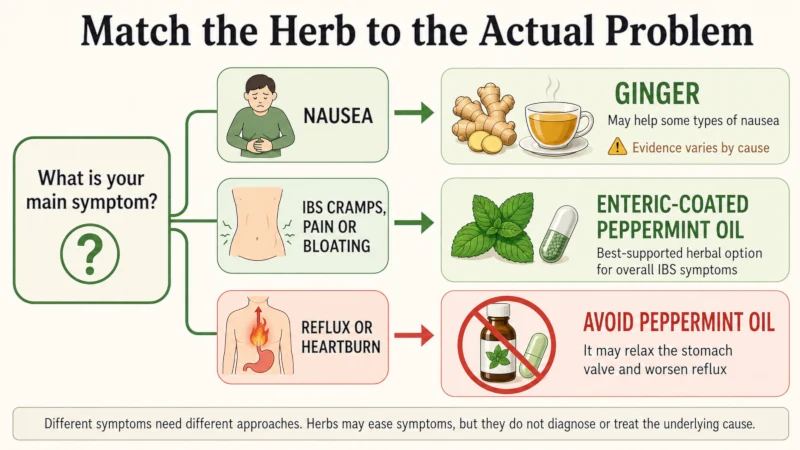
“Stomach issues” covers a lot of ground, and the herbs that help one problem often do nothing for another. Nausea, the cramping and irregularity of irritable bowel syndrome, the burning of reflux, and the vague fullness of indigestion are different problems with different best answers. Ginger is a nausea remedy; it won’t calm IBS cramps. Peppermint oil is one of the better-studied IBS remedies, but in the wrong form it can make reflux worse. Sorting out which bucket your symptoms fall into is the difference between a remedy that helps and one that’s useless — or counterproductive.
If your discomfort turns out to be gastritis, for instance, the gentler foods that calm an inflamed stomach lining are a better first move than any herb — our guide on foods to eat with gastritis covers what helps and what to skip.
The herbs with real evidence
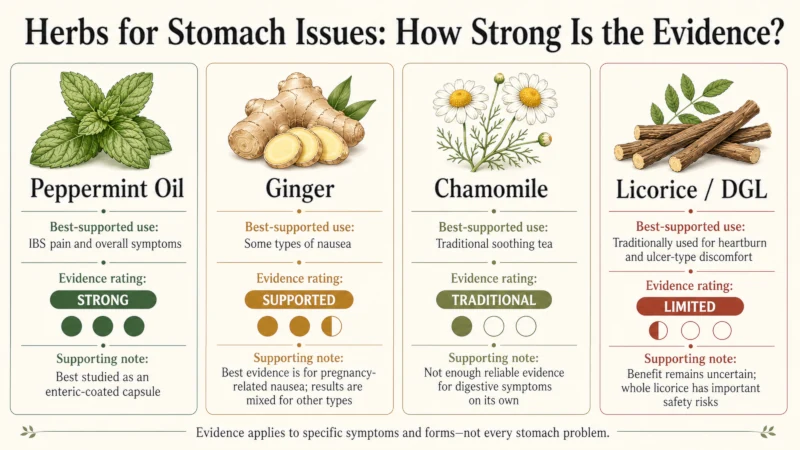
Peppermint oil — the standout for IBS
If any herb has earned its reputation for the gut, it’s peppermint. Peppermint oil relaxes the smooth muscle of the digestive tract, and in enteric-coated capsules — the kind designed to open in the intestine rather than the stomach — it has the strongest research behind it of anything in this guide. A 2022 review of 10 studies involving 1,030 people found peppermint oil beat placebo at improving overall IBS symptoms and easing abdominal pain [NCCIH, 2025]. It’s solid enough that the American College of Gastroenterology’s 2021 guideline recommends peppermint oil for overall relief of IBS symptoms [NCCIH, 2025].
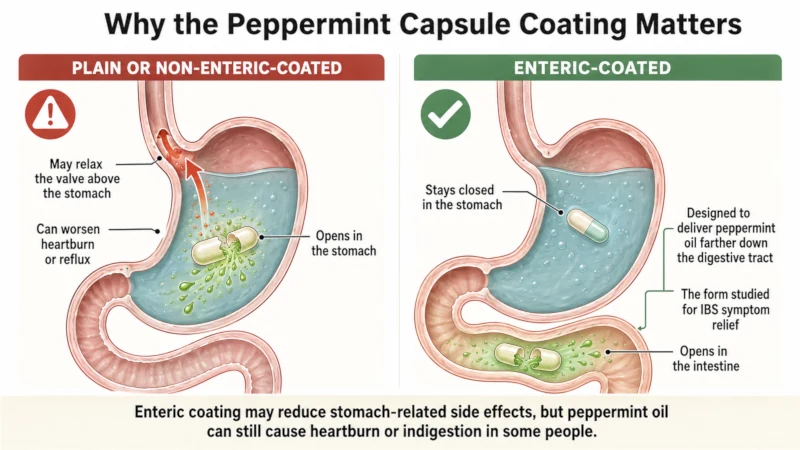
The catch is the form and the fine print. In those same studies, peppermint oil caused more side effects than placebo — usually mild, most often heartburn and indigestion [NCCIH, 2025]. That points to its main drawback: taken as a plain, non-enteric-coated oil, peppermint can relax the valve at the top of the stomach and make reflux or heartburn worse. Enteric-coated capsules are used specifically to sidestep that. And peppermint oil on its own hasn’t been shown to help ordinary indigestion — in some people it makes it worse — though specific products combining peppermint oil with caraway oil do appear to ease indigestion symptoms [NCCIH, 2025].
Bottom line: for IBS, enteric-coated peppermint oil is a reasonable, evidence-backed thing to try. For reflux-type symptoms, it’s the wrong tool.
Ginger — the go-to for nausea
Ginger is the other herb with genuine human evidence, and its lane is nausea. Research shows ginger may help the nausea and vomiting of pregnancy [NCCIH, 2025] — one of the few remedies many clinicians are comfortable suggesting for morning sickness, though it’s still worth clearing with your own provider first. The picture is more mixed elsewhere: most studies of ginger for motion sickness haven’t found it helpful, and its value for chemotherapy-related and post-surgery nausea is still uncertain [NCCIH, 2025].
Ginger is generally well tolerated, but it isn’t side-effect-free — it can cause abdominal discomfort, heartburn, diarrhea, and mouth or throat irritation [NCCIH, 2025]. Most people take it as tea, crystallized ginger, or capsules; there’s no single proven dose, so it’s reasonable to start small.
The traditional standbys
These next herbs have centuries of use and a lot of goodwill behind them, but thinner evidence. That doesn’t make them worthless — gentle and low-risk has value when your stomach is off — it just means the honest label is “traditional and soothing,” not “proven.”
Chamomile
Chamomile is the classic settle-your-stomach tea, and as a warm, calming drink it’s a pleasant, low-risk choice. But it’s worth being fair about what it is: for digestion specifically, there isn’t enough reliable evidence to say chamomile does much on its own [NCCIH, 2024]. Its better-studied use is actually for anxiety, and even the products tested for children’s colic and diarrhea were herbal blends, not chamomile alone.
Chamomile isn’t risk-free for everyone, either. People allergic to ragweed, chrysanthemums, marigolds, or daisies can react to it. It may lessen the effect of birth control pills, could interact with the blood thinner warfarin and with some drugs processed by the liver, and there isn’t much information on its safety in pregnancy or breastfeeding [NCCIH, 2024].
Licorice and DGL — helpful reputation, real safety catch
Licorice has an old reputation as a stomach and ulcer remedy, and you’ll see it stated flatly all over the internet. The evidence is softer than that: whether licorice on its own helps digestive symptoms is unclear [NCCIH, 2025]. A processed form called DGL (deglycyrrhizinated licorice) is often suggested for heartburn and ulcer-type symptoms, but even there the proof of benefit is limited [NCCIH, 2025]. You can read our fuller, evidence-first breakdown in our guide to licorice root benefits.
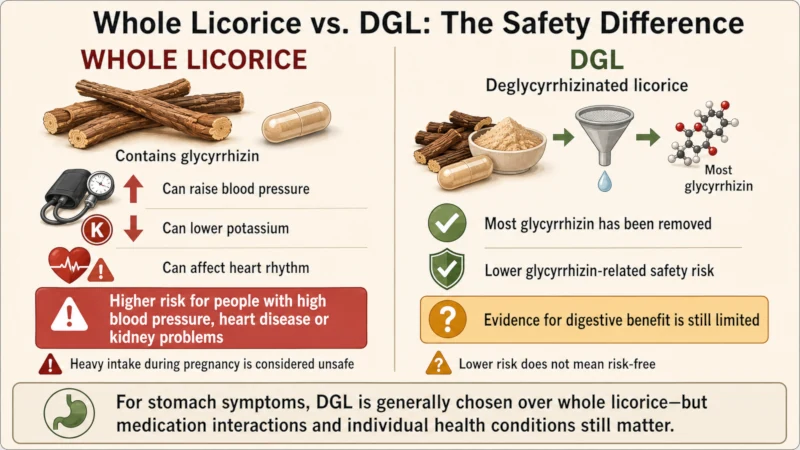
Here’s the part that matters most, because it’s a genuine safety issue rather than just “it might not work.” Whole licorice contains glycyrrhizin, a compound that can raise blood pressure, deplete potassium, and — especially in large amounts or with long-term use — trigger an irregular heartbeat and other serious effects [NCCIH, 2025]. Even small amounts can cause trouble in people who eat a lot of salt or who already have high blood pressure, heart disease, or kidney problems [NCCIH, 2025]. DGL is processed to remove most of the glycyrrhizin, which is why it’s the form usually chosen when the goal is digestive comfort. If you’re going to use licorice for your stomach, this is the distinction to get right.
Bitters and warming spices
A cluster of kitchen herbs and spices — turmeric, caraway, and other traditional “carminatives” used for gas and bloating — appears in nearly every list of stomach remedies. Turmeric, for example, has long been used to stimulate digestion and ease the fullness of dyspepsia; you can read more in our overview of turmeric’s traditional uses. The honest framing is that these are traditional digestive aids with limited high-quality human evidence for any single spice, with the notable exception of the peppermint-plus-caraway combination mentioned earlier. In ordinary culinary amounts or a modest tea they’re low-risk; as concentrated supplements, they deserve the same caution as anything else on this page.
The herb you’ll see called a “cure”: cabbage juice
Cabbage juice deserves a special mention because it’s often presented as a proven ulcer cure. The claim traces back to a real study — but a small, old one. In 1949, a physician named Garnett Cheney reported that 13 patients with peptic ulcers appeared to heal faster while drinking fresh cabbage juice [Cheney, 1949]. It’s a genuine piece of medical history, and cabbage does contain compounds of interest. But 13 patients, no control group, and more than seventy years before modern ulcer treatment existed is not the same as proof.
Reviews of gastritis and ulcer remedies today place cabbage juice in the “mostly lab or anecdotal, not enough solid human evidence” column. Peptic ulcers are now known to be driven largely by H. pylori and by NSAID painkillers, and they’re treated effectively with targeted medicine — a far surer path than a glass of juice.
How to use stomach herbs sensibly
A few practical habits keep herbal remedies in the “helpful” column:
- Match the form to the goal — enteric-coated capsules for peppermint and IBS; tea or crystallized ginger for nausea.
- Start with the lowest reasonable amount and give it a few days rather than escalating quickly.
- Treat concentrated extracts and high-dose capsules more carefully than a cup of tea; “natural” doesn’t mean “no dose to respect.”
- Don’t stack a herbal product on top of a prescription for the same problem without asking a pharmacist or doctor.
- If a remedy isn’t helping within a week or two, treat that as information — a cue to reassess, not to double down. For the everyday habits that keep digestion comfortable, see our digestive health section.
Safety, interactions, and who should be careful
Herbs are drugs with dilute, variable doses, and they interact with real medications. The specifics differ by herb, but a few cautions come up again and again.
Medication interactions. Chamomile may interact with warfarin and reduce the effectiveness of birth control pills [NCCIH, 2024]. Licorice’s glycyrrhizin can amplify corticosteroids and collides with blood-pressure and heart medications [NCCIH, 2025]. As a blanket rule, if you take prescription medicine, clear any herbal supplement with your pharmacist or doctor first [NCCIH, 2025].
Pregnancy and breastfeeding. This is where caution earns its keep. Ginger in dietary-supplement amounts may be safe in pregnancy, but even there the advice is to check with your provider, and little is known about breastfeeding [NCCIH, 2025]. Peppermint in food amounts is likely fine; medicinal amounts haven’t been well studied for pregnancy or breastfeeding [NCCIH, 2025]. Chamomile’s safety in pregnancy and breastfeeding is largely unknown [NCCIH, 2024]. Licorice is the clearest “avoid”: heavy intake in pregnancy is considered unsafe and has been linked to earlier delivery [NCCIH, 2025].
Who should be extra careful. Anyone with high blood pressure, heart disease, or kidney problems should steer clear of whole (glycyrrhizin-containing) licorice [NCCIH, 2025]. People with ragweed-type allergies should be cautious with chamomile [NCCIH, 2024]. And anyone whose “stomach issue” is really reflux should be wary of plain peppermint oil.
When it’s more than an upset stomach
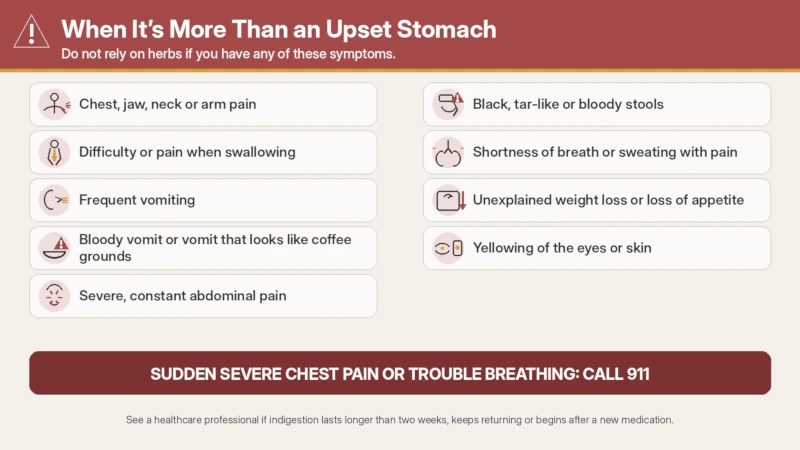
Most stomach trouble is short-lived and settles on its own or with gentle help. Some symptoms are different, and no herb is the right response to them. Based on U.S. guidance, see a doctor right away if indigestion comes with any of the following [NIDDK, 2025]:
- Pain in your chest, jaw, neck, or arm
- Difficulty swallowing or painful swallowing
- Frequent vomiting, or vomit that is bloody or looks like coffee grounds
- Severe, constant abdominal pain
- Black, tar-like or bloody stools
- Shortness of breath, or sweating along with the pain
- Unexplained weight loss or loss of appetite
- Yellowing of the eyes or skin
For sudden, severe chest pain or trouble breathing, call 911 — those can signal a heart problem, not indigestion. Even without alarm symptoms, see a doctor if your indigestion lasts longer than two weeks, keeps returning, or starts after a new medication, especially a painkiller [NIDDK, 2025]. Testing for H. pylori, reviewing your medications, or looking at the stomach lining directly is the kind of step that resolves the cause — something no tea can do. Depending on how you feel, primary care or urgent care is the right starting point; the emergency room and 911 are for the red-flag symptoms above.
| Health Disclaimer: This article is for general education and information only. It is not medical advice and is not a substitute for diagnosis or treatment from a qualified healthcare professional. Herbs can have side effects and can interact with prescription medicines. If you are pregnant or breastfeeding, take prescription medication, or have a heart, blood-pressure, kidney, or other ongoing condition, talk to your doctor or pharmacist before using any herb or supplement for your stomach. If you have severe or constant abdominal pain, are vomiting blood, notice black or bloody stools, or have chest pain or trouble breathing, seek emergency care or call 911. |
Frequently Asked Questions
What is the best herb for an upset stomach?
It depends on the problem. For nausea, ginger has the most support; for irritable bowel syndrome, enteric-coated peppermint oil is the best-evidenced choice [NCCIH, 2025] [NCCIH, 2025]. For a vague, off-feeling stomach, a warm chamomile or ginger tea is a reasonable, low-risk comfort measure rather than a proven fix.
Can peppermint make heartburn worse?
It can. Plain peppermint oil can relax the valve between the stomach and esophagus and worsen reflux, which is why enteric-coated capsules — designed to bypass the stomach — are used for IBS instead [NCCIH, 2025]. If your main symptom is burning reflux, peppermint is not the herb to reach for.
Is licorice safe to take for stomach problems?
Whole licorice carries a real risk: its glycyrrhizin can raise blood pressure, lower potassium, and cause heart-rhythm problems, especially in larger amounts or with existing heart, blood-pressure, or kidney conditions [NCCIH, 2025]. The deglycyrrhizinated form (DGL) removes most of that risk and is the form usually chosen for digestive symptoms, though its proven benefit is limited. Anyone pregnant or with heart, blood-pressure, or kidney issues should avoid whole licorice.
Does cabbage juice really heal ulcers?
That claim rests on a single small study from 1949, without a control group and long before modern ulcer treatment existed [Cheney, 1949]. It’s interesting history, not proof. Today’s ulcers are treated effectively by addressing their real causes — usually H. pylori infection or NSAID use — which is far more reliable than juice.
Are herbal teas safe during pregnancy?
Some are gentler than others, but “herbal” doesn’t mean “automatically safe in pregnancy.” Ginger in modest amounts is often considered acceptable but still worth checking with your provider; licorice should be avoided; and several herbs simply haven’t been well studied [NCCIH, 2025] [NCCIH, 2025]. When pregnant or breastfeeding, ask a healthcare professional before using any herb medicinally.
References
- National Center for Complementary and Integrative Health (NCCIH). “Peppermint Oil: Usefulness and Safety.” Last updated May 2025. View source
- National Center for Complementary and Integrative Health (NCCIH). “Ginger: Usefulness and Safety.” Last updated February 2025. View source
- National Center for Complementary and Integrative Health (NCCIH). “Chamomile: Usefulness and Safety.” Last updated November 2024. View source
- National Center for Complementary and Integrative Health (NCCIH). “Licorice Root: Usefulness and Safety.” Last updated April 2025. View source
- National Institute of Diabetes and Digestive and Kidney Diseases (NIDDK). “Indigestion (Dyspepsia).” Last reviewed March 2025. View source
- Cheney G. “Rapid Healing of Peptic Ulcers in Patients Receiving Fresh Cabbage Juice.” California Medicine. 1949;70(1):10–15. PMID 18104715. Cited only as historical context; small, uncontrolled, pre-dates modern ulcer treatment. View source
