
Prickly lettuce (Lactuca serriola) is a tall, bitter wild plant whose milky sap was used in European folk medicine for centuries as a mild sedative, a cough remedy, and a pain reliever.
Most of what circulates about it online rests on tradition and early animal research, not human trials. That gap is the whole story here. Below is what the plant actually is, what its dried sap — lactucarium — contains, what the studies do and don’t show, and who should stay away from it.
What is prickly lettuce?
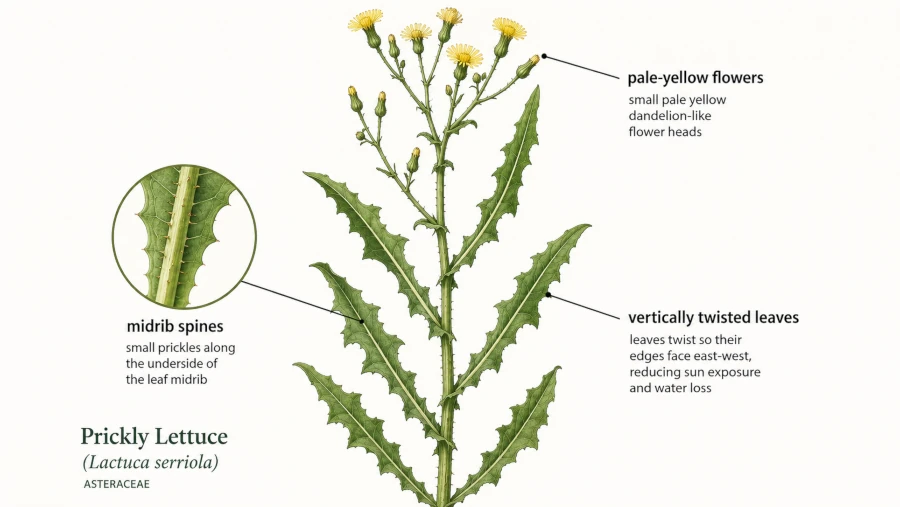
Lactuca serriola is an annual or biennial member of the daisy family (Asteraceae). It grows from about 40 cm to over 1.5 m, with a stiff stem, toothed leaves carrying a row of prickly spines along the midrib, and small pale-yellow flowers that ripen into fluffy, wind-dispersed seeds [Chadha & Florentine, 2021]. It began in the Mediterranean Basin and has since spread across Europe, western Asia, North Africa, and most temperate parts of the world — usually as an invasive roadside and field weed rather than a tended herb [Chadha & Florentine, 2021].
You may see it called the compass plant. In strong sun its upper leaves twist to stand on edge, roughly lined up north to south, which cuts water loss and helps it ride out drought [Chadha & Florentine, 2021]. It is also the wild ancestor of the lettuce in your salad, Lactuca sativa, which is why the young leaves of the two are so hard to tell apart.
How it differs from garden lettuce and “wild” lettuce
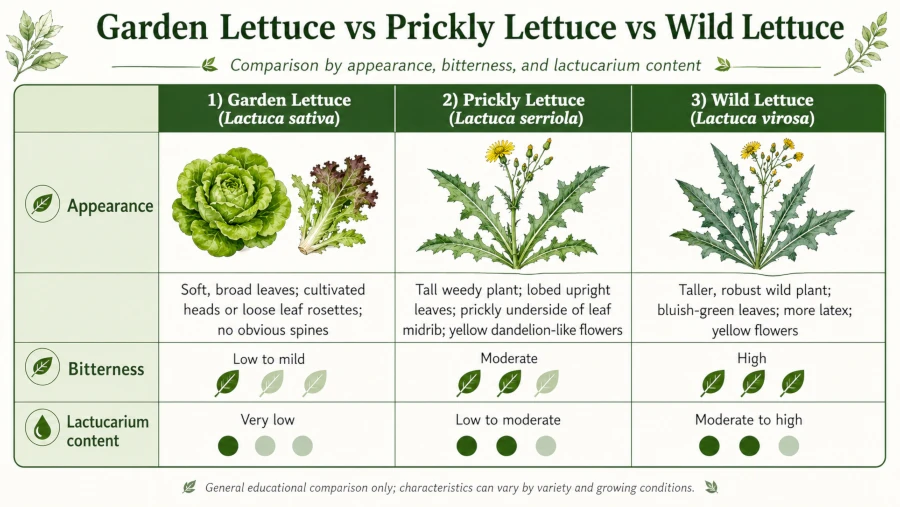
Three plants get muddled together, and the difference matters if you are reading old remedies:
- Garden lettuce (L. sativa): bred to be tender and mild, with only traces of the bitter compounds discussed here.
- Prickly lettuce (L. serriola): the bitter, spiny wild progenitor, carrying meaningful lactucarium that peaks when the plant flowers.
- Wild or “opium” lettuce (L. virosa): a separate European species that 19th-century pharmacists treated as the official, richest source of lactucarium [Chemeurope, n.d.].
Older medical texts that describe “lettuce opium” usually mean L. virosa, though the same codices also accepted lactucarium from L. serriola and in places rated it highly [Chemeurope, n.d.]. A lot of current herbal writing treats the two as one plant. They aren’t, and their potency differs.
What lactucarium is, and why it’s nicknamed lettuce opium
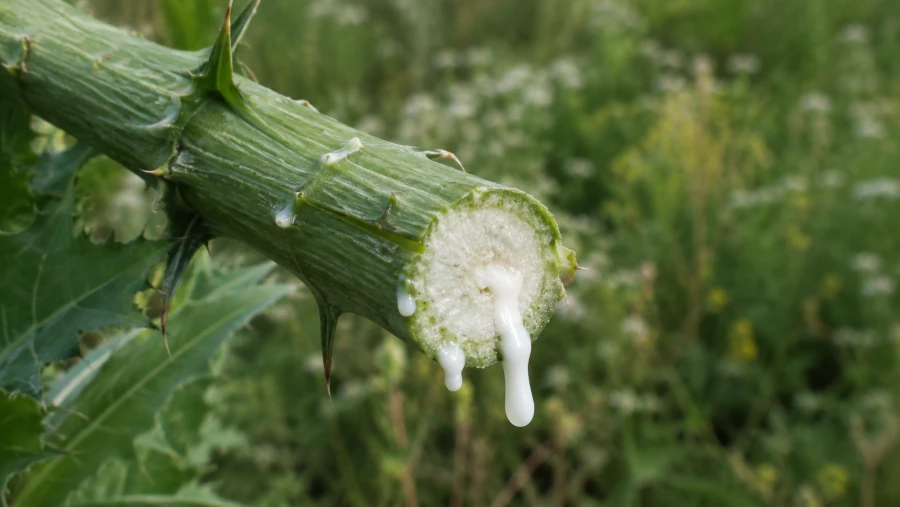
Cut any part of the plant and a white latex bleeds from the wound. Left to dry, it hardens into a brown, resin-like solid called lactucarium. The nickname “lettuce opium” comes from its faint sedative feel — not from any opium chemistry. Lactucarium contains no morphine, codeine, or related alkaloids, and a published case found none of the opiate effects sometimes claimed for it [Mullins & Horowitz, 1998].
Its best-studied components are bitter sesquiterpene lactones — chiefly lactucin, lactucopicrin, and 11β,13-dihydrolactucin. The same compounds turn up in chicory and in trace amounts in cultivated lettuce [Wesolowska et al., 2006]. Levels are low in young rosettes and climb as the plant bolts into flower, which is why traditional harvesters waited for mature, flowering plants [PFAF, n.d.].
Lactucarium has a real pharmaceutical past. It was described and standardized in the 1898 United States Pharmacopoeia and the 1911 British Pharmaceutical Codex, going into cough syrups, tinctures, and mild sleep lozenges [Chemeurope, n.d.]. Then it faded — and not only because synthetic drugs arrived. By the mid-20th century, analyses of commercial lactucarium found little or no activity; a 1944 review judged its reputation as a sleep aid closer to superstition than pharmacology, partly because the active bitter principles are unstable and largely break down in stored preparations [Chemeurope, n.d.]. That history is worth keeping in mind whenever a product promises strong effects from dried lettuce sap.
Traditional uses of prickly lettuce
Across European, Middle Eastern, and South Asian folk medicine, prickly lettuce and its cousin L. virosa were reached for to calm restlessness and ease occasional sleeplessness, to quiet a dry or whooping cough, to take the edge off mild pain including period and muscle pain, and to settle nervous tension [RxList, 2021].
Some older sources went further, listing it as an “anti-aphrodisiac” or a sedative for excitable children [RxList, 2021]. Read those as cultural history. None has been confirmed in a modern trial, and a couple — sedating children in particular — would not pass today’s safety bar.
What the evidence actually shows
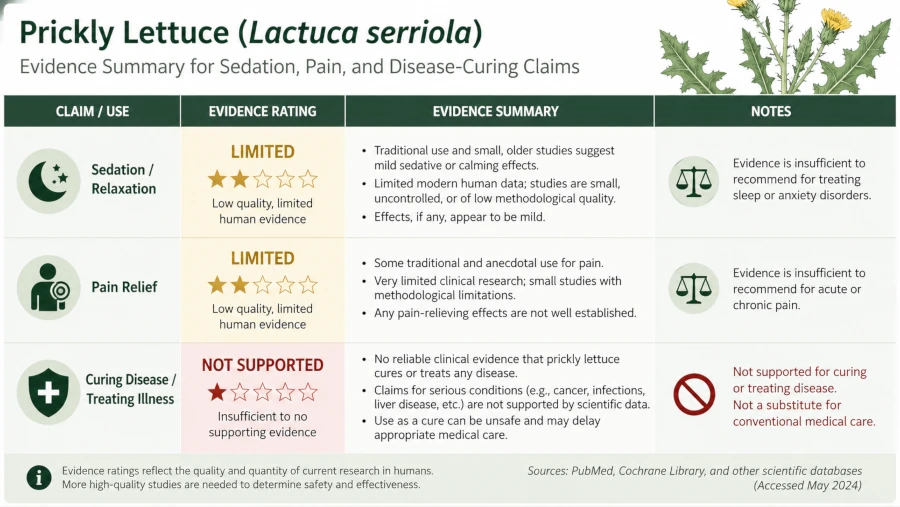
Here is the honest version: there are essentially no controlled human trials of prickly lettuce. Almost everything pharmacological comes from three places — isolated compounds tested in rodents, crude extracts tested on isolated animal tissue, and a handful of clinical reports, most of them about toxicity. That is enough to say something real is probably happening at the molecular level. It is not enough to say the plant treats any specific condition.
Sedation and sleep
In a 2006 study at the Polish Academy of Sciences, researchers gave mice purified lactucin, lactucopicrin, and 11β,13-dihydrolactucin and measured how much the animals moved. Lactucin and lactucopicrin — but not the dihydro form — cut spontaneous movement, the kind of result you’d expect from a mild sedative [Wesolowska et al., 2006]. No placebo-controlled sleep study has been run in people, so the claim that prickly lettuce “works for insomnia” leans on folklore plus those mouse data. If your real goal is steadier sleep through diet, our guide to foods that support the nervous system is a more grounded place to start.
Pain relief
The same team ran two standard rodent pain tests, the hot plate and the tail flick. In the hot-plate test the compounds at 15 and 30 mg/kg matched ibuprofen given at 30 mg/kg; in the tail-flick test, 30 mg/kg of the compounds was comparable to a 60 mg/kg dose of ibuprofen, with lactucopicrin the strongest of the three [Wesolowska et al., 2006]. Those are genuinely interesting preclinical numbers. They show the molecules are active — not that a mug of prickly lettuce tea will dull a headache.
Cough, asthma, and the airways
A 2013 pharmacology study tested a methanol extract of L. serriola on isolated rabbit windpipe tissue and found it relaxed the airway muscle as the dose rose — a plausible mechanism behind the plant’s old use for coughs [Janbaz et al., 2013]. Again, this is rabbit tissue in a dish, not a clinical result. For a kitchen remedy with sturdier evidence behind it, see our piece on onions for respiratory support.
Gut and blood vessels
In the same study the extract had a two-sided effect on rabbit intestine: it triggered contractions at lower concentrations (0.03–3 mg/mL) and then relaxed the tissue at a higher one (5 mg/mL). It also relaxed segments of aorta. The authors pointed to calcium-channel blocking as the likely mechanism [Janbaz et al., 2013]. Same caveat — a real signal, no human confirmation.
Where the evidence stands today:
| Claim | Evidence level | What kind of data |
| Mild sedative / sleep aid | Limited | Isolated compounds in mice; historical pharmacopoeia |
| Pain relief (analgesic) | Limited | Isolated compounds in mice |
| Cough / airway relaxation | Very limited | Isolated rabbit windpipe tissue |
| Antispasmodic (gut, vessels) | Very limited | Isolated rabbit intestine and aorta |
| Cures insomnia, pain, or whooping cough | Not supported | No controlled human trials |
How prickly lettuce has been prepared
These methods are here for context, not as a recipe — read the safety section first. Traditional herbalists worked in three main ways:
- A leaf decoction — roughly 100 g of fresh flowering plant simmered about 10 minutes in a litre of water, strained, sometimes sweetened with honey.
- Dried lactucarium — the air-dried latex, historically given at 0.1–1 g a day in lozenges or pills, the form the old pharmacopoeias standardized [Chemeurope, n.d.].
- Fresh juice or tincture — pressed from the flowering tops, often blended with calming herbs such as valerian, hops, or passionflower.
Two practical points. The active compounds barely register in young plants and peak at flowering, so rosettes eaten as salad have little medicinal effect; and large helpings of the raw leaf can upset your stomach [PFAF, n.d.].
Safety, side effects, and drug interactions
Prickly lettuce is not a gentle, consequence-free herb. Its active compounds act on the nervous system, and the sap can be concentrated into something far stronger than a cup of tea. Both the Natural Medicines safety monograph and published case reports document real harm [RxList, 2021].
Who should avoid prickly lettuce
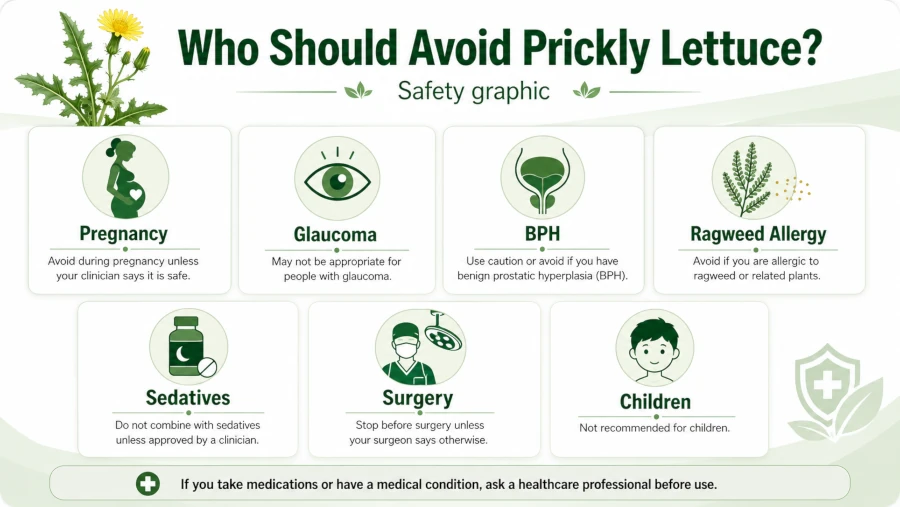
- Pregnant or breastfeeding people — safety data are lacking.
- Anyone with narrow-angle glaucoma — it may worsen the condition.
- People with an enlarged prostate (BPH) or other urinary retention — it can make passing urine harder.
- Anyone allergic to ragweed, daisies, chrysanthemums, or marigolds — all Asteraceae relatives, and cross-reaction is common.
- Anyone on CNS depressants — benzodiazepines, opioids, prescription sleep aids, alcohol, or other sedating herbs — because the effects can stack dangerously.
- Anyone facing surgery — stop at least two weeks ahead, because of a possible interaction with anesthesia.
- Children — older texts called it safe for “excitable” children, but there is no modern pediatric safety data and the sap isn’t dose-standardized.
Source: RxList / Natural Medicines monograph for wild lettuce.
Reported side effects
Small culinary amounts of young leaves are usually fine. Concentrated extracts or the dried latex are a different story and have been linked to sweating, a racing heart, dilated pupils, blurred vision, ringing in the ears, dizziness, heavy sedation, and nausea — and, in serious cases, slowed or difficult breathing. Very large amounts can be dangerous [RxList, 2021].
Two reports make the point. In 2009, BMJ Case Reports described eight people in northern Iran who developed fever, chills, abdominal, flank and back pain, neck stiffness, headache, and a raised white-cell count after eating wild lettuce; all recovered, though one spent 48 hours in intensive care [Besharat et al., 2009]. Separately, three people who injected a homemade wild-lettuce extract became acutely ill — a reminder that “natural” does not mean safe to inject, which no one should ever do [Mullins & Horowitz, 1998].
When to see a healthcare professional
Skip the self-treatment and get checked if you have:
- Insomnia that drags on beyond a few weeks.
- A cough lasting more than three weeks, or one with blood, breathlessness, chest pain, fever, or unexplained weight loss.
- Severe or worsening pain, or pain with numbness, weakness, or changes in bladder or bowel control.
- Any sign of an allergic reaction after contact with the plant — hives, swelling, wheezing, or trouble breathing, which needs urgent care.
Realistic expectations
Prickly lettuce is a real piece of pharmaceutical history with plausible, early-stage support for mild sedative, pain-dulling, and cough-calming effects. It is not a tested treatment, and it is not a substitute for one. A fair way to file it: alongside other traditional bitter herbs — worth understanding, occasionally useful as part of a wider approach to winding down or soothing a tickly cough, but not a cure, and not safe in the concentrated doses some sites push.
If you want calming herbs with stronger modern evidence behind them, our guides to ashwagandha and lavender are better grounded.
| Health Disclaimer This article is for general education only and is not a substitute for professional medical advice, diagnosis, or treatment. Prickly lettuce and lactucarium are not approved by the FDA or EMA to treat any disease. Do not use prickly lettuce, wild lettuce, or any lactucarium product if you are pregnant or breastfeeding, have narrow-angle glaucoma or an enlarged prostate (BPH), are allergic to plants in the Asteraceae/ragweed family, take sedatives or other central-nervous-system depressants, or have surgery scheduled. Talk with a qualified healthcare professional before starting any herbal remedy — especially if you have a medical condition, take prescription medication, or are considering giving herbs to a child. |
Frequently asked questions
Is prickly lettuce the same as “wild lettuce”?
Not quite. “Wild lettuce” is used loosely for several Lactuca species. In herbal commerce it usually means L. virosa, the official pharmacopoeial source of lactucarium. Prickly lettuce is L. serriola, a close relative that makes smaller amounts of the same bitter compounds [Chemeurope, n.d.]. They are botanically distinct and differ in potency.
Does prickly lettuce actually make you sleepy?
Isolated lactucin and lactucopicrin reduced movement in mice at lab doses, which fits a mild sedative effect [Wesolowska et al., 2006]. Whether a cup of prickly lettuce tea produces a noticeable sleep effect in people has never been tested in a controlled trial. Tradition and anecdote suggest it is mild at best, and stored preparations may lose much of their activity.
Is prickly lettuce the same as opium?
No. “Lettuce opium” is a nickname for dried lactucarium because of its faint sedative resemblance to opium. It contains no morphine, codeine, or other opiate alkaloids, and it works through completely different chemistry [Mullins & Horowitz, 1998].
Can I eat prickly lettuce in a salad?
Young rosette leaves are edible and have been eaten as a foraged green around the Mediterranean, though they are bitter. Large amounts can upset your stomach, and older flowering plants turn too bitter and too concentrated to eat freely [PFAF, n.d.]. Correct identification matters — confirm the plant before eating any wild green.
Is prickly lettuce legal?
In most countries prickly lettuce and wild lettuce are unregulated and can be grown, harvested, and sold as herbal products [RxList, 2021]. Legal is not the same as proven safe or effective — it only means there is no specific law against it.
References
- Wesolowska A, Nikiforuk A, Michalska K, Kisiel W, Chojnacka-Wójcik E. (2006). Analgesic and sedative activities of lactucin and some lactucin-like guaianolides in mice. J Ethnopharmacol. 107(2):254–258. → View source
- Janbaz KH, Latif MF, Saqib F, Imran I, Zia-Ul-Haq M, De Feo V. (2013). Pharmacological effects of Lactuca serriola L. in an experimental model of gastrointestinal, respiratory, and vascular ailments. Evid Based Complement Alternat Med. 2013:304394. → View source
- Chadha A, Florentine S. (2021). Biology, ecology, distribution and control of the invasive weed, Lactuca serriola L. (wild lettuce): a global review. Plants (Basel). 10(10):2157. → View source
- Besharat S, Besharat M, Jabbari A. (2009). Wild lettuce (Lactuca virosa) toxicity. BMJ Case Rep. 2009:bcr06.2008.0134. → View source
- Mullins ME, Horowitz BZ. (1998). The case of the salad shooters: intravenous injection of wild lettuce extract. Vet Hum Toxicol. 40(5):290–291. → View source
- RxList / Natural Medicines Comprehensive Database. Wild Lettuce: Uses, Side Effects & Warnings. → View source
- Chemeurope Encyclopedia. Lactucarium. → View source
- Plants For A Future (PFAF). Lactuca serriola — Prickly Lettuce. → View source
