
No single food will clear up eczema, and a diet that promises to is promising too much. What you eat still matters in a few specific ways. Food supplies the nutrients your skin depends on, a true food allergy can make flares worse, and for babies with eczema, the timing of certain foods can lower the odds of a lifelong peanut or egg allergy. The 10 best foods for eczema below are ranked by what the evidence actually shows, from strong to thin, with a plain note on each about what to expect.
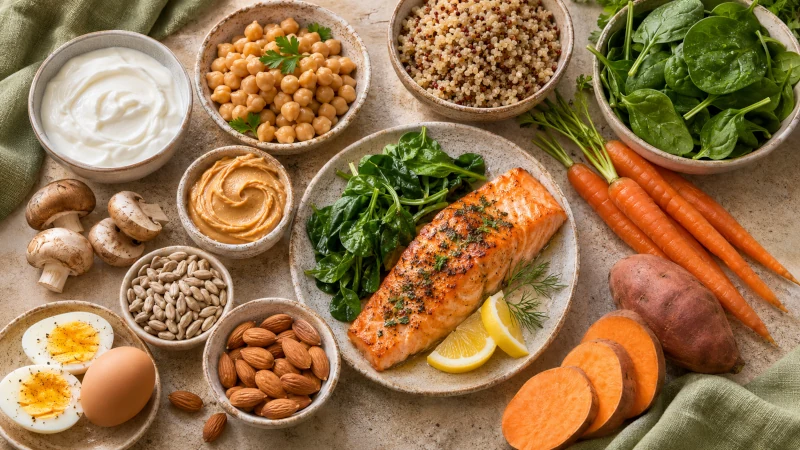
Start with realistic expectations. The American Academy of Dermatology says relief for most children comes from baths, moisturizers, managing triggers and medication, and that changing the diet seldom fixes the rash [AAD, n.d.]. About 40% of babies and young children with moderate or severe eczema do have a food allergy, yet removing the offending food rarely stops the eczema itself [AAD, n.d.]. The National Eczema Association agrees there is no special eczema diet, and that food is rarely the root cause [NEA, 2025].
So your plate has three jobs: give your skin everything it needs, leave out only the foods you’ve been shown to react to, and, if you’re feeding a baby with eczema, bring in key allergens on time.
The 10 Best Foods for Eczema, Ranked by Evidence
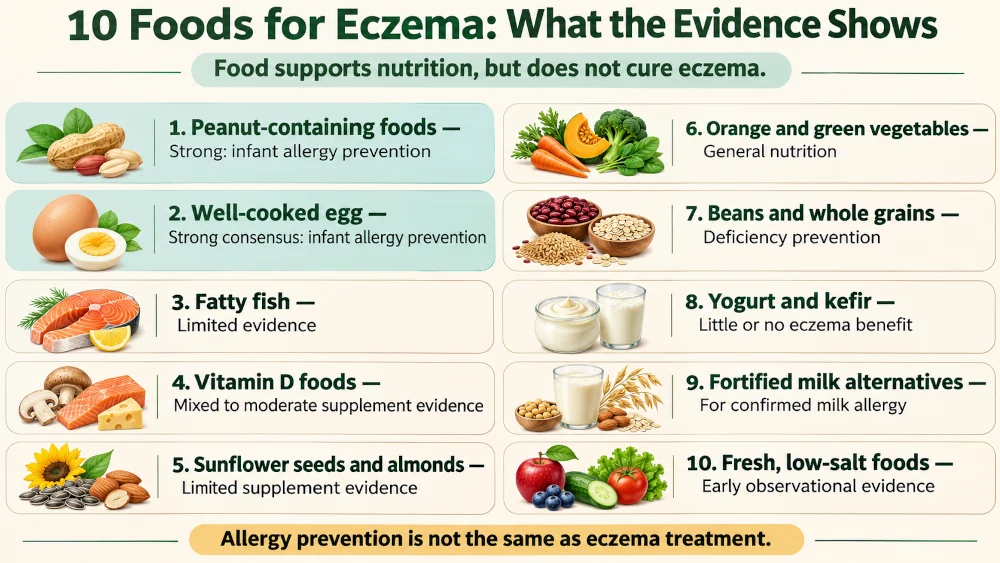
| # | Food | What it offers | Strength of evidence |
| 1 | Peanut-containing foods (babies) | Lowers the risk of peanut allergy in high-risk infants | Strong: large randomized trial plus US guidelines |
| 2 | Well-cooked egg (babies) | Lowers the risk of egg allergy | Strong expert consensus |
| 3 | Fatty fish | Omega-3 fats and vitamin D | Limited |
| 4 | Vitamin D foods | Vitamin D | Mixed to moderate (supplement trials) |
| 5 | Sunflower seeds and almonds | Vitamin E | Limited (one supplement trial) |
| 6 | Orange and dark-green vegetables | Beta-carotene (vitamin A) | General nutrition; no eczema trials |
| 7 | Beans, peanuts, whole grains, potatoes | Niacin and vitamin B6 | Prevents deficiency rashes; not an eczema treatment |
| 8 | Yogurt and kefir | Live cultures | Little or no effect on eczema |
| 9 | Fortified milk alternatives | Replaces milk’s nutrients | Useful only with a confirmed milk allergy |
| 10 | Fresh, low-salt whole foods | Less sodium | Early, observational |
1. Peanut-containing foods, introduced early (for babies)
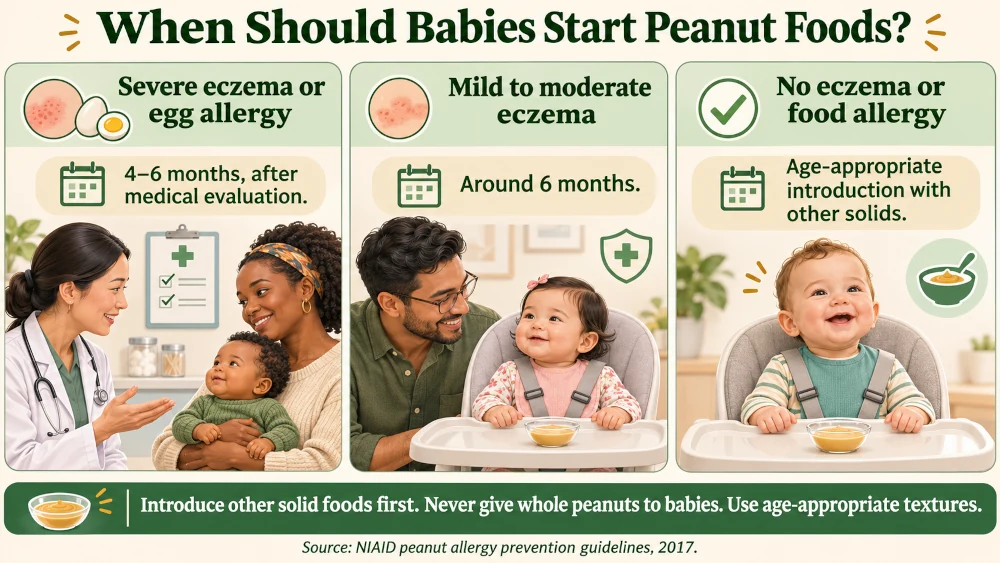
This is the strongest food evidence anywhere near eczema, though it is about preventing an allergy, not calming the rash. In the LEAP trial, 640 infants with severe eczema, egg allergy, or both were randomly assigned to eat peanut regularly or avoid it [Du Toit et al., 2015]. Eating peanut from infancy lowered the risk of peanut allergy by age 5 by 81 percent [NIAID, 2017a].
US guidelines now reflect this. Infants with severe eczema, egg allergy, or both should be evaluated, often with a blood or skin test, and can then start peanut-containing foods as early as 4 to 6 months. Infants with mild to moderate eczema can start around 6 months [NIAID, 2017b]. Introduce other solid foods first, and never give whole peanuts to babies or small children, because of the choking risk [NIAID, 2017a]. If your baby’s eczema is severe, talk to your pediatrician before the first taste. For the wider picture, see peanuts’ nutrition and allergy safety.
2. Well-cooked egg (for babies)
Consensus guidance from the major North American allergy societies names eczema as the biggest risk factor for IgE-mediated food allergy and recommends introducing both peanut and egg around 6 months of age, but not before 4 months [Fleischer et al., 2021]. Screening tests aren’t required first, though some families prefer them. The same guidance encourages a varied diet once solids begin, since diet diversity may help prevent food allergy [Fleischer et al., 2021].
If a baby already has a confirmed egg allergy, the picture changes. A Cochrane review found some evidence, from a single study, that an egg-free diet helped infants with suspected egg allergy and positive egg-specific IgE tests [Bath-Hextall et al., 2008]. That’s a call for your child’s doctor, not a reason to drop egg in advance.
3. Fatty fish: salmon, sardines, mackerel
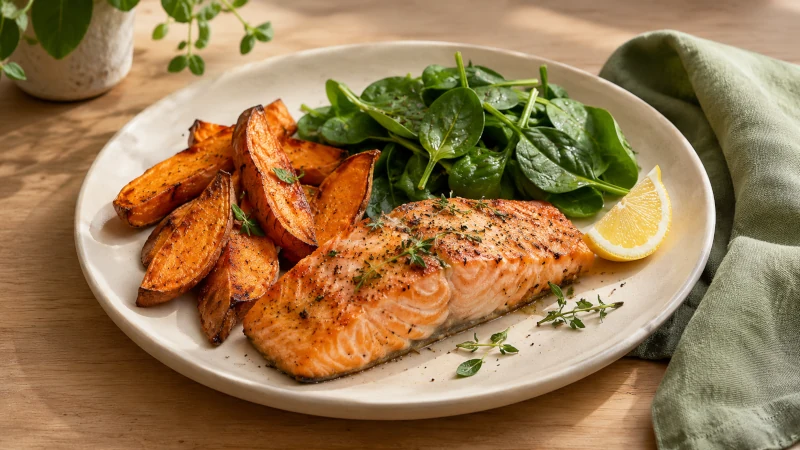
Fatty fish supply omega-3 fats and are among the best natural sources of vitamin D [NIH ODS, Omega-3s] [NIH ODS, Vitamin D]. For eczema itself, the evidence is thin. A Cochrane review of dietary supplements found no convincing benefit overall. Two small fish oil trials found slight improvements in itch and quality of life, but the reviewers said a much larger trial would be needed before practice should change [Bath-Hextall et al., 2012].
Eating fish regularly is a reasonable choice for overall nutrition. Fish is also one of the common food allergens [NEA, 2025], so leave it out if it has ever caused hives or swelling. For supplements specifically, read what fish oil can and can’t do.
4. Vitamin D foods: egg yolks, mushrooms, fortified milks
Vitamin D has the most promising data of any nutrient here. A 2024 meta-analysis of 11 randomized trials with 686 children and adults found that vitamin D reduced eczema severity compared with control, and rated the evidence as moderate certainty [Nielsen et al., 2024]. The caveats are real: only 3 of the 11 trials showed a significant benefit on their own, most were small and enrolled mild to moderate cases, and the effect was not significant for severe eczema [Nielsen et al., 2024]. These were supplement trials, not food trials.
Food sources include fatty fish, egg yolks, mushrooms (some are treated with UV light to boost their vitamin D), and fortified milk, plant milks and cereals [NIH ODS, Vitamin D]. Food alone rarely adds up to a large dose. If you’re considering a supplement, ask your doctor whether a blood test makes sense, and don’t go above 100 mcg (4,000 IU) a day from all sources unless a clinician recommends it [NIH ODS, Vitamin D].
5. Sunflower seeds and almonds
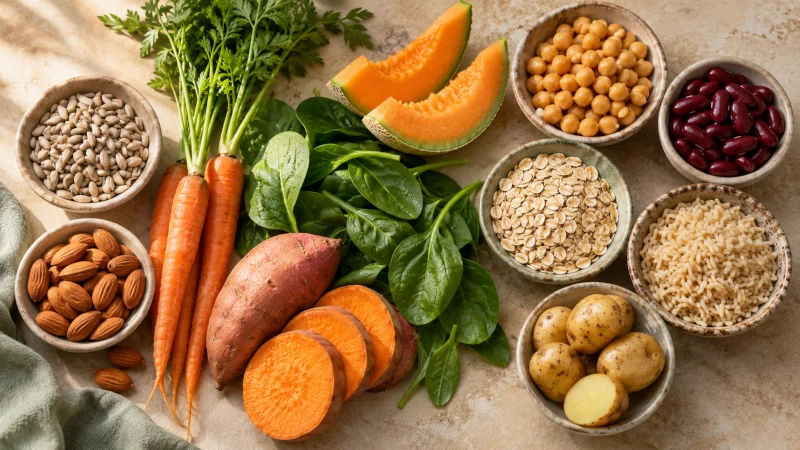
Both rank among the richest food sources of vitamin E (see these other vitamin E-rich foods). In one randomized, double-blind trial, 70 people with mild to moderate eczema took 400 IU of vitamin E a day or a placebo for four months, and the vitamin E group improved more on a standard severity score [Jaffary et al., 2015]. That is one modest study using a supplement dose far larger than a handful of seeds provides, so treat it as a hint rather than a reason to stock up.
Choose unsalted versions, and skip them if you have a tree nut or seed allergy.
6. Orange and dark-green vegetables
Carrots, sweet potatoes, spinach and cantaloupe are major sources of beta-carotene, which your body converts to vitamin A [NIH ODS, Vitamin A]. Vitamin A is an essential nutrient, but no trial shows that eating more of these vegetables treats eczema. Their value is simpler: they make up the plant-heavy, minimally processed way of eating that the National Eczema Association describes as a sensible baseline [NEA, 2025]. More on plant sources of vitamin A.
Get your vitamin A from food rather than high-dose pills. Preformed vitamin A above the upper limit can cause birth defects, and large doses of beta-carotene supplements raised lung cancer risk in smokers [NIH ODS, Vitamin A].
7. Beans, peanuts, whole grains and potatoes
Legumes, nuts and grains supply niacin, and potatoes, fish and poultry supply vitamin B6 [NIH ODS, Niacin] [NIH ODS, Vitamin B6]. Severe niacin deficiency causes pellagra, which includes a rough rash on sun-exposed skin [NIH ODS, Niacin] [MedlinePlus, n.d.], and low B6 can cause itchy rashes and cracks at the corners of the mouth [NIH ODS, Vitamin B6].
Those rashes are not atopic eczema, and both deficiencies are rare in the US [NIH ODS, Niacin] [NIH ODS, Vitamin B6]. If you already eat a varied diet, more beans won’t change your skin. If your diet is very restricted, because of several food avoidances, alcohol use disorder or a digestive condition, it’s worth asking your doctor about deficiency. Read more about vitamin B6.
8. Yogurt and kefir
Fermented foods are recommended for eczema all the time, and the best evidence is underwhelming. A 2018 Cochrane review concluded that currently available probiotics probably make little or no difference to eczema symptoms such as itch and sleep loss [Makrgeorgou et al., 2018]. If you enjoy yogurt and tolerate dairy, there’s no reason to stop. Just don’t expect your skin to change.
9. Fortified milk alternatives (only with a confirmed milk allergy)
Milk is one of the foods most likely to cause allergy in children with eczema [AAD, n.d.]. If an allergist confirms a milk allergy, a fortified plant milk helps replace some of the vitamin D and other nutrients milk would have supplied [NIH ODS, Vitamin D].
Soy milk is not an automatic safe swap. In a study of 93 young children with IgE-mediated cow’s milk allergy, 14% were also allergic to soy [Zeiger et al., 1999]. For babies, don’t switch on your own: most formula-fed infants with cow’s milk allergy do well on a hypoallergenic (extensively hydrolyzed) formula, and a few need an amino acid formula [AAP, n.d.]. Without a confirmed allergy, cutting dairy is more likely to cost you nutrients than calm your skin [AAD, n.d.].
10. Fresh, low-salt whole foods in place of processed ones
Salt is a newer line of research. A 2024 study of about 216,000 UK adults estimated sodium intake from urine samples and found that each extra gram of daily sodium was linked to 11% higher odds of an eczema diagnosis and 16% higher odds of active eczema [Chiang et al., 2024]. It’s a cross-sectional study, so it shows an association, not proof that salt causes flares.
Even so, cooking more meals from vegetables, fruit, beans and fish lowers your sodium and cuts back on processed and sugary foods, which the National Eczema Association suggests limiting because they can promote inflammation [NEA, 2025].
Foods to Avoid With Eczema: Only the Ones You React To
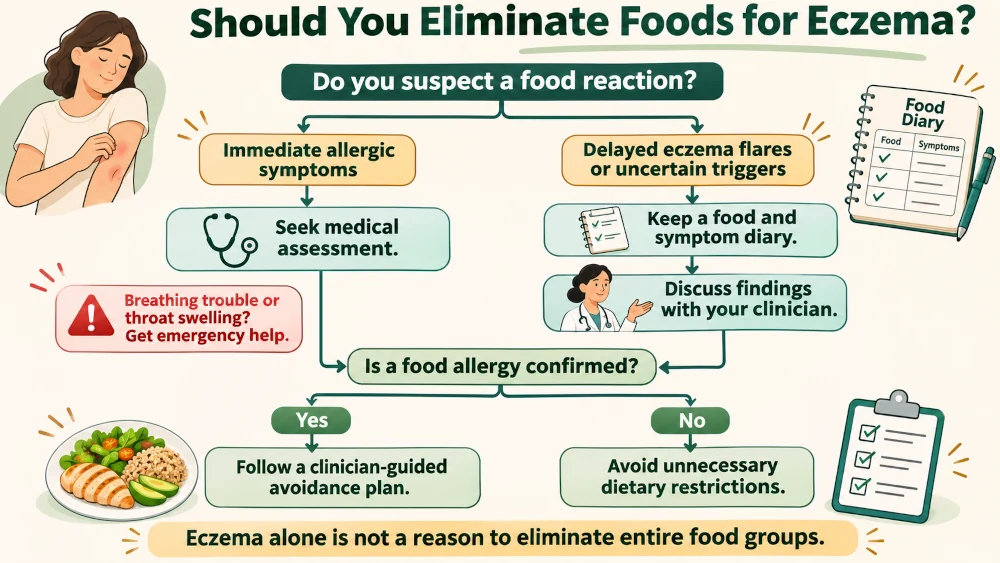
There is no universal avoid list. Milk, eggs, wheat, soy and nuts are the foods most likely to cause allergy in children with eczema [AAD, n.d.], and fish, shellfish and peanuts are also common, but doctors don’t advise avoiding them simply because you have eczema [NEA, 2025]. Our guide to the most common food allergy triggers covers each one.
Cutting foods on a hunch has costs. Long-term avoidance of staples like milk, eggs, wheat, soy and nuts can lead to weight loss, poor growth and vitamin and mineral deficiencies in children [AAD, n.d.]. Elimination can also backfire on the allergy itself. In one study of children with food-triggered eczema and no history of immediate reactions, 19% developed new immediate reactions after starting an elimination diet, and 30% of those reactions were anaphylaxis [Chang et al., 2016]. A Cochrane review of exclusion diets found little evidence of benefit for most people with eczema [Bath-Hextall et al., 2008].
If you suspect a food, keep a simple diary of meals and flares and take it to your doctor before removing anything. The AAD recommends food allergy testing for children whose moderate to severe eczema isn’t controlled by skin care, trigger management and medication, or who react right after eating a particular food [AAD, n.d.]. Skin prick and blood tests can give false positives, and a food challenge supervised by a clinician is more reliable [NEA, 2025]. If a food does need to go long term, ask for a referral to a dietitian [AAD, n.d.].
You may also see claims that vegetable juices or “detoxing” foods such as artichokes heal eczema by clearing toxins from the blood. No good evidence supports this. Eczema is understood to come from a mix of genetic and environmental factors [Bath-Hextall et al., 2008], and it does not respond to flushing your system.
What About Supplements?

Supplements are where most money gets spent and least benefit shows up. Here is what systematic reviews and safety agencies report.
| Supplement | What the research found | Main cautions |
| Evening primrose oil, borage oil | 27 studies with 1,596 people: no better than placebo [Bamford et al., 2013] | Evening primrose oil may increase bleeding with warfarin [Bamford et al., 2013] |
| Fish oil | No convincing benefit; two small trials hinted at less itch [Bath-Hextall et al., 2012] | Can raise bleeding risk with warfarin and other blood thinners; may cause heartburn, nausea, diarrhea [NIH ODS, Omega-3s] |
| Vitamin D | Moderate-certainty evidence of a modest benefit, mostly in mild to moderate eczema [Nielsen et al., 2024] | Adult upper limit 4,000 IU/day; interacts with steroids such as prednisone, thiazide diuretics, statins and orlistat [NIH ODS, Vitamin D] |
| Probiotics | Probably little or no difference in symptoms [Makrgeorgou et al., 2018] | Trials used many different strains and doses, so results don’t point to one product [Makrgeorgou et al., 2018] |
| Vitamin B6, niacin | No evidence they treat eczema; deficiency is rare [NIH ODS, Vitamin B6] [NIH ODS, Niacin] | High-dose B6 for a year or more can cause severe nerve damage [NIH ODS, Vitamin B6]; niacin can cause flushing and, at high doses, liver damage [NIH ODS, Niacin] |
Tell your doctor or pharmacist about any supplement you take, especially if you use prescription medicines.
Safety: Who Should Be Careful
- Babies with eczema. Plan peanut and egg introduction with your pediatrician, especially if eczema is severe. Never give whole nuts [NIAID, 2017a].
- Pregnant or breastfeeding parents. Avoiding allergens during pregnancy or breastfeeding is not recommended as a way to prevent food allergy [Fleischer et al., 2021], and the NHS advises against changing your diet while breastfeeding a baby with eczema unless a doctor tells you to [NHS, n.d.]. Avoid vitamin A supplements that provide more than 3,000 mcg RAE a day [NIH ODS, Vitamin A].
- People taking blood thinners. Check with your clinician before fish oil or evening primrose oil [NIH ODS, Omega-3s] [Bamford et al., 2013].
- Current or former smokers. Skip high-dose beta-carotene supplements [NIH ODS, Vitamin A].
- Anyone on a restricted diet. If you’ve cut several foods, ask a dietitian to check that you’re still getting enough protein, vitamins and minerals [AAD, n.d.].
When to See a Doctor
Book an appointment if your eczema isn’t improving with regular moisturizing and the treatment you’ve been prescribed, or if you think a food is involved. Talk to a board-certified dermatologist before cutting foods, especially for a child [AAD, n.d.].
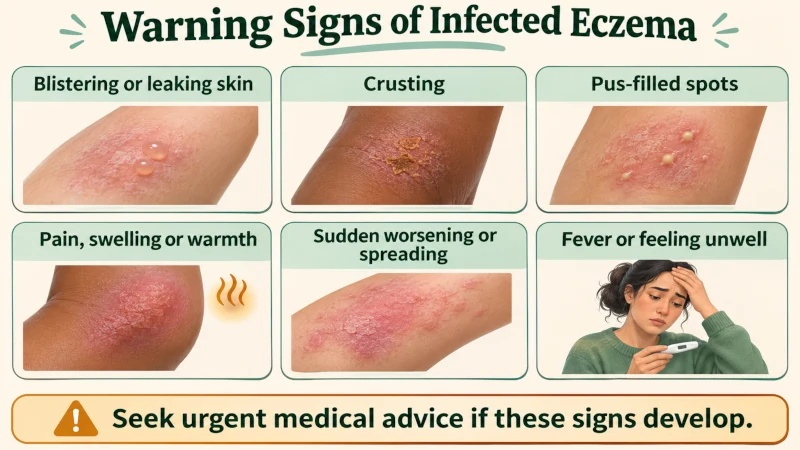
Get urgent medical advice if you notice any of these, which can signal infected eczema or a more serious infection called eczema herpeticum [NHS, n.d.]:
- Blistered, crusty or leaking skin, or spots filled with pus
- Pain, swelling or warmth in the skin
- Eczema that suddenly gets worse or spreads
- A high temperature or feeling generally unwell
Treat it as an emergency if hives, swelling, throat tightness, coughing, wheezing or trouble breathing start within minutes to two hours of eating a food [AAP, n.d.]. These are signs of an immediate allergic reaction, not an eczema flare.
| HEALTH DISCLAIMER: This information is for general education and is not a substitute for advice, diagnosis or treatment from a qualified healthcare professional. Eczema and food allergy are individual, and some changes described here, such as removing foods or introducing allergens to a baby, should be planned with a doctor. If you are pregnant, breastfeeding, taking medication or caring for an infant, talk to your doctor or pharmacist before starting any supplement or making major diet changes. |
Frequently Asked Questions
Can changing my diet cure eczema?
No. Diet changes seldom fix eczema, and relief mainly comes from skin care, managing triggers and medication [AAD, n.d.]. A balanced diet supports your skin, and avoiding a food you’re truly allergic to can prevent reactions, but neither replaces treatment.
Should I cut out dairy if I have eczema?
Do sugar or gluten cause eczema flares?
Some people report that cutting dairy, simple carbs or gluten helps, but the National Eczema Association says more research is needed [NEA, 2025]. A food diary reviewed with your doctor is more reliable than a broad cut.
Is it safe to give peanut to a baby with eczema?
For most babies it’s recommended. Infants with mild to moderate eczema can usually start peanut-containing foods around 6 months, while those with severe eczema or egg allergy should be evaluated first and may start at 4 to 6 months [NIAID, 2017b]. Never give whole peanuts [NIAID, 2017a].
Do I need allergy testing for eczema?
References
- American Academy of Dermatology. Can food fix eczema? View source
- American Academy of Pediatrics. Food Allergies and Intolerances in Newborns and Infants. View source
- Bamford JTM, Ray S, Musekiwa A, et al. Oral evening primrose oil and borage oil for eczema. View source
- Bath-Hextall FJ, Delamere FM, Williams HC. Dietary exclusions for established atopic eczema. View source
- Bath-Hextall FJ, Jenkinson C, Humphreys R, Williams HC. Dietary supplements for established atopic eczema. View source
- Chang A, Robison R, Cai M, Singh AM. Natural history of food-triggered atopic dermatitis and development of immediate reactions in children. View source
- Chiang BM, Ye M, Chattopadhyay A, Halezeroglu Y, Van Blarigan EL, Abuabara K. Sodium intake and atopic dermatitis. View source
- Du Toit G, Roberts G, Sayre PH, et al. Randomized trial of peanut consumption in infants at risk for peanut allergy. View source
- Fleischer DM, Chan ES, Venter C, et al. A consensus approach to the primary prevention of food allergy through nutrition: View source
- Jaffary F, Faghihi G, Mokhtarian A, Hosseini SM. Effects of oral vitamin E on treatment of atopic dermatitis: a randomized controlled trial. View source
- Makrgeorgou A, Leonardi-Bee J, Bath-Hextall FJ, et al. Probiotics for treating eczema. View source
- MedlinePlus Medical Encyclopedia. Pellagra. View source
- National Eczema Association. Diet & Nutrition for Eczema. View source
- National Institute of Allergy and Infectious Diseases. Addendum Guidelines for the Prevention of Peanut Allergy in the United States: View source
- National Institute of Allergy and Infectious Diseases. Addendum Guidelines for the Prevention of Peanut Allergy in the United States: View source
- NHS. Atopic eczema. View source
- Nielsen AY, Høj S, Thomsen SF, Meteran H. Vitamin D supplementation for treating atopic dermatitis in children and adults: View source
- NIH Office of Dietary Supplements. Niacin: View source
- NIH Office of Dietary Supplements. Omega-3 Fatty Acids: View source
- NIH Office of Dietary Supplements. Vitamin A and Carotenoids: View source
- NIH Office of Dietary Supplements. Vitamin B6: View source
- NIH Office of Dietary Supplements. Vitamin D: View source
- Zeiger RS, Sampson HA, Bock SA, et al. Soy allergy in infants and children with IgE-associated cow’s milk allergy. View source


