If you’re here because you’ve heard the madder plant is a natural fix for kidney stones or a gentle diuretic, here’s the honest short answer: those are traditional uses, not proven ones — and the madder plant’s benefits come attached to a real safety problem that most enthusiastic write-ups skip. The root contains compounds that damage DNA in laboratory tests, produced tumors in animal studies, and led at least one country to pull madder-based medicines from the market. So this page will give you the full picture: what madder was used for, what modern research can and can’t support, and why swallowing it is no longer considered a good idea.
What Is Madder (Rubia tinctorum)?
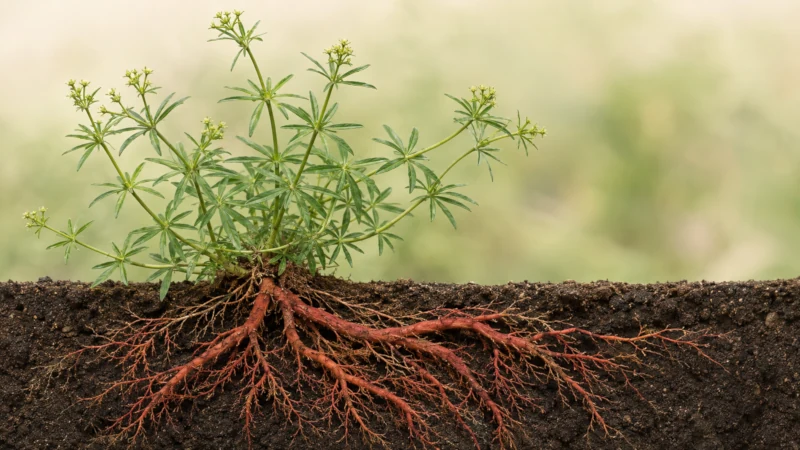
Madder, or Rubia tinctorum, is a scrambling perennial in the same botanical family as coffee and cleavers. For centuries its thick red root was prized less as a medicine than as a dye — it yields a vivid red pigment (alizarin) that colored textiles across the Mediterranean and beyond until synthetic dyes replaced it. Alongside that industrial life, folk medicine put the root to work as a diuretic and a remedy for “stones,” and that reputation is what still circulates online today.
The chemistry that made madder a good dye is exactly the chemistry that makes it a poor medicine. The red comes from a group of compounds called hydroxyanthraquinones — and some of those compounds are the reason for the caution below.
The Benefits People Traditionally Claim for Madder
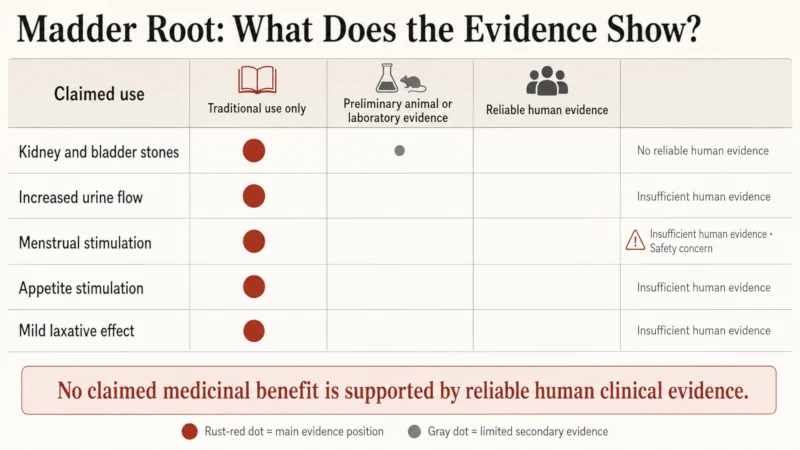
In older herbal texts and the pages that echo them, madder root is credited with a familiar cluster of effects: increasing urine flow, easing the pain of kidney colic, helping pass or dissolve kidney stones, stimulating appetite, prompting menstruation, and acting as a mild laxative. Its most persistent reputation, across sources, is as a treatment for kidney and bladder stones — madder root has long been described as a traditional herbal medicine used against kidney stones.
It’s worth being clear about what that pedigree does and doesn’t mean. Traditional use tells you people found a plant worth trying and passed the practice down. It does not tell you the plant works, how well, at what dose, or whether it’s safe — those are separate questions that need evidence, and for madder the evidence lands in an uncomfortable place.
What the Research Actually Shows
Kidney Stones and the Urinary Tract
This is madder’s strongest thread, and it’s still thin. A 2021 laboratory study in rats found that an antioxidant- and polyphenol-rich ethanol extract of Rubia tinctorum, given alongside a stone-inducing chemical, reduced calcium oxalate crystals in the urine and limited the kidney damage the model would otherwise cause — the co-administered extracts significantly reduced calcium oxalate in urine and prevented biochemical and kidney-tissue changes associated with urolithiasis [Marhoume et al., Molecules, 2021].
That’s a genuinely interesting signal about why the tradition exists — but it’s an animal study, using a prepared extract, aimed at preventing crystals in a controlled model, not a human trial showing madder safely dissolves an existing stone.
When you step back to what’s been established in people, the picture is blunt. The Natural Medicines database, summarized by WebMD, rates the evidence for madder in kidney stones, menstrual problems, urinary problems, and every other traditional use as insufficient — there simply aren’t the human studies to support them [WebMD / Natural Medicines, 2026].
The Other Traditional Uses
The appetite-stimulating, menstruation-promoting, and laxative reputations sit on even less. They come from historical practice and the anthraquinone content of the root, not from clinical research. No reliable human data backs them, and — as the next section explains — the menstruation-promoting property is a reason for caution, not a selling point.
The Safety Problem That Changes Everything
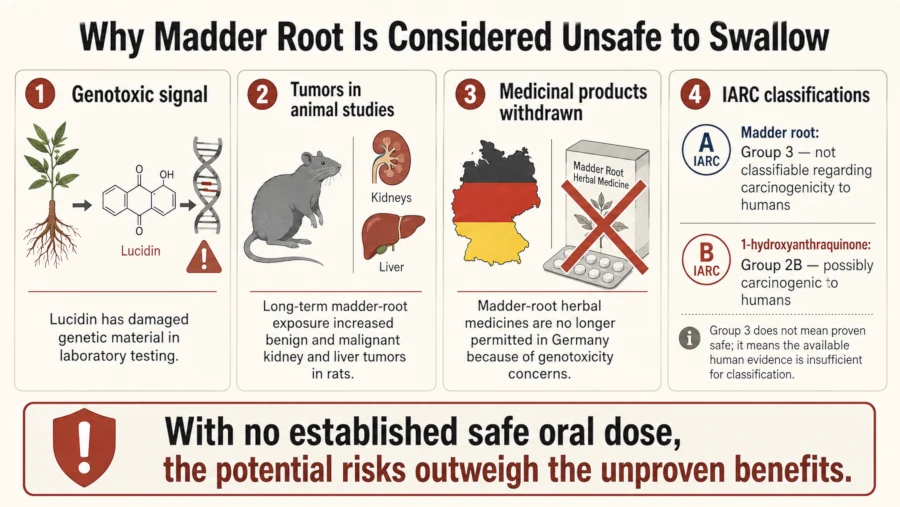
Here is the part that reshapes the whole “benefits” conversation. Madder root contains lucidin, a hydroxyanthraquinone that has repeatedly tested positive as a mutagen and genotoxin — it damages genetic material in bacteria and in cultured mammalian cells and forms DNA adducts in animals [IARC, 2002; Westendorf et al., 1988].
That lab signal was followed up in living animals. When rats were fed madder root over long periods, it produced benign and malignant tumors in the liver and kidney — madder root caused an increase in hepatocellular adenomas and adenomas and carcinomas of the renal cortex in male and female rats [IARC, 2002], with DNA-adduct patterns tying the effect back to lucidin [Westendorf et al., Carcinogenesis, 1998].
What “Genotoxic” Means Here
Grading this honestly matters. The International Agency for Research on Cancer reviewed madder in 2002 and placed madder root itself in Group 3 — “not classifiable” as to human cancer risk — because the human data don’t exist and the animal evidence, while real, was judged limited [IARC, 2002].
Group 3 is not a clean bill of health; it means undetermined. In the same review, a related anthraquinone that the body can form, 1-hydroxyanthraquinone, was rated Group 2B, “possibly carcinogenic to humans,” on the strength of animal evidence [IARC, 2002]. In plain terms: a plant whose active compounds damage DNA and cause tumors in animals, with no human safety studies to reassure you, is not something to take by mouth on a folk reputation.
How Regulators Responded
Health authorities acted on exactly that reasoning. Herbal medicines prepared from madder root are no longer permitted in Germany, a restriction attributed specifically to the genotoxic effects of lucidin [Meyler’s Side Effects of Drugs, via ScienceDirect, 2006]. Consumer drug references now reflect the same conclusion: taken by mouth, madder is rated likely unsafe, with the note that its chemicals may cause cancer [WebMD / Natural Medicines, 2026].
Side Effects and Who Should Avoid Madder
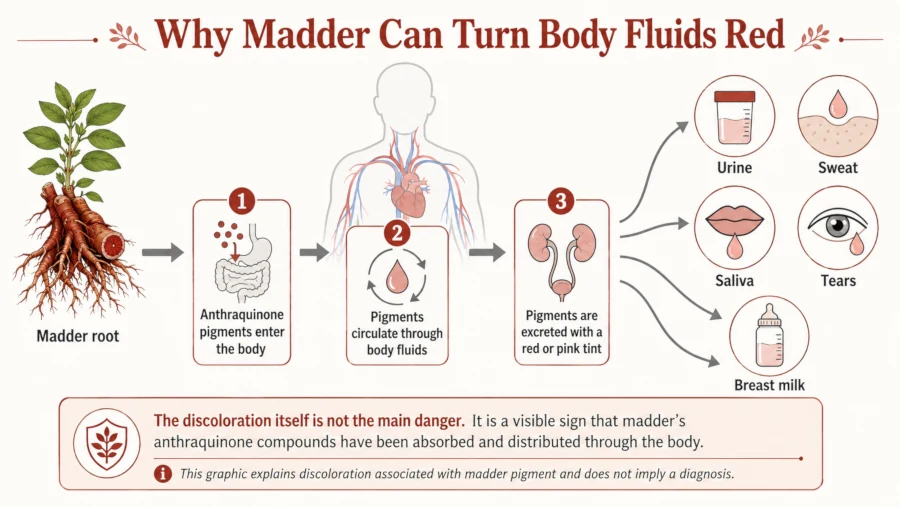
One effect of madder is harmless but startling, and it’s a useful reminder of how thoroughly the pigment moves through the body: it can turn urine, sweat, saliva, tears, and breast milk red [WebMD / Natural Medicines, 2026]. The color itself isn’t the danger; it’s a visible sign of the anthraquinones being distributed and excreted.
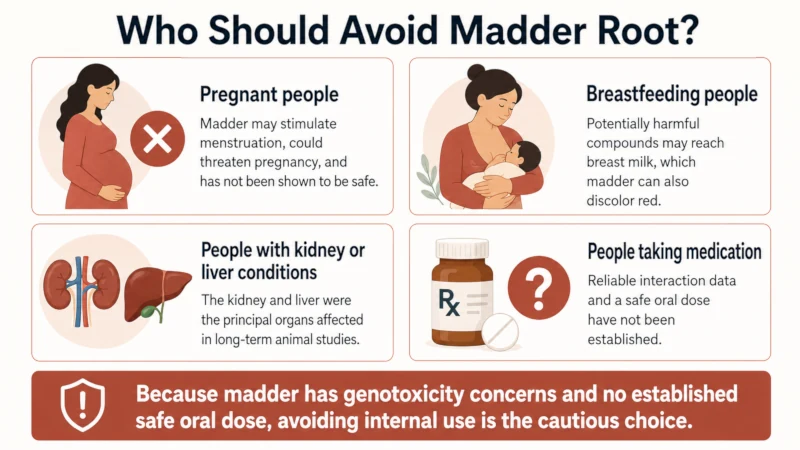
The people who should not use madder are easy to name, and the list is broad:
| Group | Why |
| Anyone pregnant | Rated unsafe. Madder may stimulate menstruation, which could threaten a pregnancy, and it may cause birth defects [WebMD / Natural Medicines, 2026]. |
| Anyone breastfeeding | Rated unsafe; it may harm a nursing infant and can turn breast milk red [WebMD / Natural Medicines, 2026]. |
| People with kidney or liver conditions | The organs shown to be damaged in animal studies are the kidney and liver [IARC, 2002]. |
| Anyone wanting to avoid genotoxic exposure | Lucidin damages DNA in laboratory tests [IARC, 2002; Westendorf et al., 1988]. |
On drug interactions, the honest answer is that reliable human data are lacking — which is its own kind of warning. When a substance has no established safe dose and no interaction profile, there’s no way to use it responsibly alongside prescription medicines. If you take any regular medication, this alone is reason to steer clear and talk to a pharmacist.
Because no reputable body has established a safe amount of madder to swallow, no dose is given here. The absence isn’t an oversight — it reflects that the appropriate intake for internal use hasn’t been determined, and safety hasn’t been shown [WebMD / Natural Medicines, 2026].
A Safer Way to Protect Your Kidneys and Urinary Tract
If a stone or a stubborn urinary problem is what sent you looking at madder, that concern is real and worth addressing — just with tools that have evidence and safety behind them. The single best-supported step against kidney stones is unglamorous: drink enough fluid to keep your urine pale, which dilutes the minerals that crystallize into stones. Diet matters too, and it’s genuinely actionable once you know your stone type; our guide to foods that raise and lower kidney stone risk walks through the specifics, including the common mistake of cutting dietary calcium.
For general urinary support, plenty of well-tolerated herbs have gentler safety profiles than madder; you can compare them in our overview of herbal options for urinary system support. And if you’re trying to sort out which urinary complaints respond to self-care and which don’t, our breakdown of urinary conditions and when they need a doctor is a good next stop.
When to See a Doctor
Urinary and kidney symptoms have a habit of masquerading as minor until they aren’t. Get prompt medical care — urgent care, your doctor, or the emergency room — if you have severe or wave-like pain in your back, side, or lower abdomen, pain radiating toward the groin, blood in your urine, fever or chills alongside urinary symptoms (a sign infection may have reached the kidney), or you’re unable to pass urine. Fever with flank pain in particular is not a wait-and-see situation. No herb substitutes for evaluation when these red flags appear.
| Health Disclaimer: This article is for general education, not medical advice, and it isn’t a recommendation to use madder. Based on current evidence, swallowing madder root is considered likely unsafe, and it is unsafe during pregnancy and breastfeeding. Do not use madder or any herbal product to self-treat kidney stones, urinary infections, or other medical conditions without talking to a qualified healthcare professional first — especially if you are pregnant or nursing, have kidney or liver disease, or take any medication. If you have symptoms that concern you, seek care from a licensed clinician. |
Frequently Asked Questions
Is the madder plant poisonous?
Not in the sense of an immediate toxin, but taken by mouth it’s rated likely unsafe: its compounds damage DNA in lab tests and caused tumors in animals, and herbal madder medicines have been withdrawn from the market in Germany over that concern [IARC, 2002; WebMD / Natural Medicines, 2026]. “Not acutely poisonous” and “safe to consume” are not the same thing.
Does madder root actually dissolve kidney stones?
There’s no human evidence that it does. A rat study found a madder extract reduced stone-forming crystals in a prevention model [Marhoume et al., 2021], which helps explain the tradition, but clinical databases rate the evidence in people as insufficient [WebMD / Natural Medicines, 2026]. Hydration and stone-specific diet changes are the better-supported approach.
Why does madder turn urine or sweat red?
Its red pigment (an anthraquinone) is absorbed and then excreted through urine, sweat, saliva, tears, and even breast milk, tinting them red or pink [WebMD / Natural Medicines, 2026]. The color is harmless in itself; the concern is the compounds producing it, not the stain.
Can I take madder if I’m pregnant or breastfeeding?
No. It’s rated unsafe in both cases — it may stimulate menstruation and risk the pregnancy, may cause birth defects, and may harm a nursing baby [WebMD / Natural Medicines, 2026].
Is madder still used for anything?
Historically its main role was as a red textile dye, and it retains niche interest there. As an internal medicine, its use has fallen away in favor of safer, better-studied options.
References
- International Agency for Research on Cancer (IARC). Rubia tinctorum, Morinda officinalis and Anthraquinones — Monographs Vol. 82 Summary & Evaluation, 2002. [View source]
- Westendorf J, Pfau W, Schulte A. Carcinogenicity and DNA adduct formation observed in ACI rats after long-term treatment with madder root, Rubia tinctorum L. Carcinogenesis 1998;19:2163–8. PMID 9886573. [View source]
- Westendorf J, Poginsky B, Marquardt H, et al. The genotoxicity of lucidin, a natural component of Rubia tinctorum L. Cell Biol Toxicol 1988;4(2):225–239. PMID 3069188. [View source]
- Marhoume FZ, Aboufatima R, Zaid Y, et al. Antioxidant and Polyphenol-Rich Ethanolic Extract of Rubia tinctorum L. Prevents Urolithiasis in an Ethylene Glycol Experimental Model in Rats. Molecules 2021;26(4):1005. DOI 10.3390/molecules26041005; PMID 33672875; PMC7917717. [View source]
- WebMD / Natural Medicines (Therapeutic Research Center). Madder — Uses, Side Effects, and More. Accessed 2026. [View source]
- Rubia (overview drawing on Meyler’s Side Effects of Drugs, 15th ed., 2006). ScienceDirect Topics. [View source]
