
Dwarf elder is a wild Sambucus plant with a long history in traditional herbal medicine, but it is not a safe elderberry substitute. Its berries and other plant parts can cause poisoning, and there is not enough human evidence to support using it as a home remedy for arthritis, fluid retention, fever, infections, or weight loss [RxList, 2026].
The safer way to understand dwarf elder is this: it is a medicinal plant of historical interest, not a casual kitchen herb. If you find it outdoors, do not eat the berries, roots, leaves, or stems. If you are considering any preparation made from dwarf elder, talk with a qualified healthcare professional first.
Dwarf elder at a glance
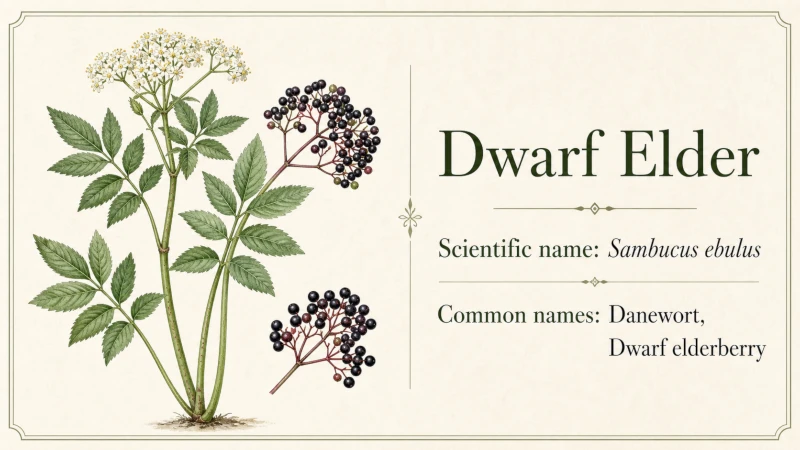
| Feature | What to know |
| Scientific name | Sambucus ebulus L. |
| Common names | Dwarf elder, dwarf elderberry, danewort, blood elder, walewort, wild elder |
| French name | Hièble |
| Spanish name | Yezgo |
| Current botanical family | Viburnaceae in modern garden references; older herbals may list Caprifoliaceae |
| Native range | Madeira, northwest Africa, Europe, and parts of western/central Asia [RBG Kew, 2026] |
| Growth habit | Herbaceous perennial; dies back rather than forming a woody shrub or tree |
| Main safety issue | Harmful if eaten; large amounts can be dangerous [RHS, 2026]; RxList, 2026 |
| Best practical advice | Do not self-dose dwarf elder internally |
What is dwarf elder?
Dwarf elder (Sambucus ebulus) is a herbaceous member of the elder group. Unlike black elder (Sambucus nigra), which grows as a shrub or small tree, dwarf elder usually grows from underground rhizomes and sends up upright stems each year. It can form dense clumps and has a strong, unpleasant odor that helps distinguish it from more familiar elderberry shrubs [RHS, 2026].
The plant produces small white flowers followed by dark berries. The berry clusters tend to be more upright than the drooping clusters often seen on black elderberry. That difference can help, but it is not enough for safe foraging. Plant identification based on berry color alone is risky because several elder species produce dark or reddish berries, and their safety profiles differ.
Scientific facts
- Sambucus ebulus L. is an accepted botanical species [RBG Kew, 2026].
- It grows mainly in temperate regions and is native across a broad range from parts of Europe and northwest Africa into western and central Asia [RBG Kew, 2026].
- Modern horticultural sources list it in the Viburnaceae family and describe it as potentially harmful if eaten [RHS, 2026].
- Traditional medicine sources describe use of the leaves, roots, fruit, and flowers, but modern safety and dosing data are not strong enough to support unsupervised use [Jabbari et al., 2017]; [RxList, 2026].
Dwarf elder vs. black elderberry
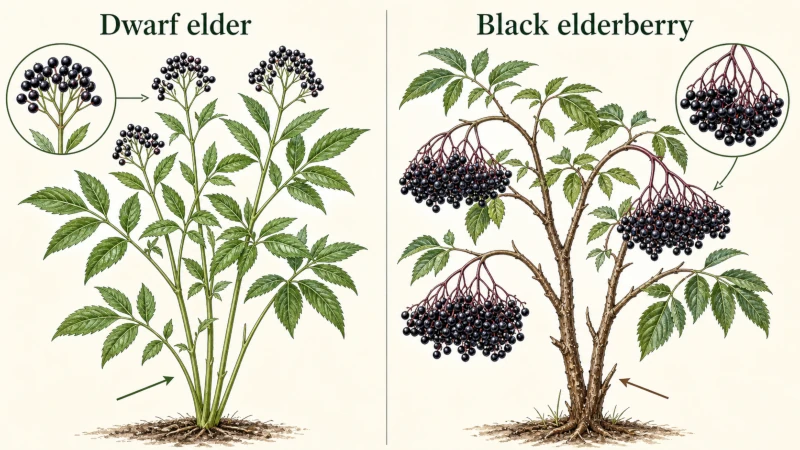
Dwarf elder and black elderberry belong to the same genus, but they should not be treated as interchangeable.
| Feature | Dwarf elder (Sambucus ebulus) | Black elderberry (Sambucus nigra) |
| Growth form | Herbaceous perennial; stems die back | Woody shrub or small tree |
| Height | Often around 1-2 meters | Often taller, commonly shrub-sized |
| Smell | Strong and unpleasant | Aromatic flowers; less harsh odor |
| Berry clusters | Often more upright | Often drooping when ripe |
| Common use | Traditional medicine; not a common food herb | Cooked berries and flowers used in foods and supplements |
| Safety | Harmful if eaten; no established safe dose | Raw or improperly prepared parts can still be toxic; cooked berries are commonly used |
Even black elderberry needs care. Raw elderberries, stems, leaves, seeds, and flowers may contain compounds that can release cyanide during digestion, and raw or improperly prepared elderberries have caused nausea, vomiting, diarrhea, weakness, dizziness, and hospitalization in documented outbreaks [CDC, 1983]; [UMN Extension, 2026]; [OSU Extension, 2024]. Dwarf elder deserves at least as much caution.
Traditional uses of dwarf elder
Dwarf elder has been used in European and Middle Eastern folk medicine for several complaints, including joint pain, fever, wounds, infections, and swelling [Jabbari et al., 2017]. Those uses belong in a historical or ethnobotanical discussion. They should not be presented as proven treatments.
Diuretic and “water retention” use
Older herbals describe dwarf elder root or leaf preparations as diuretic, meaning they were used to increase urination. That is why it appears in traditional discussions of edema, also called fluid retention.
Modern readers should be careful here. Fluid retention can come from heart, kidney, liver, vein, lymph, medication, or hormone-related causes. A plant that increases urination could also worsen dehydration, electrolyte problems, kidney strain, or medication side effects. There is not enough reliable human research to recommend dwarf elder for edema or kidney problems [RxList, 2026].
For a broader safety-first discussion of urinary herbs, see this guide to herbal remedies for urinary system support. Juniper is another traditional urinary herb with a clearer modern safety discussion, though it also has important cautions.
Fever and sweating claims
Dwarf elder has been described as sudorific, which means sweat-promoting. Older sources used sweat-promoting herbs during febrile illnesses such as colds, flu-like infections, and malaria.
This should be handled carefully. Fever is a symptom, not a diagnosis. Malaria requires prompt medical testing and prescription treatment. Influenza, COVID-19, pneumonia, kidney infections, meningitis, and other infections may also require medical care. Dwarf elder should not be used to treat fever, malaria, influenza, or any serious infection.
For food-based support during ordinary cold and flu recovery, a safer starting point is this evidence-based guide to foods for cold and flu.
Joint and skin use
Dwarf elder has also been used externally in folk medicine for rheumatic aches, bruises, wounds, and irritated skin [Jabbari et al., 2017]. Some lab and animal research has explored anti-inflammatory, antimicrobial, and wound-related effects, but those findings do not prove that home preparations are safe or effective in people.
Topical use can still cause problems. Plant extracts may irritate the skin, trigger allergic reactions, or contaminate wounds if prepared poorly. Do not apply dwarf elder to open wounds, burns, infected skin, or rashes that are spreading, painful, warm, or draining pus.
Insect-repellent use
Fresh dwarf elder leaves have a folk reputation for repelling insects. A 2024 laboratory and field study tested dwarf elder leaf and flower extracts against mosquito larvae and egg-laying behavior. The researchers found larvicidal activity under experimental conditions, especially with certain extracts and phenolic compounds [Farina et al., 2024].
That does not mean rubbing dwarf elder leaves on the skin is safe or effective. The study looked at prepared extracts and mosquito behavior, not human skin use. For mosquito protection, use proven options such as EPA-registered repellents, protective clothing, window screens, and removal of standing water.
What the evidence actually supports
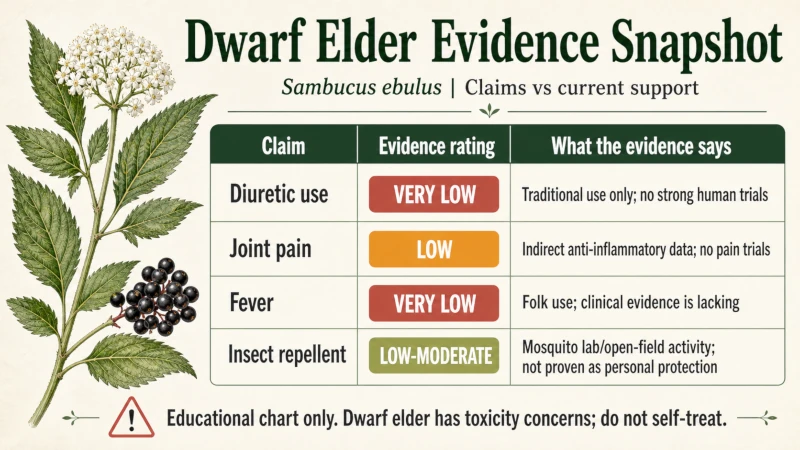
The evidence for dwarf elder is much weaker than many herbal pages imply.
| Claim | Evidence level | Practical interpretation |
| Dwarf elder has been used traditionally for swelling, fever, joint pain, wounds, and infections | Historical and ethnobotanical evidence | Valid as history, not proof of benefit |
| Dwarf elder contains bioactive compounds | Chemical and lab research | Interesting, but not enough to guide home use |
| It may have anti-inflammatory or antimicrobial effects | Mostly lab, animal, or early-stage research | Not proven as a treatment in people |
| It works as a diuretic | Traditional use; insufficient modern human data | Do not use for fluid retention or kidney problems without medical guidance |
| It is safe in small amounts | Not established | Avoid internal self-use |
| It can be used as a mosquito repellent | Early experimental extract research | Not enough evidence for direct skin use |
A major problem with dwarf elder content online is that it often jumps from “traditionally used” to “recommended.” Those are different claims. Traditional use tells us what people did. Clinical evidence tells us whether it works and how safe it is. For dwarf elder, the clinical evidence is not strong enough to support routine self-treatment.
Dwarf elder toxicity and side effects
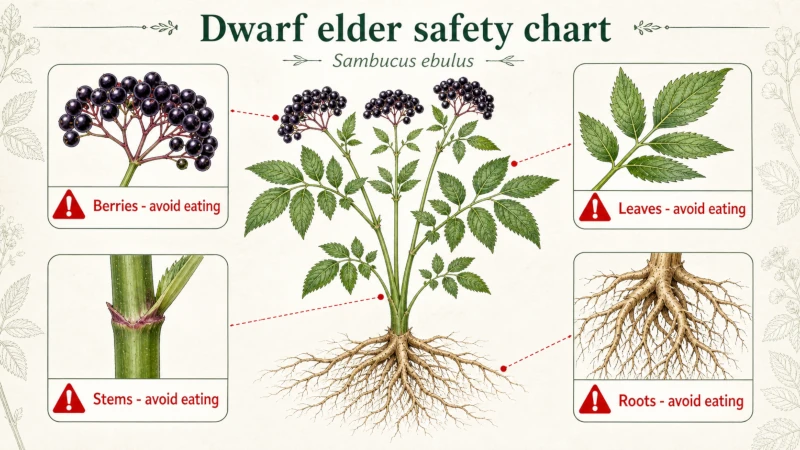
Dwarf elder can cause serious side effects, especially when used in large amounts [RxList, 2026]. Reported concerns include vomiting, diarrhea, dizziness, headache, breathing problems, loss of consciousness, and in severe cases, death [RxList, 2026].
Dwarf elder also contains ebulin-related proteins. Ebulin is a ribosome-inactivating protein, a type of plant protein that can interfere with protein production in cells. A review in Toxins describes dwarf elder’s usefulness as food as restricted by toxicity and highlights concern around ebulin toxicity [Jiménez et al., 2015]. This does not mean every exposure is fatal, but it does mean casual use is not justified.
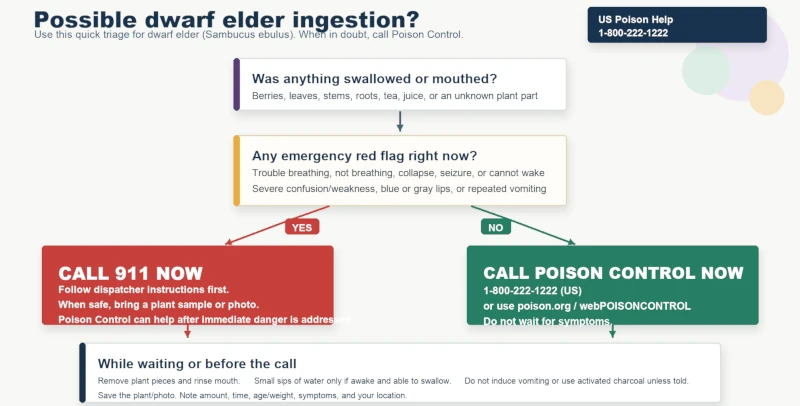
Symptoms that need urgent help
Seek urgent medical help if someone eats dwarf elder berries, leaves, roots, stems, or an unknown elder plant and develops:
- repeated vomiting
- bloody diarrhea
- severe abdominal cramps
- dizziness, fainting, confusion, or unusual sleepiness
- trouble breathing
- seizures
- inability to stay awake
- symptoms in a child, pregnant person, older adult, or person with kidney, liver, or heart disease
For possible poisoning in the United States, contact Poison Control at 1-800-222-1222 or use the webPOISONCONTROL tool. Call emergency services right away if the person collapses, has a seizure, has trouble breathing, or cannot be awakened [Poison Control, 2026].
Who should avoid dwarf elder
Avoid dwarf elder unless a qualified clinician specifically advises otherwise. This is especially true for:
- pregnant or breastfeeding people
- children
- older adults
- people with kidney disease
- people with liver disease
- people with heart failure or unexplained swelling
- people with inflammatory bowel disease or a history of severe diarrhea
- people taking prescription diuretics or blood pressure medicines
- people taking diabetes medicines
- people taking immune-suppressing medicines
- anyone scheduled for surgery
Because the safe dose is not established, “start low” is not a reliable safety strategy.
Medication and condition cautions
Dwarf elder’s traditional diuretic and laxative effects raise practical concerns. It may add to the effect of water pills, blood pressure medicines, laxatives, or other herbs that increase urination or loosen stools. Vomiting or diarrhea can also affect blood sugar control and the absorption of medications.
Fluid retention deserves medical attention when it is new, one-sided, painful, associated with shortness of breath, or linked with chest pain, reduced urination, sudden weight gain, pregnancy, or known heart/kidney/liver disease. Do not use dwarf elder to manage those symptoms.
Should you use dwarf elder at home?
For most readers, the safest answer is no. Dwarf elder is better treated as a plant to identify and avoid rather than a home remedy to prepare. Its traditional uses are interesting, but the evidence is limited and the safety concerns are real.
If you already have a commercial supplement that lists dwarf elder, do not assume it is safe because it is “natural.” Check the label, avoid combining it with diuretics or laxatives, and ask a physician, pharmacist, or qualified herbal clinician before using it. Stop and seek care if you develop vomiting, diarrhea, dizziness, weakness, or breathing symptoms.
| Health Disclaimer This article is for educational purposes only. It does not provide medical advice, diagnosis, or treatment. Dwarf elder may be toxic, and there is no well-established safe dose for home use. Do not eat or prepare dwarf elder berries, roots, leaves, stems, or homemade extracts. If you think someone has swallowed dwarf elder or an unknown elder plant, contact Poison Control or emergency services, especially if symptoms appear. |
Frequently Asked Questions
Is dwarf elder the same as elderberry?
No. Dwarf elder usually refers to Sambucus ebulus. Elderberry commonly refers to black elderberry, Sambucus nigra, or related elder species used in foods and supplements. They are related, but they are not interchangeable.
Are dwarf elder berries edible if cooked?
Do not rely on cooking to make dwarf elder berries safe. Some elderberry species are used after proper cooking, but dwarf elder has stronger safety concerns and no established safe home-preparation method. Avoid the berries.
What happens if you eat dwarf elder berries?
Possible symptoms include nausea, vomiting, diarrhea, abdominal pain, dizziness, headache, weakness, and more serious poisoning symptoms in larger exposures. Children and vulnerable adults need extra caution. Contact Poison Control if ingestion occurs.
Can dwarf elder help with edema or water retention?
There is not enough reliable human evidence to recommend dwarf elder for edema. Fluid retention can signal heart, kidney, liver, vein, lymph, or medication-related problems, so it should not be self-treated with a potentially toxic herb.
Can I use dwarf elder leaves as an insect repellent?
Folk use and early extract research suggest dwarf elder may affect mosquitoes, but that does not prove fresh leaves are safe or effective on human skin. Use tested mosquito repellents instead.
What is the safest way to handle dwarf elder?
Wear gloves when handling the plant, avoid touching your face, wash hands afterward, and keep berries and plant parts away from children and pets. Do not harvest it for homemade remedies.
References
- CDC. (1983). Poisoning from Elderberry Juice – California. Centers for Disease Control and Prevention, MMWR. View source
- Farina, P., Pisuttu, C., Tani, C., Bedini, S., Nali, C., Landi, M., Lauria, G., Conti, B., & Pellegrini, E. (2024). Leaf and Flower Extracts from the Dwarf Elder (Sambucus ebulus): Toxicity and Repellence against Cosmopolitan Mosquito-Borne Diseases Vectors. Insects, 15(7), 482. View source
- Jabbari, M., Daneshfard, B., Emtiazy, M., Khiveh, A., & Hashempur, M. H. (2017). Biological Effects and Clinical Applications of Dwarf Elder (Sambucus ebulus L): A Review. Journal of Evidence-Based Complementary & Alternative Medicine, 22(4), 996-1001. View source
- Jiménez, P., Cabrero, P., Tejero, J., Córdoba-Díaz, D., Córdoba-Díaz, M., & Girbés, T. (2015). Ebulin from Dwarf Elder (Sambucus ebulus L.): A Mini-Review. Toxins, 7(3), 648-658. View source
- Oregon State University Extension. (2024). Play It Safe When Preserving Elderberries. View source
- Poison Control. (2026). Get Poison Control Help Online Now. View source
- Royal Botanic Gardens, Kew. (2026). Sambucus ebulus L. – Plants of the World Online. View source
- Royal Horticultural Society. (2026). Sambucus ebulus – Dwarf Elder. View source
- RxList. (2026). Dwarf Elder: Health Benefits, Side Effects, Uses, Dose & Precautions. View source
- University of Minnesota Extension. (2026). Elderberries the Safe Way. View source
