
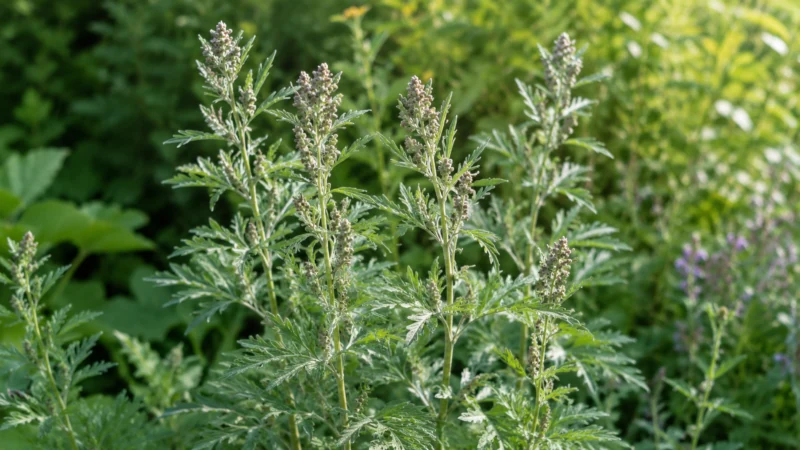
Mugwort has one of the longest résumés in Western herbalism and one of the shortest lists of things it has actually been shown to do. The National Center for Complementary and Integrative Health states the position plainly: very little research has been done on this plant in people, and there is not enough evidence to determine whether it is safe or useful for any health condition [NCCIH fact sheet on mugwort, 2025]. That is the honest starting point for any discussion of mugwort benefits. One traditional use has moderate-quality trial evidence behind it, and that use does not involve swallowing anything at all.
What the research is much clearer about is the other column of the ledger — who should stay away from this plant, and why.
What Mugwort Actually Is
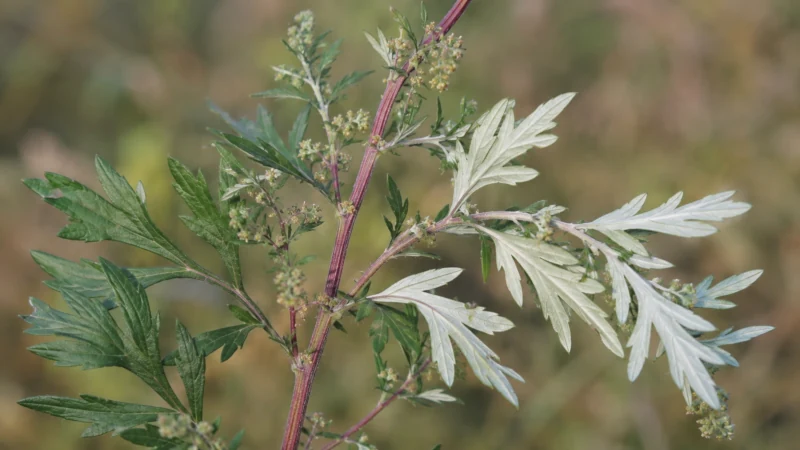
Mugwort is Artemisia vulgaris, a tall perennial in the daisy family (Asteraceae). You can usually spot it by the silvery-white, felted underside of its leaves and a smell somewhere between sage and chrysanthemum. Medieval European herbals called it the “mother of herbs” [NCCIH fact sheet on mugwort, 2025], and its Latin name traces to the goddess Artemis, largely because of the plant’s reputation for acting on menstruation and childbirth [Ekiert et al., Molecules, 2020].
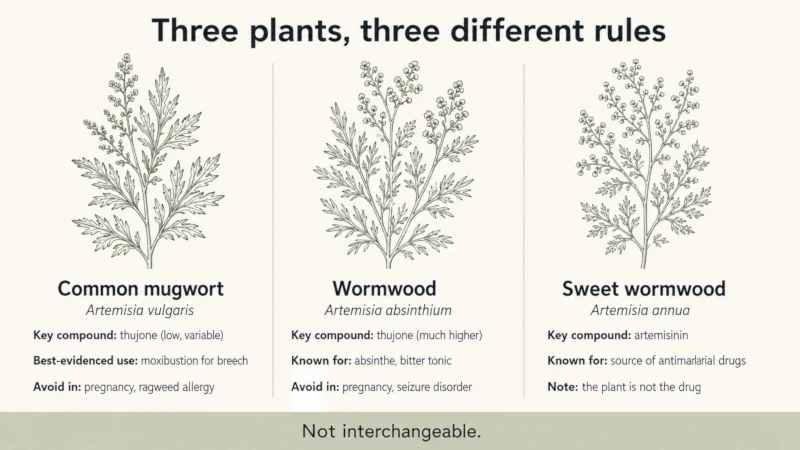
The naming is where people get into trouble. Several different plants are sold as “mugwort,” and they are not interchangeable:
- Artemisia vulgaris — common mugwort. The plant this article is about.
- Artemisia annua — sweet wormwood. The source of artemisinin, the compound behind modern antimalarial drugs. Different plant, different chemistry, different rules.
- Artemisia absinthium — wormwood, much higher in thujone and the basis of absinthe.
- Artemisia argyi and A. princeps — Chinese, Korean and Japanese mugwort. These are the leaves usually processed into moxa, and the ssuk and yomogi used in Korean and Japanese cooking.
There is a second, less obvious problem. Mugwort’s essential oil composition swings enormously with where the plant grew. Reported camphor content ranges from none at all to roughly 48 percent of the oil, and 1,8-cineole from about 3 to 18 percent, with thujone present in variable amounts [Ekiert et al., Molecules, 2020]. Two jars of dried mugwort leaf can be meaningfully different products. Any tidy-looking “dose” you find online is softer than it appears.
Mugwort Benefits, Graded by the Evidence
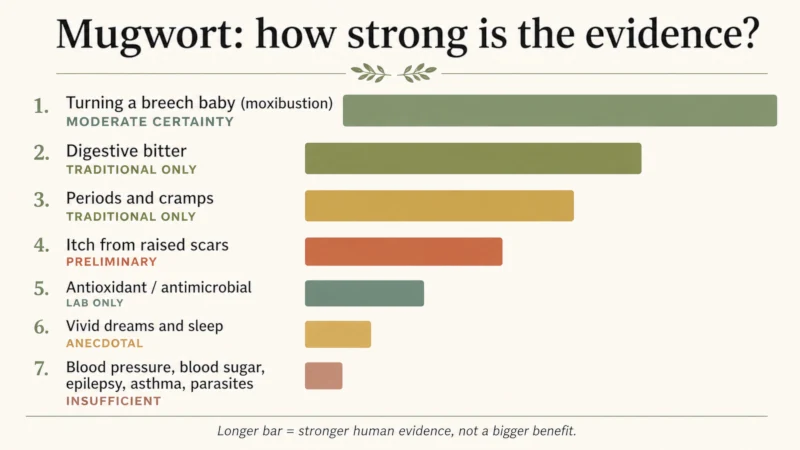
Grouping claims by how strong the underlying research is makes the picture much easier to read than a flat list of promises.
| What people claim | What the research actually is | Strength |
| Helping a breech baby turn (moxibustion — burned near the skin, not swallowed) | 13 randomized trials, 2,181 women, pooled in a Cochrane review | Moderate certainty |
| Digestive bitter for appetite and sluggish digestion | Centuries of use; a 1988 German monograph listed the traditional indications but stated efficacy was not confirmed | Traditional only |
| Bringing on or easing periods | Long folk use; weak estrogenic and anti-implantation activity in yeast and rat models | Traditional; safety-relevant |
| Itching from raised (hypertrophic) scars | One preliminary study of a lotion containing mugwort plus menthol | Preliminary; ingredient cannot be isolated |
| Vivid dreams, sleep, relaxation | Personal reports; no controlled human trials | Anecdotal |
| Antioxidant, antibacterial, antifungal, anticancer activity | Cell-culture and rodent studies | Lab only |
| Blood pressure, blood sugar, epilepsy, asthma, intestinal parasites | Scattered animal and test-tube signals; no human trials | Insufficient |
The one use with real evidence: moxibustion for a breech baby
Moxibustion burns dried, aged mugwort near an acupuncture point at the outer corner of the little toe. Nothing is eaten. It is the only mugwort-related practice with a real body of randomized trials behind it, and a 2023 Cochrane review pooled 13 studies covering 2,181 women [Cochrane review of moxibustion for breech presentation, 2023].
The results are worth reading precisely, because they are more modest than the headlines around them:
- Moxibustion added to usual care probably reduces the chance of a baby still being bottom-down at birth (risk ratio 0.87, 95% CI 0.78 to 0.99; 7 trials, 1,152 women) — moderate-certainty evidence.
- It probably makes little or no difference to the caesarean rate (RR 0.94, 95% CI 0.83 to 1.05; 6 trials, 1,030 women) — also moderate-certainty evidence.
- One trial of 260 women found it probably reduces the use of oxytocin before or during labor (RR 0.28, 95% CI 0.13 to 0.60).
- Side effects were poorly reported across the trials. Those described included increased fetal movement, uterine contractions, nausea, headache, and burns from holding the moxa stick too close to the skin.
A measurable effect on which way the baby is facing, no clear effect on whether you end up in an operating room, and safety data thin enough that the review authors said so. If a breech presentation is your situation, this belongs in a conversation with your obstetric team and a trained practitioner rather than in a do-it-yourself plan.
Mugwort as a digestive bitter
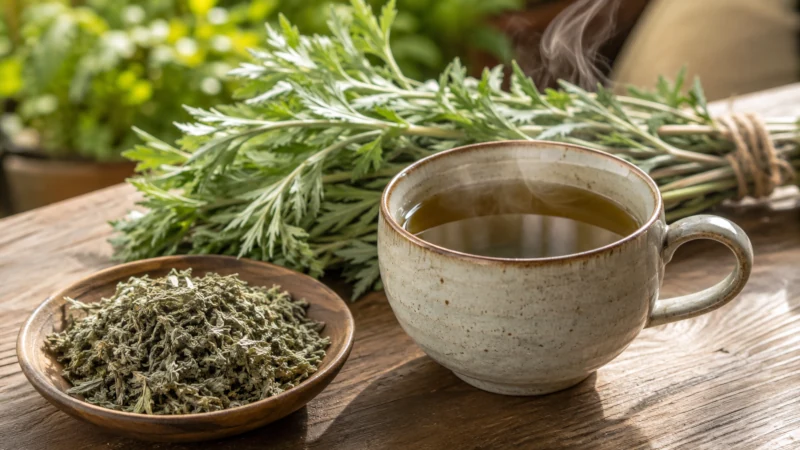
The oldest and most coherent traditional use is bitter-tonic: a small, sharply bitter drink before a heavy meal to prompt saliva, stomach acid, and bile. A German pharmacopoeial monograph published in 1988 recorded those traditional indications, then stated that the effectiveness of mugwort preparations had not been confirmed and that they were not recommended for therapeutic use [Ekiert et al., Molecules, 2020]. No European regulator has issued a positive assessment since.
That is not the same as “it does nothing.” Bitterness is a genuine physiological trigger, and plenty of people find a bitter tea settles a heavy stomach. Treat it as a food-level effect rather than a treatment for a diagnosed digestive disorder. The brewing side is covered in more depth in our guide to the benefits of mugwort tea.
Periods, cramps, and the part that usually gets left out
Mugwort’s classical reputation is as an emmenagogue — something that brings on menstrual flow. European folk medicine also used it to induce labor or miscarriage [Ekiert et al., Molecules, 2020]. In the laboratory, extracts of the aerial parts showed weak estrogenic activity in a yeast reporter assay, roughly 5 percent of the response produced by 17-beta-estradiol, and leaf extracts showed anti-implantation activity in female rats [Ekiert et al., Molecules, 2020].
Those are the same property described twice. The action people want for a late or painful period is the action that makes mugwort dangerous in pregnancy. You cannot have one without the other, and neither has been tested in a human trial.
Sleep, dreams, and smoking it
Dream enhancement drives most of mugwort’s current popularity and has the least behind it. No controlled human trial has shown that mugwort changes dreams or sleep. It is not a hallucinogen, and expectation shapes dream recall powerfully. Some people smoke the dried leaf for a faster effect; whatever the herb itself does, inhaling smoke from burning plant matter irritates airway tissue, which we look at in detail in our piece on smoking mugwort.
What is still only laboratory work
Much of the online enthusiasm traces back to preclinical research collected in a 2020 review: antioxidant activity in assay systems, antibacterial and antifungal effects of the essential oil against organisms including E. coli, Staphylococcus aureus and Candida albicans, cytotoxicity against cancer cell lines, and hepatoprotective, mildly analgesic, and bronchodilator effects in rodents [Ekiert et al., Molecules, 2020]. Those are real findings. None of them tells you what a cup of tea does inside a human body.
Parasites deserve their own note, since mugwort’s folk history is tangled up with worming. It was a traditional vermifuge, there are no human trials, and the wider group of thujone- and ascaridole-containing worming herbs was largely abandoned once safer drugs existed. Our overview of antiparasitic herbs grades that whole category.
Where the Reputation Ran Ahead of the Evidence
Nineteenth-century European practice added epilepsy and nervous disorders to mugwort’s list of indications [Ekiert et al., Molecules, 2020], and older herbals carried claims about swollen glands, earache, hay fever, and asthma. Those are historical artifacts rather than findings. Nothing in the modern literature supports using mugwort to treat a neurological condition, and because its thujone content acts in the opposite direction from an anticonvulsant, self-treating a seizure disorder with it would be actively unwise.
Twentieth-century pharmacognosy went further, arguing that the plant’s allergenic potential made it unsuitable for medicinal use altogether and that its proper place was the kitchen rather than the medicine cabinet [Ekiert et al., Molecules, 2020]. That verdict may be harsher than the evidence strictly requires. It does point straight at the one thing mugwort is thoroughly documented for.
How Mugwort Is Used, and What to Expect
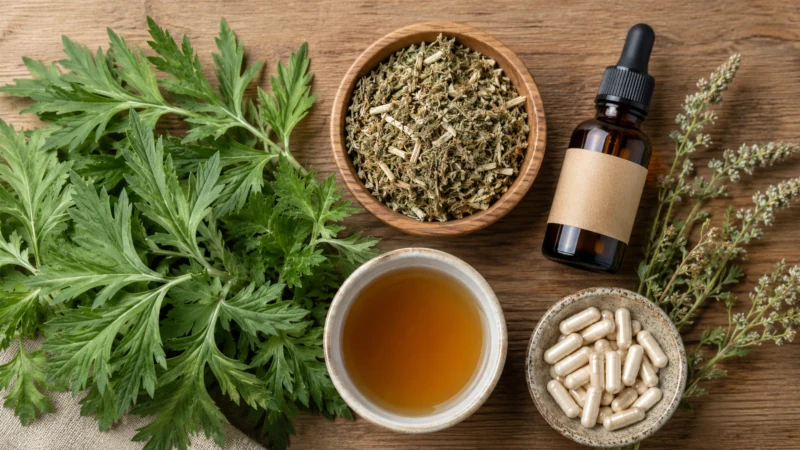
- Infusion (tea). Roughly a teaspoon — about 1.2 g — of dried herb per cup, kept covered while it steeps so the volatile oils stay in [Ekiert et al., Molecules, 2020].
- Tincture and capsules. Widely sold. No established therapeutic dose exists for any mugwort preparation.
- Moxa. Compressed dried leaf burned near the skin rather than taken internally.
- Food. In Korea and Japan, related species go into rice cakes, soups and teas — culinary quantities, not medicinal ones.
- Topical products. Skin-care and anti-itch formulations, almost always alongside other ingredients.
Two hard lines. Never swallow mugwort essential oil: severe human poisonings have been documented after ingestion of thujone-rich essential oils [European Medicines Agency HMPC statement on thujone, 2012]. And do not expect a reference book to hand you a number. Dosing for mugwort is not established, and the plant’s chemical variability makes any single figure unreliable.
Mugwort Side Effects, Interactions, and Who Should Avoid It
Pregnancy and breastfeeding
This is the clearest instruction in the whole literature. NCCIH states that mugwort should not be used during pregnancy, and that little is known about whether it is safe while breastfeeding [NCCIH fact sheet on mugwort, 2025]. European regulators reached a parallel conclusion from the thujone side: no studies allow a reliable assessment for pregnant women or children, so exposure in those groups should be kept to a minimum [European Medicines Agency HMPC statement on thujone, 2012]. Anyone pregnant, breastfeeding, or trying to conceive should skip mugwort in every form.
Mugwort must also never be used to try to end a pregnancy. It is neither safe nor reliable for that, and attempting it can cause serious harm. A doctor or a licensed clinic can discuss real options.
Allergy — the most solidly documented thing mugwort does
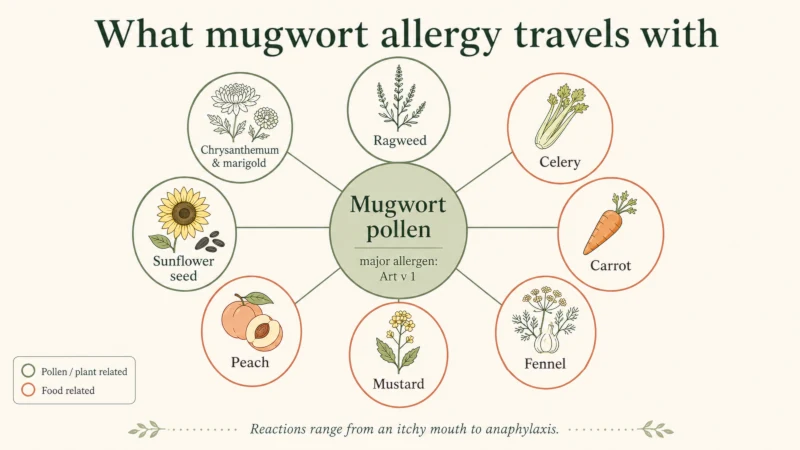
Mugwort pollen is a major weed allergen of late summer and early fall. Among suspected allergy patients in Europe, sensitization rates run roughly 10 to 15 percent, and mugwort is a leading cause of autumn rhinitis, conjunctivitis and asthma in parts of Asia. Its major allergen, Art v 1, is recognized by more than 95 percent of sensitized patients [Thermo Fisher allergen encyclopedia entry for mugwort, 2020].
For readers in the United States, the ragweed connection matters most. Mugwort and ragweed are closely related weeds that share cross-reactive allergens — Art v 1 with Amb a 4, Art v 4 with Amb a 8, Art v 6 with Amb a 1 [Thermo Fisher allergen encyclopedia entry for mugwort, 2020]. If ragweed season flattens you every September, mugwort is a plausible trigger rather than a neutral herb.
Food is the other half. Mugwort sits at the center of several recognized pollen-food allergy syndromes: celery-mugwort-spice, mugwort-peach, mugwort-mustard and mugwort-fennel. In one Chinese study of 148 patients with mugwort pollinosis, 72 percent reported food allergy, with oral symptoms in 68 percent, hives in 51 percent and anaphylaxis in 48 percent — peach was the most common trigger [Thermo Fisher allergen encyclopedia entry for mugwort, 2020]. A 2024 study of 79 patients with confirmed celery allergy found that sensitization to the celery defensin Api g 7, which tracks closely with mugwort’s Art v 1, carried roughly six times the odds of a severe anaphylactic reaction rather than mild mouth symptoms [Paul-Ehrlich-Institut on celery and mugwort allergy, 2024].
Reactions can follow eating the herb, drinking the tea, or handling the plant. If you react to ragweed, chrysanthemum, marigold, daisies, celery, carrot, fennel, mustard or peach, treat mugwort as a likely problem rather than a maybe.
Thujone
Mugwort’s volatile oil contains alpha- and beta-thujone. Alpha-thujone acts on the GABA-gated chloride channel, the opposite direction from a sedative, and it is two to three times more potent than the beta form. The hallmark of acute thujone poisoning is seizures [European Medicines Agency HMPC statement on thujone, 2012].
Proportion matters here. After reviewing the toxicology, the European Medicines Agency’s herbal committee concluded that thujone exposures in the range of about 3 to 7 mg per day do not raise special concerns [European Medicines Agency HMPC statement on thujone, 2012]. A normally brewed cup of mugwort tea sits well below that. The real risk sits with concentrated essential oil, heavy or prolonged use, and products of unknown strength. That is European guidance; there is no equivalent US limit for thujone in herbal supplements, though thujone is not authorized as a food flavoring in either region.
Medications and medical conditions
Reliable human interaction data for mugwort does not exist, and that absence is itself the caution. Given thujone’s activity on GABA signaling, the sensible flags are sedatives, anticonvulsants, and any diagnosed seizure disorder. NCCIH’s general guidance applies directly: if you take any medicine, talk with a healthcare professional before using an herbal product, because some herbs and medicines interact in harmful ways [NCCIH fact sheet on mugwort, 2025]. A pharmacist is often the fastest person to ask.
Regulation is part of the picture too. Herbal products sold as dietary supplements in the United States are not approved by the FDA before they reach the shelf; manufacturers are responsible for evaluating their own safety and labeling [NCCIH fact sheet on mugwort, 2025]. Potency and purity vary between brands, and mugwort’s natural chemical variability sits on top of that.
Who should avoid mugwort entirely
- Anyone pregnant, breastfeeding, or trying to conceive
- People allergic to ragweed, chrysanthemum, marigold, daisies, or other plants in the Asteraceae family
- People with celery, carrot, fennel, mustard, peach, or spice allergies
- People with a seizure disorder, or taking anticonvulsant or sedative medication
- Children, unless a doctor specifically advises it
- Anyone with surgery scheduled soon, or on prescription medication, until a doctor or pharmacist has reviewed it
When to Get Medical Care
Stop using mugwort and get help promptly in any of these situations:
- Swelling of the lips, tongue or throat, trouble breathing, widespread hives, or feeling faint after taking mugwort. Call 911. This is anaphylaxis.
- A seizure, or unusual tremor, confusion, or repeated vomiting after taking mugwort or any mugwort-containing oil. This needs urgent care; Poison Control (1-800-222-1222) can advise while you get there.
- You are pregnant or breastfeeding and have already taken mugwort — contact your doctor or midwife.
- Digestive, menstrual, or sleep symptoms that you have been treating with mugwort and that are new, worsening, or long-running. Those deserve a diagnosis rather than a home remedy.
- A late or missed period. If pregnancy is possible, take a test first; an herb is the wrong tool for that question.
| Health Disclaimer: This article is for general education and is not medical advice, diagnosis, or treatment. Mugwort is sold as a dietary supplement rather than a regulated medicine, and nothing here is intended to diagnose, treat, cure, or prevent any disease. This page does not cover every possible use, interaction, or risk. Talk with a doctor, pharmacist, or registered dietitian before using mugwort, especially if you are pregnant, breastfeeding, trying to conceive, giving it to a child, taking prescription medication, or managing a health condition. If you have signs of a serious allergic reaction, stop and call 911. |
Frequently Asked Questions
What is mugwort actually good for?
On current evidence, very little that you swallow. Moxibustion — burning mugwort near the skin — has moderate-certainty evidence for helping a breech baby turn. Everything else, including digestion, periods, and sleep, rests on tradition and laboratory work rather than human trials.
Is mugwort safe to take every day?
There is no long-term human safety data, and its thujone content argues against sustained heavy use. Occasional small amounts are generally considered low risk for healthy, non-pregnant adults, but daily long-term use is not something anyone can currently call safe.
Can mugwort bring on a late period?
It has a long traditional reputation for that, and no proof of reliability. It must never be used to try to end a pregnancy. If your period is late and pregnancy is possible, take a test, then talk to a doctor about why.
Is mugwort the same as wormwood?
No, though they are relatives. Wormwood is Artemisia absinthium and contains considerably more thujone; mugwort is Artemisia vulgaris. Sweet wormwood, Artemisia annua, is a third plant entirely and the source of the antimalarial drug artemisinin. Do not treat the three as interchangeable.
Does mugwort really cause vivid dreams?
Some people report more vivid or memorable dreams; many notice nothing. There are no controlled human trials, expectation plays a large role in dream recall, and mugwort is not a hallucinogen.
Can I use mugwort if I am allergic to ragweed?
Best not to. Mugwort and ragweed share several cross-reactive allergens, and mugwort sensitivity is also linked to reactions to celery, carrot, fennel, mustard and peach. If ragweed affects you, ask an allergist before trying mugwort in any form.
References
- National Center for Complementary and Integrative Health. “Mugwort: Usefulness and Safety.” National Institutes of Health, last updated April 2025. View source
- Ekiert H, Pajor J, Klin P, Rzepiela A, Ślesak H, Szopa A. “Significance of Artemisia vulgaris L. (Common Mugwort) in the History of Medicine and Its Possible Contemporary Applications Substantiated by Phytochemical and Pharmacological Studies.” Molecules. 2020;25(19):4415. PMID 32992959. DOI 10.3390/molecules25194415. View source
- Coyle ME, Smith C, Peat B. “Cephalic version by moxibustion for breech presentation.” Cochrane Database of Systematic Reviews, 2023, Issue 5. Art. No.: CD003928. DOI 10.1002/14651858.CD003928.pub4. View source
- Committee on Herbal Medicinal Products (HMPC), European Medicines Agency. “Public statement on the use of herbal medicinal products containing thujone” (EMA/HMPC/732886/2010 Rev. 1), 22 May 2012. View source
- Thermo Fisher Scientific. “w6 Mugwort,” Allergen Encyclopedia. Reviewed December 2020. View source
- Paul-Ehrlich-Institut. “New Insights on Celery Allergies and Associated Risks.” Press release 07/2024, reporting Ballmer-Weber BK et al., Journal of Allergy and Clinical Immunology 2024;154:679–689.e5. View source
