
Tormentil is a small, yellow-flowered herb whose red, tannin-packed root has been Europe’s go-to remedy for an upset gut since the Middle Ages. Today the tormentil plant (Potentilla erecta) has official recognition for exactly two jobs: short-term relief of mild diarrhea and calming minor inflammation inside the mouth. That status rests on long, safe use, not on clinical trials [EMA, 2019].

The research is thin but not empty. One small randomized trial found that a tormentil extract shortened rotavirus diarrhea in young children, and a 16-person pilot study in ulcerative colitis looked encouraging [Subbotina et al., 2003; Huber et al., 2007]. Nearly everything else you’ll read — antiviral, antidiabetic, anti-clotting — comes from lab dishes and animals. Used briefly, by adults, at the doses Europe’s herbal medicines committee sets, it appears to be low-risk.
| Tormentil at a glance | |
| Botanical name | Potentilla erecta (L.) Raeusch.; older synonym Potentilla tormentilla |
| Family | Rosaceae (rose family) |
| Other names | Tormentil; Blutwurz (German); tormentille (French); tormentilla (Italian) |
| Part used | Dried rhizome (underground stem), with the rootlets removed |
| Main compounds | Condensed tannins (about 15–20%), ellagitannins including agrimoniin, triterpenes |
| Recognized uses | Mild diarrhea; minor inflammation of the mouth lining (EU traditional use, adults only) |
| Typical forms | Tea or decoction, tincture, liquid or dry extract, mouth rinse |
What is the tormentil plant?
Tormentil is a low perennial of bogs, heaths, moors, grassland, open woods, and alpine slopes across Europe and western Asia. Its stems reach about 10 to 25 cm, and its leaves grow in threes with two leaf-like stipules, so each one looks as if it has five leaflets [Melzig & Böttger, 2020].
The quickest identification check is the flower. Tormentil has four yellow petals; the other Potentilla species, including its cousin silverweed, have five [Melzig & Böttger, 2020].
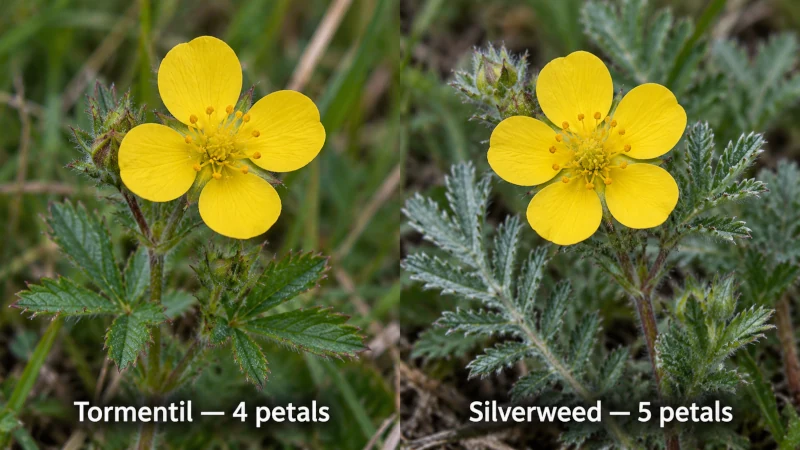
The name comes from the Latin tormentina, meaning intestinal colic — a nod to its medieval use for cramping diarrhea — while Potentilla refers to the plant’s reputed power. German speakers call it Blutwurz, “blood root,” because the broken root turns red [Melzig & Böttger, 2020]. That translation sometimes ends up on product labels, so don’t confuse tormentil with the North American wildflower called bloodroot (Sanguinaria canadensis). Bloodroot belongs to the poppy family, and its rootstock is caustic and poisonous if swallowed [Missouri Botanical Garden].
Only the root is used medicinally. The European Pharmacopoeia defines the herbal drug as the dried rhizome, freed from its roots [EMA, 2010].
What’s in tormentil root
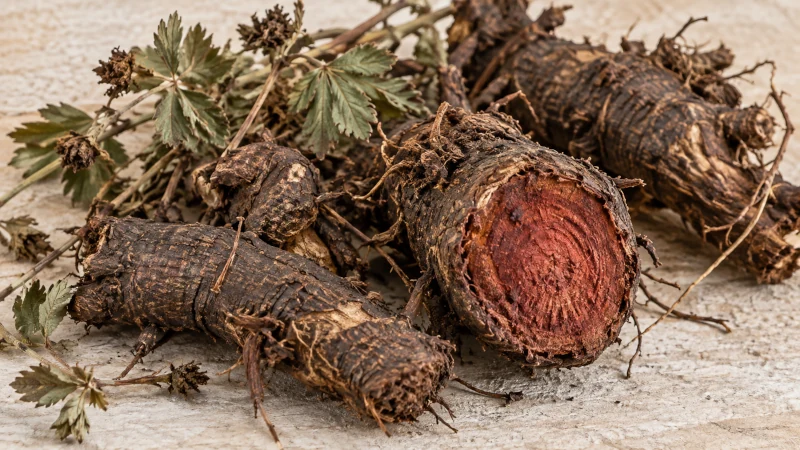
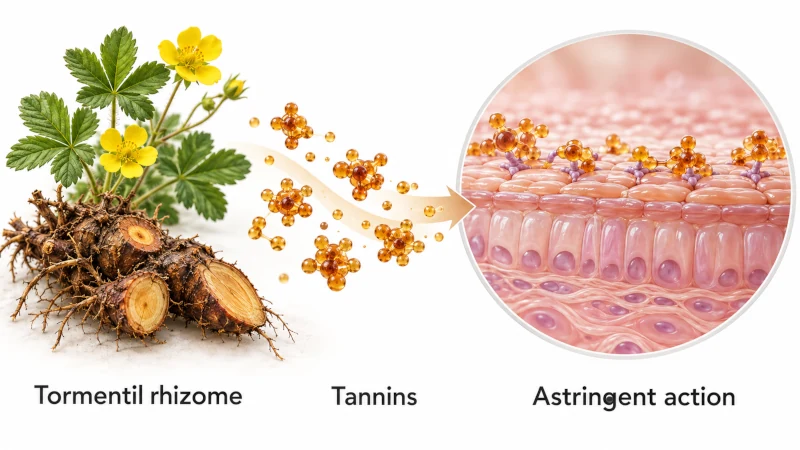
Mostly tannins. Condensed tannins (proanthocyanidins) make up about 15–20% of the rhizome, with up to 3.5% more as hydrolyzable tannins. The best studied of these is agrimoniin, an ellagitannin present at around 2%. A smaller triterpene fraction (0.6–1.7%) includes tormentoside, tormentic acid, and the chinovic acid that older herbals mention [Melzig & Böttger, 2020].
Tannins bind to proteins on the surface of tissue and tighten it — the dry, puckering feel of over-steeped black tea. That astringent action is the most plausible explanation for tormentil’s traditional uses, and reviewers attribute most of the genus’s measured activity to its tannins [Tomczyk & Latté, 2009].
Two details shape how you should think about it. First, the tannins stay in the gut: a study giving up to 3,000 mg of extract a day found none in patients’ blood [Huber et al., 2007]. Second, gut bacteria turn ellagitannins such as agrimoniin into compounds called urolithins, which are absorbed and show anti-inflammatory effects in lab work. That may explain some of the effects people report, but it hasn’t been tested in tormentil users [Melzig & Böttger, 2020].
Tormentil plant benefits, graded by the evidence
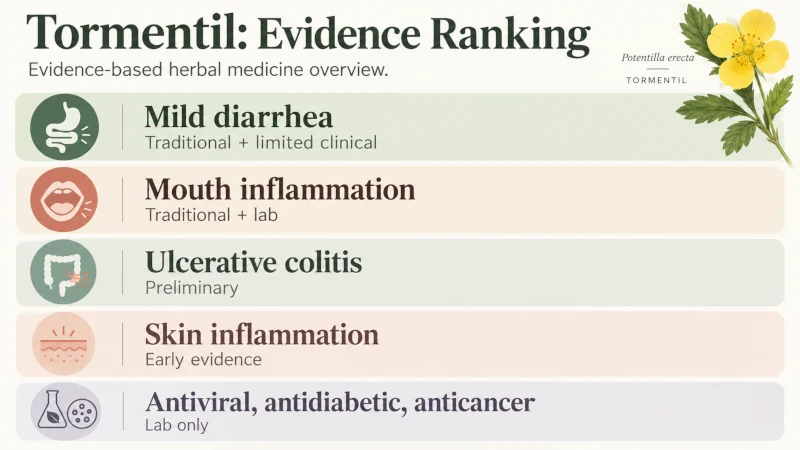
Tradition and proof aren’t the same thing. Here is how each common use holds up.
| Use | What backs it | Evidence strength |
| Mild, short-term diarrhea (adults) | EU traditional-use monograph; astringent mechanism; one small pediatric trial | Traditional + limited clinical |
| Minor mouth and gum inflammation (rinse) | EU traditional-use monograph; lab activity against oral bacteria | Traditional + lab |
| Ulcerative colitis | One open-label pilot, 16 patients, no placebo group | Preliminary, unconfirmed |
| Inflamed skin (topical) | Small human skin-redness tests; lab studies | Early |
| Hemorrhoids, nosebleeds | Folk use only | Insufficient |
| Antiviral, antidiabetic, anti-clotting, anticancer | Cell-culture and animal studies | Insufficient (lab only) |
Mild diarrhea
This is tormentil’s core use. The European Medicines Agency’s Committee on Herbal Medicinal Products (HMPC) accepts it for symptomatic treatment of mild diarrhea in adults. The basis is at least 30 years of safe use, 15 of them in the EU, plus lab evidence that tannins act as astringents and reduce the fluid moving into the intestine — not clinical trials [EMA, 2019].
The strongest human evidence is a 2003 double-blind trial in St. Petersburg. Forty children aged 3 months to 7 years with rotavirus diarrhea received either tormentil root extract or a look-alike placebo: 3 drops per year of age, three times a day, for up to 5 days. Diarrhea lasted 3 days with tormentil versus 5 with placebo. At 48 hours, 40% of the treated children were diarrhea-free, compared with 5% on placebo, and the tormentil group needed less IV fluid [Subbotina et al., 2003].
That’s a striking result from a single small trial at one hospital, and no one had repeated it as of the most recent review [Melzig & Böttger, 2020]. Regulators read it cautiously. The EU monograph still does not recommend tormentil for anyone under 18, citing a lack of adequate data [EMA, 2010]. The fair summary: promising, unconfirmed, and not a reason to treat a child’s diarrhea at home.
For adults, tormentil is a comfort measure while your body clears a stomach bug. Fluids do the real work. Our guides to what causes diarrhea and foods that help with diarrhea cover rehydration and the warning signs to watch.
Sore mouth and gums
The second HMPC indication is minor inflammation of the mouth lining, used as a rinse [EMA, 2010]. Dentists were using tormentil preparations as astringents in the 1950s, and lab studies show tormentil extracts slow the growth of cavity-causing Streptococcus strains and cut artificial plaque and biofilm formation [Melzig & Böttger, 2020].
No clinical trial has tested it for gum disease. A rinse may settle sore tissue for a few days, but it won’t remove plaque or treat gingivitis. Our guide to herbs for teeth and gums compares tormentil with rinses that have better trial data.
Ulcerative colitis: interesting, not proven
In a German pilot study, 16 adults with active ulcerative colitis took a tormentil dry extract alongside their usual treatment, in rising doses of 1,200, 1,800, 2,400, and 3,000 mg a day. Each step lasted three weeks, followed by a four-week break. At 2,400 mg a day, the median disease-activity score fell from 8 to 4.5, and C-reactive protein, a blood marker of inflammation, fell from 8 to 3 mg/L. Scores rose again during the breaks [Huber et al., 2007].
The limits are serious. There was no placebo group, disease activity wasn’t confirmed by endoscopy, and the authors acknowledged that a strong placebo effect couldn’t be ruled out [Huber et al., 2007; Melzig & Böttger, 2020]. No follow-up trial had been published as of 2020 [Melzig & Böttger, 2020].
If you have ulcerative colitis, don’t stop or swap prescribed medication for tormentil. Raise it with your gastroenterologist if you’re curious, and see our diet for ulcerative colitis guide for changes with stronger support.
Skin, hemorrhoids, and nosebleeds
Ointments with tormentil extract are sold for eczema in Germany, Poland, and Switzerland. Small experiments support the idea: agrimoniin-rich fractions reduced UV-induced skin redness in volunteers, and one extract blanched the skin to a degree comparable with hydrocortisone in a skin test [Melzig & Böttger, 2020]. That is early evidence, not proof that it helps eczema.
Older herbals, including the earlier version of this page, recommended tormentil sitz baths for hemorrhoids and gauze soaked in decoction for nosebleeds. Neither use has been studied, and neither appears in the EU monograph [EMA, 2010], so we’ve dropped those instructions. For hemorrhoids, start with the options in our herbs for hemorrhoids, ranked by evidence, and treat any unexplained rectal bleeding as a reason to see a doctor.
Claims that come only from the lab
You’ll see tormentil described as antiviral, antibacterial, antidiabetic, and anti-clotting. Those labels come from cell cultures and animals: herpes viruses in tissue culture, insulin release in diabetic mice, smaller clots in rats given high doses [Melzig & Böttger, 2020]. The reviewers add a caution worth keeping in mind. Tannins stick to proteins indiscriminately, so in a test tube they can switch off almost anything, which makes lab results look more impressive than they are [Melzig & Böttger, 2020; Tomczyk & Latté, 2009]. Treat these as research leads.
How to use tormentil, and how much
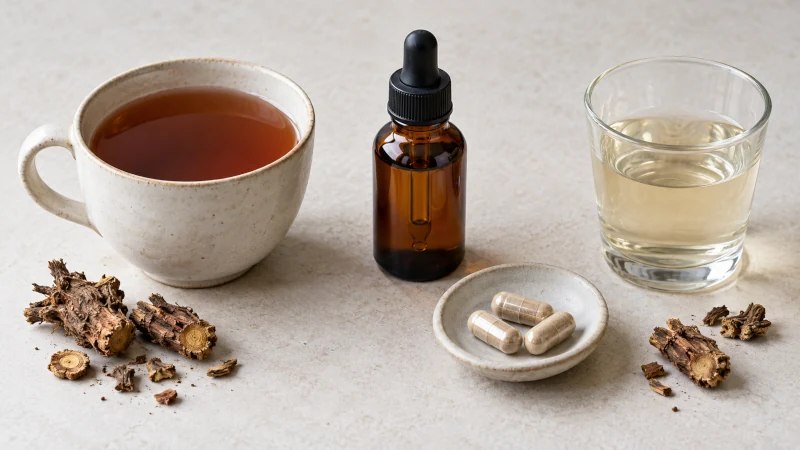
The EU monograph gives the most reliable doses available. They apply to adults and older adults only [EMA, 2010].
| Preparation | Single dose | How often / daily limit |
| Tea (infusion) of dried, cut rhizome | 1.4–4 g | Several times daily; max 12 g/day |
| Decoction (simmered) | 1.4–3 g | Several times daily; max 6 g/day |
| Tincture 1:5 (70% alcohol) | 1–2 mL in water | 3 times daily |
| Tincture 1:5 (45% alcohol) | 2–4 mL | 3 times daily |
| Liquid extract 1:1 (25% alcohol) | 2–4 mL | 3 times daily |
| Dry extract (3.5–4.5:1, 60% ethanol) | 400 mg | 3 times daily |
| Mouth rinse — infusion | 1.3–2 g per 100 mL water | Rinse several times daily |
| Mouth rinse — decoction | 0.8–3 g per 100 mL water | Rinse several times daily |
| Mouth rinse — tincture 1:5 (70%) | 1–5 mL in 150 mL water | Rinse several times daily |
Source: EU herbal monograph on Potentilla erecta rhizome [EMA, 2010].
A few rules go with those numbers:
- See a doctor if diarrhea lasts more than 3 days or mouth inflammation more than a week, or if either gets worse [EMA, 2010].
- Take tormentil at least 1 hour before or after other medicines, because it can delay their absorption [EMA, 2010].
- For a rinse, swish and spit.
- Tinctures contain alcohol [EMA, 2010]. Choose the tea if you avoid alcohol for health, recovery, or medication reasons.
One correction from the earlier version of this page: it suggested three or four cups a day of a decoction made with 30 g of root per liter. Assuming standard 250 mL cups, that adds up to roughly 22–30 g of root a day, four to five times the EU ceiling of 6 g a day for decoctions. Stick with the monograph amounts.
Side effects, interactions, and who should avoid tormentil
Short-term use appears well tolerated. The EU monograph lists mild stomach complaints such as nausea and vomiting, frequency unknown [EMA, 2010]. In the ulcerative colitis pilot, 6 of 16 people (38%) had mild upper-abdominal discomfort, though none needed to stop [Huber et al., 2007]. Single very large doses caused no acute toxicity in rats and mice [Shushunov et al., 2009], but reproductive toxicity, genotoxicity, and cancer risk have never been formally tested [EMA, 2010].
Interactions
- Other medicines. Tormentil may delay their absorption; keep at least 1 hour between them [EMA, 2010].
- Blood thinners (theoretical). High-dose tormentil extract reduced clotting in rats [Melzig & Böttger, 2020]. Whether that matters in people is unknown, but if you take warfarin or another anticoagulant or antiplatelet drug, check with a pharmacist first.
- Ulcerative colitis drugs. A review of herb–drug interactions in older adults with IBD found no reported interactions [Melzig & Böttger, 2020] — a reflection of how little tormentil has been studied, not a guarantee.
Who should avoid it
- People who are pregnant or breastfeeding — safety hasn’t been established [EMA, 2010].
- Children and teens under 18, unless a clinician advises it — the EU monograph doesn’t recommend use in this age group [EMA, 2010].
- Anyone allergic to tormentil, the only formal contraindication [EMA, 2010].
- Anyone avoiding alcohol should skip tinctures and extracts made with ethanol.
Product quality is the other unknown. As of 2020, no licensed tormentil medicine was on the EU market, only homeopathic products [Melzig & Böttger, 2020], so most of what you can buy is sold as loose herb or a supplement with varying tannin content. Buy from suppliers that list the botanical name, Potentilla erecta, and the plant part (rhizome).
When to see a doctor
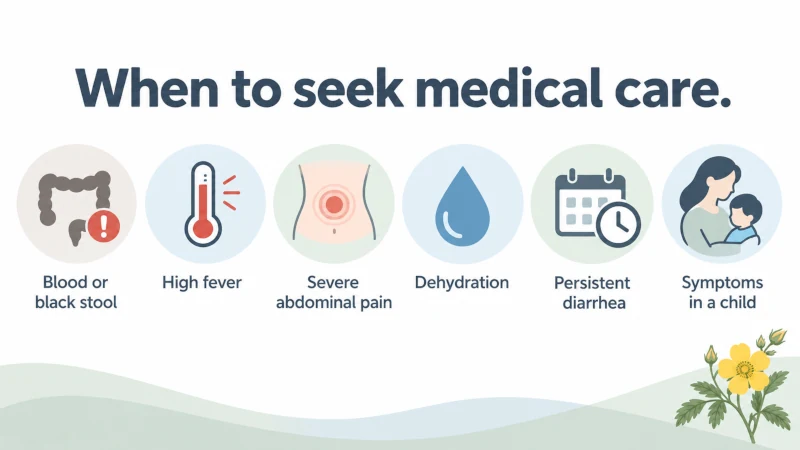
Tormentil is for minor problems that are already settling. These signs mean it’s time for medical advice instead.
Adults with diarrhea [Mayo Clinic, 2023; EMA, 2010]:
- Diarrhea that isn’t improving after 2 days. (Mayo Clinic uses 2 days; the EU monograph allows up to 3 days of self-treatment. If you’re not getting better, use the shorter window.)
- Blood in the stool, black stools, or diarrhea that keeps coming back
- Fever above 102°F (39°C)
- Severe abdominal or rectal pain
- Signs of dehydration: excessive thirst, dry mouth or skin, little or no urination, severe weakness, dizziness, or dark urine
Children with diarrhea — skip tormentil and get care if [Mayo Clinic, 2023]:
- Diarrhea doesn’t improve within 24 hours, or there’s no wet diaper in 3 or more hours
- Fever above 102°F (39°C), or bloody or black stools
- Dry mouth or tongue, crying without tears, unusual sleepiness or irritability, or sunken eyes, cheeks, or belly
Mouth symptoms that last more than a week or get worse need a dentist or doctor [EMA, 2010]. If you have ulcerative colitis, call your gastroenterologist about any flare rather than self-treating.
| Health Disclaimer: This article is for general education and isn’t medical advice. Tormentil is a traditional herbal remedy, recognized in the EU for mild diarrhea and minor mouth inflammation on the basis of long-standing use rather than clinical proof, and it is not a treatment for any disease. Don’t use it in place of care from a qualified professional. Talk to a doctor or pharmacist before using tormentil if you are pregnant or breastfeeding, considering it for a child, taking prescription medicines (especially blood thinners), or managing a condition such as ulcerative colitis. Seek prompt care for the warning signs listed above. |
Frequently Asked Questions
Is tormentil the same as bloodroot?
No. Tormentil’s German name, Blutwurz, translates as “blood root,” but the North American plant sold as bloodroot is Sanguinaria canadensis, a member of the poppy family whose rootstock is caustic and poisonous if swallowed [Missouri Botanical Garden]. Check that any product names Potentilla erecta.
Can I give tormentil to my child for diarrhea?
Not on your own. A small 2003 trial in children with rotavirus diarrhea looked encouraging, but the EU monograph doesn’t recommend tormentil under 18 because the evidence is too thin [Subbotina et al., 2003; EMA, 2010]. For a child, rehydration and a doctor’s assessment come first.
How long can I take tormentil?
Only briefly. Stop and get advice if diarrhea hasn’t settled within 3 days or mouth inflammation within a week [EMA, 2010] — sooner if you notice any of the warning signs above.
Does tormentil help ulcerative colitis?
Possibly, but it hasn’t been shown. One 16-patient study without a placebo group reported better symptom scores and CRP at 2,400 mg a day, and no larger trial has followed [Huber et al., 2007; Melzig & Böttger, 2020]. It should never replace prescribed treatment.
Is tormentil the same as silverweed?
No. Both belong to the Potentilla genus, but tormentil (P. erecta) has four petals and its own EU monograph for diarrhea, while silverweed (P. anserina) has five petals [Melzig & Böttger, 2020; EMA, 2010]. Our silverweed guide covers that plant in detail.
References
- European Medicines Agency, Committee on Herbal Medicinal Products. Community herbal monograph on Potentilla erecta (L.) Raeusch., rhizoma. EMA/HMPC/5513/2010. → View source
- European Medicines Agency. Tormentil: Potentilla erecta (L.) Raeusch., rhizoma — summary for the public. EMA/166412/2019. → View source
- Melzig MF, Böttger S. Tormentillae rhizoma – Review for an Underestimated European Herbal Drug. Planta Medica. 2020;86(15):1050–1057. DOI 10.1055/a-1129-7214. PMID 32155655. → View source
- Huber R, Ditfurth AV, Amann F, Güthlin C, Rostock M, Trittler R, Kümmerer K, Merfort I. Tormentil for active ulcerative colitis: an open-label, dose-escalating study. J Clin Gastroenterol. → View source
- Subbotina MD, Timchenko VN, Vorobyov MM, Konunova YS, Aleksandrovih YS, Shushunov S. Effect of oral administration of tormentil root extract (Potentilla tormentilla) on rotavirus diarrhea in children: a randomized, double blind, controlled trial. → View source
- Tomczyk M, Latté KP. Potentilla — a review of its phytochemical and pharmacological profile. J Ethnopharmacol. → View source
- Shushunov S, Balashov L, Kravtsova A, Krasnogorsky I, Latté KP, Vasiliev A. Determination of acute toxicity of the aqueous extract of Potentilla erecta (Tormentil) rhizomes in rats and mice. J Med Food. 2009;12:1173–1176. PMID 19857087. → View source
- Mayo Clinic Staff. Diarrhea — when to see a doctor. Mayo Clinic. August 11, 2023. → View source
- Missouri Botanical Garden. Sanguinaria canadensis (Bloodroot). Plant Finder. → View source


