
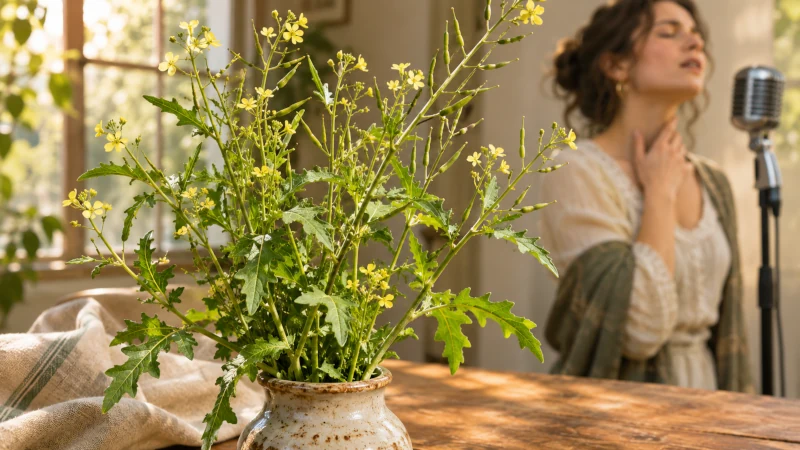
Singers in Italy call it erba dei cantanti, the herb of singers, and many still drink a cup before going on stage [Zorzan et al., 2020]. Hedge mustard (Sisymbrium officinale) has a long track record as a remedy for a hoarse voice. In the European Union it is recognized as a traditional herbal medicine for relieving throat irritation, such as hoarseness and dry cough [EMA, 2014a]. That status comes from long-standing use, though, not from proof in clinical trials. Below you’ll find what the research actually shows, how the herb is used, and the people who should avoid it, including anyone taking heart medication.
What is hedge mustard?
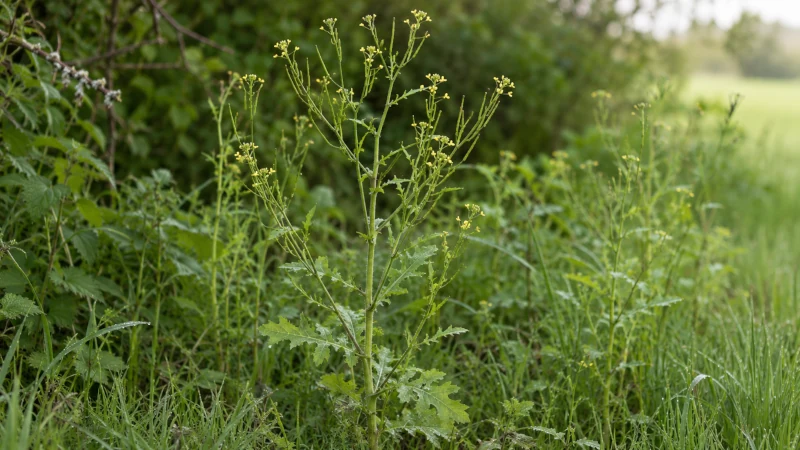
Hedge mustard is a wild member of the cabbage family (Brassicaceae). It grows up to about 90 cm tall, with clusters of small, four-petaled pale yellow flowers and thin seed pods pressed close to the stem. It flowers from April to October and turns up along roadsides, field edges, hedgerows, and wasteland [WildflowerWeb, n.d.]. It grows wild across Europe and Africa, and people also cultivate it for leaves and seeds used in salads or mustard [Zorzan et al., 2020].
Hedge mustard at a glance
| Feature | Detail |
| Scientific name | Sisymbrium officinale (L.) Scop.; formerly Erysimum officinale |
| Family | Brassicaceae (cabbage/mustard family) |
| Other names | Singers’ plant; erysimum; erba dei cantanti (Italian); hierba de los cantores (Spanish) |
| Part used medicinally | Dried flowering aerial parts (stems, leaves, flowers) |
| Key compounds | Glucosinolates (mainly glucoputranjivin), which break down into pungent isothiocyanates; mucilage |
| Main traditional use | Hoarseness, loss of voice, sore throat, dry cough |
Sources: [EMA, 2014b; Zorzan et al., 2020; Calcinoni, 2017; Borgonovo et al., 2019]
Don’t confuse it with wallflowers
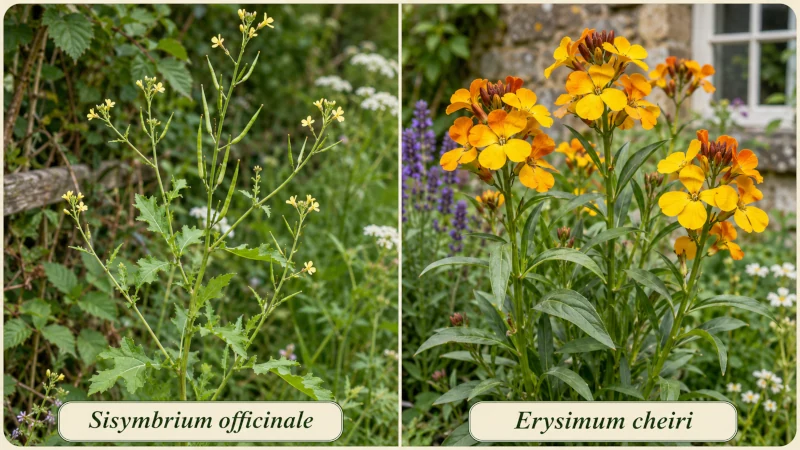
Hedge mustard products are often sold as “erysimum,” its old name. The botanical genus Erysimum is something else: wallflowers. They characteristically produce cardiac glycosides, compounds that act on the heart [Züst et al., 2018]. Check the Latin name Sisymbrium officinale on the label. If you forage, remember that several yellow-flowered wild mustards look alike. Hedge mustard is also a different plant from hedge garlic (garlic mustard), another wild green in the same family.
What hedge mustard is traditionally used for
Herbal tradition uses hedge mustard mainly for the throat and airways: pharyngitis, laryngitis, cough, loss of voice (aphonia), the common cold, sore throat, and occasionally asthma [Zorzan et al., 2020]. Some herbal sources label it an expectorant, meaning something that helps you clear mucus. The EU indication, though, focuses on irritation and dry cough rather than chesty cough [EMA, 2014a]. Folk use also extends to urinary tract and gallbladder complaints, but there isn’t enough evidence to rate it for any of these [RxList, n.d.].
Does hedge mustard work? What the evidence shows
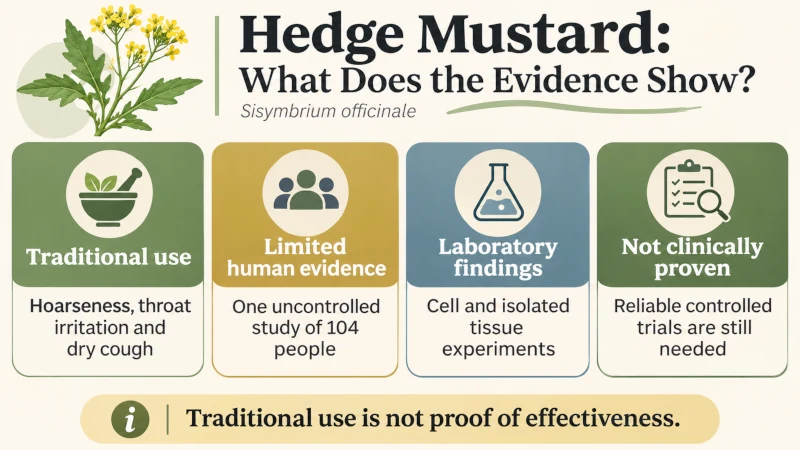
The short answer is that nobody knows for sure. When the European Medicines Agency reviewed the herb, it found no clinical studies of hedge mustard products. It approved the herb only for traditional use, which requires at least 30 years of documented use [EMA, 2014b]. A 2020 review reached a similar conclusion: the singers’ tradition is strong, but its benefits still need scientific confirmation [Zorzan et al., 2020].
| Use or effect | Evidence level | What it’s based on |
| Relief of throat irritation, hoarseness, dry cough | Traditional use | Long-standing use accepted by EU regulators; no controlled trials [EMA, 2014a; EMA, 2023] |
| Less perceived voice difficulty | Limited, low quality | One uncontrolled study of 104 patients [Calcinoni, 2017] |
| Relaxing airway muscle | Lab / animal tissue only | Isolated guinea-pig windpipe [Di Sotto et al., 2010] |
| Acting on throat “irritation” receptors (TRPA1) | Lab only | Cell assays with purified compounds [Borgonovo et al., 2019] |
| Killing bacteria | Mixed, lab only | An aqueous extract showed no antibacterial activity [Di Sotto et al., 2010] |
| Urinary tract, gallbladder | Insufficient | No usable evidence [RxList, n.d.] |
The one human study
An Italian ear, nose, and throat specialist gave 104 people with throat and voice discomfort a hedge mustard extract (90 mg a day for 10 to 20 days). Most were singers and other performers. Some also took treatment for their underlying condition. On the physical part of the Voice Handicap Index, average scores fell from 27.9 to 13.2 out of 40 [Calcinoni, 2017].
That sounds impressive, but the study had no placebo group, no blinding, and no statistical testing. Many participants had acute throat inflammation, which usually improves within a week or two anyway [Calcinoni, 2017; NHS, 2024]. EU regulators reviewed the study in 2022–2023 and did not change their assessment, because it was not placebo-controlled [EMA, 2023].
What the lab research suggests
When the plant is cut or chewed, its glucosinolates release isothiocyanates, the same family of compounds that gives mustard its bite. In cell experiments, two of hedge mustard’s main isothiocyanates strongly activated TRPA1, a receptor involved in sensing pungency and irritation, and then dampened its response. The researchers suggest this could help explain the throat effect. They also say clearly that it still has to be confirmed in living organisms and clinical trials [Borgonovo et al., 2019]. The plant’s mucilage, a gel-like soothing substance, may also contribute [Borgonovo et al., 2019].
A separate lab study found that a water extract relaxed contracted guinea-pig windpipe tissue. It showed no activity against the six bacteria and one yeast tested [Di Sotto et al., 2010]. So you shouldn’t expect hedge mustard to fight a throat infection.
How hedge mustard is taken
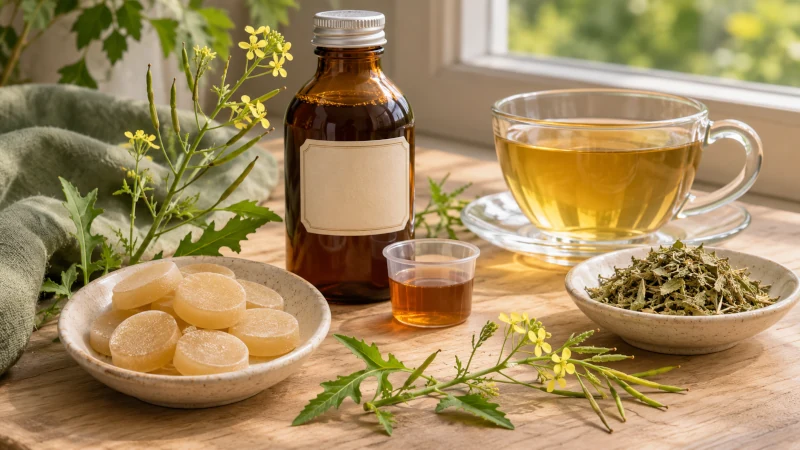
The EU-assessed products are standardized water extracts in two forms: lozenges or tablets that dissolve slowly in the mouth, and an oral liquid such as a syrup. The amounts below come from the EU monograph [EMA, 2014a]. Always follow the label of the product you buy, because extract strengths differ.
| Form | Adults and adolescents | Children | Not recommended |
| Lozenge / tablet (dissolve, don’t chew) | 7.5–10 mg extract per dose, 10–12 times a day | Ages 6–11: same dose, 5–6 times a day | Under 6 years |
| Oral liquid (syrup) | 82.5 mg extract, 3–4 times a day | Ages 3–11: 27.5 mg, 3–4 times a day | Under 3 years |
If your symptoms last longer than a week while you’re using it, see a doctor or pharmacist [EMA, 2014a].
What about hedge mustard tea? Infusions are the traditional form. Older pharmacy handbooks describe three to four cups a day [EMA, 2014b]. However, regulators did not assess homemade tea, and no tested strength exists, so the amount of active compounds per cup is unknown. If you try it, treat it as an unstandardized folk preparation, keep it short-term, and skip it entirely if you fall into any group listed under “Who should avoid hedge mustard” below.
Hedge mustard side effects and safety: where sources disagree
Reputable sources give strikingly different safety pictures. The EU monograph lists no known side effects and no reported drug interactions, and its only contraindication is allergy to the plant [EMA, 2014a]. RxList, a US drug-information site, calls the flowering parts “unsafe” to take by mouth. It lists possible vomiting, diarrhea, headache, and heart rhythm problems, a major interaction with digoxin, and moderate interactions with certain antibiotics (macrolides, tetracyclines), quinine, stimulant laxatives, and diuretics [RxList, n.d.].
The disagreement comes down to cardiac glycosides, heart-active compounds related to the drug digoxin. An analysis from 1979 found them in the flowering tops of hedge mustard. EU assessors noted that water pulls out very little of these compounds. They capped the level in water-based products and estimated the daily intake at only nanograms, far below any heart-active dose. On that basis they saw no safety concern at the monograph doses [EMA, 2014b]. That conclusion applies to standardized water extracts used as directed. It doesn’t cover strong homemade brews, tinctures, or large amounts of the plant. The EU review also noted that some national product leaflets advise caution with digoxin and low potassium [EMA, 2014b].
One more gap: the herb has never had genotoxicity testing to current EU standards. Partly for that reason, regulators did not add it to the EU’s list of herbal substances [EMA, 2014b; EMA, 2023]. That is a good reason to use it for short spells only, not as a daily habit.
Who should avoid hedge mustard
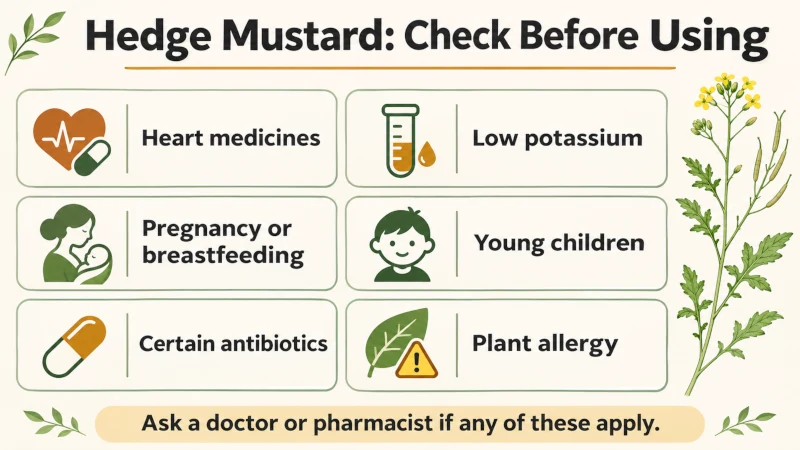
Unless a doctor or pharmacist has approved it, skip hedge mustard if you:
- take digoxin or other heart medications, or have heart disease or a heart rhythm disorder [RxList, n.d.; EMA, 2014b]
- have low potassium, or take medicines that lower it, such as diuretics (“water pills”) or stimulant laxatives [RxList, n.d.]
- are pregnant or breastfeeding. Safety hasn’t been established, and both the EU and RxList advise against it [EMA, 2014a; RxList, n.d.]
- are buying for a child under 6 (lozenges) or under 3 (liquid) [EMA, 2014a]
- take macrolide or tetracycline antibiotics or quinine (check with your pharmacist first) [RxList, n.d.]
- are allergic to hedge mustard [EMA, 2014a]
When a hoarse voice needs a doctor
Most hoarseness is laryngitis, which usually clears up by itself within one to two weeks. The basics help more than any herb: rest your voice, drink plenty of fluids, keep the air moist, avoid smoke, and don’t whisper or shout [NHS, 2024]. Warm salt-water gargles are a simple option for adults [NHS, 2024]. If your cough is part of a chest infection, our guide to foods to eat when you have bronchitis covers what helps and the warning signs to watch for. High mallow is another traditional herb used for throat irritation and dry cough.
Get medical help right away if you:
- have difficulty breathing (call emergency services) [NHS, 2024]
- have severe pain or trouble swallowing [NHS, 2024]
- develop a fever or cough up discolored (pus-like) mucus [EMA, 2014a]

Book a doctor’s appointment if your symptoms haven’t improved after two weeks, or if you keep getting laryngitis or voice problems [NHS, 2024]. Hoarseness that persists without a clear cause should be checked, especially if you are 45 or older or you smoke. Scottish guidelines, for example, recommend urgent referral for an unexplained hoarse voice lasting three weeks or more [Cancer Research UK, 2024]. If you rely on your voice for work, it’s reasonable to get checked sooner rather than self-treating through a run of performances.
| HEALTH DISCLAIMER: This article is for general education and is not a substitute for advice, diagnosis, or treatment from a qualified health professional. Hedge mustard is a traditional herbal remedy, and there is little clinical evidence for its effects. Talk to a doctor or pharmacist before using it if you take any prescription medicine (especially digoxin, other heart medicines, diuretics, or laxatives), have a heart condition, are pregnant or breastfeeding, or are giving it to a child. Seek medical care for breathing difficulty, trouble swallowing, fever, or hoarseness that lasts more than two weeks. |
Frequently Asked Questions
Is hedge mustard the same as the mustard in a jar?
No. It belongs to the same plant family as table mustard and contains similar pungent compounds, but it is a different species, Sisymbrium officinale. Its seeds and leaves are sometimes used in salads or mustard [Zorzan et al., 2020; Borgonovo et al., 2019].
How quickly does hedge mustard work for hoarseness?
There’s no reliable answer. The only human study measured results after 10 to 20 days and had no comparison group [Calcinoni, 2017]. If you’re still hoarse after a week of use, see a professional [EMA, 2014a].
Can I take hedge mustard with digoxin or heart medicine?
Not without your doctor’s approval. RxList rates the combination with digoxin as a major interaction. EU assessors judged the risk to be theoretical at standardized lozenge and syrup doses, but some national leaflets still advise caution [RxList, n.d.; EMA, 2014b].
Is hedge mustard safe for children?
In the EU, lozenges are only for children 6 and older, and the liquid only for children 3 and older, at lower doses than for adults [EMA, 2014a]. Ask a pharmacist or pediatrician first, and don’t give a child homemade tea.
Is hedge mustard safe during pregnancy?
Its safety in pregnancy and breastfeeding hasn’t been established, so it isn’t recommended [EMA, 2014a; RxList, n.d.].
References
- European Medicines Agency, HMPC. European Union herbal monograph on Sisymbrium officinale (L.) Scop., View source
- European Medicines Agency, HMPC. Assessment report on Sisymbrium officinale (L.) Scop., View source
- European Medicines Agency, HMPC. Addendum to assessment report on Sisymbrium officinale (L.) Scop., View source
- European Medicines Agency. Sisymbrii officinalis herba – herbal medicinal product. View source
- Zorzan M, et al. Sisymbrium officinale, the plant of singers: a review of its properties and uses. View source
- Calcinoni O. Sisymbrium “Singers’ plant” efficacy in reducing perceived vocal tract disability. View source
- Borgonovo G, Zimbaldi N, Guarise M, De Nisi P, De Petrocellis L, Schiano Moriello A, Bassoli A. View source
- Di Sotto A, Vitalone A, Nicoletti M, Piccin A, Mazzanti G. View source
- Züst T, Mirzaei M, Jander G. Erysimum cheiranthoides, an ecological research system with potential as a genetic and genomic model for studying cardiac glycoside biosynthesis. View source
- RxList. Hedge mustard: health benefits, side effects, uses, dose & precautions. View source
- NHS. Laryngitis. View source
- Cancer Research UK. Referral to a specialist for laryngeal cancer. View source
- WildflowerWeb. Hedge mustard (Sisymbrium officinale). View source


